Arm Pain Rehab Challenge · 44
Arm pain that comes from the neck: cervical radiculopathy
Cervical radiculopathy is dysfunction of a cervical nerve root — most often from disc protrusion or foraminal narrowing — producing arm pain in a…
Key points
- Screen. Rule out serious pathology and myelopathy (clumsy hands, gait or bladder change) before any loading plan.
- Test. Use Spurling, distraction and neurodynamic tests together with a neurological check; no single test decides.
- Load. Keep active; graded neck and arm exercise, with traction in a multimodal plan for persistent radiating pain.
What it is
Cervical radiculopathy is dysfunction of a cervical nerve root — most often from disc protrusion or foraminal narrowing — producing arm pain in a dermatomal pattern, with or without numbness, weakness or reflex change; the arm pain often exceeds the neck pain.
How we analysed the movement
Three movements relevant to this topic were analysed from illustrated reference figures. Joint centres were located with two-dimensional pose estimation where the whole arm was visible; elbow and wrist angles, and the directions of external load and tendon pull, were then drawn on the figure; on hand close-ups, where pose estimation does not apply, the landmarks were placed manually. The figures are educational estimates that show how position changes mechanical demand; they are not measurements of a patient. Every research value quoted below comes from the published source cited beside it.
Movement A: Head tilted back (side view)
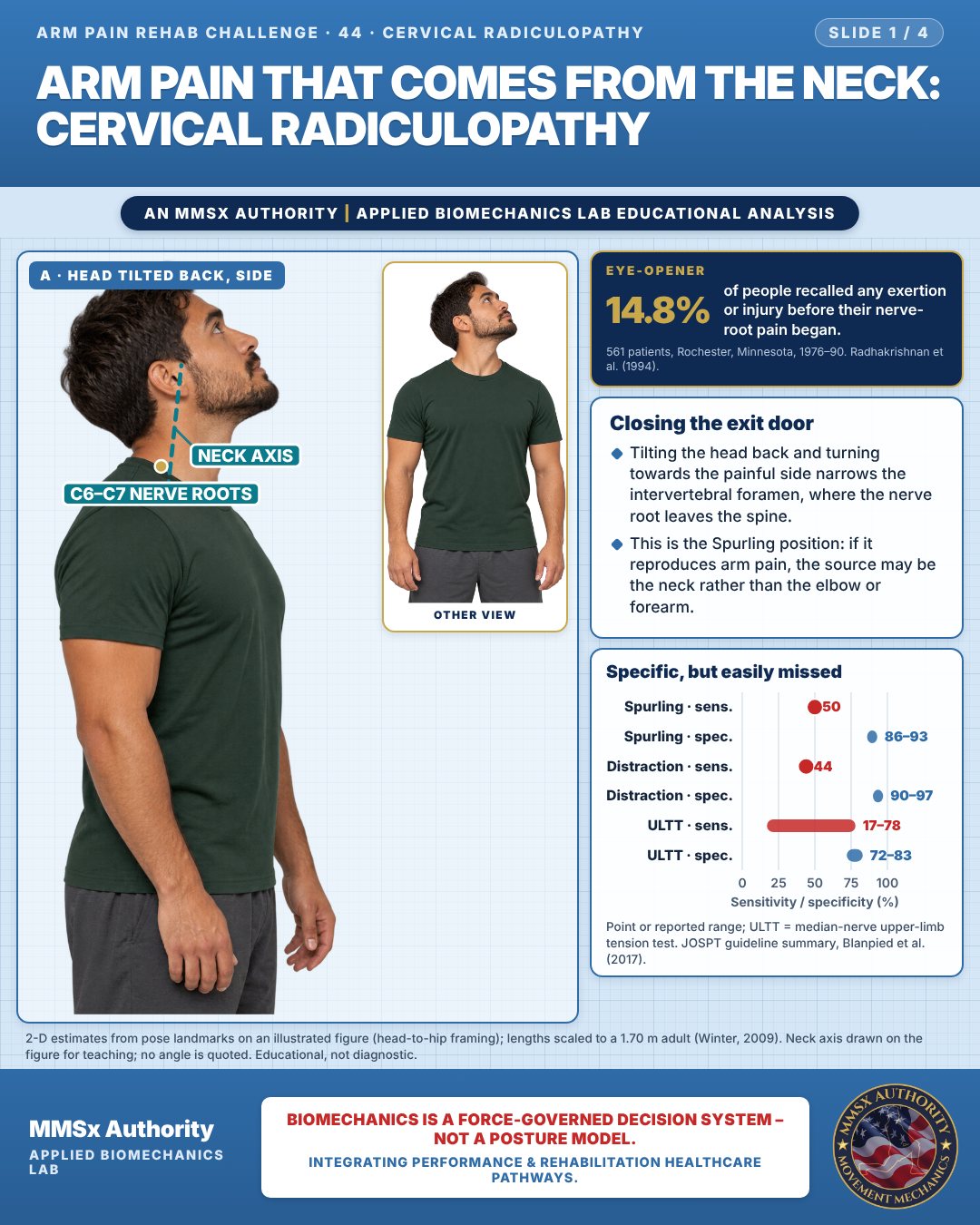
Closing the exit door
Tilting the head back and turning towards the painful side narrows the intervertebral foramen, where the nerve root leaves the spine.
This is the Spurling position: if it reproduces arm pain, the source may be the neck rather than the elbow or forearm.
Specific, but easily missed
Movement B: Hand on head (front view)
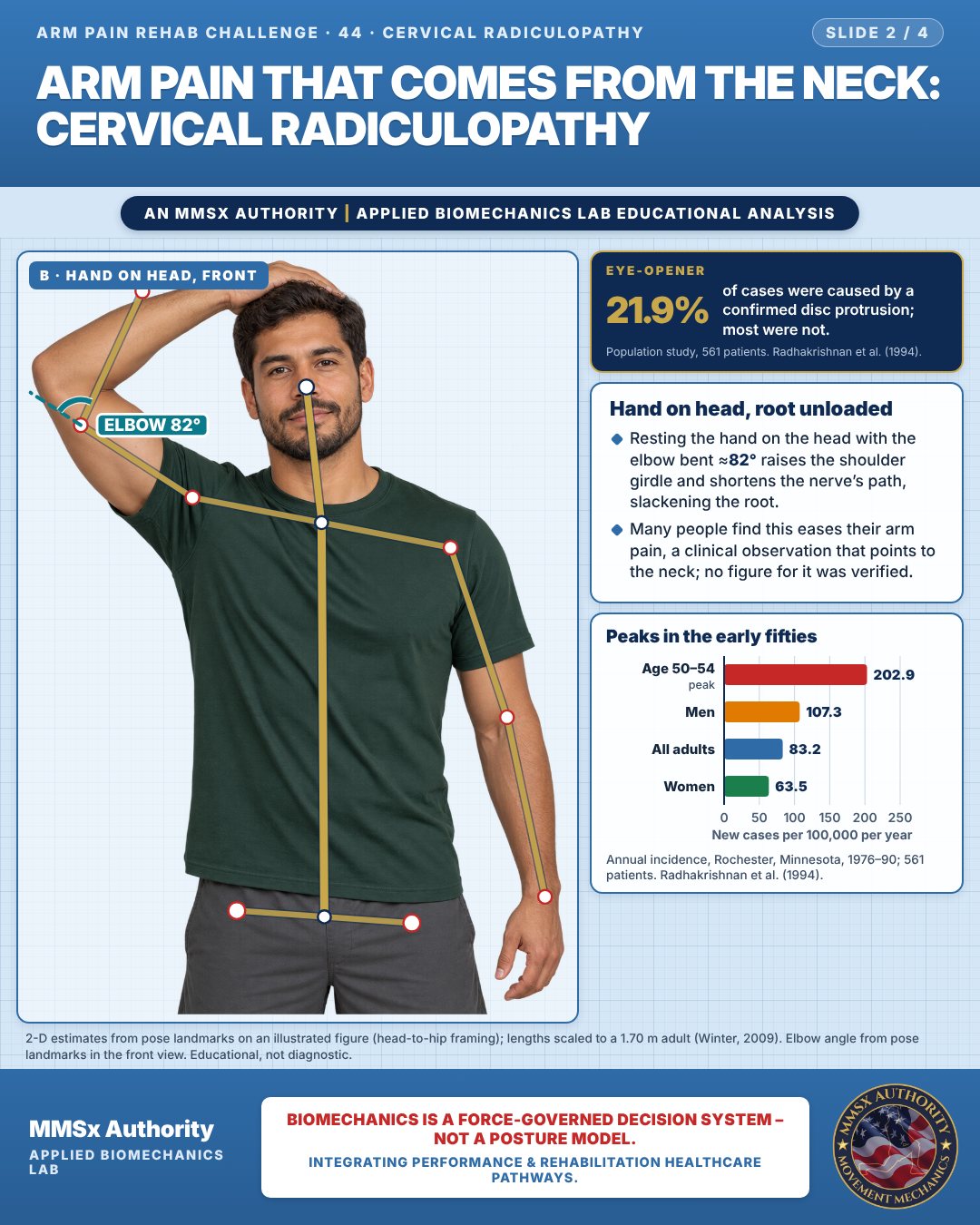
Hand on head, root unloaded
Resting the hand on the head with the elbow bent ≈82° raises the shoulder girdle and shortens the nerve’s path, slackening the root.
Many people find this eases their arm pain, a clinical observation that points to the neck; no figure for it was verified.
Peaks in the early fifties
Movement C: Rubbing forearm (front view)
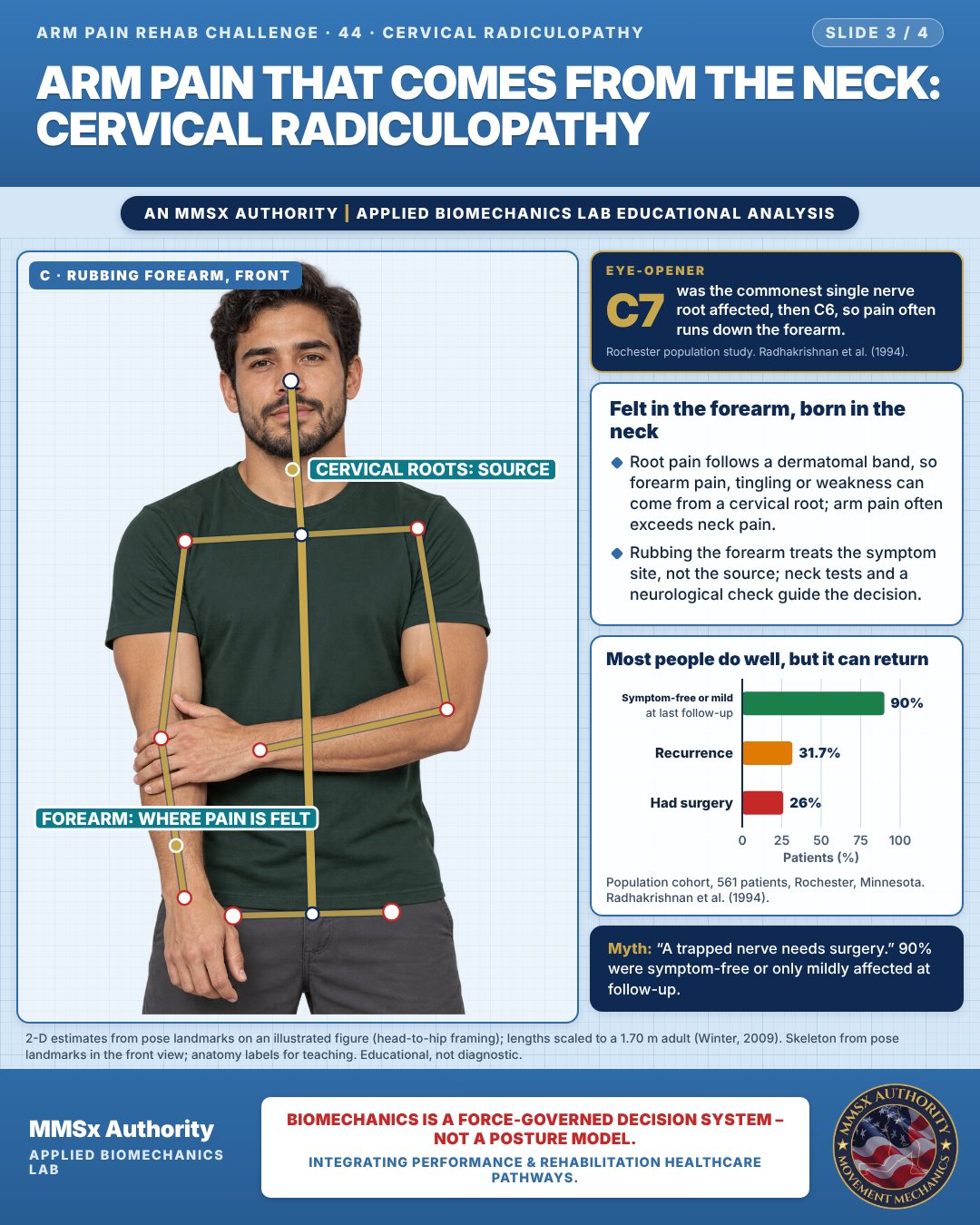
Felt in the forearm, born in the neck
Root pain follows a dermatomal band, so forearm pain, tingling or weakness can come from a cervical root; arm pain often exceeds neck pain.
Rubbing the forearm treats the symptom site, not the source; neck tests and a neurological check guide the decision.
Most people do well, but it can return
Decision pathway
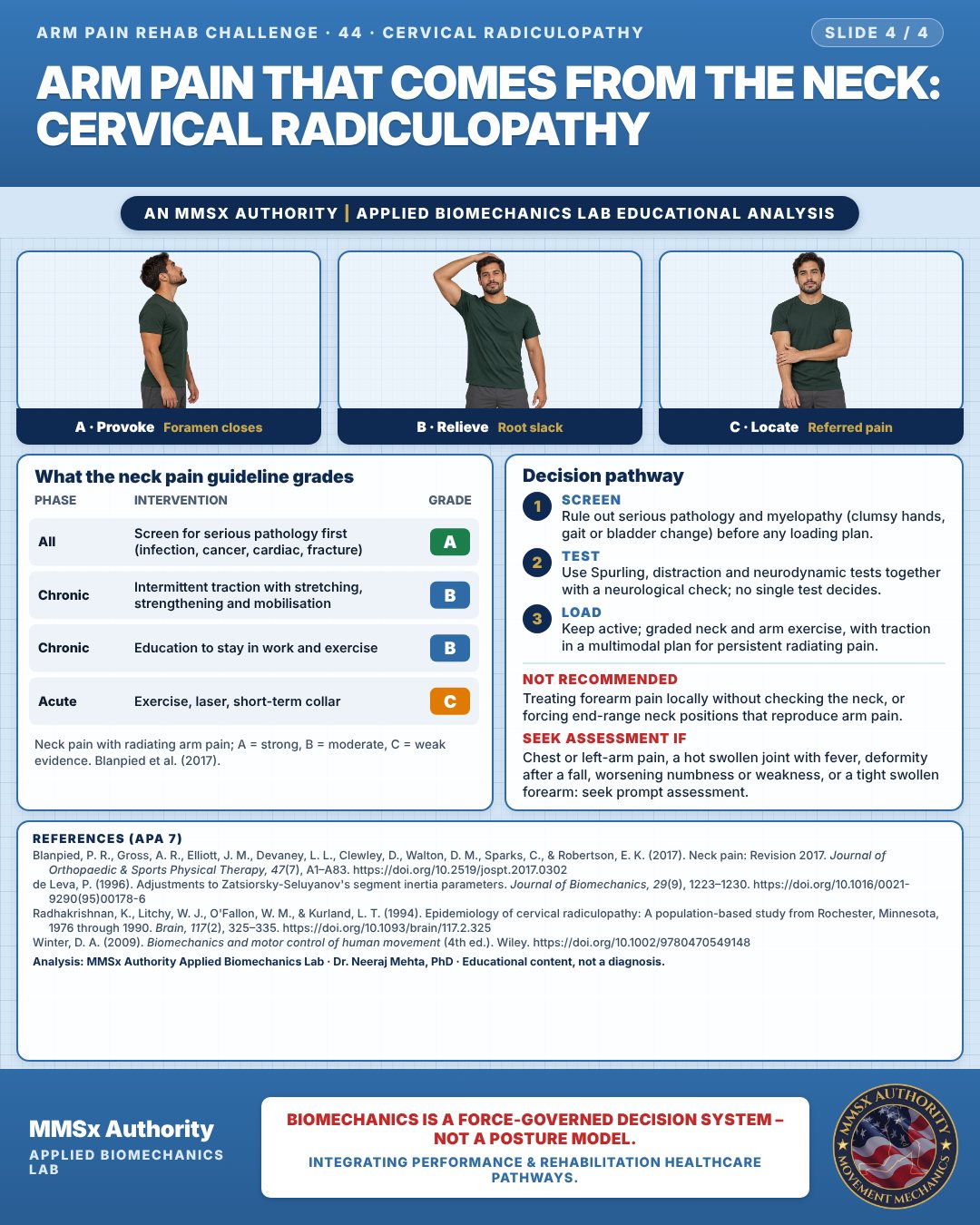
What the neck pain guideline grades
Screen
Rule out serious pathology and myelopathy (clumsy hands, gait or bladder change) before any loading plan.
Test
Use Spurling, distraction and neurodynamic tests together with a neurological check; no single test decides.
Load
Keep active; graded neck and arm exercise, with traction in a multimodal plan for persistent radiating pain.
What the evidence supports
- Per clinical practice guideline (Blanpied et al., 2017): screen for serious pathology first (Grade A list below); acute radiating pain — exercises, short-term collar, laser (Grade C); chronic radiating pain — intermittent traction within a multimodal programme (Grade B) and education to stay active and at work (Grade B). Surgical referral for progressive neurological deficit or persistent disabling pain (26% had surgery in the population cohort).
Myth and evidence
Myth“Forearm pain must start in the forearm.”
EvidenceRadicular pain is referred along the root; C7 and C6 are the commonest roots (Radhakrishnan et al., 1994). And "a trapped nerve needs surgery": 90% were asymptomatic or only mildly incapacitated at follow-up.
Cautions
Not recommended
Treating forearm pain locally without checking the neck, or forcing end-range neck positions that reproduce arm pain.
Seek assessment if
Chest or left-arm pain, a hot swollen joint with fever, deformity after a fall, worsening numbness or weakness, or a tight swollen forearm: seek prompt assessment.
Methods note
2-D estimates from pose landmarks on an illustrated figure (head-to-hip framing); lengths scaled to a 1.70 m adult (Winter, 2009). Neck axis drawn on the figure for teaching; no angle is quoted. Elbow angle from pose landmarks in the front view. Skeleton from pose landmarks in the front view; anatomy labels for teaching. These are educational estimates, not a diagnosis.
References
- Blanpied, P. R., Gross, A. R., Elliott, J. M., Devaney, L. L., Clewley, D., Walton, D. M., Sparks, C., & Robertson, E. K. (2017). Neck pain: Revision 2017. Journal of Orthopaedic & Sports Physical Therapy, 47(7), A1–A83. https://doi.org/10.2519/jospt.2017.0302
- de Leva, P. (1996). Adjustments to Zatsiorsky-Seluyanov's segment inertia parameters. Journal of Biomechanics, 29(9), 1223–1230. https://doi.org/10.1016/0021-9290(95)00178-6
- Radhakrishnan, K., Litchy, W. J., O'Fallon, W. M., & Kurland, L. T. (1994). Epidemiology of cervical radiculopathy: A population-based study from Rochester, Minnesota, 1976 through 1990. Brain, 117(2), 325–335. https://doi.org/10.1093/brain/117.2.325
- Winter, D. A. (2009). Biomechanics and motor control of human movement (4th ed.). Wiley. https://doi.org/10.1002/9780470549148
Cite this article
Mehta, N. (2026, October 28). Arm pain that comes from the neck: cervical radiculopathy. MMSx Authority Applied Biomechanics Lab. https://mmsxauthority.org/edu/analysis/arm/44-arm-pain-that-comes-from-the-neck-cervical-radiculopathy/
Part of the collection
Mehta, N. (2026). Elbow, Forearm, Wrist and Hand Rehabilitation: 50 Evidence-Based Biomechanics Analyses [Collection]. MMSx Authority Applied Biomechanics Lab. Zenodo. https://doi.org/10.5281/zenodo.23735910
All Arm Pain Rehab Challenge articles · Rehabilitation Library