Arm Pain Rehab Challenge · 43
Dupuytren’s contracture: when a finger slowly pulls into the palm
Dupuytren's disease is a benign fibroproliferative disorder of the palmar fascia that forms nodules and cords.
Key points
- Check. Tabletop test and joint extension deficits; refer for a hand-surgery opinion when the hand cannot lie flat.
- Discuss. Weigh needle fasciotomy (quick, recurs more), collagenase and limited fasciectomy (more durable).
- Track. Re-measure deficits over time; progression, especially at the PIP joint, brings review forward.
What it is
Dupuytren's disease is a benign fibroproliferative disorder of the palmar fascia that forms nodules and cords; when cords shorten, the metacarpophalangeal and/or proximal interphalangeal joints are drawn into fixed flexion (contracture). It is not a tendon problem and is usually painless.
How we analysed the movement
Three movements relevant to this topic were analysed from illustrated reference figures. Joint centres were located with two-dimensional pose estimation where the whole arm was visible; elbow and wrist angles, and the directions of external load and tendon pull, were then drawn on the figure; on hand close-ups, where pose estimation does not apply, the landmarks were placed manually. The figures are educational estimates that show how position changes mechanical demand; they are not measurements of a patient. Every research value quoted below comes from the published source cited beside it.
Movement A: Tabletop test, top
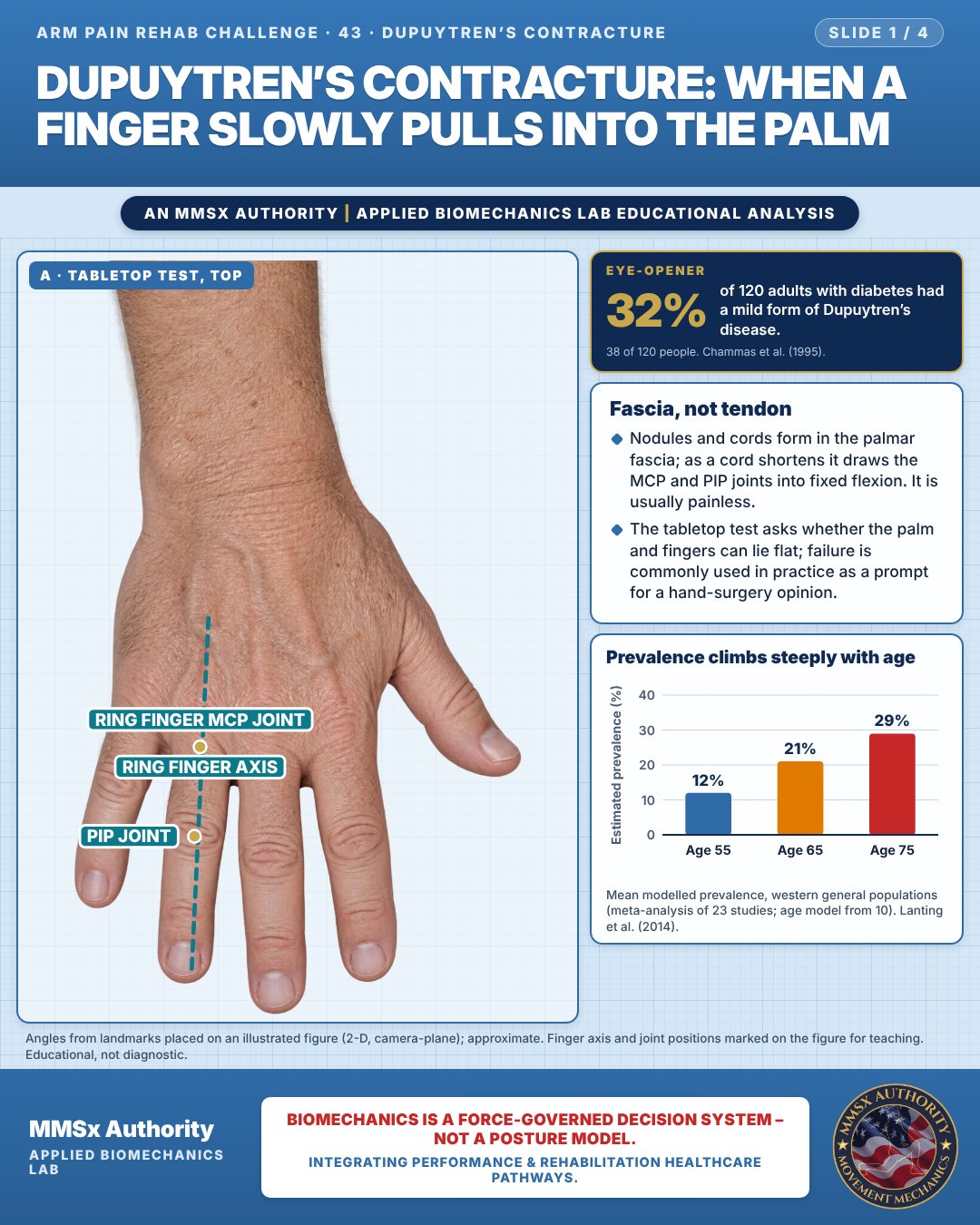
Fascia, not tendon
Nodules and cords form in the palmar fascia; as a cord shortens it draws the MCP and PIP joints into fixed flexion. It is usually painless.
The tabletop test asks whether the palm and fingers can lie flat; failure is commonly used in practice as a prompt for a hand-surgery opinion.
Prevalence climbs steeply with age
Movement B: Palm up, top
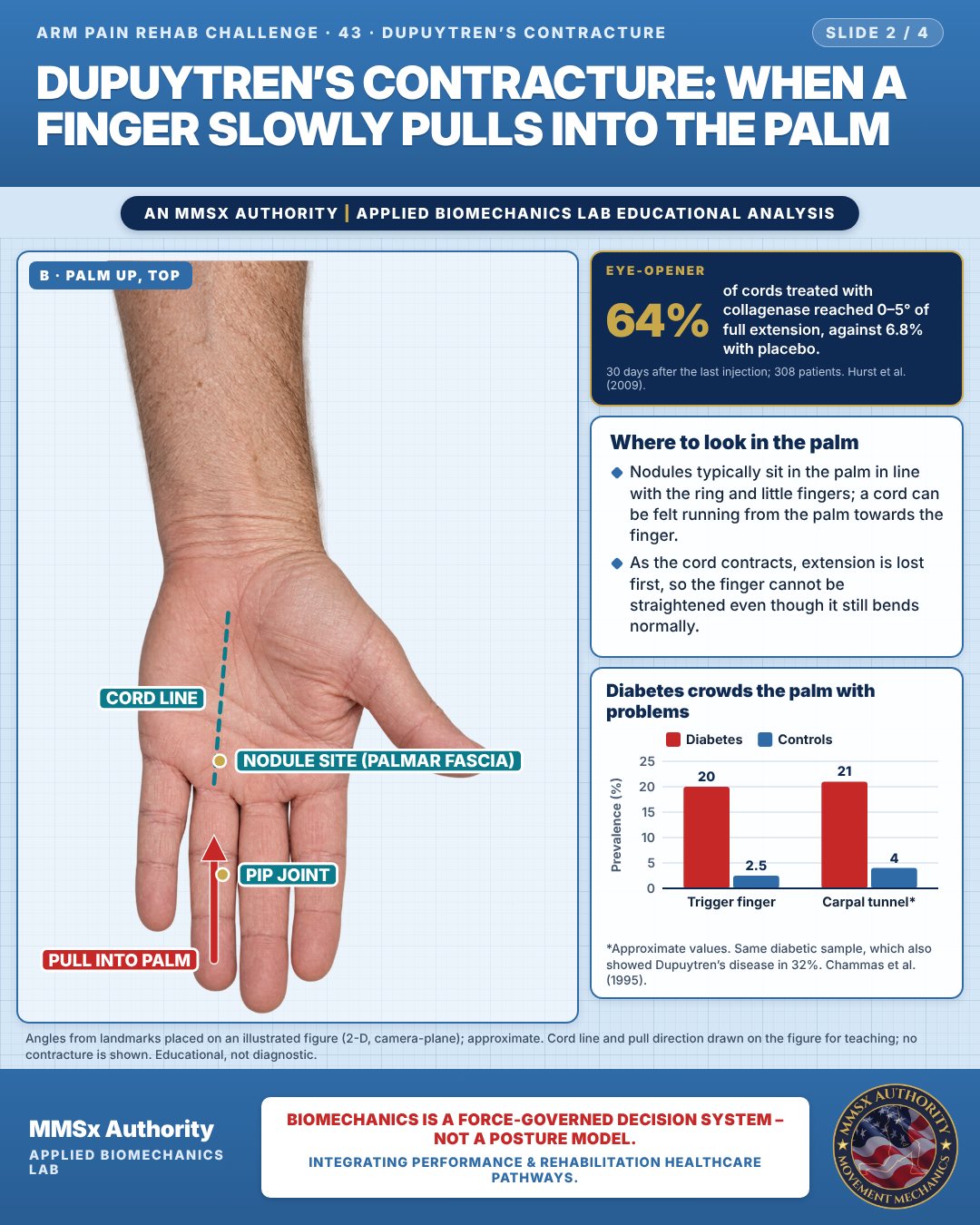
Where to look in the palm
Nodules typically sit in the palm in line with the ring and little fingers; a cord can be felt running from the palm towards the finger.
As the cord contracts, extension is lost first, so the finger cannot be straightened even though it still bends normally.
Diabetes crowds the palm with problems
Movement C: Glass grip (side view)
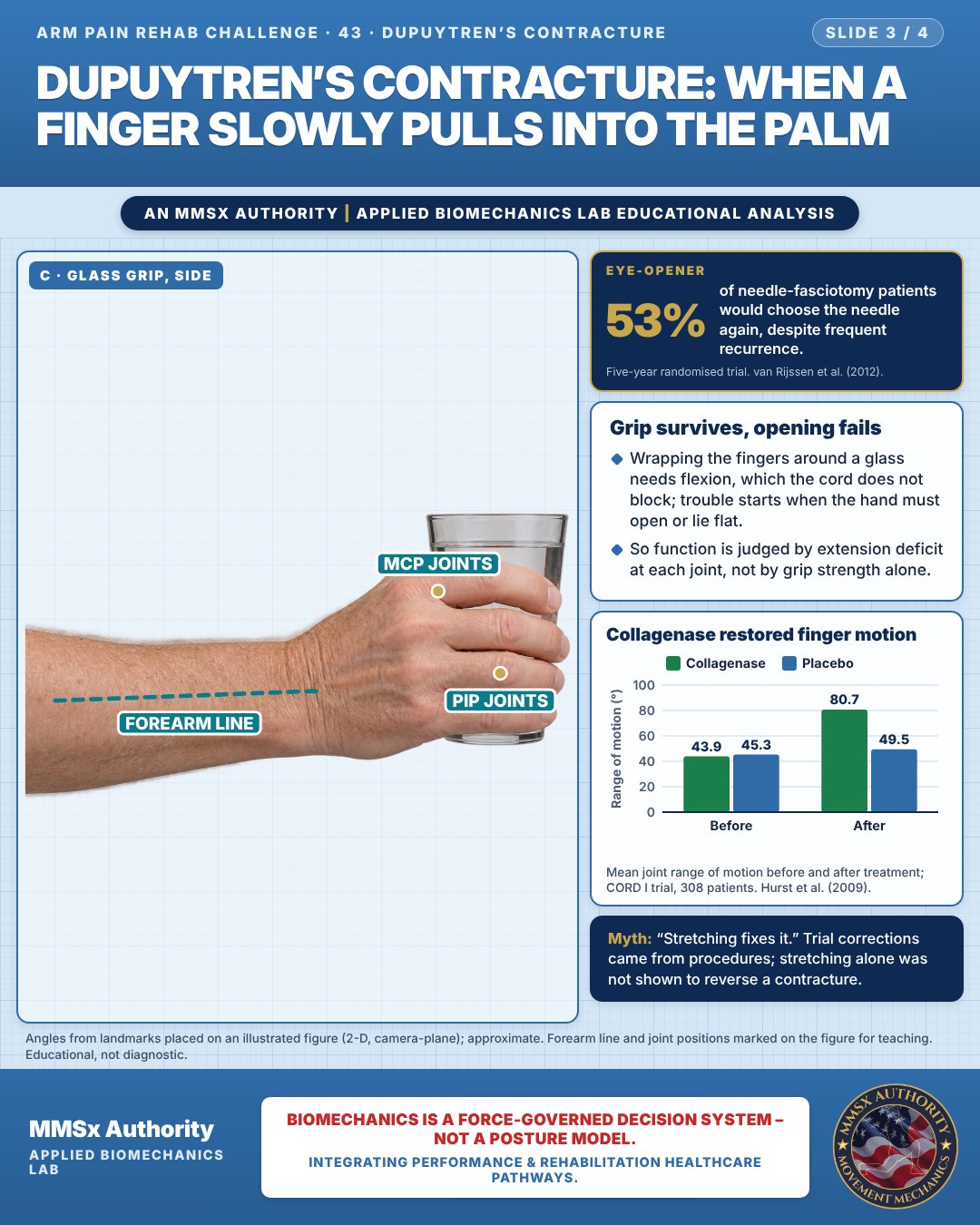
Grip survives, opening fails
Wrapping the fingers around a glass needs flexion, which the cord does not block; trouble starts when the hand must open or lie flat.
So function is judged by extension deficit at each joint, not by grip strength alone.
Collagenase restored finger motion
Decision pathway
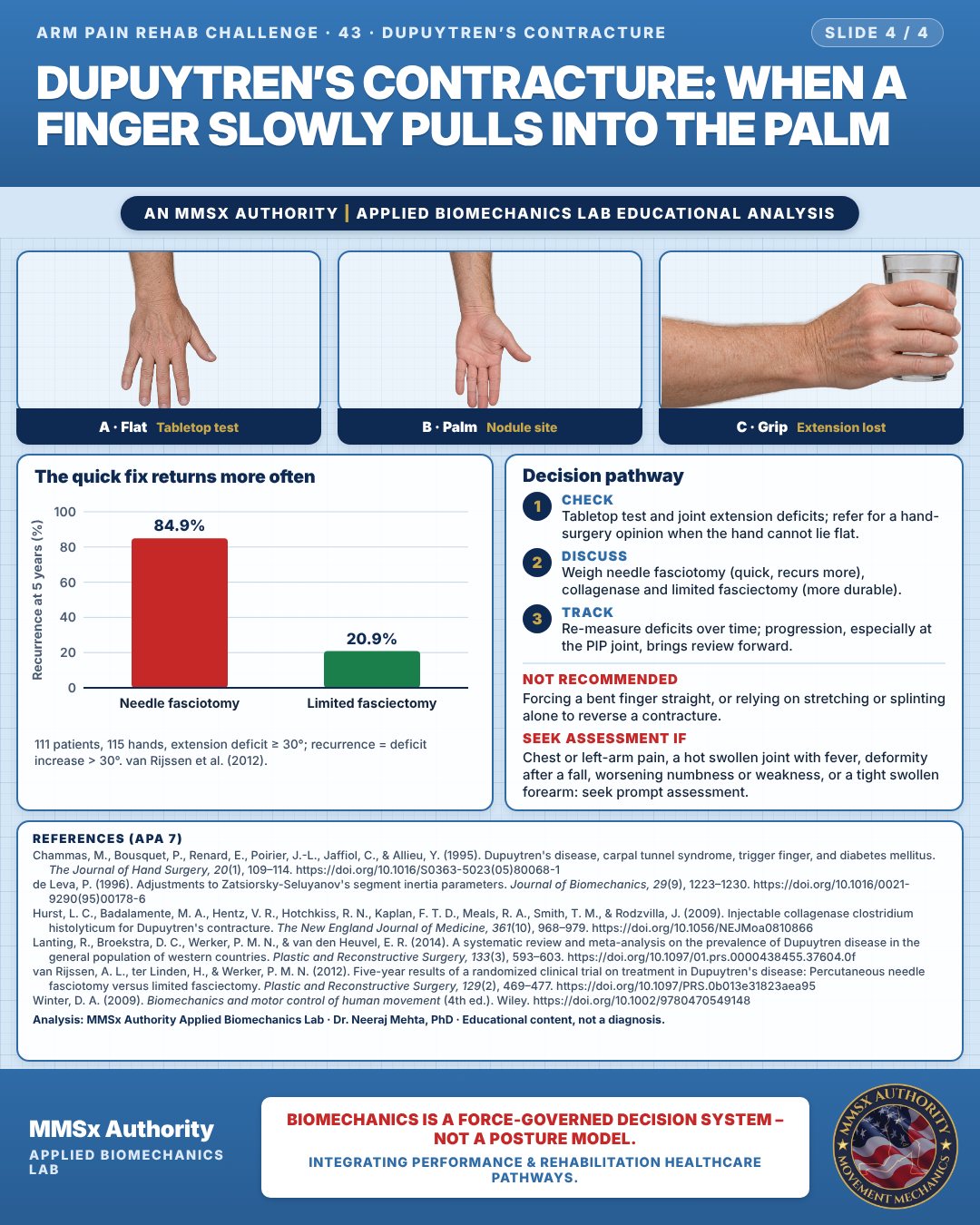
The quick fix returns more often
Check
Tabletop test and joint extension deficits; refer for a hand-surgery opinion when the hand cannot lie flat.
Discuss
Weigh needle fasciotomy (quick, recurs more), collagenase and limited fasciectomy (more durable).
Track
Re-measure deficits over time; progression, especially at the PIP joint, brings review forward.
Myth and evidence
Myth“Dupuytren's is caused by hard manual work and stretching fixes it.”
EvidenceThe sources read show strong age dependence (12% → 29% from 55 to 75; Lanting et al., 2014) and association with diabetes (Chammas et al., 1995); effective correction in trials came from procedures (needle, collagenase, fasciectomy), not stretching.
Cautions
Not recommended
Forcing a bent finger straight, or relying on stretching or splinting alone to reverse a contracture.
Seek assessment if
Chest or left-arm pain, a hot swollen joint with fever, deformity after a fall, worsening numbness or weakness, or a tight swollen forearm: seek prompt assessment.
Methods note
Angles from landmarks placed on an illustrated figure (2-D, camera-plane); approximate. Finger axis and joint positions marked on the figure for teaching. Cord line and pull direction drawn on the figure for teaching; no contracture is shown. Forearm line and joint positions marked on the figure for teaching. These are educational estimates, not a diagnosis.
References
- Chammas, M., Bousquet, P., Renard, E., Poirier, J.-L., Jaffiol, C., & Allieu, Y. (1995). Dupuytren's disease, carpal tunnel syndrome, trigger finger, and diabetes mellitus. The Journal of Hand Surgery, 20(1), 109–114. https://doi.org/10.1016/S0363-5023(05)80068-1
- de Leva, P. (1996). Adjustments to Zatsiorsky-Seluyanov's segment inertia parameters. Journal of Biomechanics, 29(9), 1223–1230. https://doi.org/10.1016/0021-9290(95)00178-6
- Hurst, L. C., Badalamente, M. A., Hentz, V. R., Hotchkiss, R. N., Kaplan, F. T. D., Meals, R. A., Smith, T. M., & Rodzvilla, J. (2009). Injectable collagenase clostridium histolyticum for Dupuytren's contracture. The New England Journal of Medicine, 361(10), 968–979. https://doi.org/10.1056/NEJMoa0810866
- Lanting, R., Broekstra, D. C., Werker, P. M. N., & van den Heuvel, E. R. (2014). A systematic review and meta-analysis on the prevalence of Dupuytren disease in the general population of western countries. Plastic and Reconstructive Surgery, 133(3), 593–603. https://doi.org/10.1097/01.prs.0000438455.37604.0f
- van Rijssen, A. L., ter Linden, H., & Werker, P. M. N. (2012). Five-year results of a randomized clinical trial on treatment in Dupuytren's disease: Percutaneous needle fasciotomy versus limited fasciectomy. Plastic and Reconstructive Surgery, 129(2), 469–477. https://doi.org/10.1097/PRS.0b013e31823aea95
- Winter, D. A. (2009). Biomechanics and motor control of human movement (4th ed.). Wiley. https://doi.org/10.1002/9780470549148
Cite this article
Mehta, N. (2026, October 28). Dupuytren’s contracture: when a finger slowly pulls into the palm. MMSx Authority Applied Biomechanics Lab. https://mmsxauthority.org/edu/analysis/arm/43-dupuytrens-contracture-when-a-finger-slowly-pulls-into-the-palm/
Part of the collection
Mehta, N. (2026). Elbow, Forearm, Wrist and Hand Rehabilitation: 50 Evidence-Based Biomechanics Analyses [Collection]. MMSx Authority Applied Biomechanics Lab. Zenodo. https://doi.org/10.5281/zenodo.23735910
All Arm Pain Rehab Challenge articles · Rehabilitation Library