Arm Pain Rehab Challenge · 42
Hand osteoarthritis: Heberden's nodes, pain and exercise
Hand osteoarthritis is a common joint condition affecting the distal (Heberden's nodes) and proximal (Bouchard's nodes) interphalangeal joints and…
Key points
- Educate. Explain that nodes are common and often painless; teach pacing, joint-friendly grips and assistive devices.
- Load. Prescribe hand exercise for function, strength and pain, built up gradually.
- Track. Review pain, stiffness and task ease; topical NSAIDs before oral, oral only short-term.
What it is
Hand osteoarthritis is a common joint condition affecting the distal (Heberden's nodes) and proximal (Bouchard's nodes) interphalangeal joints and the thumb base, with bony enlargement, pain, stiffness and reduced grip; an erosive subset is more painful and more common in women.
How we analysed the movement
Three movements relevant to this topic were analysed from illustrated reference figures. Joint centres were located with two-dimensional pose estimation where the whole arm was visible; elbow and wrist angles, and the directions of external load and tendon pull, were then drawn on the figure; on hand close-ups, where pose estimation does not apply, the landmarks were placed manually. The figures are educational estimates that show how position changes mechanical demand; they are not measurements of a patient. Every research value quoted below comes from the published source cited beside it.
Movement A: Hands resting, top
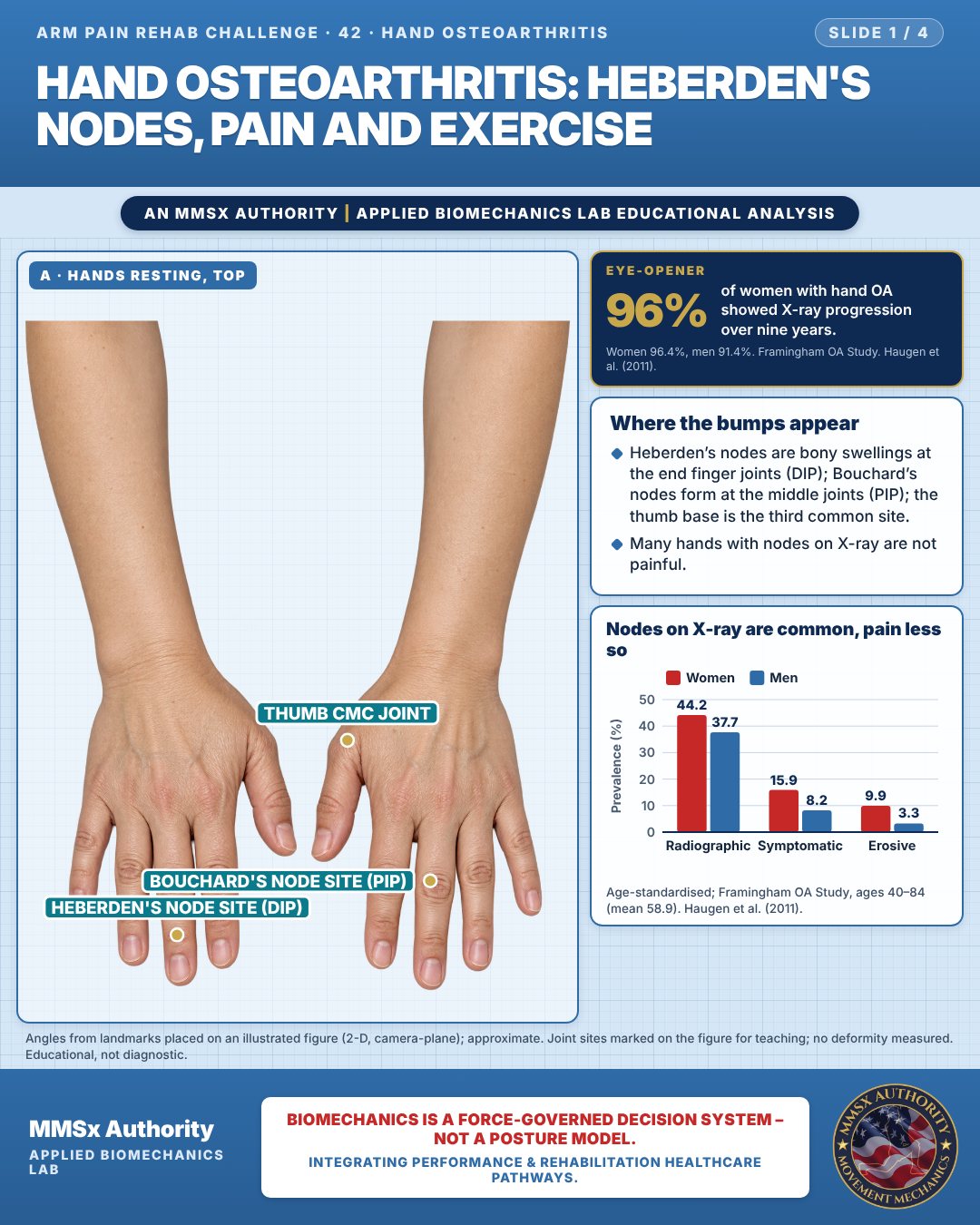
Where the bumps appear
Heberden’s nodes are bony swellings at the end finger joints (DIP); Bouchard’s nodes form at the middle joints (PIP); the thumb base is the third common site.
Many hands with nodes on X-ray are not painful.
Nodes on X-ray are common, pain less so
Movement B: Buttoning a shirt (front view)
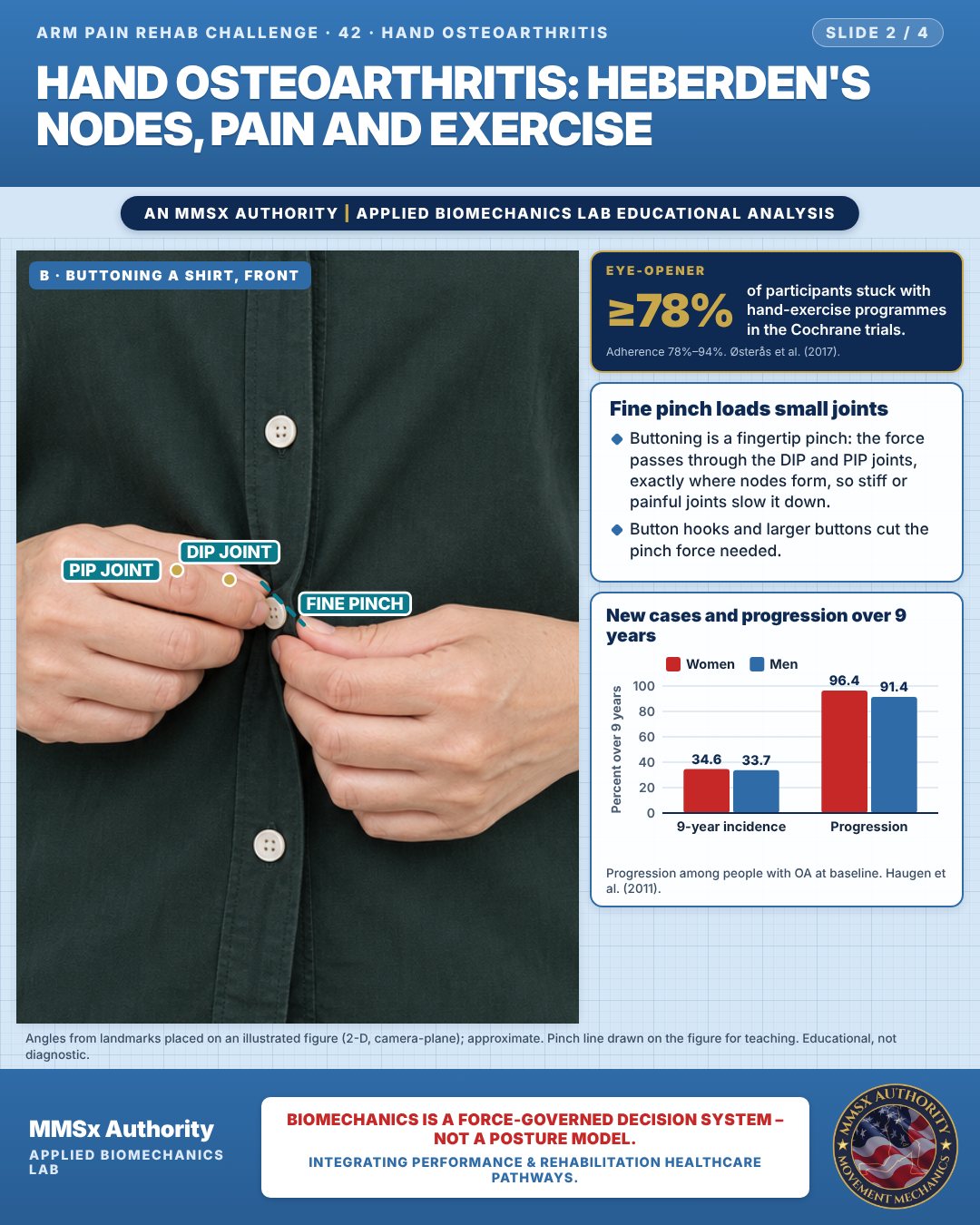
Fine pinch loads small joints
Buttoning is a fingertip pinch: the force passes through the DIP and PIP joints, exactly where nodes form, so stiff or painful joints slow it down.
Button hooks and larger buttons cut the pinch force needed.
New cases and progression over 9 years
Movement C: Squeezing a soft ball, top
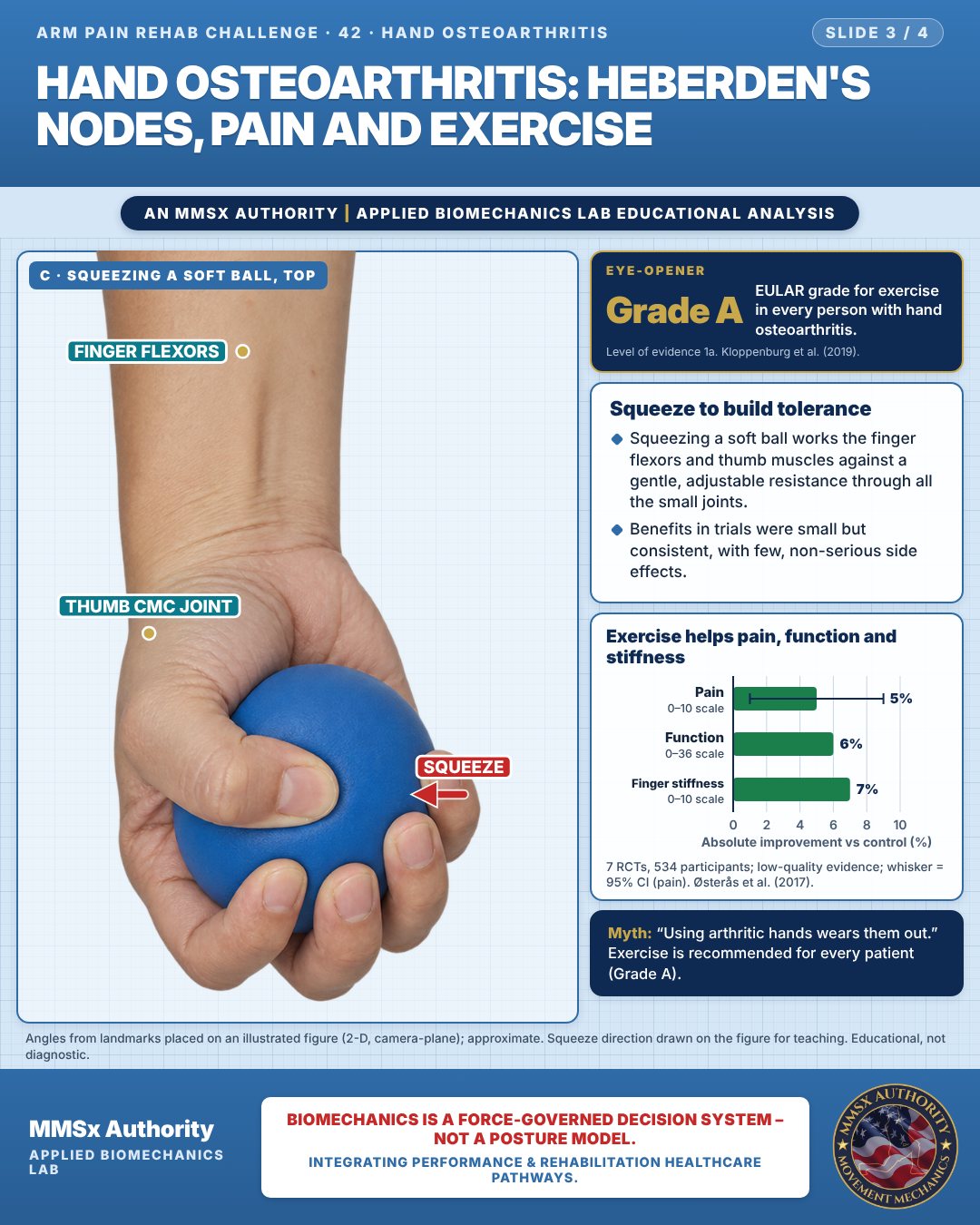
Squeeze to build tolerance
Squeezing a soft ball works the finger flexors and thumb muscles against a gentle, adjustable resistance through all the small joints.
Benefits in trials were small but consistent, with few, non-serious side effects.
Exercise helps pain, function and stiffness
Decision pathway
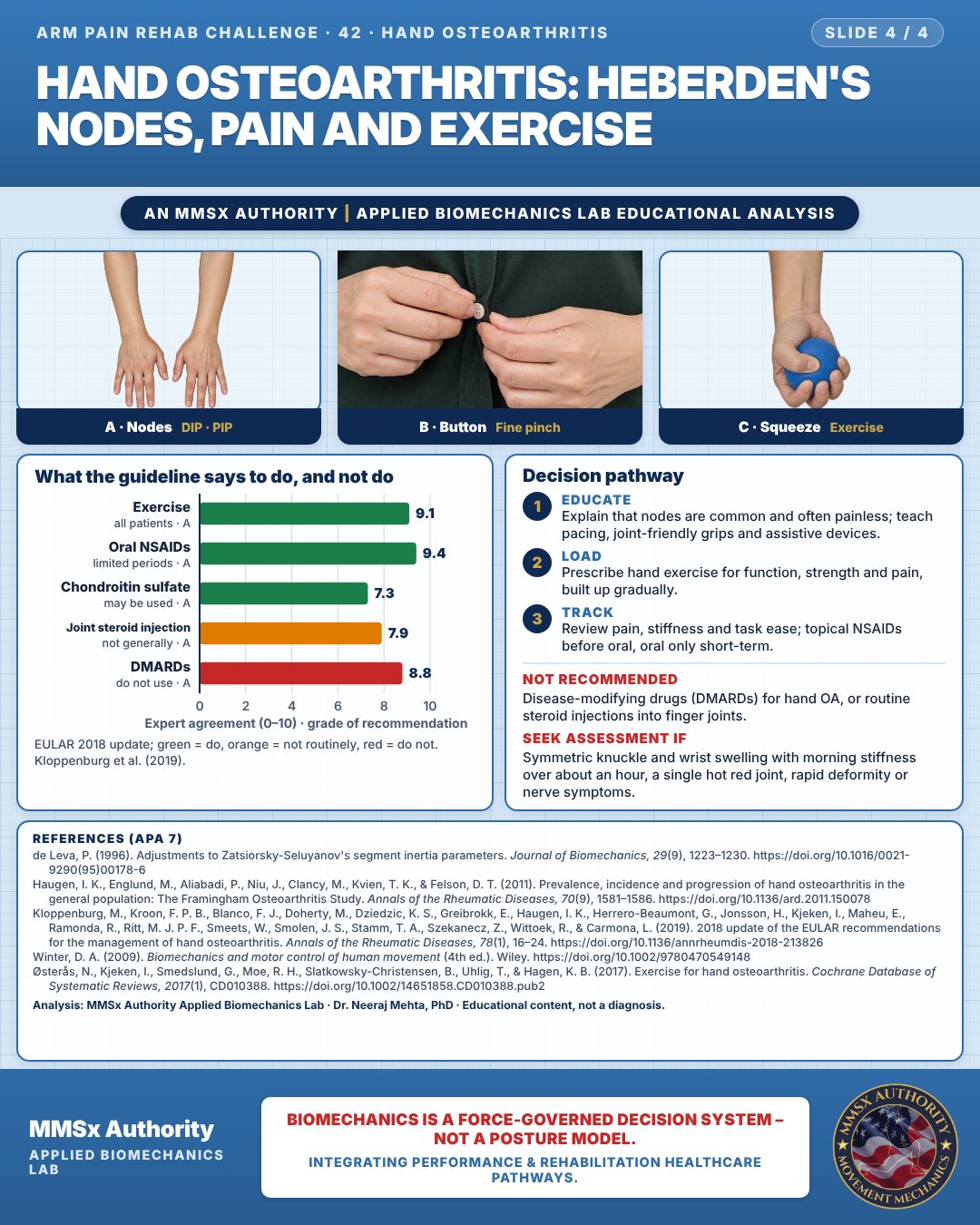
What the guideline says to do, and not do
Educate
Explain that nodes are common and often painless; teach pacing, joint-friendly grips and assistive devices.
Load
Prescribe hand exercise for function, strength and pain, built up gradually.
Track
Review pain, stiffness and task ease; topical NSAIDs before oral, oral only short-term.
What the evidence supports
- As above (Kloppenburg et al., 2019): education and self-management for all; ergonomic advice, pacing and assistive devices; hand exercise for function, strength and pain; topical NSAIDs preferred over systemic; oral NSAIDs short-term; chondroitin sulfate may be used (LoE 1b, Grade A, agreement 7.3). Do not recommend DMARDs for hand OA; glucocorticoid injection not routinely. Paracetamol was not superior to placebo or active comparator in three small trials cited in the guideline text.
Myth and evidence
Myth“Using arthritic hands wears them out faster.”
EvidenceEULAR grades exercise as Grade A for every patient (Kloppenburg et al., 2019), and the Cochrane review found small benefits for pain, function and stiffness with few, non-serious adverse events (Østerås et al., 2017).
Cautions
Not recommended
Disease-modifying drugs (DMARDs) for hand OA, or routine steroid injections into finger joints.
Seek assessment if
Symmetric knuckle and wrist swelling with morning stiffness over about an hour, a single hot red joint, rapid deformity or nerve symptoms.
Methods note
Angles from landmarks placed on an illustrated figure (2-D, camera-plane); approximate. Joint sites marked on the figure for teaching; no deformity measured. Pinch line drawn on the figure for teaching. Squeeze direction drawn on the figure for teaching. These are educational estimates, not a diagnosis.
References
- de Leva, P. (1996). Adjustments to Zatsiorsky-Seluyanov's segment inertia parameters. Journal of Biomechanics, 29(9), 1223–1230. https://doi.org/10.1016/0021-9290(95)00178-6
- Haugen, I. K., Englund, M., Aliabadi, P., Niu, J., Clancy, M., Kvien, T. K., & Felson, D. T. (2011). Prevalence, incidence and progression of hand osteoarthritis in the general population: The Framingham Osteoarthritis Study. Annals of the Rheumatic Diseases, 70(9), 1581–1586. https://doi.org/10.1136/ard.2011.150078
- Kloppenburg, M., Kroon, F. P. B., Blanco, F. J., Doherty, M., Dziedzic, K. S., Greibrokk, E., Haugen, I. K., Herrero-Beaumont, G., Jonsson, H., Kjeken, I., Maheu, E., Ramonda, R., Ritt, M. J. P. F., Smeets, W., Smolen, J. S., Stamm, T. A., Szekanecz, Z., Wittoek, R., & Carmona, L. (2019). 2018 update of the EULAR recommendations for the management of hand osteoarthritis. Annals of the Rheumatic Diseases, 78(1), 16–24. https://doi.org/10.1136/annrheumdis-2018-213826
- Winter, D. A. (2009). Biomechanics and motor control of human movement (4th ed.). Wiley. https://doi.org/10.1002/9780470549148
- Østerås, N., Kjeken, I., Smedslund, G., Moe, R. H., Slatkowsky-Christensen, B., Uhlig, T., & Hagen, K. B. (2017). Exercise for hand osteoarthritis. Cochrane Database of Systematic Reviews, 2017(1), CD010388. https://doi.org/10.1002/14651858.CD010388.pub2
Cite this article
Mehta, N. (2026, October 28). Hand osteoarthritis: Heberden's nodes, pain and exercise. MMSx Authority Applied Biomechanics Lab. https://mmsxauthority.org/edu/analysis/arm/42-hand-osteoarthritis-heberdens-nodes-pain-and-exercise/
Part of the collection
Mehta, N. (2026). Elbow, Forearm, Wrist and Hand Rehabilitation: 50 Evidence-Based Biomechanics Analyses [Collection]. MMSx Authority Applied Biomechanics Lab. Zenodo. https://doi.org/10.5281/zenodo.23735910
All Arm Pain Rehab Challenge articles · Rehabilitation Library