Arm Pain Rehab Challenge · 39
Trigger finger: catching and locking when the finger bends
Trigger finger (stenosing flexor tenosynovitis) is a size mismatch between a flexor tendon and the A1 pulley at the base of the finger, producing…
Key points
- Modify. Use padded, thicker handles and limit sustained hard gripping; splinting can settle a mild case.
- Treat. Discuss a steroid injection first; up to two injections cured 86% in the trial.
- Track. If catching returns or persists, a percutaneous or open release is the next step.
What it is
Trigger finger (stenosing flexor tenosynovitis) is a size mismatch between a flexor tendon and the A1 pulley at the base of the finger, producing pain at the palm crease, catching, clicking or locking as the finger bends and straightens.
How we analysed the movement
Three movements relevant to this topic were analysed from illustrated reference figures. Joint centres were located with two-dimensional pose estimation where the whole arm was visible; elbow and wrist angles, and the directions of external load and tendon pull, were then drawn on the figure; on hand close-ups, where pose estimation does not apply, the landmarks were placed manually. The figures are educational estimates that show how position changes mechanical demand; they are not measurements of a patient. Every research value quoted below comes from the published source cited beside it.
Movement A: Full fist (side view)
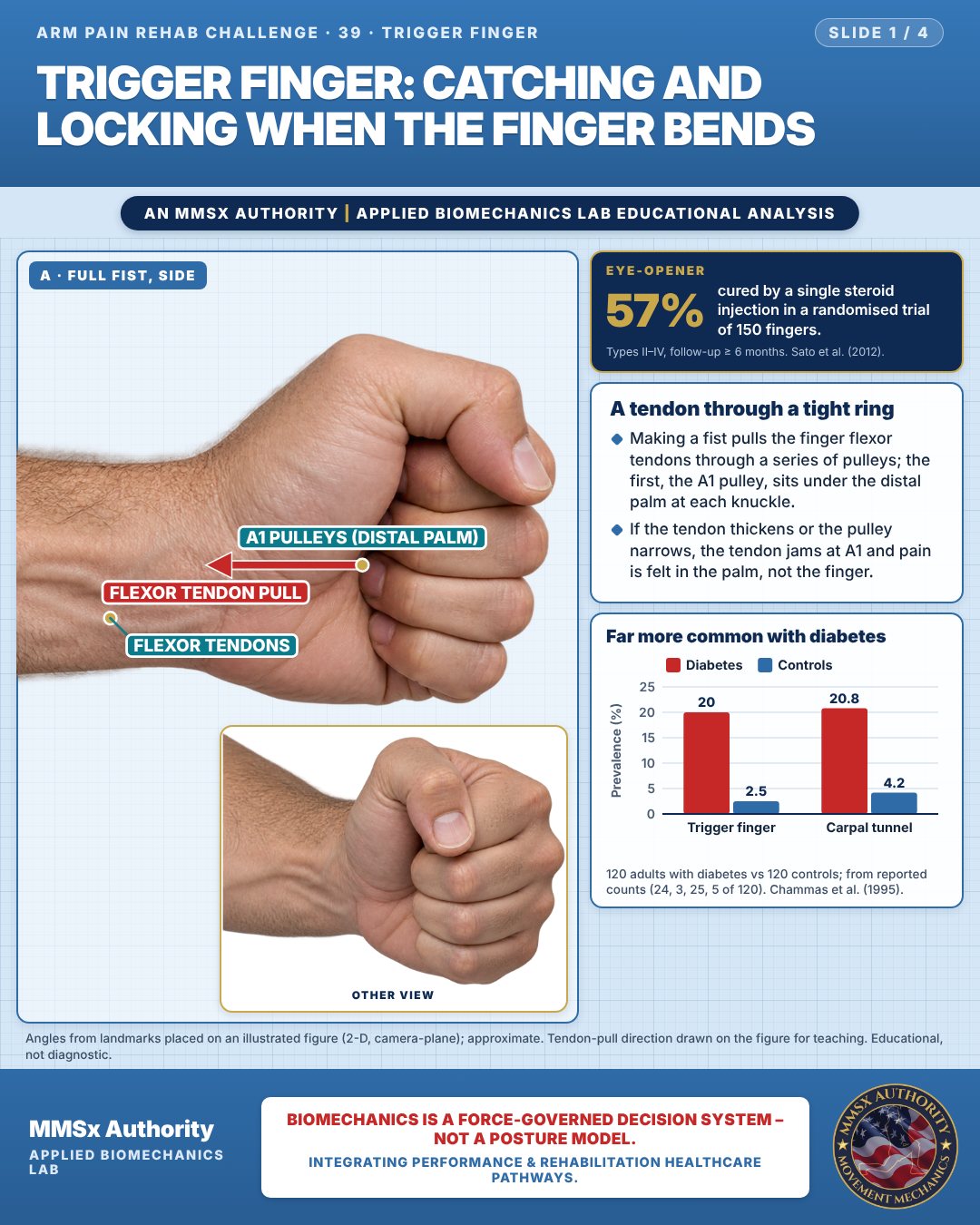
A tendon through a tight ring
Making a fist pulls the finger flexor tendons through a series of pulleys; the first, the A1 pulley, sits under the distal palm at each knuckle.
If the tendon thickens or the pulley narrows, the tendon jams at A1 and pain is felt in the palm, not the finger.
Far more common with diabetes
Movement B: Ring finger bent (side view)
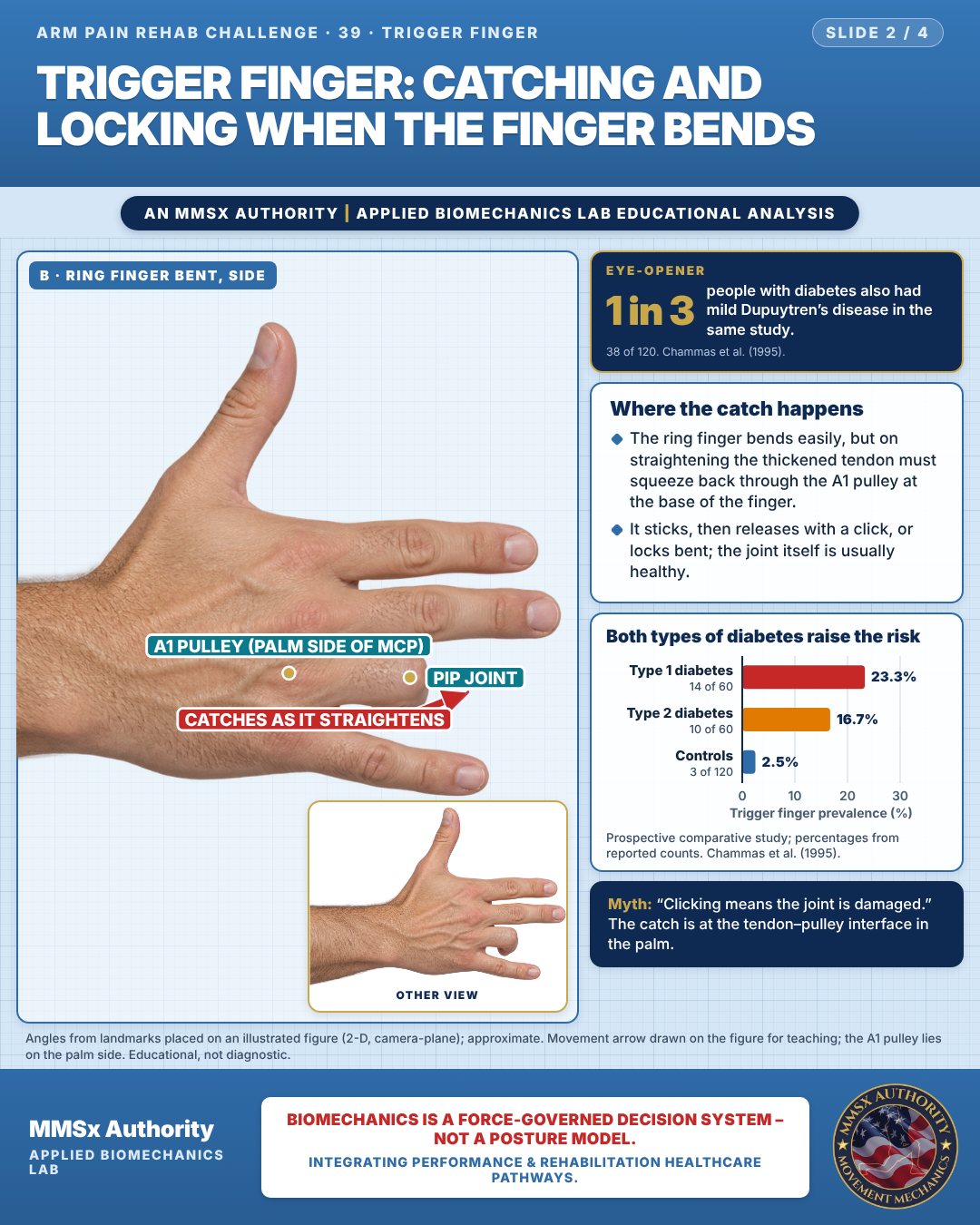
Where the catch happens
The ring finger bends easily, but on straightening the thickened tendon must squeeze back through the A1 pulley at the base of the finger.
It sticks, then releases with a click, or locks bent; the joint itself is usually healthy.
Both types of diabetes raise the risk
Movement C: Gripping a trowel (side view)
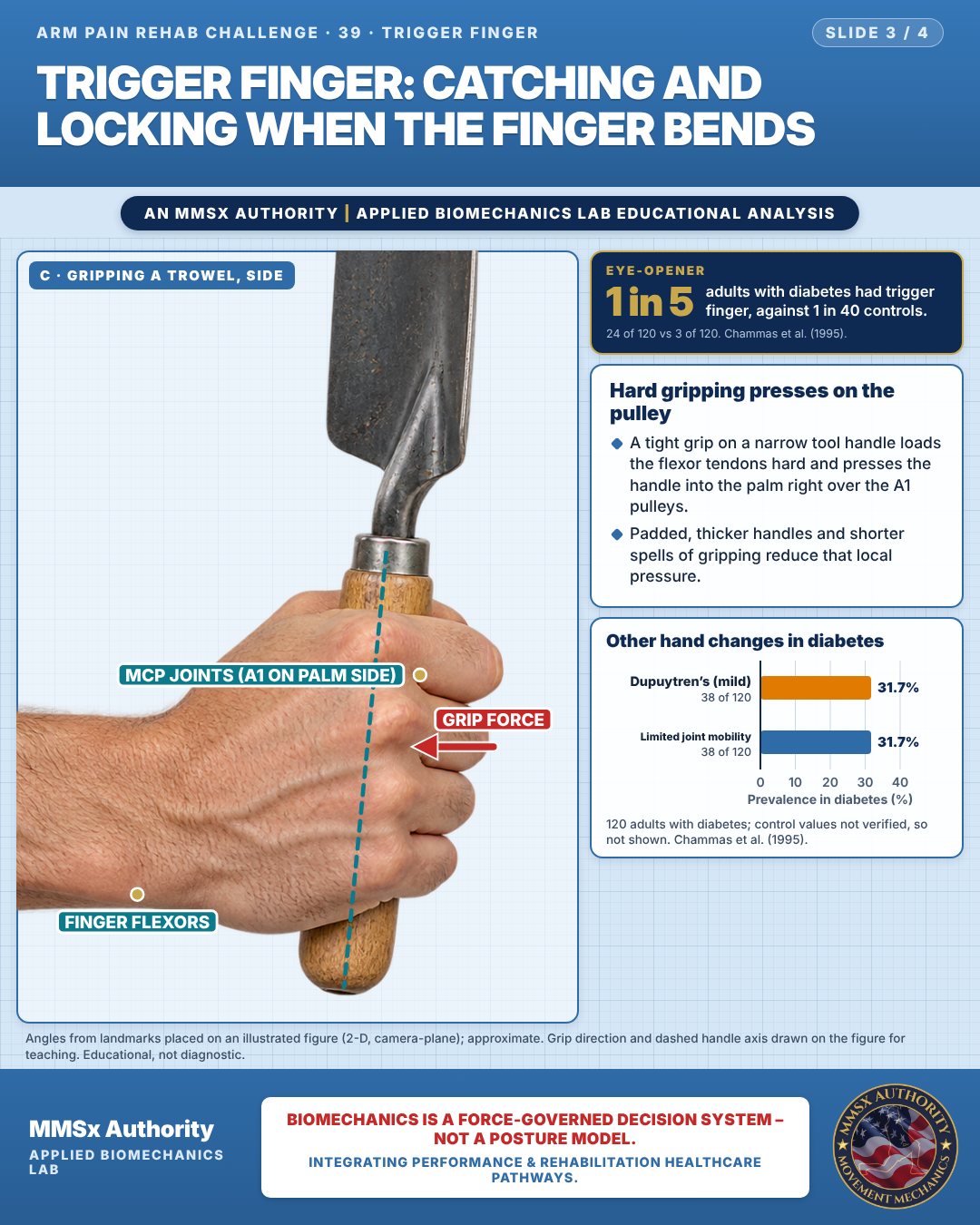
Hard gripping presses on the pulley
A tight grip on a narrow tool handle loads the flexor tendons hard and presses the handle into the palm right over the A1 pulleys.
Padded, thicker handles and shorter spells of gripping reduce that local pressure.
Other hand changes in diabetes
Decision pathway
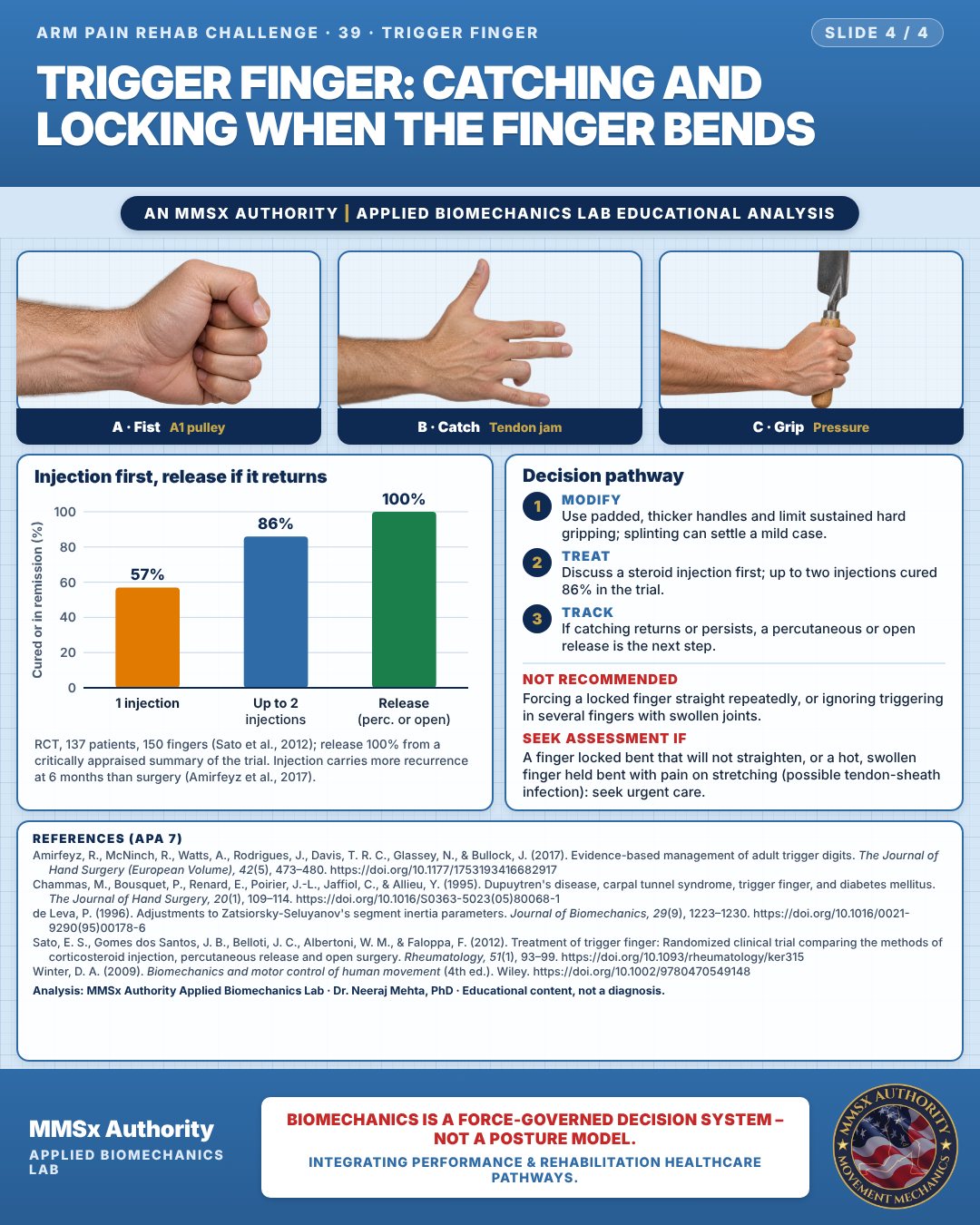
Injection first, release if it returns
Modify
Use padded, thicker handles and limit sustained hard gripping; splinting can settle a mild case.
Treat
Discuss a steroid injection first; up to two injections cured 86% in the trial.
Track
If catching returns or persists, a percutaneous or open release is the next step.
Myth and evidence
Myth“Clicking means the joint is damaged.”
EvidenceThe catch is at the tendon–pulley interface in the palm, not in the finger joint; most cases respond to injection or a small release procedure (Sato et al., 2012).
Cautions
Not recommended
Forcing a locked finger straight repeatedly, or ignoring triggering in several fingers with swollen joints.
Seek assessment if
A finger locked bent that will not straighten, or a hot, swollen finger held bent with pain on stretching (possible tendon-sheath infection): seek urgent care.
Methods note
Angles from landmarks placed on an illustrated figure (2-D, camera-plane); approximate. Tendon-pull direction drawn on the figure for teaching. Movement arrow drawn on the figure for teaching; the A1 pulley lies on the palm side. Grip direction and dashed handle axis drawn on the figure for teaching. These are educational estimates, not a diagnosis.
References
- Amirfeyz, R., McNinch, R., Watts, A., Rodrigues, J., Davis, T. R. C., Glassey, N., & Bullock, J. (2017). Evidence-based management of adult trigger digits. The Journal of Hand Surgery (European Volume), 42(5), 473–480. https://doi.org/10.1177/1753193416682917
- Chammas, M., Bousquet, P., Renard, E., Poirier, J.-L., Jaffiol, C., & Allieu, Y. (1995). Dupuytren's disease, carpal tunnel syndrome, trigger finger, and diabetes mellitus. The Journal of Hand Surgery, 20(1), 109–114. https://doi.org/10.1016/S0363-5023(05)80068-1
- de Leva, P. (1996). Adjustments to Zatsiorsky-Seluyanov's segment inertia parameters. Journal of Biomechanics, 29(9), 1223–1230. https://doi.org/10.1016/0021-9290(95)00178-6
- Sato, E. S., Gomes dos Santos, J. B., Belloti, J. C., Albertoni, W. M., & Faloppa, F. (2012). Treatment of trigger finger: Randomized clinical trial comparing the methods of corticosteroid injection, percutaneous release and open surgery. Rheumatology, 51(1), 93–99. https://doi.org/10.1093/rheumatology/ker315
- Winter, D. A. (2009). Biomechanics and motor control of human movement (4th ed.). Wiley. https://doi.org/10.1002/9780470549148
Cite this article
Mehta, N. (2026, October 28). Trigger finger: catching and locking when the finger bends. MMSx Authority Applied Biomechanics Lab. https://mmsxauthority.org/edu/analysis/arm/39-trigger-finger-catching-and-locking-when-the-finger-bends/
Part of the collection
Mehta, N. (2026). Elbow, Forearm, Wrist and Hand Rehabilitation: 50 Evidence-Based Biomechanics Analyses [Collection]. MMSx Authority Applied Biomechanics Lab. Zenodo. https://doi.org/10.5281/zenodo.23735910
All Arm Pain Rehab Challenge articles · Rehabilitation Library