Arm Pain Rehab Challenge · 38
Texting thumb: smartphone load on the thumb tendons
"Texting thumb" is an informal term for pain at the thumb and thumb-side wrist linked to repeated thumb movements on a handheld screen.
Key points
- Modify. Type with two thumbs, raise the phone, use voice input or a stand, and alternate hands.
- Load. Break long sessions into short bouts; keep thumb reaches short with a smaller keyboard zone.
- Track. Note thumb-side wrist pain after phone use; if swelling appears, manage as de Quervain’s.
What it is
"Texting thumb" is an informal term for pain at the thumb and thumb-side wrist linked to repeated thumb movements on a handheld screen; clinically it overlaps with thumb tendon irritation (including de Quervain's tenosynovitis) and is a load-tolerance problem rather than a distinct disease.
How we analysed the movement
Three movements relevant to this topic were analysed from illustrated reference figures. Joint centres were located with two-dimensional pose estimation where the whole arm was visible; elbow and wrist angles, and the directions of external load and tendon pull, were then drawn on the figure; on hand close-ups, where pose estimation does not apply, the landmarks were placed manually. The figures are educational estimates that show how position changes mechanical demand; they are not measurements of a patient. Every research value quoted below comes from the published source cited beside it.
Movement A: One-hand texting (front view)
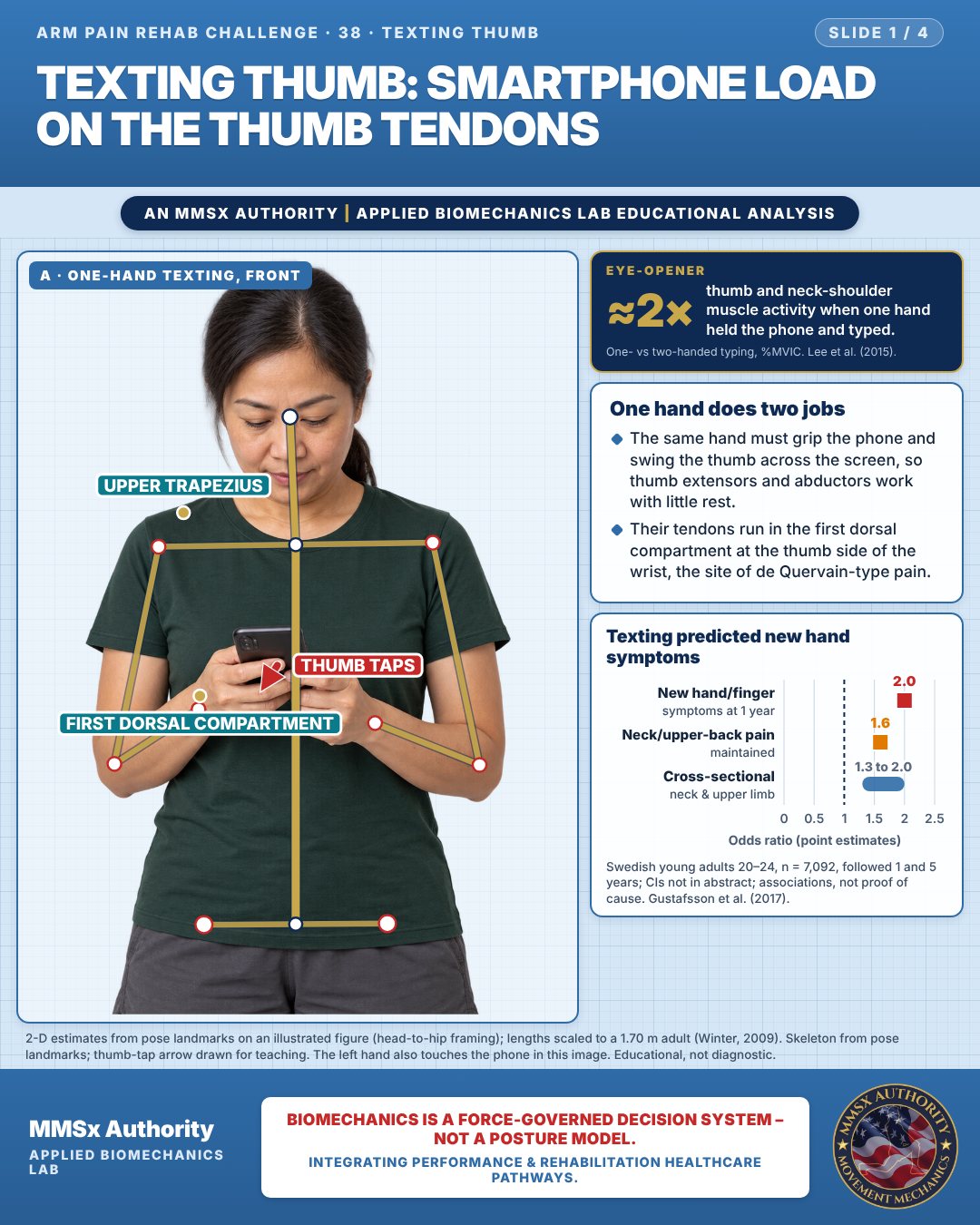
One hand does two jobs
The same hand must grip the phone and swing the thumb across the screen, so thumb extensors and abductors work with little rest.
Their tendons run in the first dorsal compartment at the thumb side of the wrist, the site of de Quervain-type pain.
Texting predicted new hand symptoms
Movement B: Two thumbs, raised (side view)
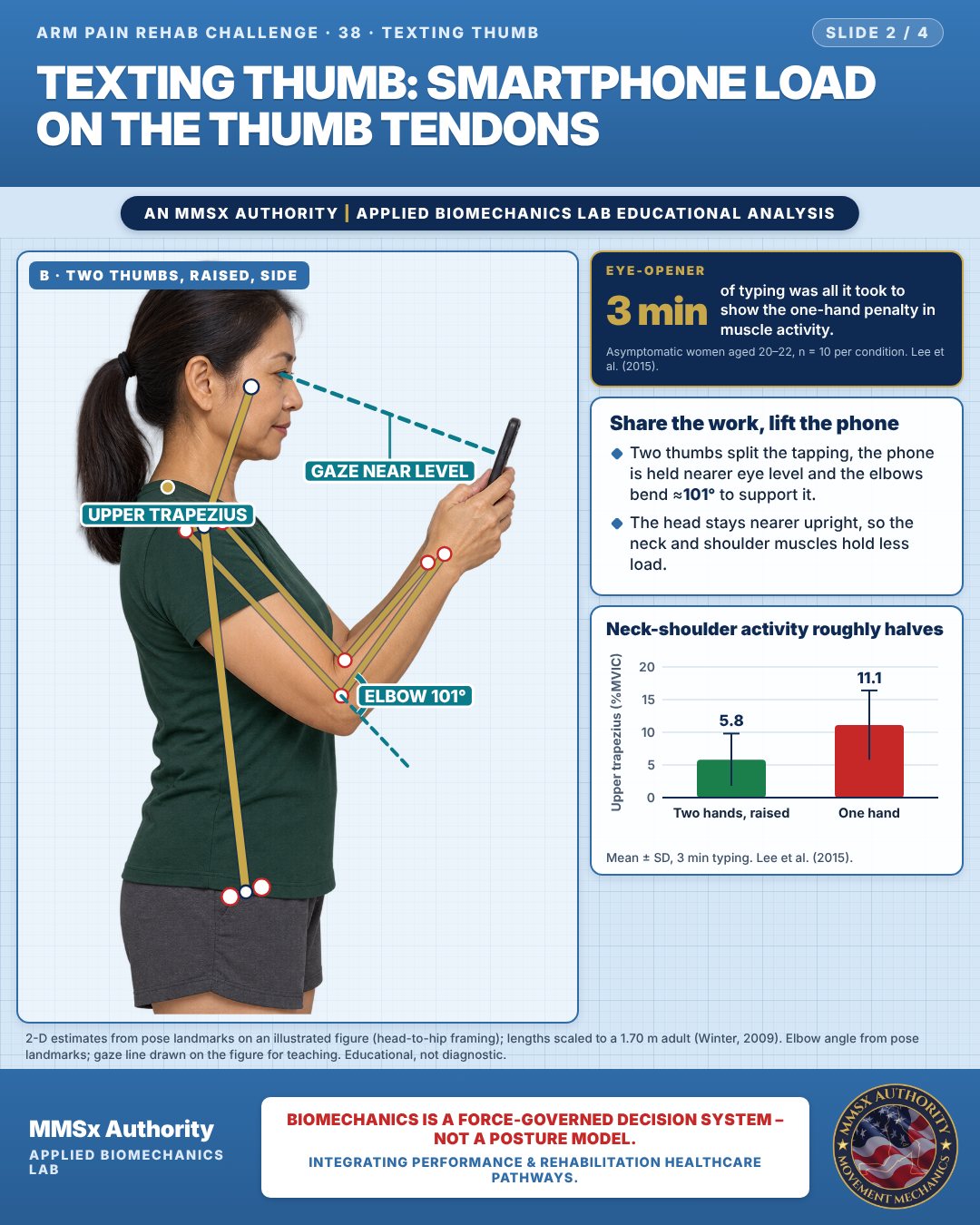
Share the work, lift the phone
Two thumbs split the tapping, the phone is held nearer eye level and the elbows bend ≈101° to support it.
The head stays nearer upright, so the neck and shoulder muscles hold less load.
Neck-shoulder activity roughly halves
Movement C: Thumb reach, top
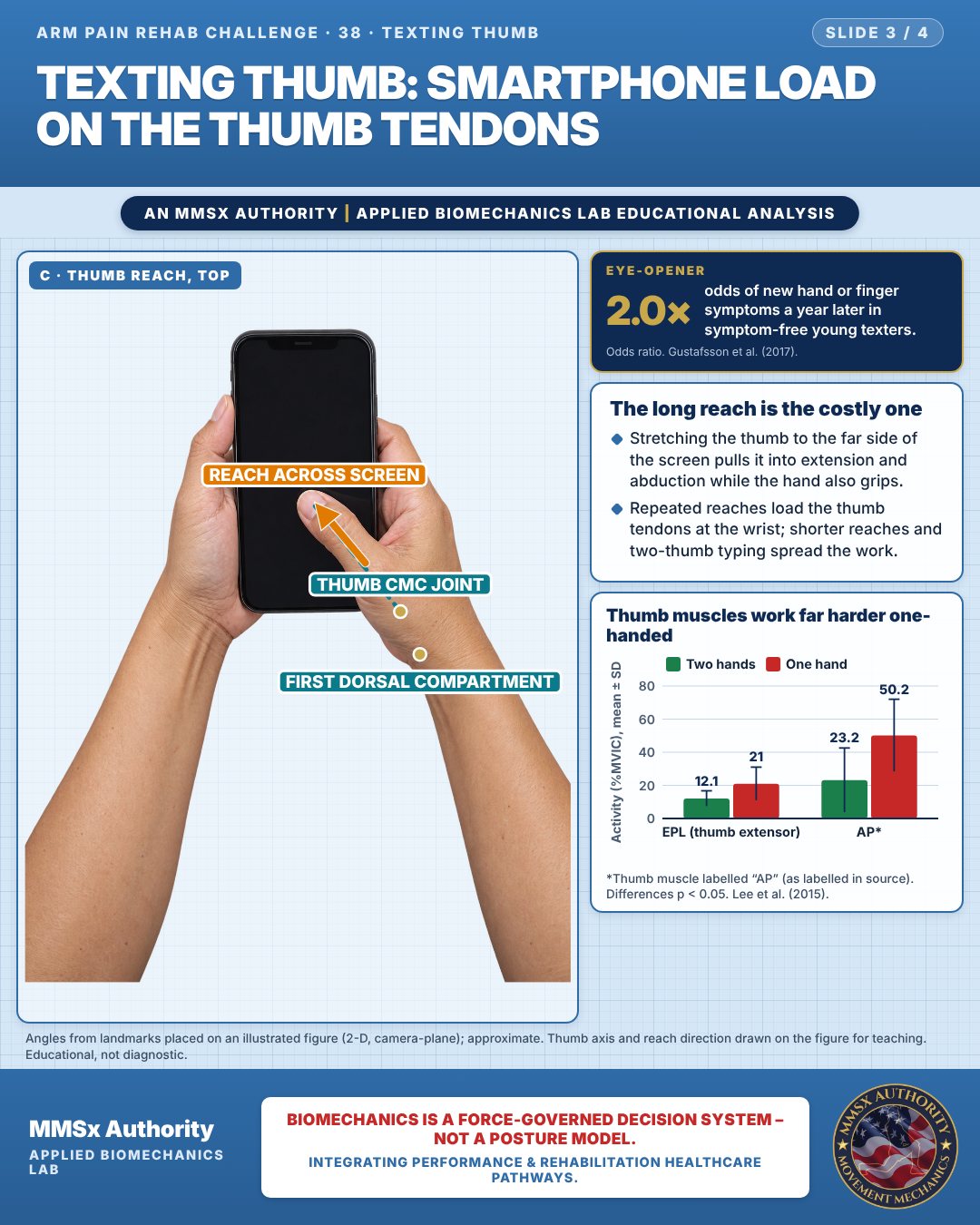
The long reach is the costly one
Stretching the thumb to the far side of the screen pulls it into extension and abduction while the hand also grips.
Repeated reaches load the thumb tendons at the wrist; shorter reaches and two-thumb typing spread the work.
Thumb muscles work far harder one-handed
Decision pathway
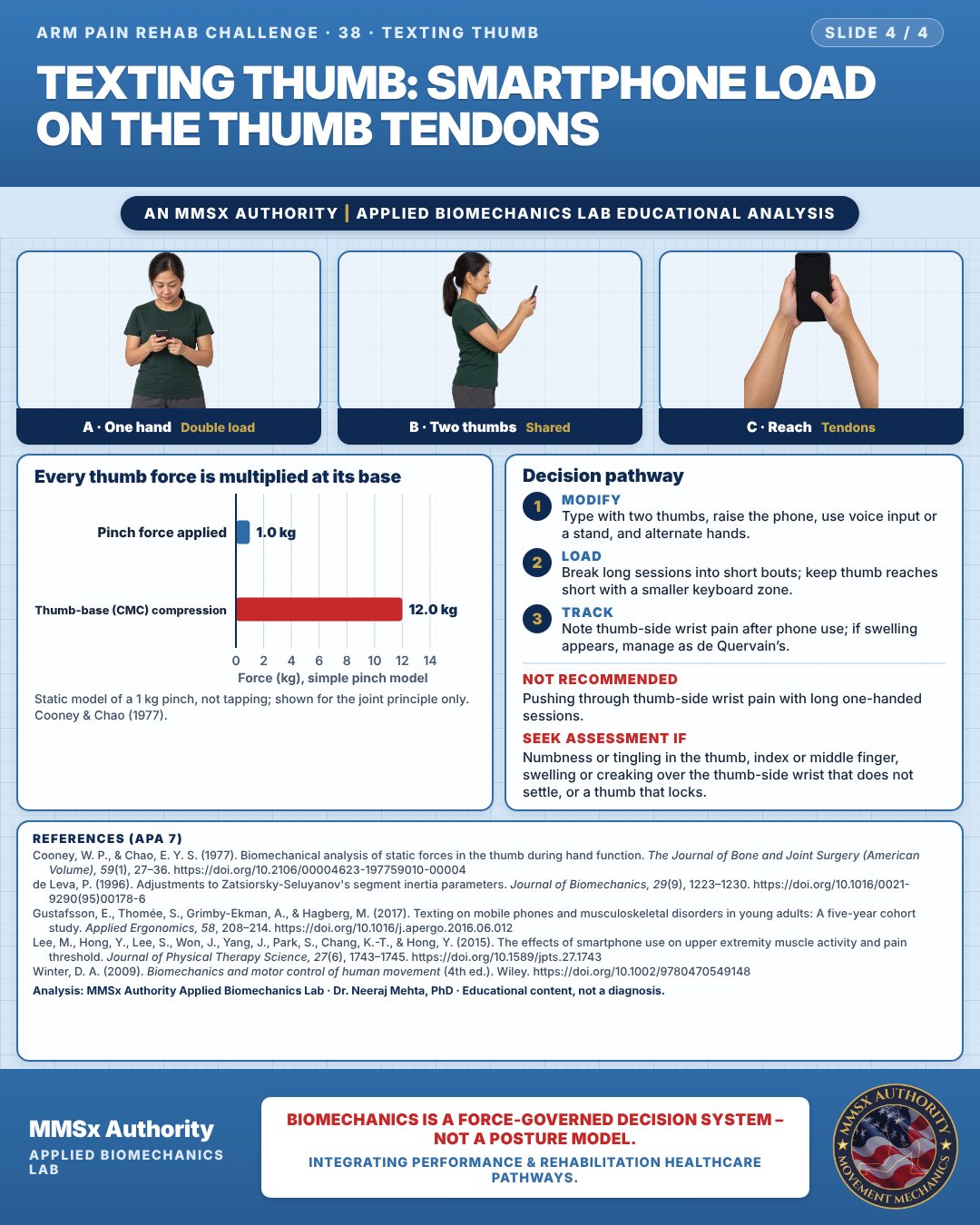
Every thumb force is multiplied at its base
Modify
Type with two thumbs, raise the phone, use voice input or a stand, and alternate hands.
Load
Break long sessions into short bouts; keep thumb reaches short with a smaller keyboard zone.
Track
Note thumb-side wrist pain after phone use; if swelling appears, manage as de Quervain’s.
Myth and evidence
Myth“It's just the neck that suffers from phones.”
EvidenceIn the cohort, texting predicted new hand/finger symptoms (OR 2.0) in previously symptom-free young adults (Gustafsson et al., 2017), and one-handed texting about doubled thumb muscle activity (Lee et al., 2015).
Cautions
Not recommended
Pushing through thumb-side wrist pain with long one-handed sessions.
Seek assessment if
Numbness or tingling in the thumb, index or middle finger, swelling or creaking over the thumb-side wrist that does not settle, or a thumb that locks.
Methods note
2-D estimates from pose landmarks on an illustrated figure (head-to-hip framing); lengths scaled to a 1.70 m adult (Winter, 2009). Skeleton from pose landmarks; thumb-tap arrow drawn for teaching. The left hand also touches the phone in this image. Elbow angle from pose landmarks; gaze line drawn on the figure for teaching. Angles from landmarks placed on an illustrated figure (2-D, camera-plane); approximate. Thumb axis and reach direction drawn on the figure for teaching. These are educational estimates, not a diagnosis.
References
- Cooney, W. P., & Chao, E. Y. S. (1977). Biomechanical analysis of static forces in the thumb during hand function. The Journal of Bone and Joint Surgery (American Volume), 59(1), 27–36. https://doi.org/10.2106/00004623-197759010-00004
- de Leva, P. (1996). Adjustments to Zatsiorsky-Seluyanov's segment inertia parameters. Journal of Biomechanics, 29(9), 1223–1230. https://doi.org/10.1016/0021-9290(95)00178-6
- Gustafsson, E., Thomée, S., Grimby-Ekman, A., & Hagberg, M. (2017). Texting on mobile phones and musculoskeletal disorders in young adults: A five-year cohort study. Applied Ergonomics, 58, 208–214. https://doi.org/10.1016/j.apergo.2016.06.012
- Lee, M., Hong, Y., Lee, S., Won, J., Yang, J., Park, S., Chang, K.-T., & Hong, Y. (2015). The effects of smartphone use on upper extremity muscle activity and pain threshold. Journal of Physical Therapy Science, 27(6), 1743–1745. https://doi.org/10.1589/jpts.27.1743
- Winter, D. A. (2009). Biomechanics and motor control of human movement (4th ed.). Wiley. https://doi.org/10.1002/9780470549148
Cite this article
Mehta, N. (2026, October 28). Texting thumb: smartphone load on the thumb tendons. MMSx Authority Applied Biomechanics Lab. https://mmsxauthority.org/edu/analysis/arm/38-texting-thumb-smartphone-load-on-the-thumb-tendons/
Part of the collection
Mehta, N. (2026). Elbow, Forearm, Wrist and Hand Rehabilitation: 50 Evidence-Based Biomechanics Analyses [Collection]. MMSx Authority Applied Biomechanics Lab. Zenodo. https://doi.org/10.5281/zenodo.23735910
All Arm Pain Rehab Challenge articles · Rehabilitation Library