Arm Pain Rehab Challenge · 40
Mallet finger: the drooping fingertip and why splint time matters
Mallet finger is loss of active extension at the fingertip (distal interphalangeal joint) caused by rupture of the terminal extensor tendon or…
Key points
- Protect. Splint the DIP straight promptly after a drooping-tip injury and keep it on continuously.
- Dose. Keep 6 weeks continuous for acute and 8 weeks for chronic injuries; extend if a lag persists.
- Check. Have the tip reviewed; a large bony fragment or a joint out of line needs a specialist decision.
What it is
Mallet finger is loss of active extension at the fingertip (distal interphalangeal joint) caused by rupture of the terminal extensor tendon or avulsion of its bony insertion, typically from a sudden forced bend of the straight fingertip (e.g. a ball striking it).
How we analysed the movement
Three movements relevant to this topic were analysed from illustrated reference figures. Joint centres were located with two-dimensional pose estimation where the whole arm was visible; elbow and wrist angles, and the directions of external load and tendon pull, were then drawn on the figure; on hand close-ups, where pose estimation does not apply, the landmarks were placed manually. The figures are educational estimates that show how position changes mechanical demand; they are not measurements of a patient. Every research value quoted below comes from the published source cited beside it.
Movement A: Ball meets fingertips (side view)
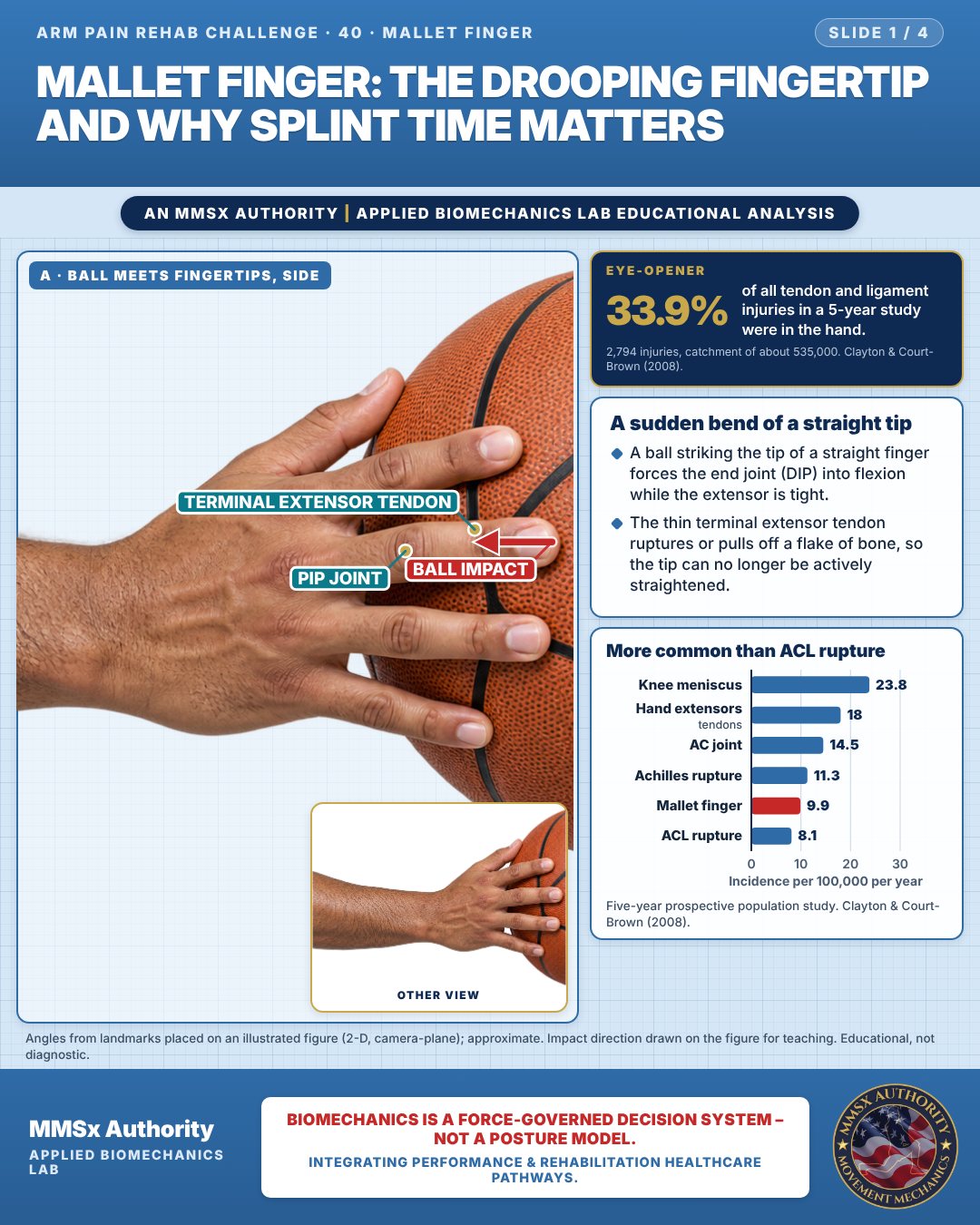
A sudden bend of a straight tip
A ball striking the tip of a straight finger forces the end joint (DIP) into flexion while the extensor is tight.
The thin terminal extensor tendon ruptures or pulls off a flake of bone, so the tip can no longer be actively straightened.
More common than ACL rupture
Movement B: Mallet splint (side view)
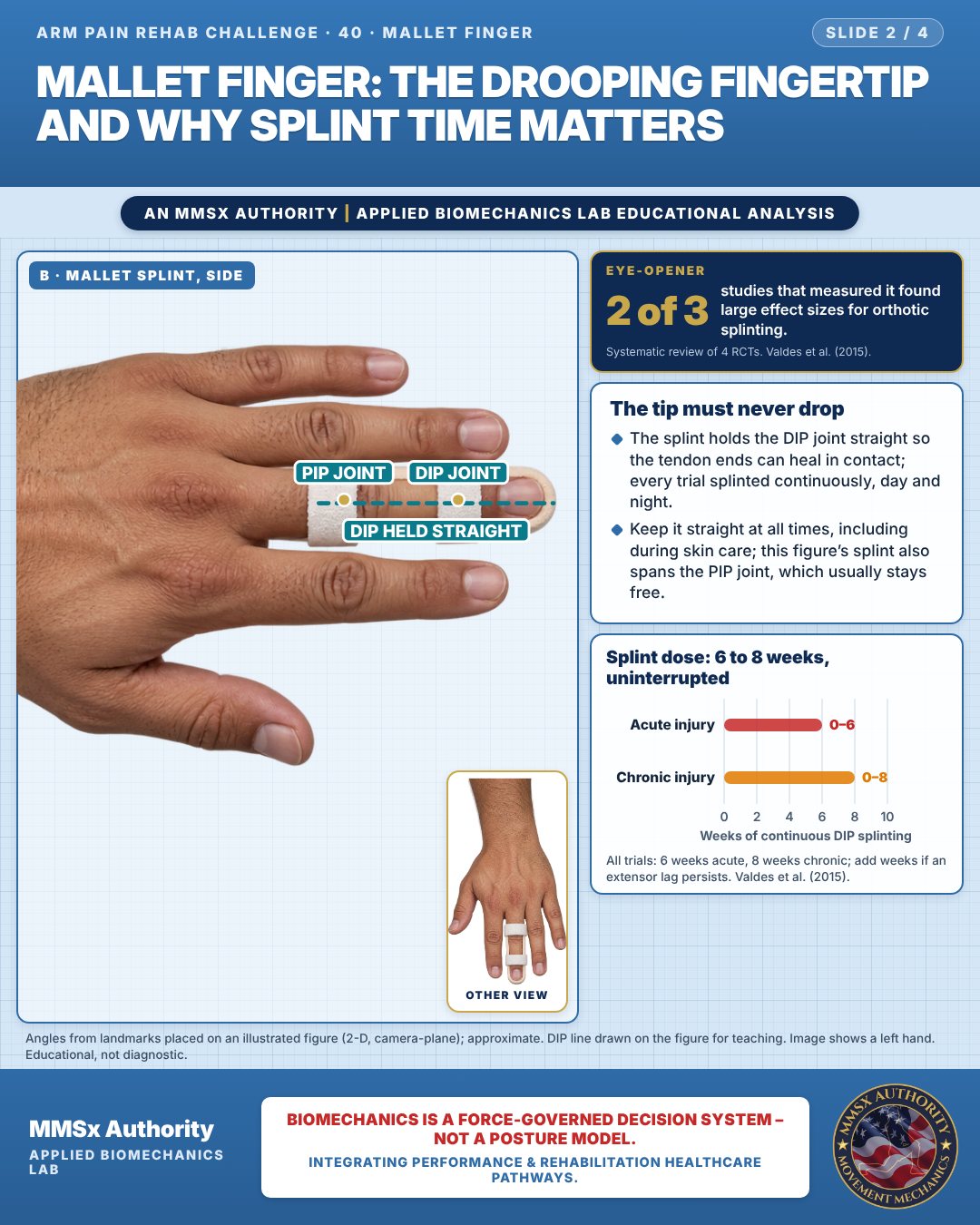
The tip must never drop
The splint holds the DIP joint straight so the tendon ends can heal in contact; every trial splinted continuously, day and night.
Keep it straight at all times, including during skin care; this figure’s splint also spans the PIP joint, which usually stays free.
Splint dose: 6 to 8 weeks, uninterrupted
Movement C: Hand flat, top
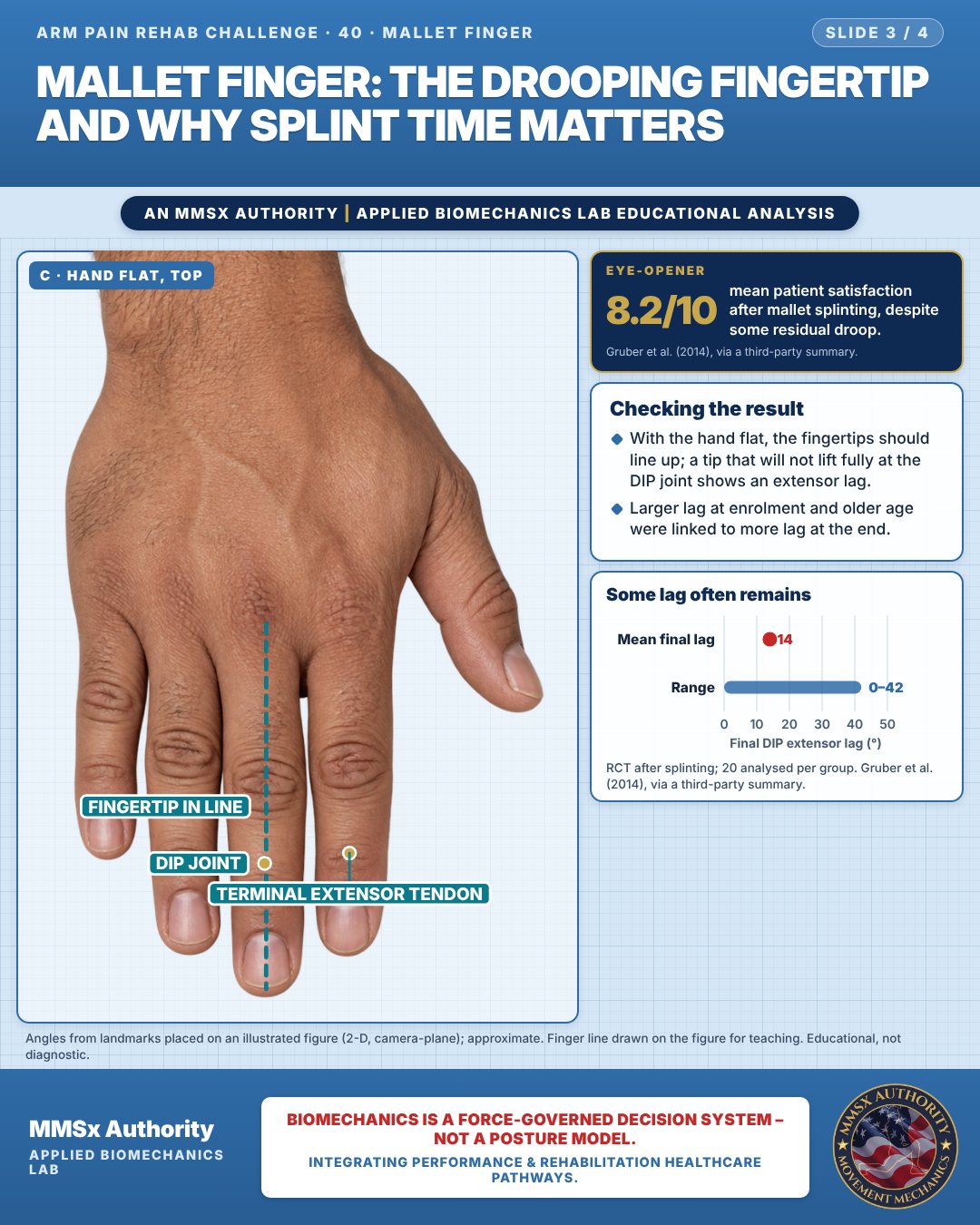
Checking the result
With the hand flat, the fingertips should line up; a tip that will not lift fully at the DIP joint shows an extensor lag.
Larger lag at enrolment and older age were linked to more lag at the end.
Some lag often remains
Decision pathway
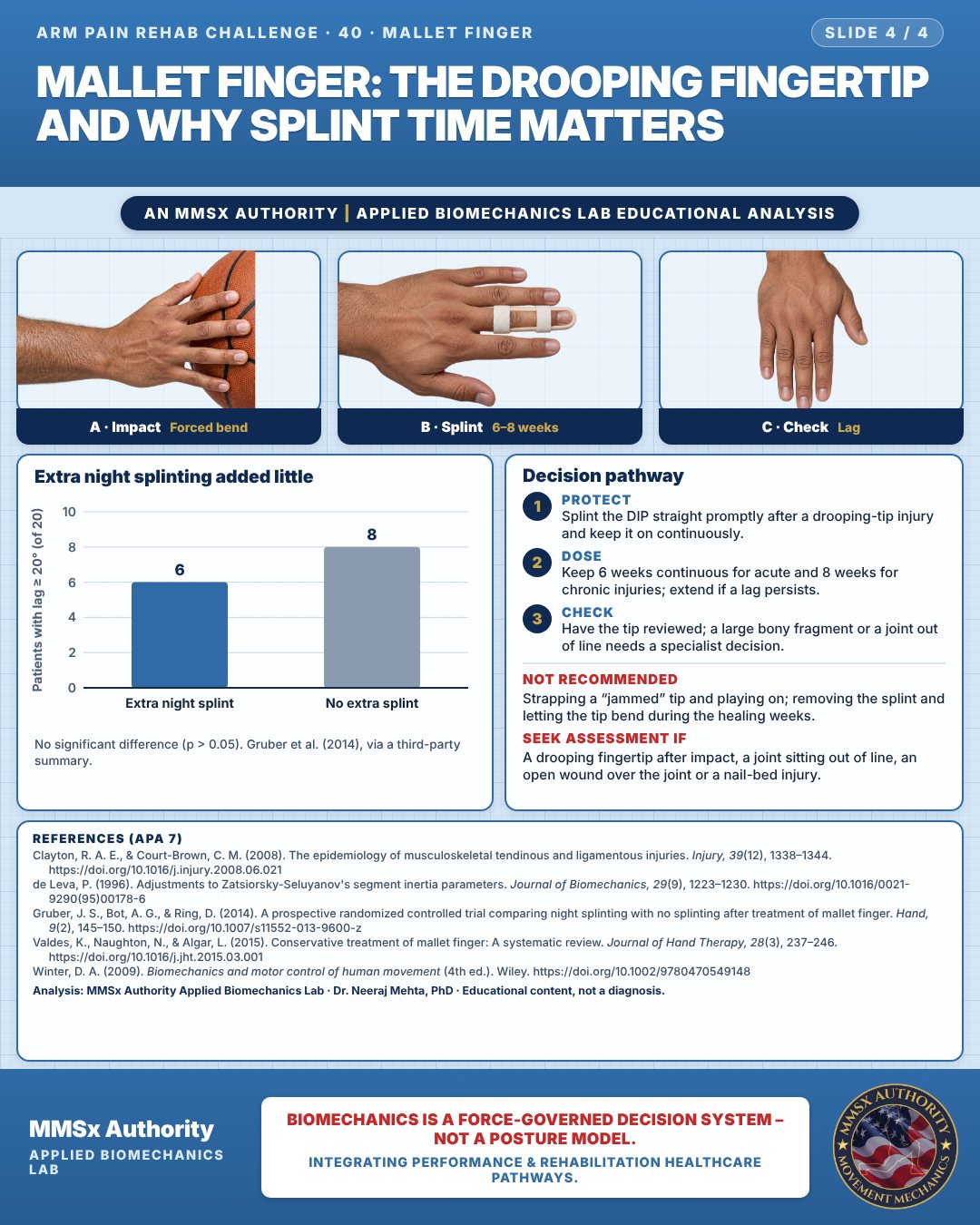
Extra night splinting added little
Protect
Splint the DIP straight promptly after a drooping-tip injury and keep it on continuously.
Dose
Keep 6 weeks continuous for acute and 8 weeks for chronic injuries; extend if a lag persists.
Check
Have the tip reviewed; a large bony fragment or a joint out of line needs a specialist decision.
What the evidence supports
- Continuous extension splinting of the DIP joint for 6 weeks (acute) to 8 weeks (chronic), keeping the fingertip straight at all times — including during skin care — with extra weeks if a lag persists (Valdes et al., 2015). Additional night-only splinting afterwards did not significantly reduce final lag in one RCT (Gruber et al., 2014). Surgery is generally reserved for specific bony mallet injuries with joint subluxation or large fragments (state as specialist decision; not graded here).
Myth and evidence
Myth“It's just a jammed finger — strap it and keep playing.”
EvidenceMallet finger is a tendon or bony avulsion injury needing 6–8 weeks of uninterrupted splinting (Valdes et al., 2015); it is more common than ACL rupture in population data (Clayton & Court-Brown, 2008).
Cautions
Not recommended
Strapping a “jammed” tip and playing on; removing the splint and letting the tip bend during the healing weeks.
Seek assessment if
A drooping fingertip after impact, a joint sitting out of line, an open wound over the joint or a nail-bed injury.
Methods note
Angles from landmarks placed on an illustrated figure (2-D, camera-plane); approximate. Impact direction drawn on the figure for teaching. DIP line drawn on the figure for teaching. Image shows a left hand. Finger line drawn on the figure for teaching. These are educational estimates, not a diagnosis.
References
- Clayton, R. A. E., & Court-Brown, C. M. (2008). The epidemiology of musculoskeletal tendinous and ligamentous injuries. Injury, 39(12), 1338–1344. https://doi.org/10.1016/j.injury.2008.06.021
- de Leva, P. (1996). Adjustments to Zatsiorsky-Seluyanov's segment inertia parameters. Journal of Biomechanics, 29(9), 1223–1230. https://doi.org/10.1016/0021-9290(95)00178-6
- Gruber, J. S., Bot, A. G., & Ring, D. (2014). A prospective randomized controlled trial comparing night splinting with no splinting after treatment of mallet finger. Hand, 9(2), 145–150. https://doi.org/10.1007/s11552-013-9600-z
- Valdes, K., Naughton, N., & Algar, L. (2015). Conservative treatment of mallet finger: A systematic review. Journal of Hand Therapy, 28(3), 237–246. https://doi.org/10.1016/j.jht.2015.03.001
- Winter, D. A. (2009). Biomechanics and motor control of human movement (4th ed.). Wiley. https://doi.org/10.1002/9780470549148
Cite this article
Mehta, N. (2026, October 28). Mallet finger: the drooping fingertip and why splint time matters. MMSx Authority Applied Biomechanics Lab. https://mmsxauthority.org/edu/analysis/arm/40-mallet-finger-the-drooping-fingertip-and-why-splint-time-matters/
Part of the collection
Mehta, N. (2026). Elbow, Forearm, Wrist and Hand Rehabilitation: 50 Evidence-Based Biomechanics Analyses [Collection]. MMSx Authority Applied Biomechanics Lab. Zenodo. https://doi.org/10.5281/zenodo.23735910
All Arm Pain Rehab Challenge articles · Rehabilitation Library