Arm Pain Rehab Challenge · 37
Thumb base arthritis: pain with pinching, opening jars and keys
Thumb base (trapeziometacarpal, first carpometacarpal) osteoarthritis is degenerative change of the joint between the trapezium and first metacarpal,…
Key points
- Modify. Use key turners, jar openers and thick-handled tools; pace pinch-heavy tasks through the day.
- Load. Exercise for function and strength within comfort; wear a thumb orthosis regularly for at least 3 months.
- Track. Record pinch pain and task ease monthly; discuss surgery only if non-surgical care fails.
What it is
Thumb base (trapeziometacarpal, first carpometacarpal) osteoarthritis is degenerative change of the joint between the trapezium and first metacarpal, causing pain at the base of the thumb with pinch and twisting grips, weakness and, later, deformity.
How we analysed the movement
Three movements relevant to this topic were analysed from illustrated reference figures. Joint centres were located with two-dimensional pose estimation where the whole arm was visible; elbow and wrist angles, and the directions of external load and tendon pull, were then drawn on the figure; on hand close-ups, where pose estimation does not apply, the landmarks were placed manually. The figures are educational estimates that show how position changes mechanical demand; they are not measurements of a patient. Every research value quoted below comes from the published source cited beside it.
Movement A: Key pinch (side view)
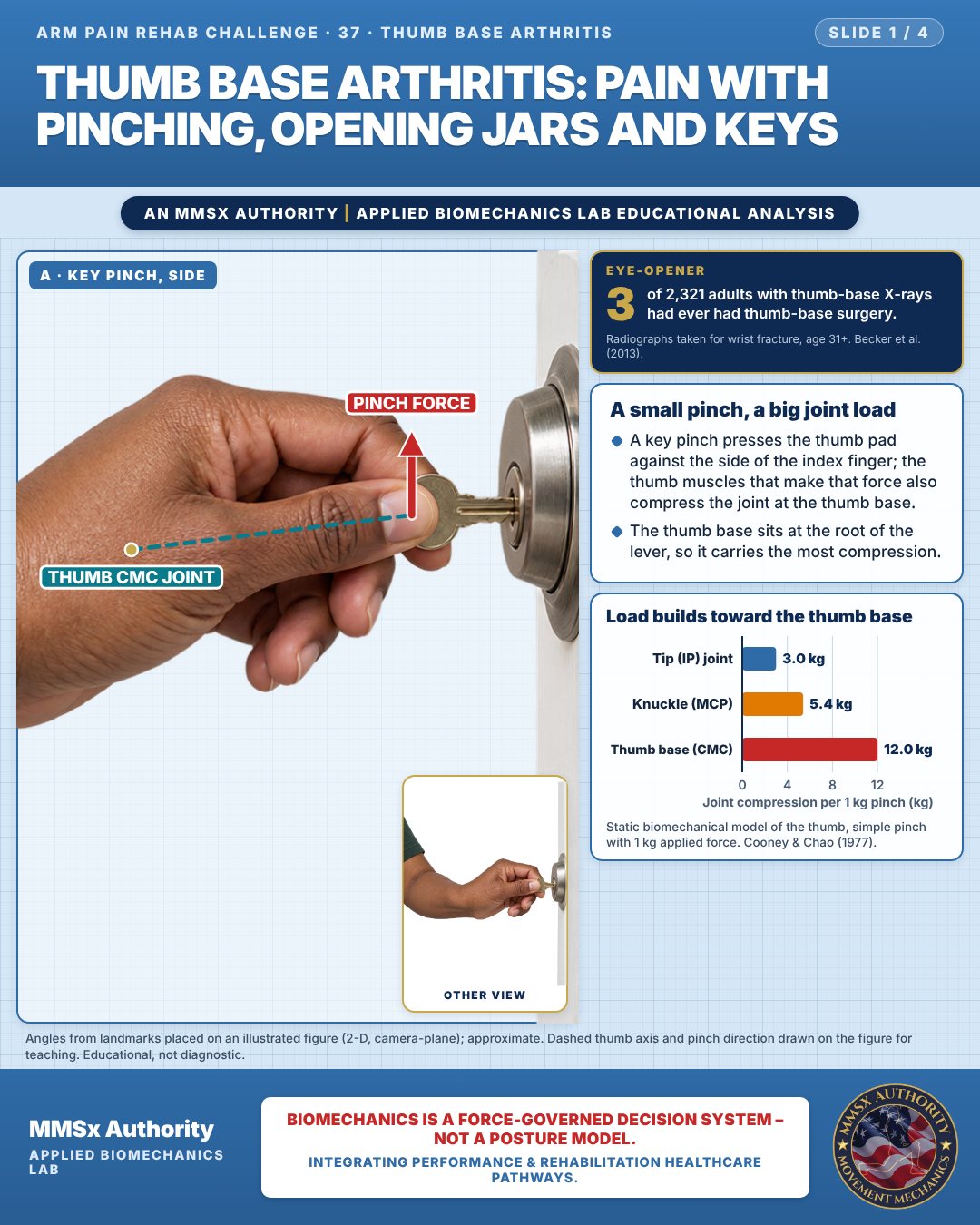
A small pinch, a big joint load
A key pinch presses the thumb pad against the side of the index finger; the thumb muscles that make that force also compress the joint at the thumb base.
The thumb base sits at the root of the lever, so it carries the most compression.
Load builds toward the thumb base
Movement B: Twisting a jar lid (side view)
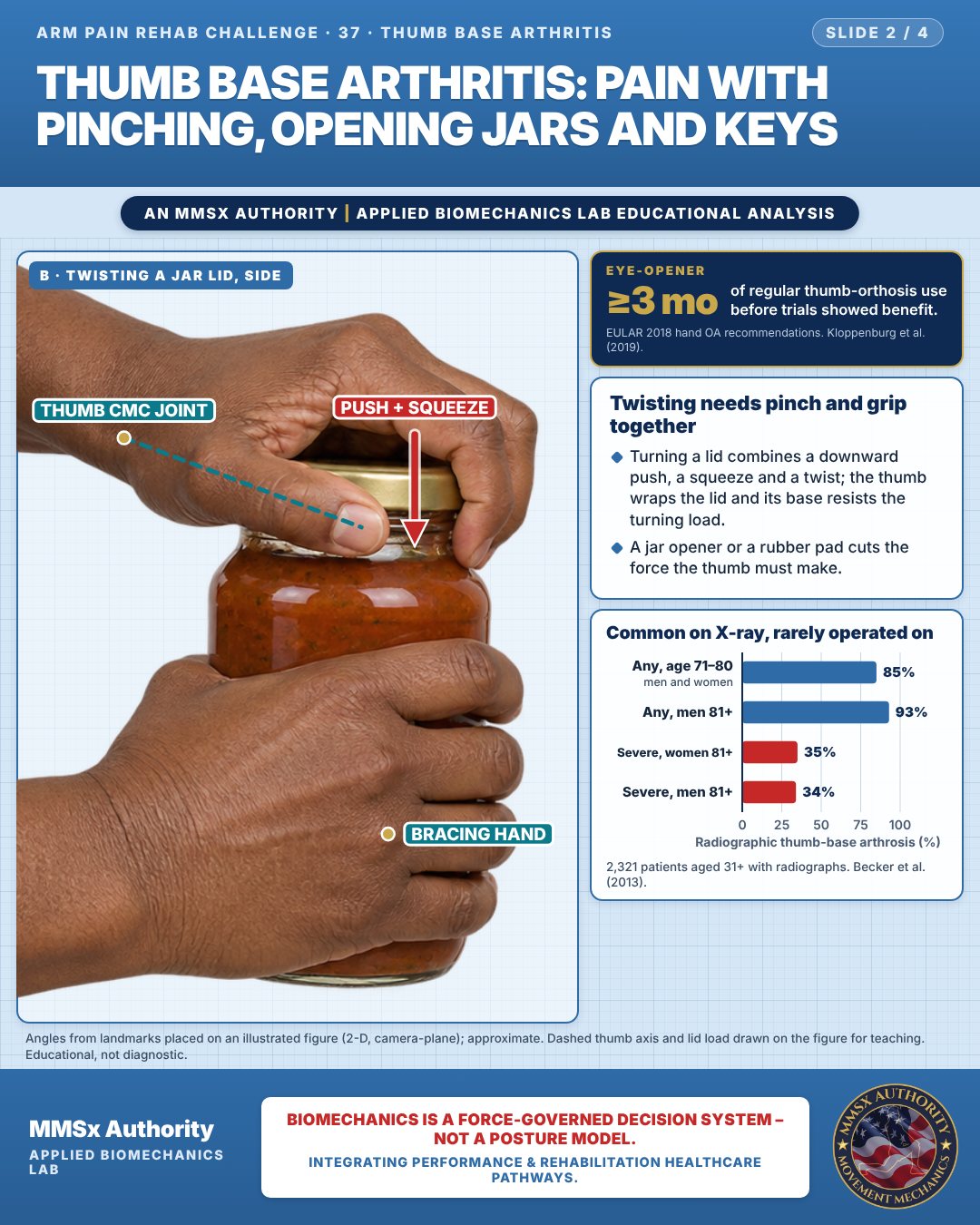
Twisting needs pinch and grip together
Turning a lid combines a downward push, a squeeze and a twist; the thumb wraps the lid and its base resists the turning load.
A jar opener or a rubber pad cuts the force the thumb must make.
Common on X-ray, rarely operated on
Movement C: Thumb opposition, top
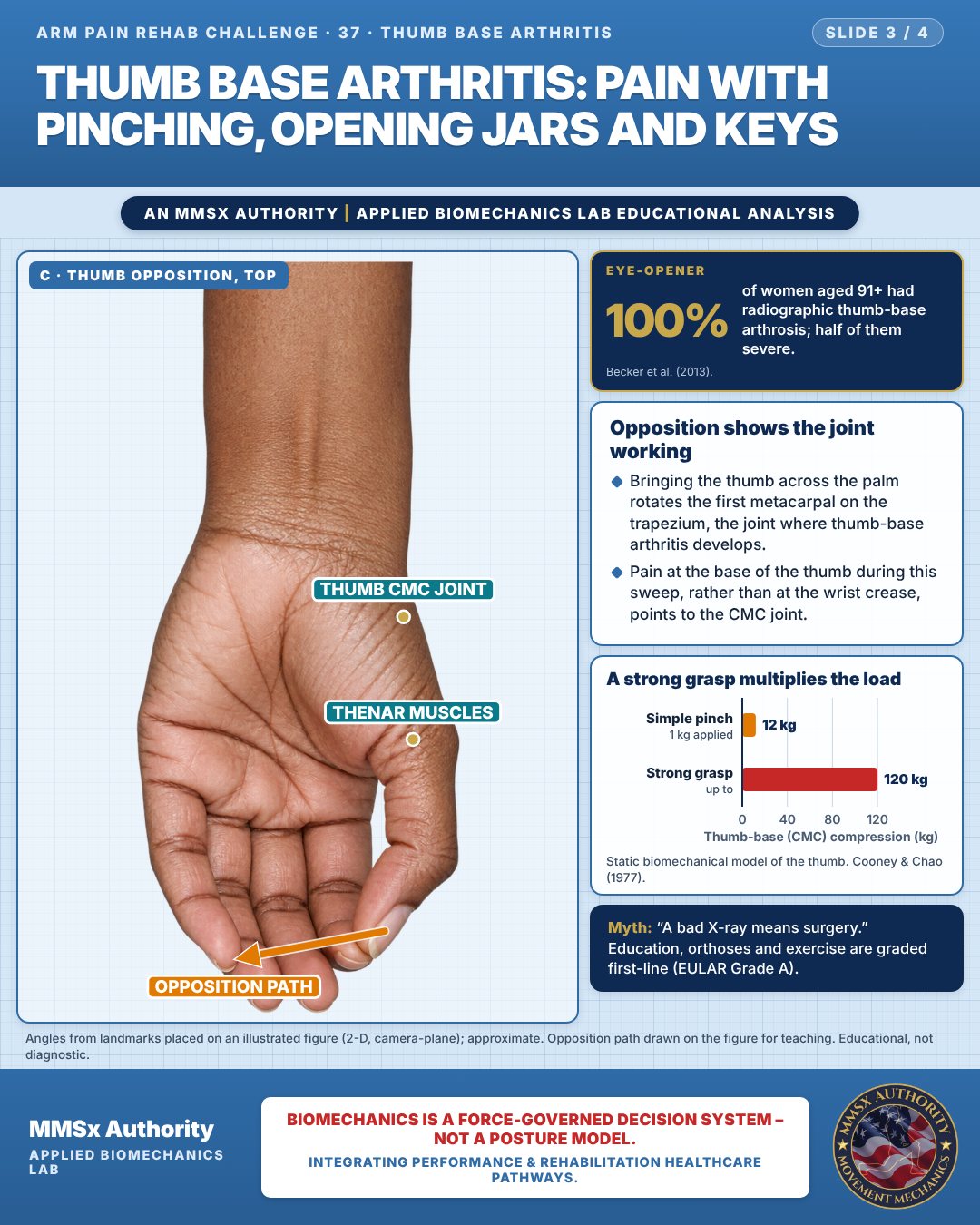
Opposition shows the joint working
Bringing the thumb across the palm rotates the first metacarpal on the trapezium, the joint where thumb-base arthritis develops.
Pain at the base of the thumb during this sweep, rather than at the wrist crease, points to the CMC joint.
A strong grasp multiplies the load
Decision pathway
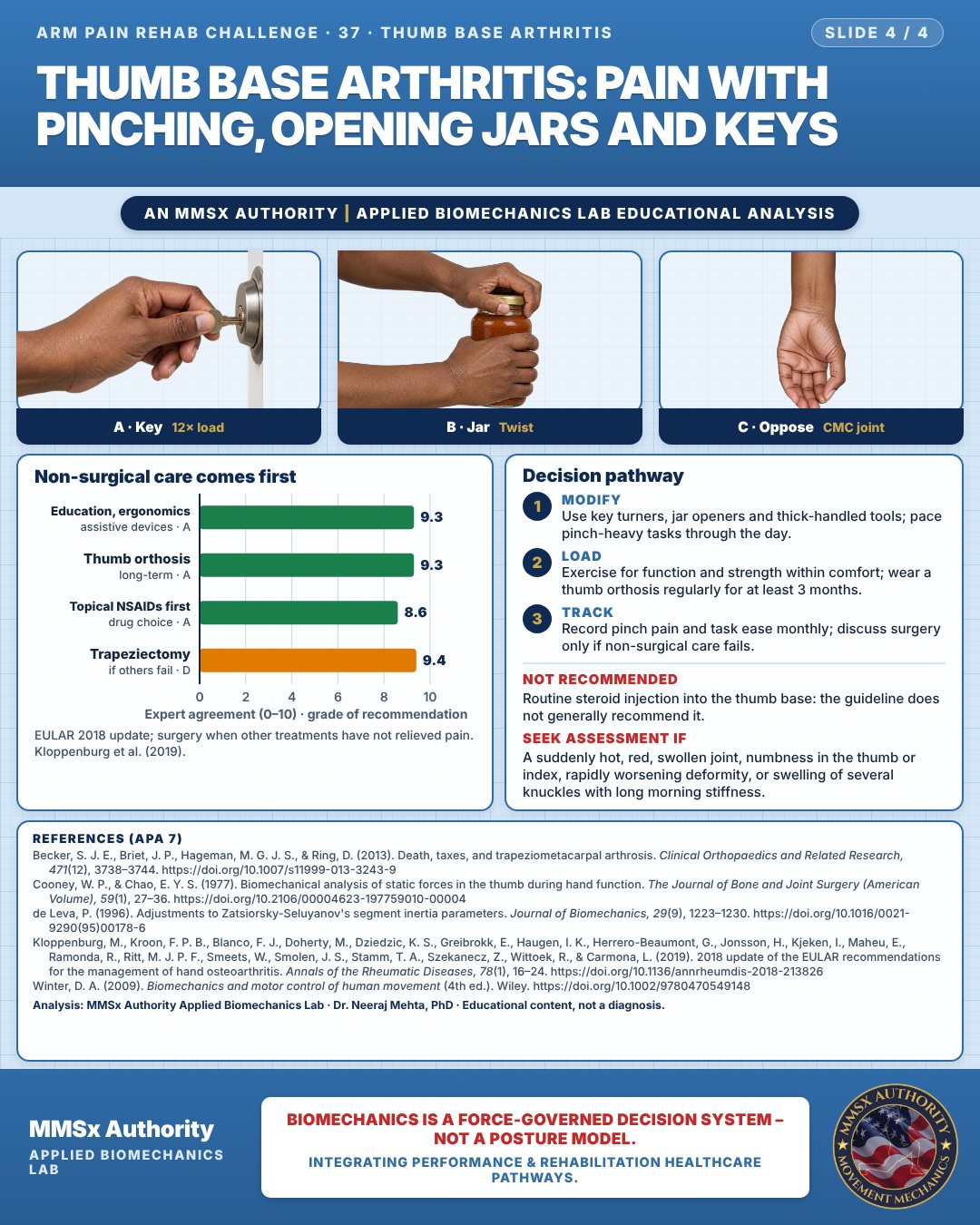
Non-surgical care comes first
Modify
Use key turners, jar openers and thick-handled tools; pace pinch-heavy tasks through the day.
Load
Exercise for function and strength within comfort; wear a thumb orthosis regularly for at least 3 months.
Track
Record pinch pain and task ease monthly; discuss surgery only if non-surgical care fails.
What the evidence supports
- Recommended: information and self-management education; ergonomic training, pacing and assistive devices (key turners, jar openers, thick-handled tools); exercise for function, strength and pain; a thumb orthosis used long-term; topical NSAIDs before oral; short courses of oral NSAIDs. Not generally recommended: intra-articular glucocorticoids (no benefit over placebo in thumb base OA per the guideline text); conventional or biological DMARDs. Surgery (trapeziectomy) when non-surgical care has not relieved pain (Kloppenburg et al., 2019).
Myth and evidence
Myth“The X-ray shows bad arthritis, so I need surgery.”
EvidenceRadiographic thumb base arthrosis reached 85% at age 71–80 with very few operations in the cohort (Becker et al., 2013), and EULAR grades education, orthoses and exercise as first-line (Grade A).
Cautions
Not recommended
Routine steroid injection into the thumb base: the guideline does not generally recommend it.
Seek assessment if
A suddenly hot, red, swollen joint, numbness in the thumb or index, rapidly worsening deformity, or swelling of several knuckles with long morning stiffness.
Methods note
Angles from landmarks placed on an illustrated figure (2-D, camera-plane); approximate. Dashed thumb axis and pinch direction drawn on the figure for teaching. Dashed thumb axis and lid load drawn on the figure for teaching. Opposition path drawn on the figure for teaching. These are educational estimates, not a diagnosis.
References
- Becker, S. J. E., Briet, J. P., Hageman, M. G. J. S., & Ring, D. (2013). Death, taxes, and trapeziometacarpal arthrosis. Clinical Orthopaedics and Related Research, 471(12), 3738–3744. https://doi.org/10.1007/s11999-013-3243-9
- Cooney, W. P., & Chao, E. Y. S. (1977). Biomechanical analysis of static forces in the thumb during hand function. The Journal of Bone and Joint Surgery (American Volume), 59(1), 27–36. https://doi.org/10.2106/00004623-197759010-00004
- de Leva, P. (1996). Adjustments to Zatsiorsky-Seluyanov's segment inertia parameters. Journal of Biomechanics, 29(9), 1223–1230. https://doi.org/10.1016/0021-9290(95)00178-6
- Kloppenburg, M., Kroon, F. P. B., Blanco, F. J., Doherty, M., Dziedzic, K. S., Greibrokk, E., Haugen, I. K., Herrero-Beaumont, G., Jonsson, H., Kjeken, I., Maheu, E., Ramonda, R., Ritt, M. J. P. F., Smeets, W., Smolen, J. S., Stamm, T. A., Szekanecz, Z., Wittoek, R., & Carmona, L. (2019). 2018 update of the EULAR recommendations for the management of hand osteoarthritis. Annals of the Rheumatic Diseases, 78(1), 16–24. https://doi.org/10.1136/annrheumdis-2018-213826
- Winter, D. A. (2009). Biomechanics and motor control of human movement (4th ed.). Wiley. https://doi.org/10.1002/9780470549148
Cite this article
Mehta, N. (2026, October 28). Thumb base arthritis: pain with pinching, opening jars and keys. MMSx Authority Applied Biomechanics Lab. https://mmsxauthority.org/edu/analysis/arm/37-thumb-base-arthritis-pain-with-pinching-opening-jars-and-keys/
Part of the collection
Mehta, N. (2026). Elbow, Forearm, Wrist and Hand Rehabilitation: 50 Evidence-Based Biomechanics Analyses [Collection]. MMSx Authority Applied Biomechanics Lab. Zenodo. https://doi.org/10.5281/zenodo.23735910
All Arm Pain Rehab Challenge articles · Rehabilitation Library