Arm Pain Rehab Challenge · 36
Wrist osteoarthritis: stiffness, grip loss and load management
Wrist osteoarthritis is degenerative loss of articular cartilage with bony change at the radiocarpal and/or midcarpal joints, most often secondary to…
Key points
- Modify. Use jar openers, thick handles and fist-on-armrest rising; spread heavy twisting tasks through the day.
- Load. Keep daily wrist motion and build grip and forearm strength within a tolerable pain response.
- Track. Log grip strength and pain the next day; splint short-term only during flare-ups.
What it is
Wrist osteoarthritis is degenerative loss of articular cartilage with bony change at the radiocarpal and/or midcarpal joints, most often secondary to old injury (scapholunate ligament tear, scaphoid non-union, distal radius fracture), presenting with activity-related pain, stiffness and weaker grip.
How we analysed the movement
Three movements relevant to this topic were analysed from illustrated reference figures. Joint centres were located with two-dimensional pose estimation where the whole arm was visible; elbow and wrist angles, and the directions of external load and tendon pull, were then drawn on the figure; on hand close-ups, where pose estimation does not apply, the landmarks were placed manually. The figures are educational estimates that show how position changes mechanical demand; they are not measurements of a patient. Every research value quoted below comes from the published source cited beside it.
Movement A: Wringing a towel (front view)
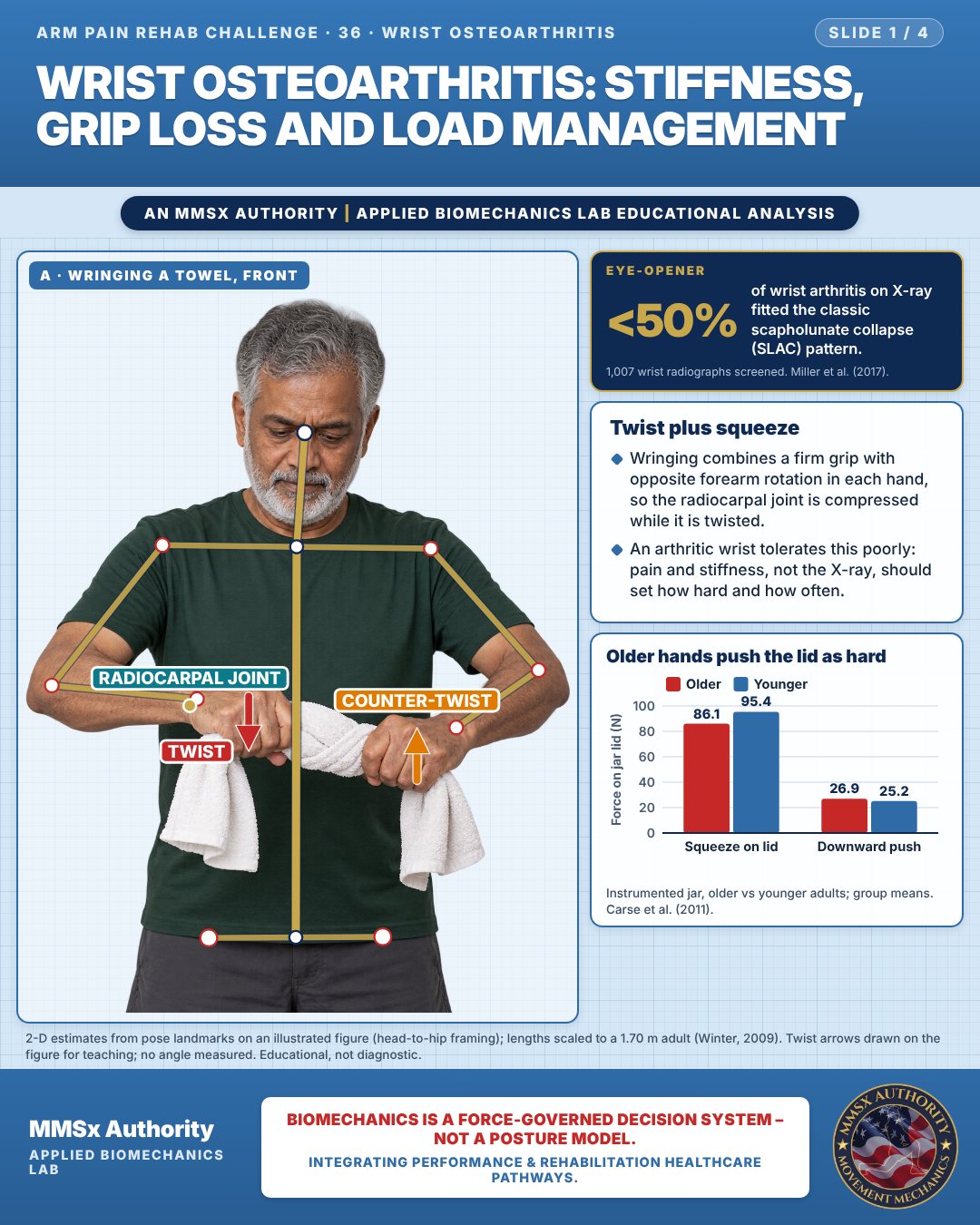
Twist plus squeeze
Wringing combines a firm grip with opposite forearm rotation in each hand, so the radiocarpal joint is compressed while it is twisted.
An arthritic wrist tolerates this poorly: pain and stiffness, not the X-ray, should set how hard and how often.
Older hands push the lid as hard
Movement B: Opening a jar (side view)
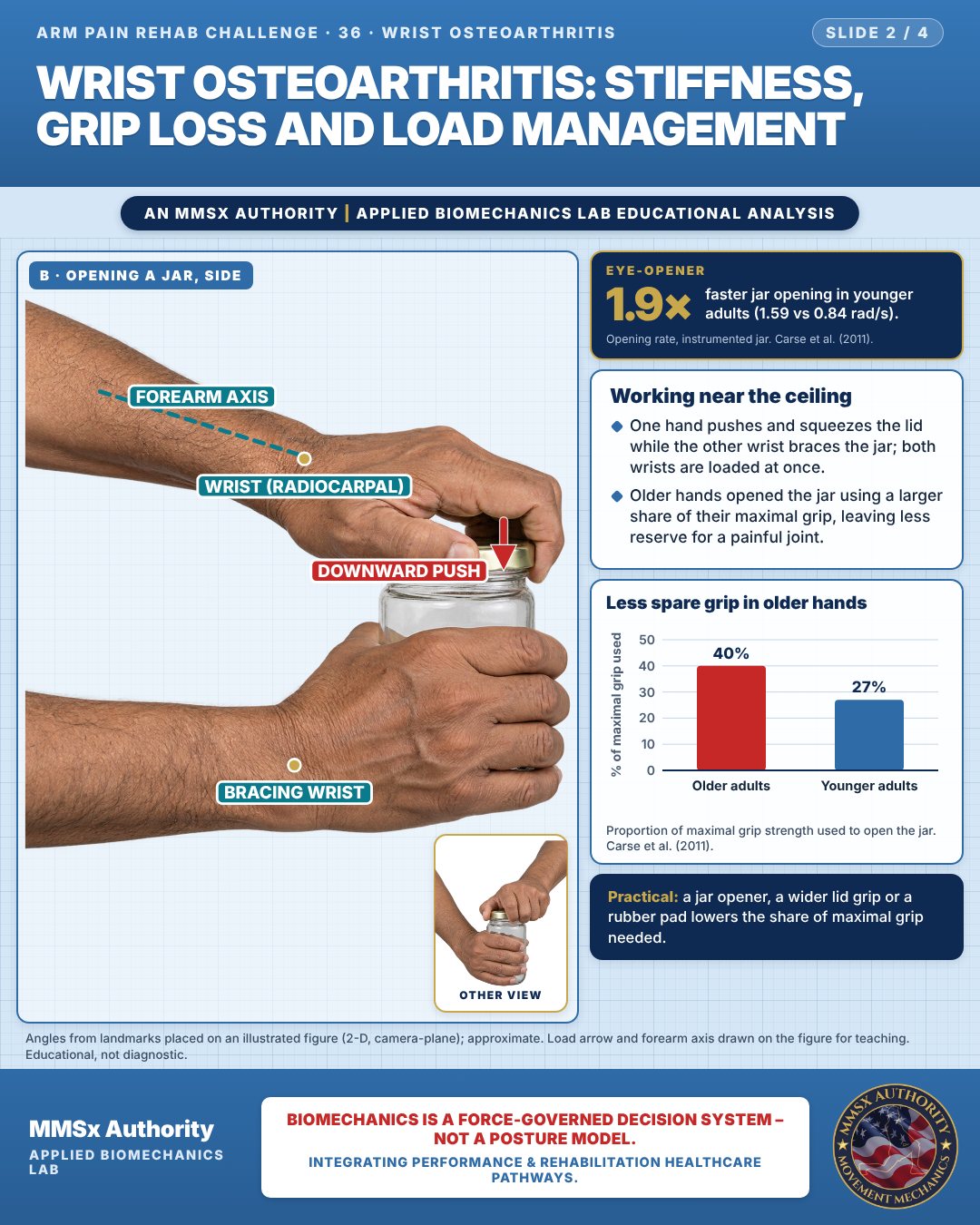
Working near the ceiling
One hand pushes and squeezes the lid while the other wrist braces the jar; both wrists are loaded at once.
Older hands opened the jar using a larger share of their maximal grip, leaving less reserve for a painful joint.
Less spare grip in older hands
Movement C: Push up from armrests (side view)
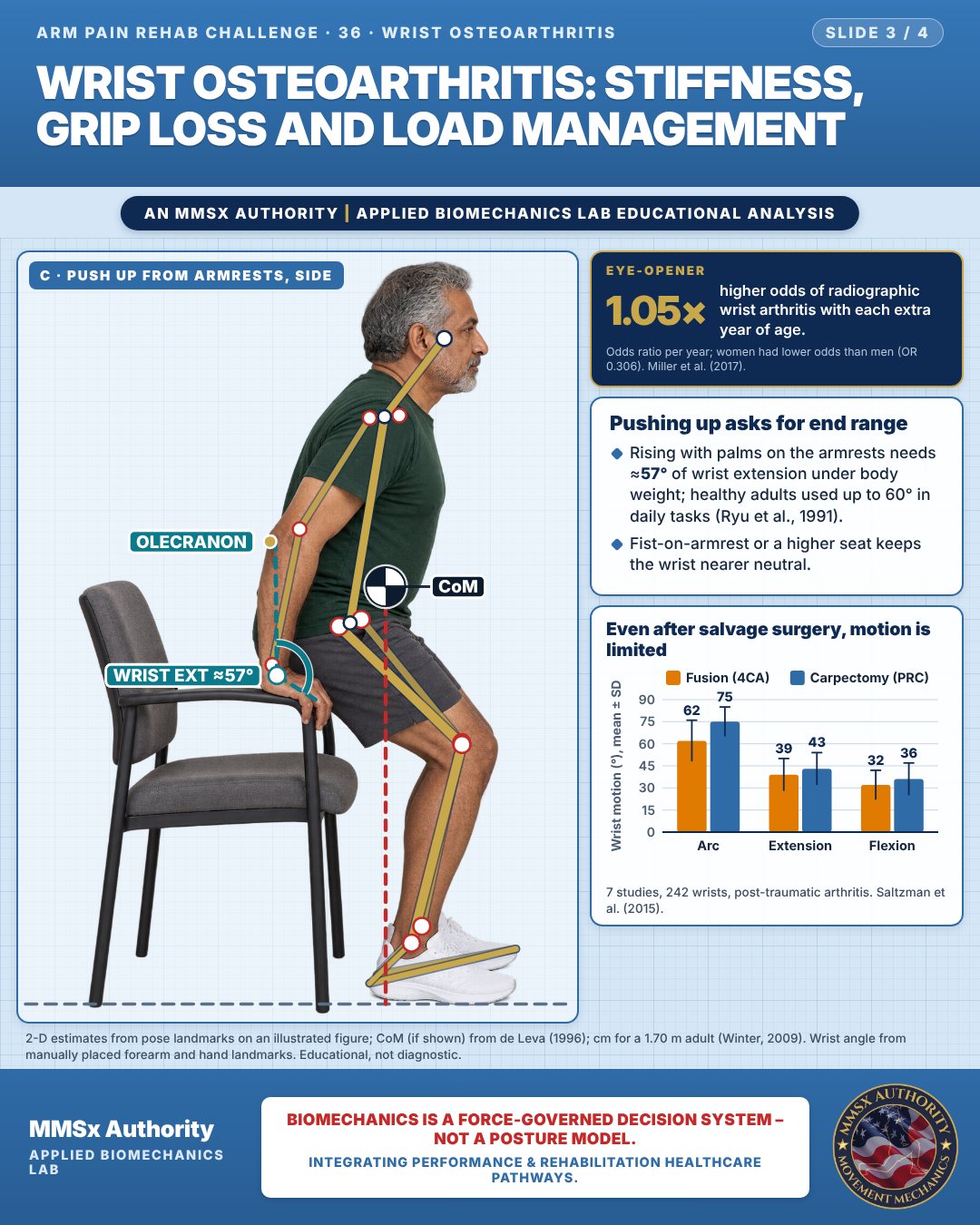
Pushing up asks for end range
Rising with palms on the armrests needs ≈57° of wrist extension under body weight; healthy adults used up to 60° in daily tasks (Ryu et al., 1991).
Fist-on-armrest or a higher seat keeps the wrist nearer neutral.
Even after salvage surgery, motion is limited
Decision pathway
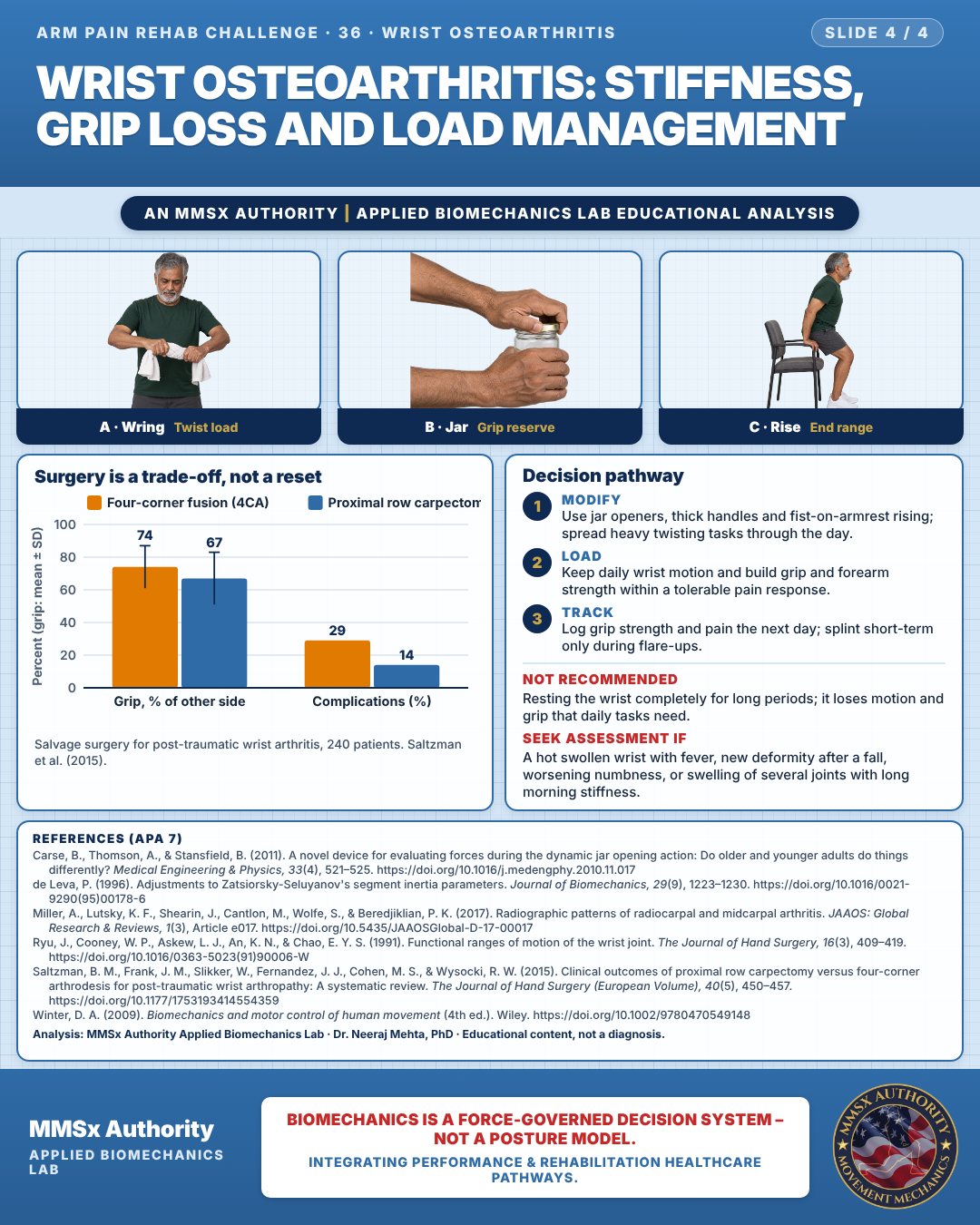
Surgery is a trade-off, not a reset
Modify
Use jar openers, thick handles and fist-on-armrest rising; spread heavy twisting tasks through the day.
Load
Keep daily wrist motion and build grip and forearm strength within a tolerable pain response.
Track
Log grip strength and pain the next day; splint short-term only during flare-ups.
Myth and evidence
Myth“Arthritis means the wrist must be rested.”
EvidenceEveryday function needs only about 40° of extension and flexion (Ryu et al., 1991); maintaining motion and grip within that range is the goal, and graded use is preferred to immobilisation except in flares.
Cautions
Not recommended
Resting the wrist completely for long periods; it loses motion and grip that daily tasks need.
Seek assessment if
A hot swollen wrist with fever, new deformity after a fall, worsening numbness, or swelling of several joints with long morning stiffness.
Methods note
2-D estimates from pose landmarks on an illustrated figure (head-to-hip framing); lengths scaled to a 1.70 m adult (Winter, 2009). Twist arrows drawn on the figure for teaching; no angle measured. Angles from landmarks placed on an illustrated figure (2-D, camera-plane); approximate. Load arrow and forearm axis drawn on the figure for teaching. 2-D estimates from pose landmarks on an illustrated figure; CoM (if shown) from de Leva (1996); cm for a 1.70 m adult (Winter, 2009). Wrist angle from manually placed forearm and hand landmarks. These are educational estimates, not a diagnosis.
References
- Carse, B., Thomson, A., & Stansfield, B. (2011). A novel device for evaluating forces during the dynamic jar opening action: Do older and younger adults do things differently? Medical Engineering & Physics, 33(4), 521–525. https://doi.org/10.1016/j.medengphy.2010.11.017
- de Leva, P. (1996). Adjustments to Zatsiorsky-Seluyanov's segment inertia parameters. Journal of Biomechanics, 29(9), 1223–1230. https://doi.org/10.1016/0021-9290(95)00178-6
- Miller, A., Lutsky, K. F., Shearin, J., Cantlon, M., Wolfe, S., & Beredjiklian, P. K. (2017). Radiographic patterns of radiocarpal and midcarpal arthritis. JAAOS: Global Research & Reviews, 1(3), Article e017. https://doi.org/10.5435/JAAOSGlobal-D-17-00017
- Ryu, J., Cooney, W. P., Askew, L. J., An, K. N., & Chao, E. Y. S. (1991). Functional ranges of motion of the wrist joint. The Journal of Hand Surgery, 16(3), 409–419. https://doi.org/10.1016/0363-5023(91)90006-W
- Saltzman, B. M., Frank, J. M., Slikker, W., Fernandez, J. J., Cohen, M. S., & Wysocki, R. W. (2015). Clinical outcomes of proximal row carpectomy versus four-corner arthrodesis for post-traumatic wrist arthropathy: A systematic review. The Journal of Hand Surgery (European Volume), 40(5), 450–457. https://doi.org/10.1177/1753193414554359
- Winter, D. A. (2009). Biomechanics and motor control of human movement (4th ed.). Wiley. https://doi.org/10.1002/9780470549148
Cite this article
Mehta, N. (2026, October 28). Wrist osteoarthritis: stiffness, grip loss and load management. MMSx Authority Applied Biomechanics Lab. https://mmsxauthority.org/edu/analysis/arm/36-wrist-osteoarthritis-stiffness-grip-loss-and-load-management/
Part of the collection
Mehta, N. (2026). Elbow, Forearm, Wrist and Hand Rehabilitation: 50 Evidence-Based Biomechanics Analyses [Collection]. MMSx Authority Applied Biomechanics Lab. Zenodo. https://doi.org/10.5281/zenodo.23735910
All Arm Pain Rehab Challenge articles · Rehabilitation Library