Arm Pain Rehab Challenge · 35
Wrist position in front squats, cleans and deadlifts
Wrist pain in barbell lifting is load-related pain at the wrist from sustained or end-range extension (front rack, clean catch) or from heavy grip…
Key points
- Modify. Rack on the shoulders with fingertip contact, high elbows and a wider grip; use straps for front squats if needed.
- Load. Build wrist-extension tolerance gradually with light holds and range work; train grip for heavy pulls.
- Track. Note pain during and the day after racking; progress load only when it stays settled.
What it is
Wrist pain in barbell lifting is load-related pain at the wrist from sustained or end-range extension (front rack, clean catch) or from heavy grip demand (deadlift); it is a training-load problem, not a diagnosis in itself.
How we analysed the movement
Three movements relevant to this topic were analysed from illustrated reference figures. Joint centres were located with two-dimensional pose estimation where the whole arm was visible; elbow and wrist angles, and the directions of external load and tendon pull, were then drawn on the figure; on hand close-ups, where pose estimation does not apply, the landmarks were placed manually. The figures are educational estimates that show how position changes mechanical demand; they are not measurements of a patient. Every research value quoted below comes from the published source cited beside it.
Movement A: Front rack (side view)
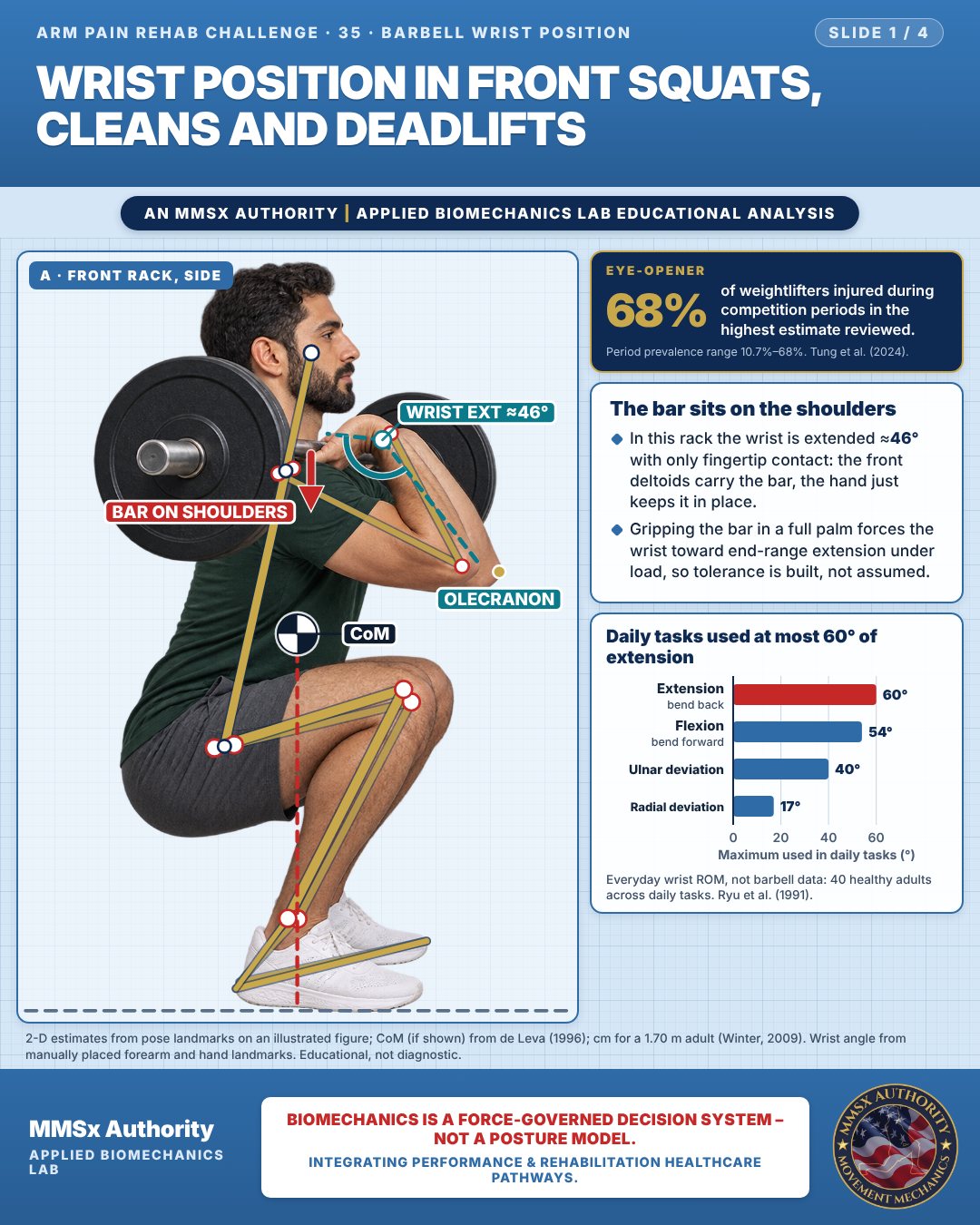
The bar sits on the shoulders
In this rack the wrist is extended ≈46° with only fingertip contact: the front deltoids carry the bar, the hand just keeps it in place.
Gripping the bar in a full palm forces the wrist toward end-range extension under load, so tolerance is built, not assumed.
Daily tasks used at most 60° of extension
Movement B: Clean catch (side view)
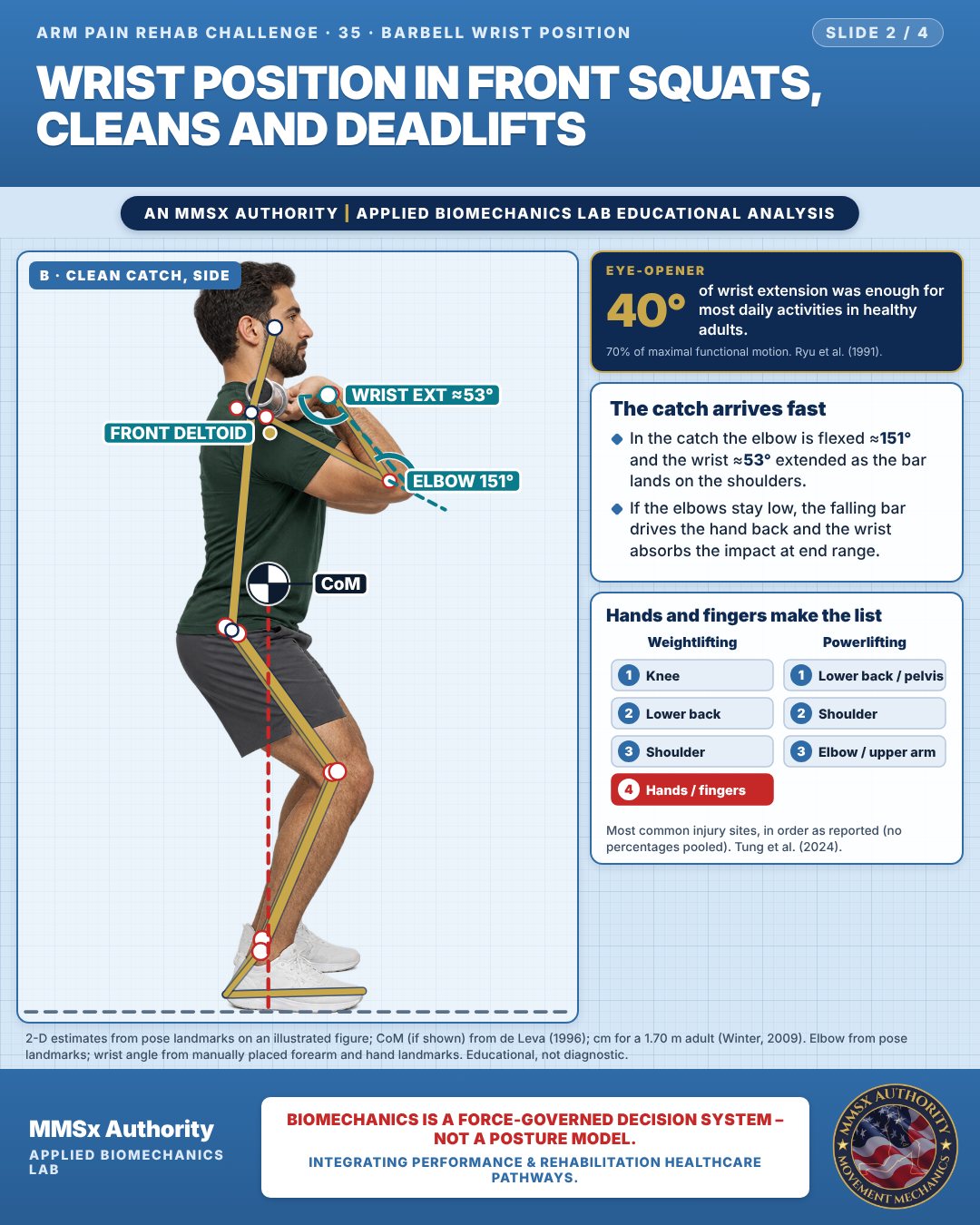
The catch arrives fast
In the catch the elbow is flexed ≈151° and the wrist ≈53° extended as the bar lands on the shoulders.
If the elbows stay low, the falling bar drives the hand back and the wrist absorbs the impact at end range.
Hands and fingers make the list
Movement C: Deadlift set-up (side view)
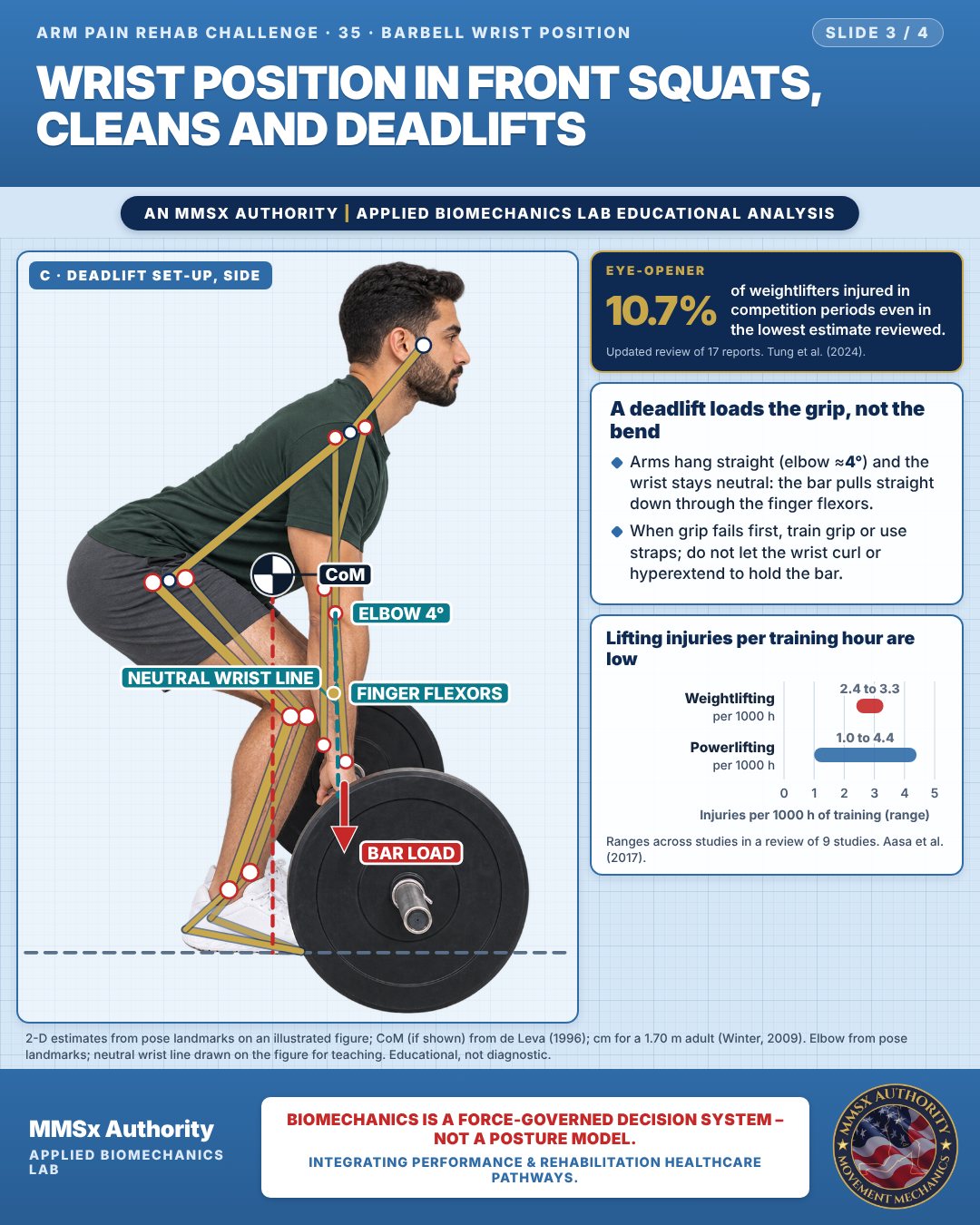
A deadlift loads the grip, not the bend
Arms hang straight (elbow ≈4°) and the wrist stays neutral: the bar pulls straight down through the finger flexors.
When grip fails first, train grip or use straps; do not let the wrist curl or hyperextend to hold the bar.
Lifting injuries per training hour are low
Decision pathway
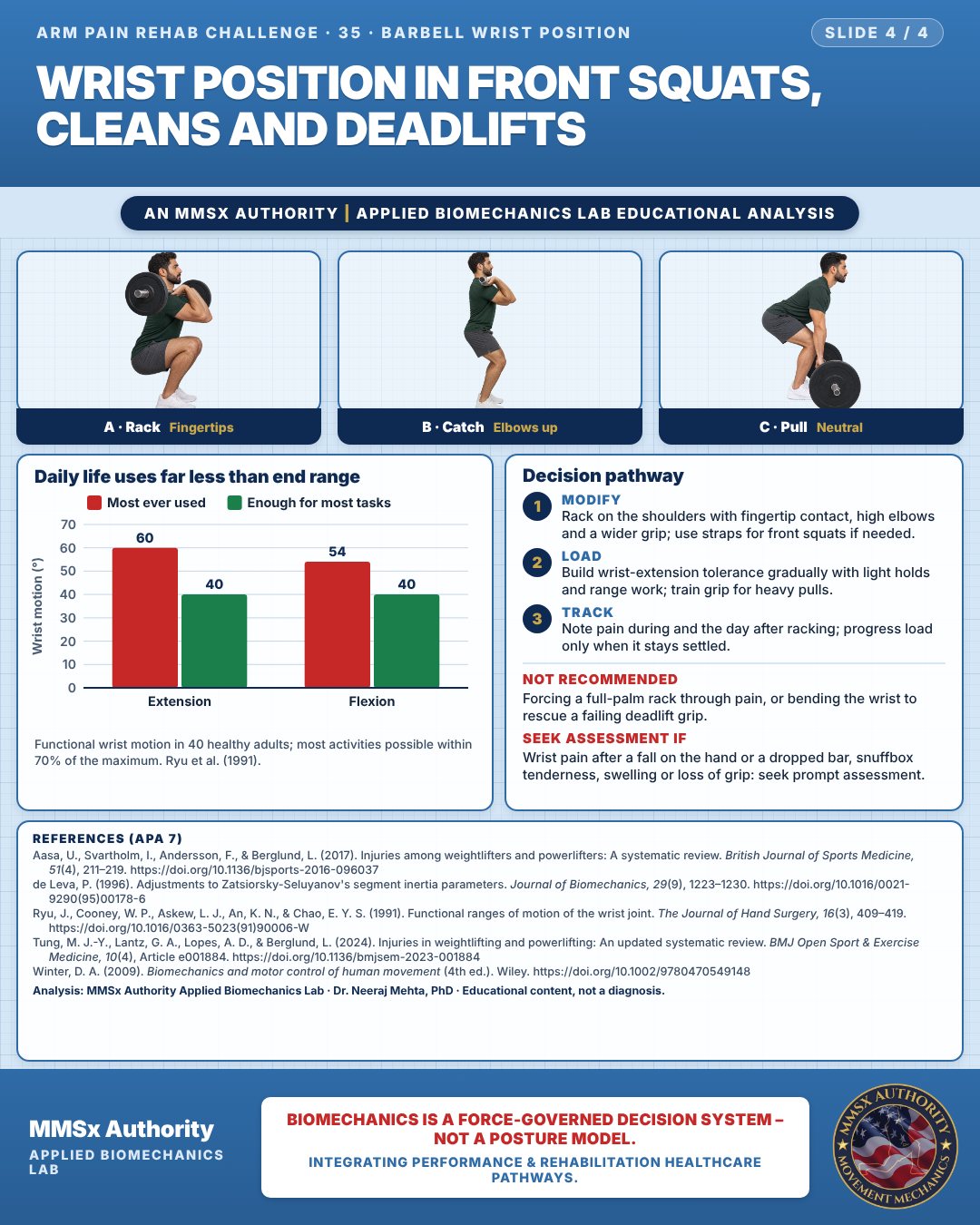
Daily life uses far less than end range
Modify
Rack on the shoulders with fingertip contact, high elbows and a wider grip; use straps for front squats if needed.
Load
Build wrist-extension tolerance gradually with light holds and range work; train grip for heavy pulls.
Track
Note pain during and the day after racking; progress load only when it stays settled.
Myth and evidence
Myth“A good front rack needs a fully bent-back wrist.”
EvidenceEveryday function uses about 40° of wrist extension (Ryu et al., 1991); the rack can be achieved with a fingertip contact and high elbows, with the bar resting on the shoulders rather than held by the wrists.
Cautions
Not recommended
Forcing a full-palm rack through pain, or bending the wrist to rescue a failing deadlift grip.
Seek assessment if
Wrist pain after a fall on the hand or a dropped bar, snuffbox tenderness, swelling or loss of grip: seek prompt assessment.
Methods note
2-D estimates from pose landmarks on an illustrated figure; CoM (if shown) from de Leva (1996); cm for a 1.70 m adult (Winter, 2009). Wrist angle from manually placed forearm and hand landmarks. Elbow from pose landmarks; wrist angle from manually placed forearm and hand landmarks. Elbow from pose landmarks; neutral wrist line drawn on the figure for teaching. These are educational estimates, not a diagnosis.
References
- Aasa, U., Svartholm, I., Andersson, F., & Berglund, L. (2017). Injuries among weightlifters and powerlifters: A systematic review. British Journal of Sports Medicine, 51(4), 211–219. https://doi.org/10.1136/bjsports-2016-096037
- de Leva, P. (1996). Adjustments to Zatsiorsky-Seluyanov's segment inertia parameters. Journal of Biomechanics, 29(9), 1223–1230. https://doi.org/10.1016/0021-9290(95)00178-6
- Ryu, J., Cooney, W. P., Askew, L. J., An, K. N., & Chao, E. Y. S. (1991). Functional ranges of motion of the wrist joint. The Journal of Hand Surgery, 16(3), 409–419. https://doi.org/10.1016/0363-5023(91)90006-W
- Tung, M. J.-Y., Lantz, G. A., Lopes, A. D., & Berglund, L. (2024). Injuries in weightlifting and powerlifting: An updated systematic review. BMJ Open Sport & Exercise Medicine, 10(4), Article e001884. https://doi.org/10.1136/bmjsem-2023-001884
- Winter, D. A. (2009). Biomechanics and motor control of human movement (4th ed.). Wiley. https://doi.org/10.1002/9780470549148
Cite this article
Mehta, N. (2026, October 28). Wrist position in front squats, cleans and deadlifts. MMSx Authority Applied Biomechanics Lab. https://mmsxauthority.org/edu/analysis/arm/35-wrist-position-in-front-squats-cleans-and-deadlifts/
Part of the collection
Mehta, N. (2026). Elbow, Forearm, Wrist and Hand Rehabilitation: 50 Evidence-Based Biomechanics Analyses [Collection]. MMSx Authority Applied Biomechanics Lab. Zenodo. https://doi.org/10.5281/zenodo.23735910
All Arm Pain Rehab Challenge articles · Rehabilitation Library