Arm Pain Rehab Challenge · 34
Wrist ganglion cyst: the lump on the back of the wrist
A benign, fluid (mucin)-filled cyst arising from a joint capsule or tendon sheath, most often on the back (dorsum) of the wrist.
Key points
- Reassure. Painless ganglia can be watched: many resolve, and aspiration was no better than reassurance.
- Modify. If loading aches, reduce end-range extension with fists, handles or an incline.
- Decide. For persistent symptoms, weigh aspiration (simple, often recurs) against excision (fewer recurrences, more complications).
What it is
A benign, fluid (mucin)-filled cyst arising from a joint capsule or tendon sheath, most often on the back (dorsum) of the wrist; it may be painless or ache with end-range wrist extension or flexion (Frames B and C) and can change size.
How we analysed the movement
Three movements relevant to this topic were analysed from illustrated reference figures. Joint centres were located with two-dimensional pose estimation where the whole arm was visible; elbow and wrist angles, and the directions of external load and tendon pull, were then drawn on the figure; on hand close-ups, where pose estimation does not apply, the landmarks were placed manually. The figures are educational estimates that show how position changes mechanical demand; they are not measurements of a patient. Every research value quoted below comes from the published source cited beside it.
Movement A: Back of hand, top
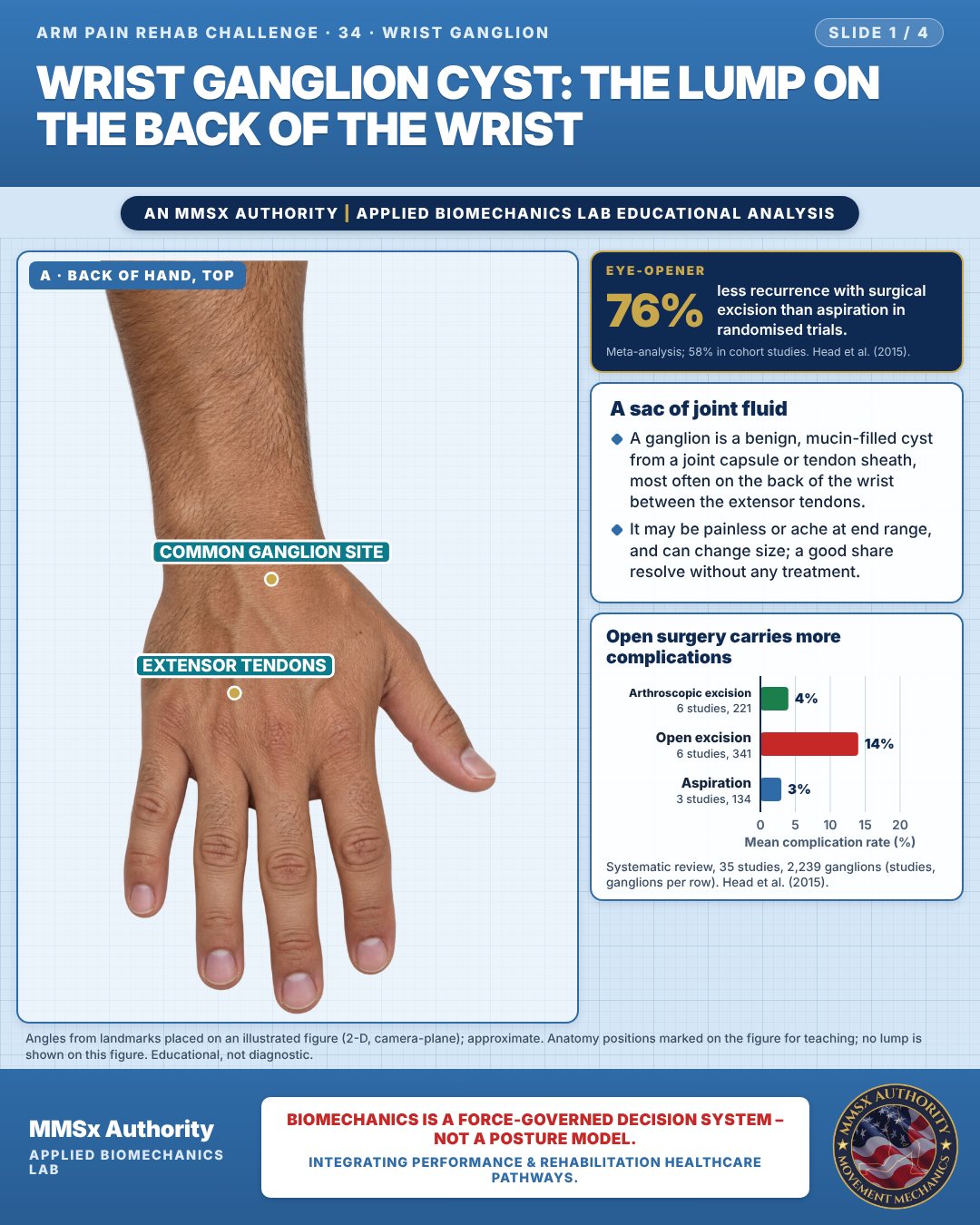
A sac of joint fluid
A ganglion is a benign, mucin-filled cyst from a joint capsule or tendon sheath, most often on the back of the wrist between the extensor tendons.
It may be painless or ache at end range, and can change size; a good share resolve without any treatment.
Open surgery carries more complications
Movement B: Kneeling push-up (side view)
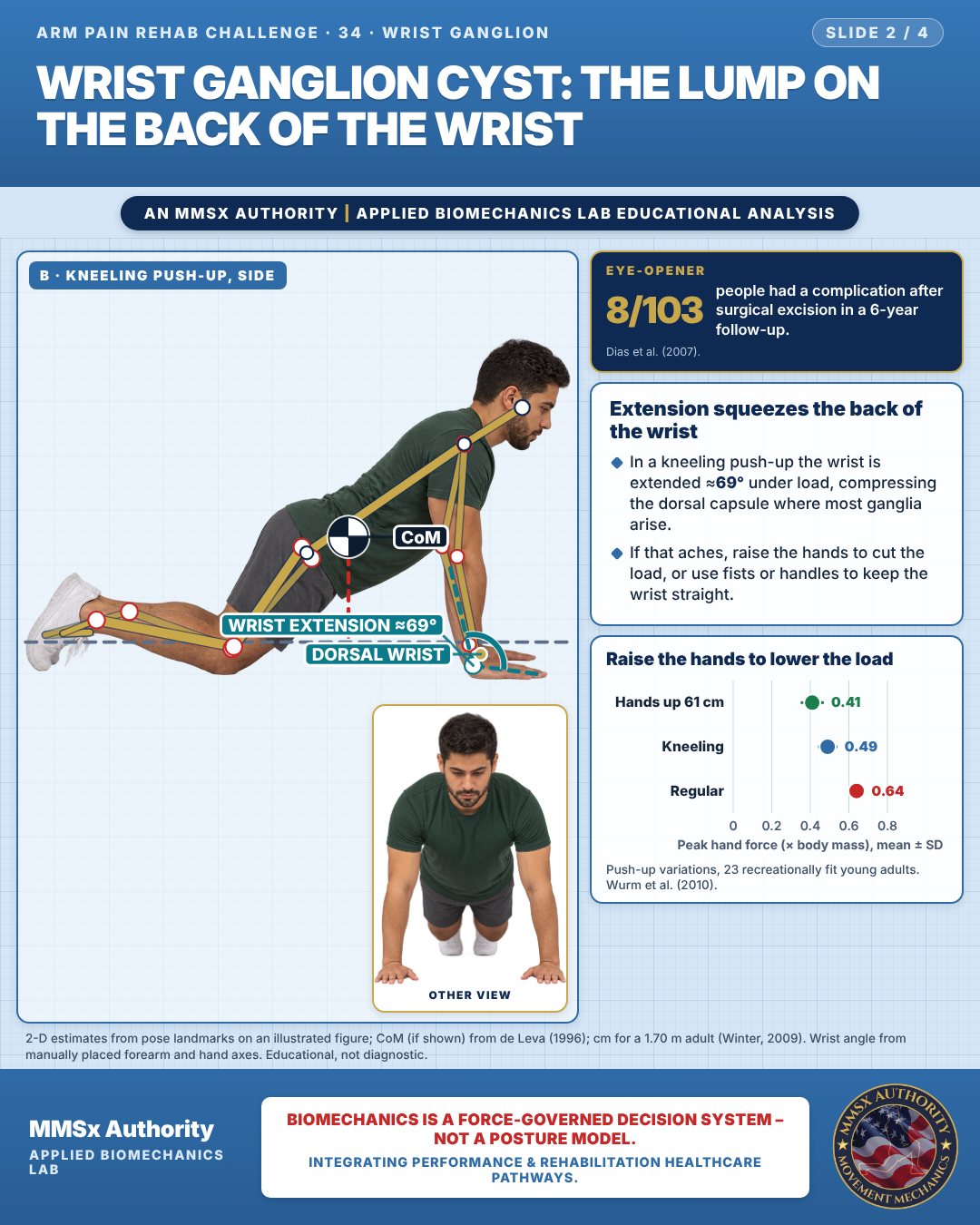
Extension squeezes the back of the wrist
In a kneeling push-up the wrist is extended ≈69° under load, compressing the dorsal capsule where most ganglia arise.
If that aches, raise the hands to cut the load, or use fists or handles to keep the wrist straight.
Raise the hands to lower the load
Movement C: Wrist flexed (side view)
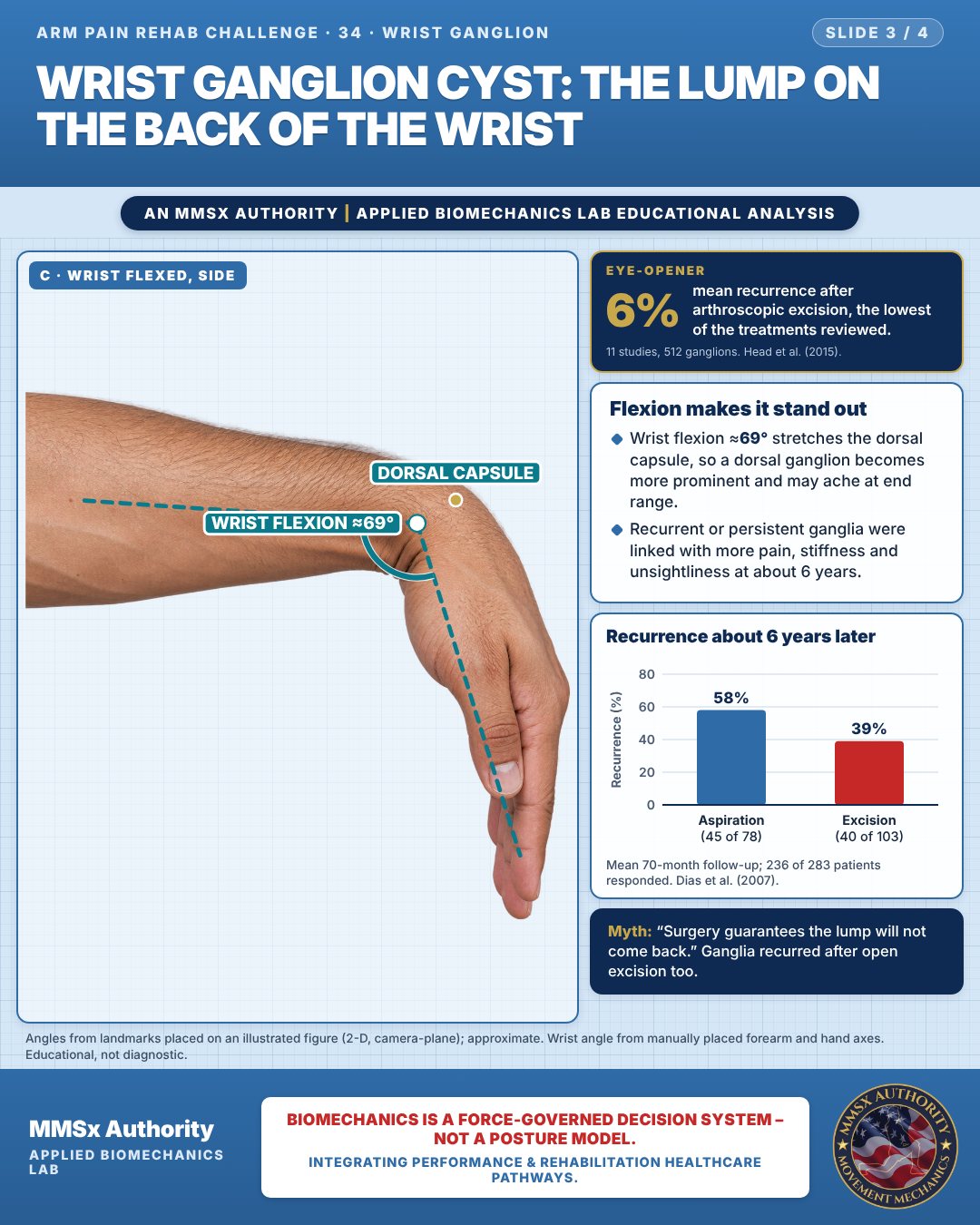
Flexion makes it stand out
Wrist flexion ≈69° stretches the dorsal capsule, so a dorsal ganglion becomes more prominent and may ache at end range.
Recurrent or persistent ganglia were linked with more pain, stiffness and unsightliness at about 6 years.
Recurrence about 6 years later
Decision pathway
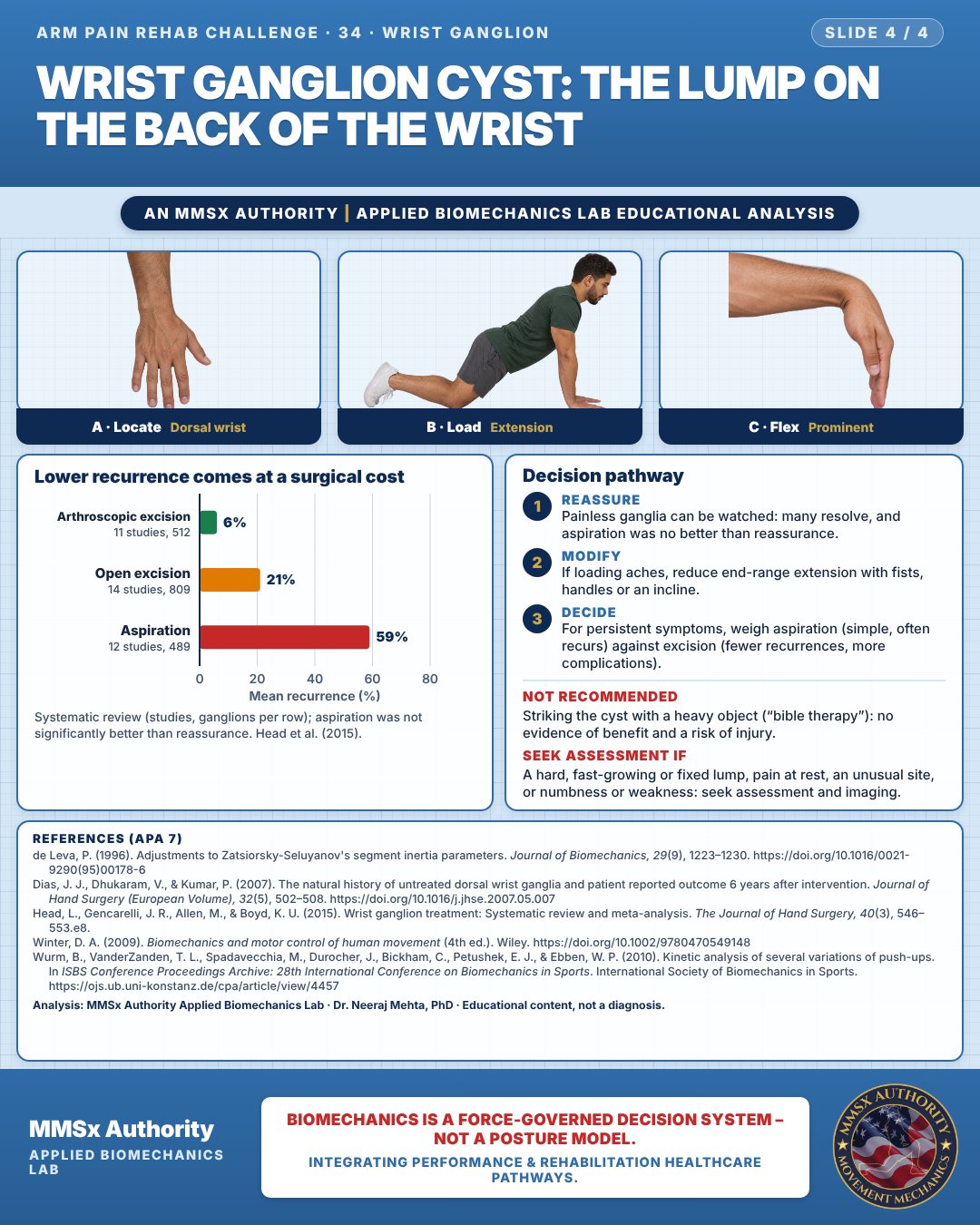
Lower recurrence comes at a surgical cost
Reassure
Painless ganglia can be watched: many resolve, and aspiration was no better than reassurance.
Modify
If loading aches, reduce end-range extension with fists, handles or an incline.
Decide
For persistent symptoms, weigh aspiration (simple, often recurs) against excision (fewer recurrences, more complications).
What the evidence supports
- Reassurance and observation are reasonable for painless ganglia (many resolve; aspiration was not significantly better than reassurance — Head et al., 2015). Aspiration is simple and low-complication but recurrence is high (58–59%); excision lowers recurrence (arthroscopic 6%, open 21%) at the cost of more complications with open surgery (14%) (Head et al., 2015; Dias et al., 2007).
Myth and evidence
Myth“Surgery guarantees the lump will not come back.”
EvidenceAfter open excision mean recurrence was 21% (Head et al., 2015) and 39% at about 6 years in one cohort (Dias et al., 2007).
Cautions
Not recommended
Striking the cyst with a heavy object (“bible therapy”): no evidence of benefit and a risk of injury.
Seek assessment if
A hard, fast-growing or fixed lump, pain at rest, an unusual site, or numbness or weakness: seek assessment and imaging.
Methods note
Angles from landmarks placed on an illustrated figure (2-D, camera-plane); approximate. Anatomy positions marked on the figure for teaching; no lump is shown on this figure. 2-D estimates from pose landmarks on an illustrated figure; CoM (if shown) from de Leva (1996); cm for a 1.70 m adult (Winter, 2009). Wrist angle from manually placed forearm and hand axes. These are educational estimates, not a diagnosis.
References
- de Leva, P. (1996). Adjustments to Zatsiorsky-Seluyanov's segment inertia parameters. Journal of Biomechanics, 29(9), 1223–1230. https://doi.org/10.1016/0021-9290(95)00178-6
- Dias, J. J., Dhukaram, V., & Kumar, P. (2007). The natural history of untreated dorsal wrist ganglia and patient reported outcome 6 years after intervention. Journal of Hand Surgery (European Volume), 32(5), 502–508. https://doi.org/10.1016/j.jhse.2007.05.007
- Head, L., Gencarelli, J. R., Allen, M., & Boyd, K. U. (2015). Wrist ganglion treatment: Systematic review and meta-analysis. The Journal of Hand Surgery, 40(3), 546–553.e8.
- Winter, D. A. (2009). Biomechanics and motor control of human movement (4th ed.). Wiley. https://doi.org/10.1002/9780470549148
- Wurm, B., VanderZanden, T. L., Spadavecchia, M., Durocher, J., Bickham, C., Petushek, E. J., & Ebben, W. P. (2010). Kinetic analysis of several variations of push-ups. In ISBS Conference Proceedings Archive: 28th International Conference on Biomechanics in Sports. International Society of Biomechanics in Sports. https://ojs.ub.uni-konstanz.de/cpa/article/view/4457
Cite this article
Mehta, N. (2026, October 28). Wrist ganglion cyst: the lump on the back of the wrist. MMSx Authority Applied Biomechanics Lab. https://mmsxauthority.org/edu/analysis/arm/34-wrist-ganglion-cyst-the-lump-on-the-back-of-the-wrist/
Part of the collection
Mehta, N. (2026). Elbow, Forearm, Wrist and Hand Rehabilitation: 50 Evidence-Based Biomechanics Analyses [Collection]. MMSx Authority Applied Biomechanics Lab. Zenodo. https://doi.org/10.5281/zenodo.23735910
All Arm Pain Rehab Challenge articles · Rehabilitation Library