Arm Pain Rehab Challenge · 33
Distal radius fracture: rehab after a broken wrist
Fracture of the distal end of the radius, usually from a fall onto the outstretched hand. Movement analysis, verified research data and a decision pathway.
Key points
- Early. Keep fingers, elbow and shoulder moving while the wrist is immobilised.
- Range. After the cast or fixation, rebuild active wrist and forearm range towards daily-task targets.
- Strength. Progress grip from soft-ball squeezes to heavier work; expect it to lag for at least 6 months.
What it is
Fracture of the distal end of the radius, usually from a fall onto the outstretched hand; treated with cast immobilisation or surgical fixation, followed by rehabilitation to restore wrist motion (Movement A), forearm rotation (Movement B) and grip (Movement C).
How we analysed the movement
Three movements relevant to this topic were analysed from illustrated reference figures. Joint centres were located with two-dimensional pose estimation where the whole arm was visible; elbow and wrist angles, and the directions of external load and tendon pull, were then drawn on the figure; on hand close-ups, where pose estimation does not apply, the landmarks were placed manually. The figures are educational estimates that show how position changes mechanical demand; they are not measurements of a patient. Every research value quoted below comes from the published source cited beside it.
Movement A: Supported wrist lift (side view)
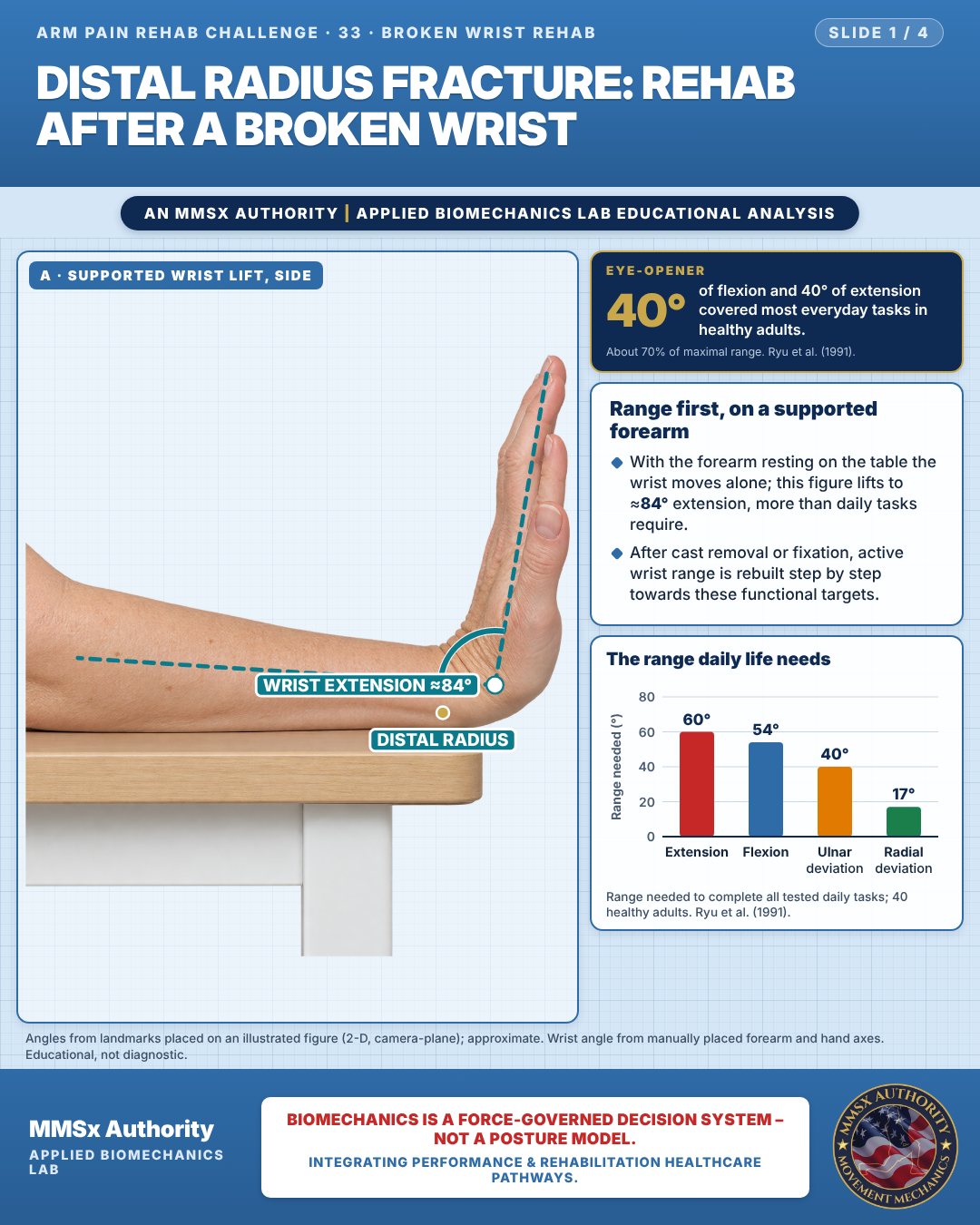
Range first, on a supported forearm
With the forearm resting on the table the wrist moves alone; this figure lifts to ≈84° extension, more than daily tasks require.
After cast removal or fixation, active wrist range is rebuilt step by step towards these functional targets.
The range daily life needs
Movement B: Hammer rotation (front view)
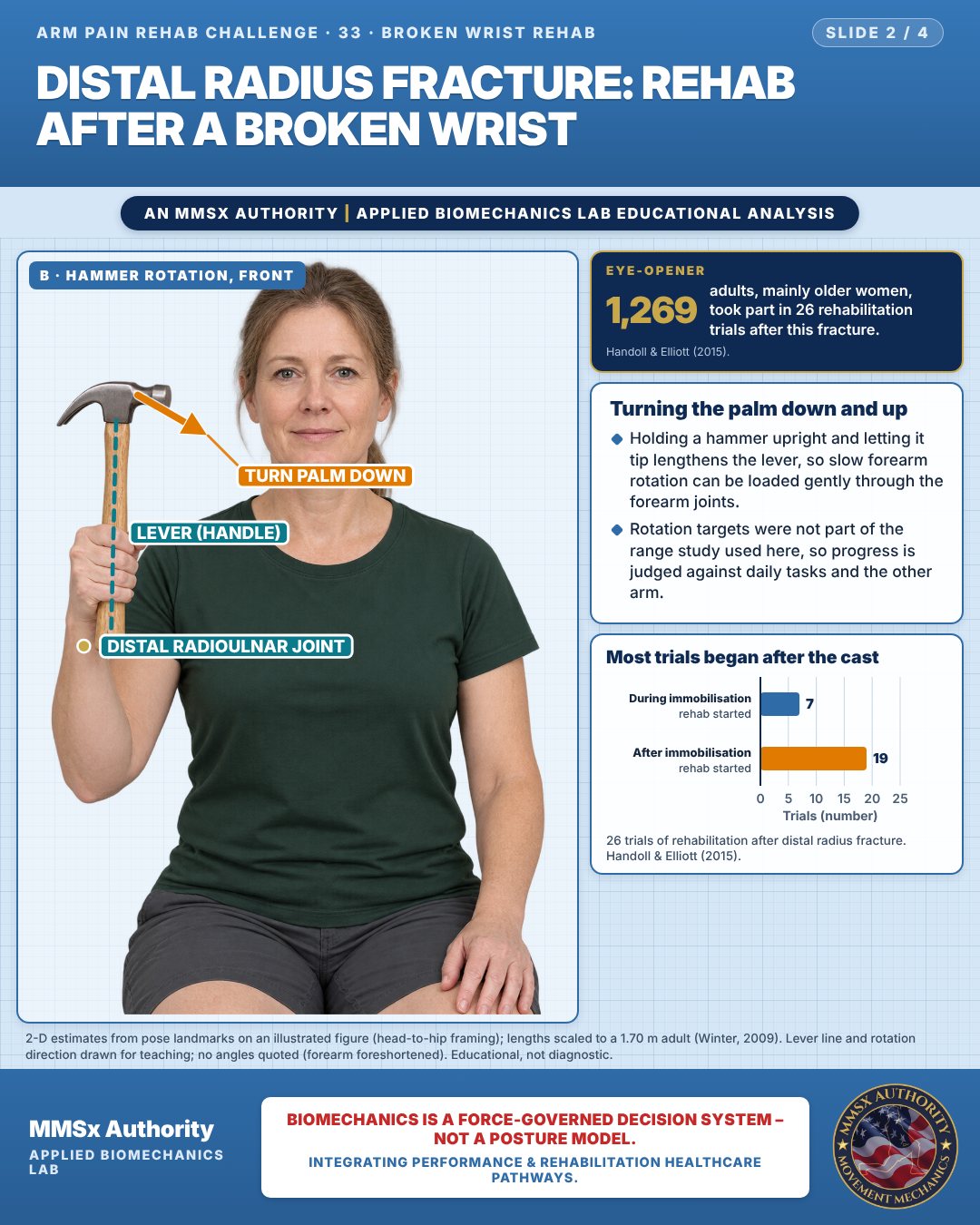
Turning the palm down and up
Holding a hammer upright and letting it tip lengthens the lever, so slow forearm rotation can be loaded gently through the forearm joints.
Rotation targets were not part of the range study used here, so progress is judged against daily tasks and the other arm.
Most trials began after the cast
Movement C: Soft-ball squeeze (front view)
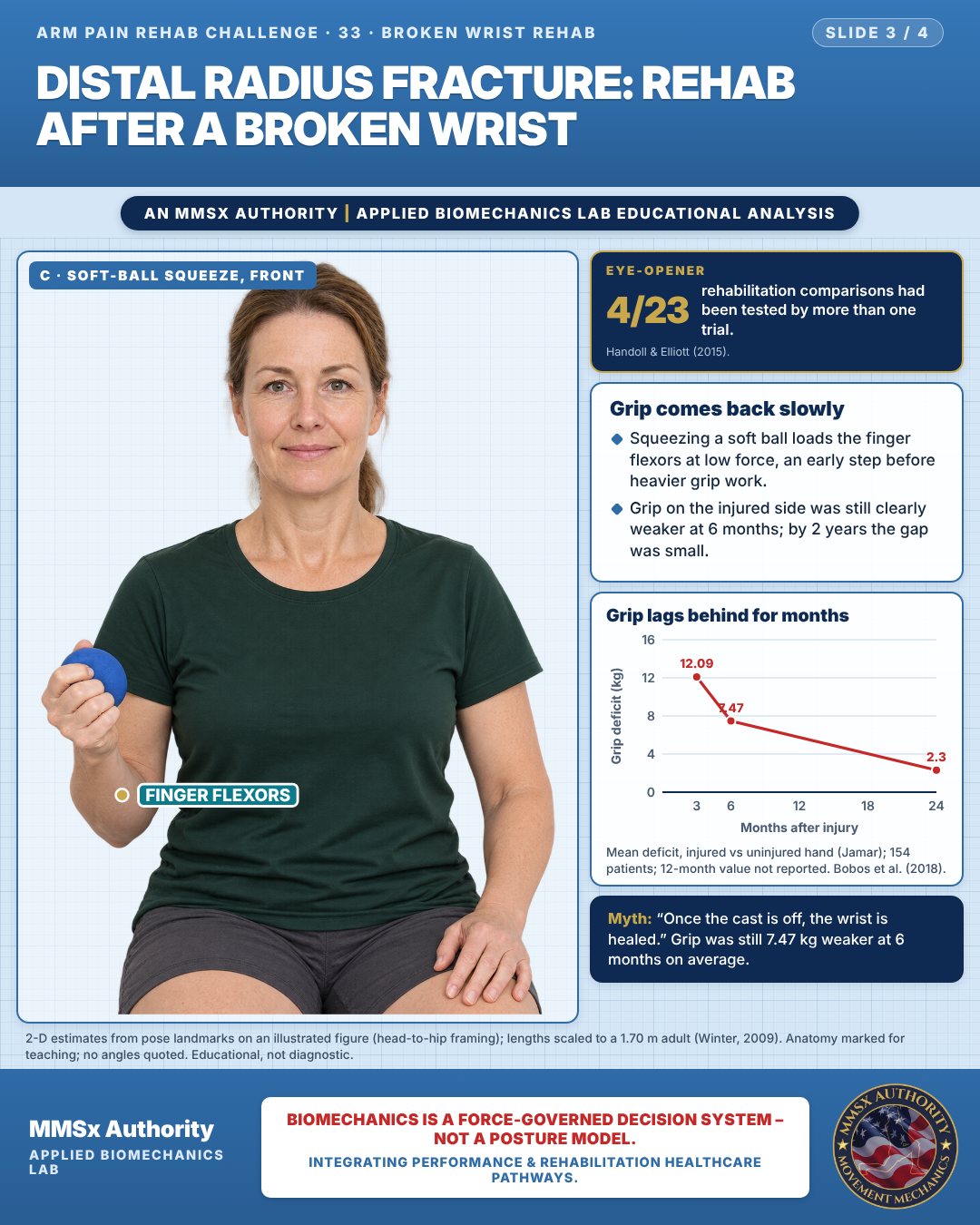
Grip comes back slowly
Squeezing a soft ball loads the finger flexors at low force, an early step before heavier grip work.
Grip on the injured side was still clearly weaker at 6 months; by 2 years the gap was small.
Grip lags behind for months
Decision pathway
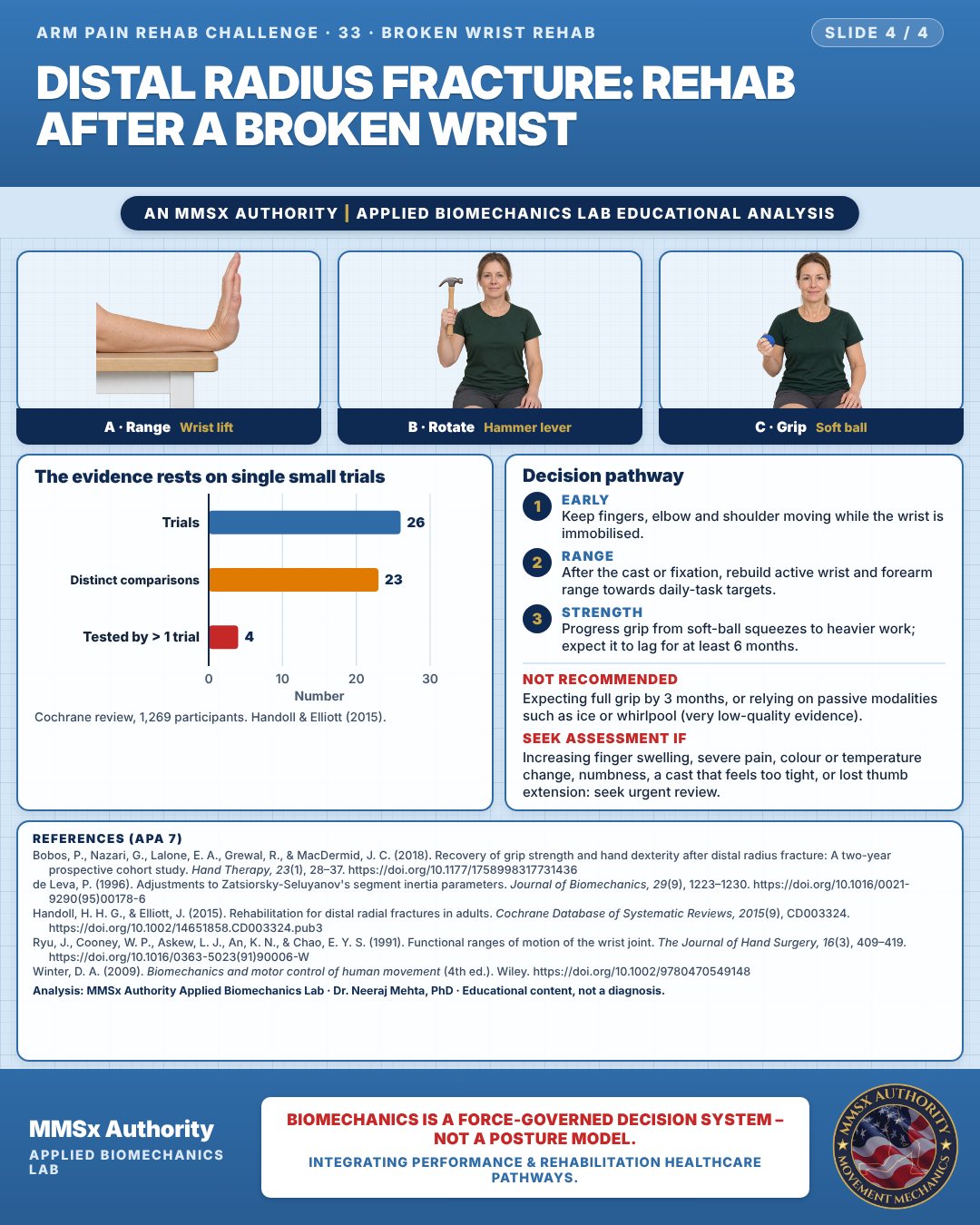
The evidence rests on single small trials
Early
Keep fingers, elbow and shoulder moving while the wrist is immobilised.
Range
After the cast or fixation, rebuild active wrist and forearm range towards daily-task targets.
Strength
Progress grip from soft-ball squeezes to heavier work; expect it to lag for at least 6 months.
Myth and evidence
Myth“Once the cast is off, the wrist is healed.”
EvidenceMean grip strength on the injured side was still 7.47 kg lower at 6 months (Bobos et al., 2018).
Cautions
Not recommended
Expecting full grip by 3 months, or relying on passive modalities such as ice or whirlpool (very low-quality evidence).
Seek assessment if
Increasing finger swelling, severe pain, colour or temperature change, numbness, a cast that feels too tight, or lost thumb extension: seek urgent review.
Methods note
Angles from landmarks placed on an illustrated figure (2-D, camera-plane); approximate. Wrist angle from manually placed forearm and hand axes. 2-D estimates from pose landmarks on an illustrated figure (head-to-hip framing); lengths scaled to a 1.70 m adult (Winter, 2009). Lever line and rotation direction drawn for teaching; no angles quoted (forearm foreshortened). Anatomy marked for teaching; no angles quoted. These are educational estimates, not a diagnosis.
References
- Bobos, P., Nazari, G., Lalone, E. A., Grewal, R., & MacDermid, J. C. (2018). Recovery of grip strength and hand dexterity after distal radius fracture: A two-year prospective cohort study. Hand Therapy, 23(1), 28–37. https://doi.org/10.1177/1758998317731436
- de Leva, P. (1996). Adjustments to Zatsiorsky-Seluyanov's segment inertia parameters. Journal of Biomechanics, 29(9), 1223–1230. https://doi.org/10.1016/0021-9290(95)00178-6
- Handoll, H. H. G., & Elliott, J. (2015). Rehabilitation for distal radial fractures in adults. Cochrane Database of Systematic Reviews, 2015(9), CD003324. https://doi.org/10.1002/14651858.CD003324.pub3
- Ryu, J., Cooney, W. P., Askew, L. J., An, K. N., & Chao, E. Y. S. (1991). Functional ranges of motion of the wrist joint. The Journal of Hand Surgery, 16(3), 409–419. https://doi.org/10.1016/0363-5023(91)90006-W
- Winter, D. A. (2009). Biomechanics and motor control of human movement (4th ed.). Wiley. https://doi.org/10.1002/9780470549148
Cite this article
Mehta, N. (2026, October 28). Distal radius fracture: rehab after a broken wrist. MMSx Authority Applied Biomechanics Lab. https://mmsxauthority.org/edu/analysis/arm/33-distal-radius-fracture-rehab-after-a-broken-wrist/
Part of the collection
Mehta, N. (2026). Elbow, Forearm, Wrist and Hand Rehabilitation: 50 Evidence-Based Biomechanics Analyses [Collection]. MMSx Authority Applied Biomechanics Lab. Zenodo. https://doi.org/10.5281/zenodo.23735910
All Arm Pain Rehab Challenge articles · Rehabilitation Library