Arm Pain Rehab Challenge · 31
TFCC injury: little-finger-side wrist pain with twisting
Injury or degeneration of the triangular fibrocartilage complex (TFCC) — the cartilage disc and ligaments between the ulna and the carpus that…
Key points
- Modify. Reduce gripping with rotation and little-finger tilt; brace or splint while pain settles.
- Load. Rebuild grip and forearm rotation strength in graded steps within comfort.
- Track. If pain, clicking or weakness persist, seek specialist assessment; judge the scan against the examination.
What it is
Injury or degeneration of the triangular fibrocartilage complex (TFCC) — the cartilage disc and ligaments between the ulna and the carpus that stabilise the distal radioulnar joint and transmit part of the axial load — presenting as ulnar-sided wrist pain with gripping, forearm rotation (door handles, Movement A) and ulnar deviation (tennis forehand, Movement B).
How we analysed the movement
Three movements relevant to this topic were analysed from illustrated reference figures. Joint centres were located with two-dimensional pose estimation where the whole arm was visible; elbow and wrist angles, and the directions of external load and tendon pull, were then drawn on the figure; on hand close-ups, where pose estimation does not apply, the landmarks were placed manually. The figures are educational estimates that show how position changes mechanical demand; they are not measurements of a patient. Every research value quoted below comes from the published source cited beside it.
Movement A: Turn door handle (side view)
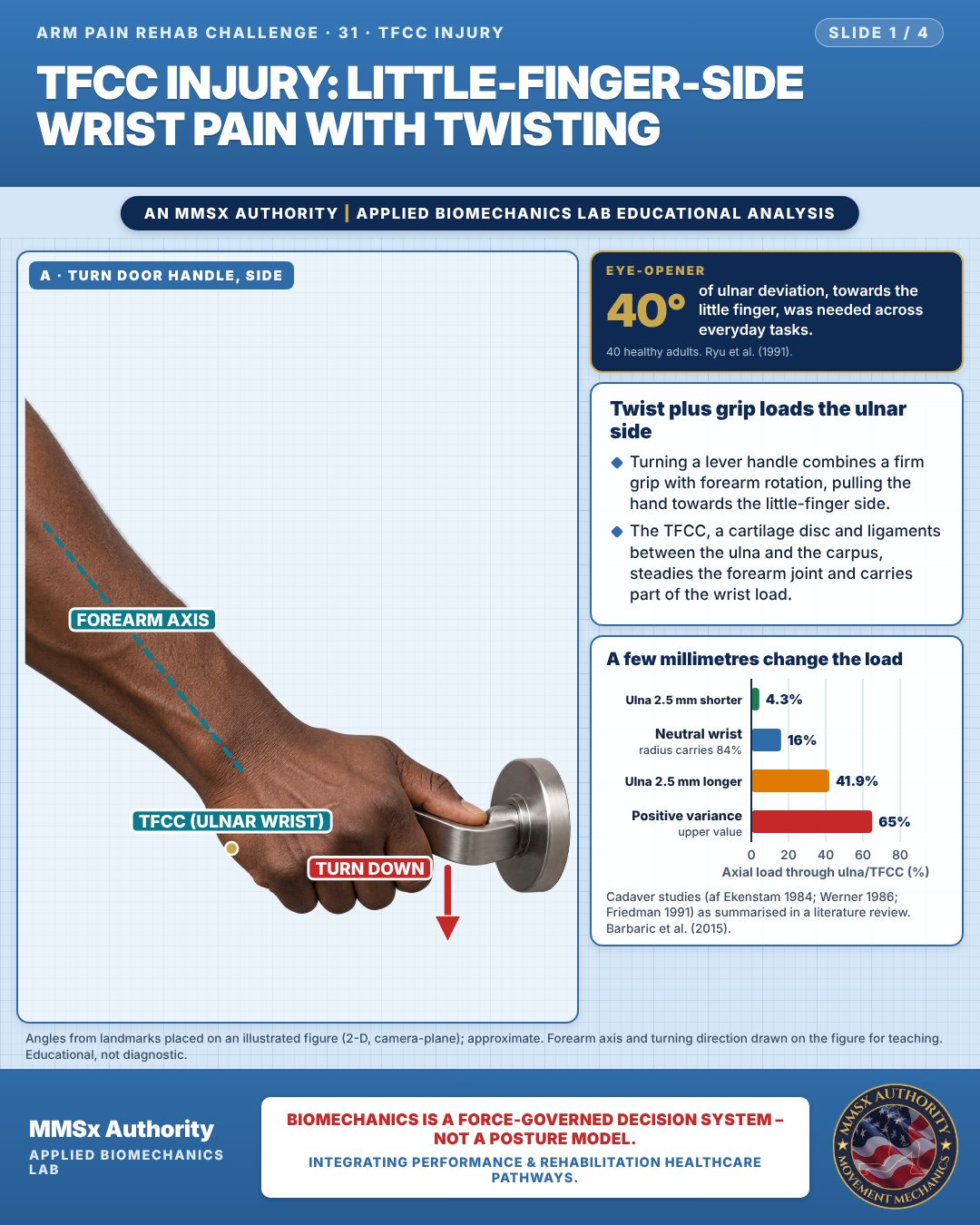
Twist plus grip loads the ulnar side
Turning a lever handle combines a firm grip with forearm rotation, pulling the hand towards the little-finger side.
The TFCC, a cartilage disc and ligaments between the ulna and the carpus, steadies the forearm joint and carries part of the wrist load.
A few millimetres change the load
Movement B: Tennis forehand (side view)
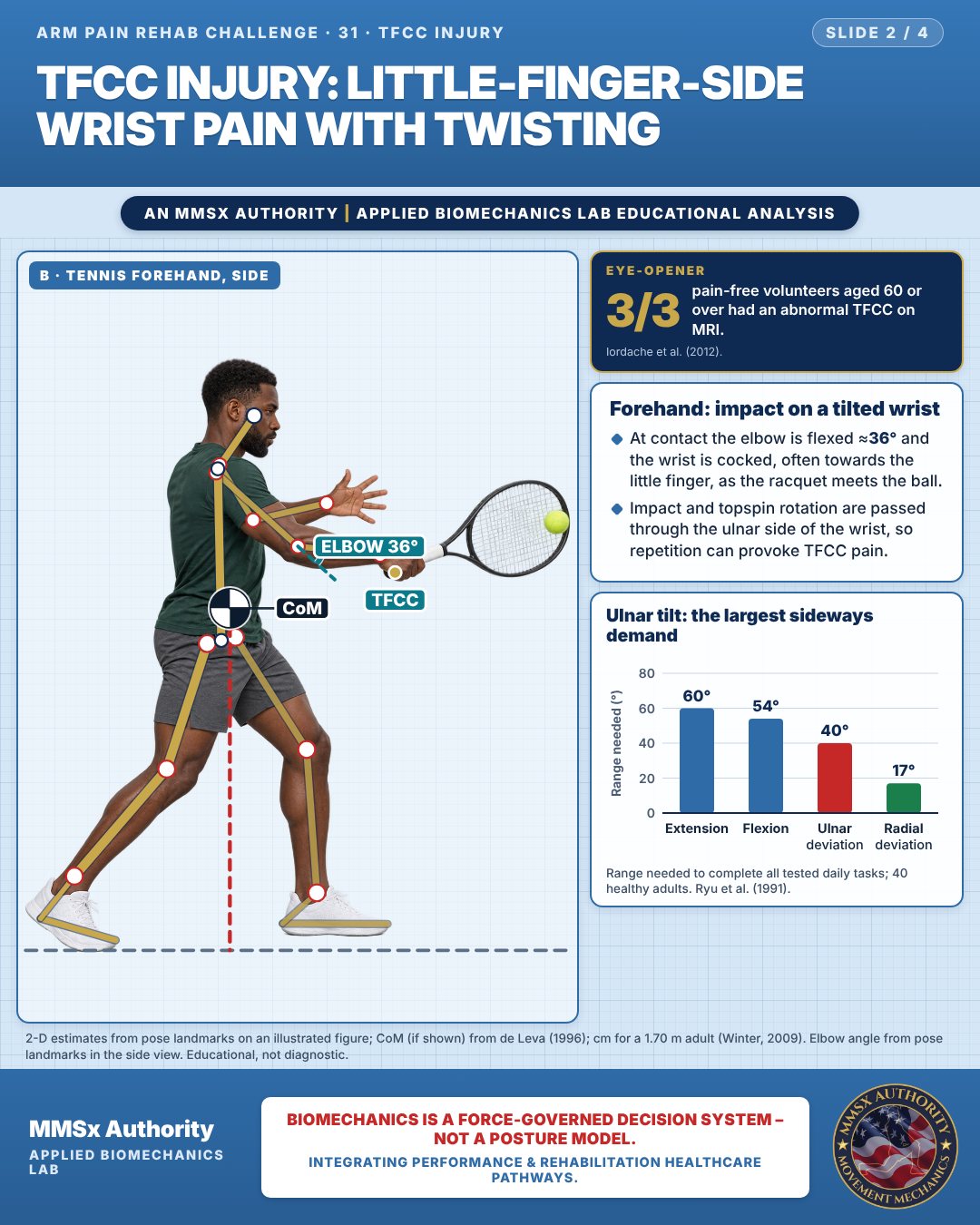
Forehand: impact on a tilted wrist
At contact the elbow is flexed ≈36° and the wrist is cocked, often towards the little finger, as the racquet meets the ball.
Impact and topspin rotation are passed through the ulnar side of the wrist, so repetition can provoke TFCC pain.
Ulnar tilt: the largest sideways demand
Movement C: Holding ulnar wrist (front view)
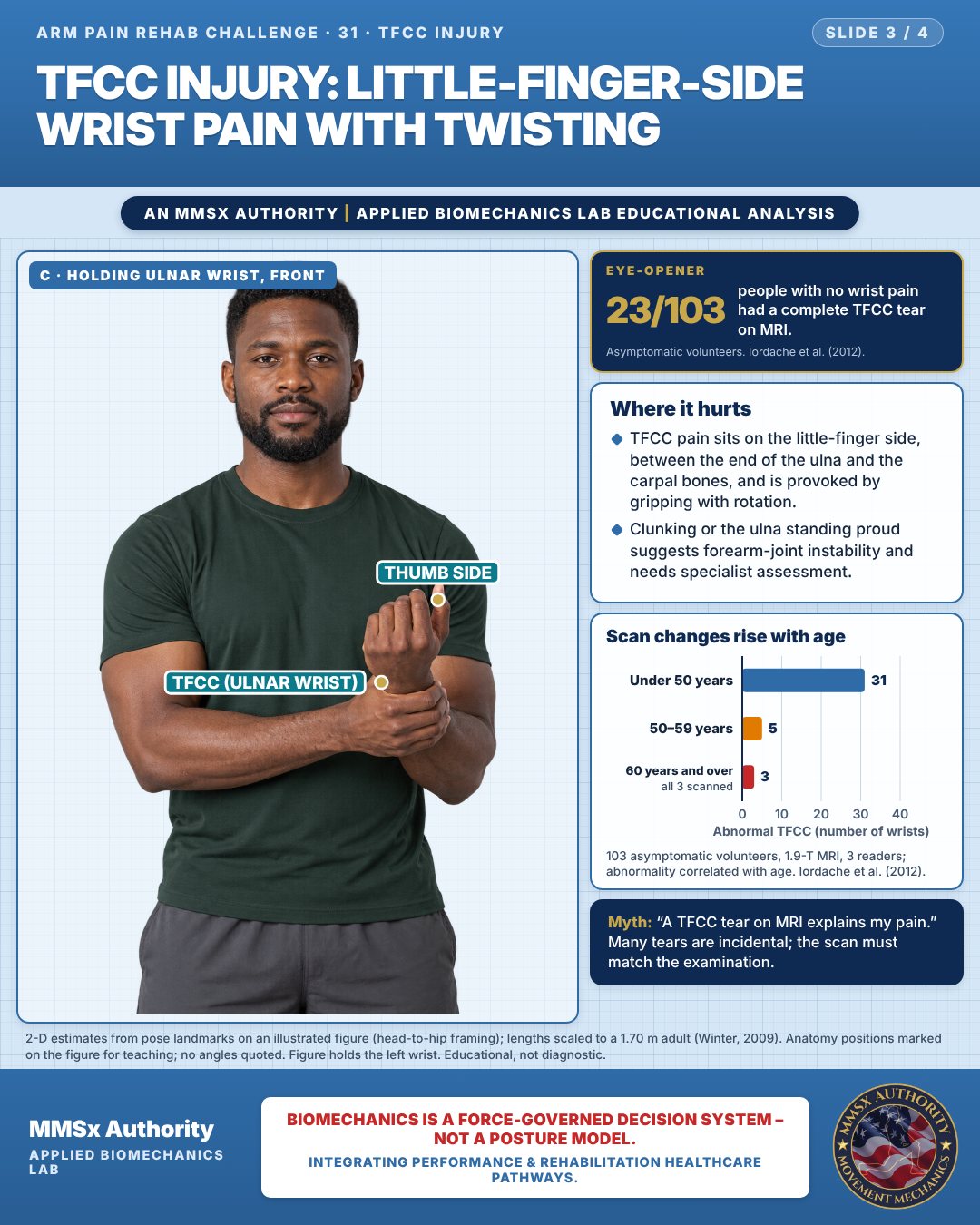
Where it hurts
TFCC pain sits on the little-finger side, between the end of the ulna and the carpal bones, and is provoked by gripping with rotation.
Clunking or the ulna standing proud suggests forearm-joint instability and needs specialist assessment.
Scan changes rise with age
Decision pathway
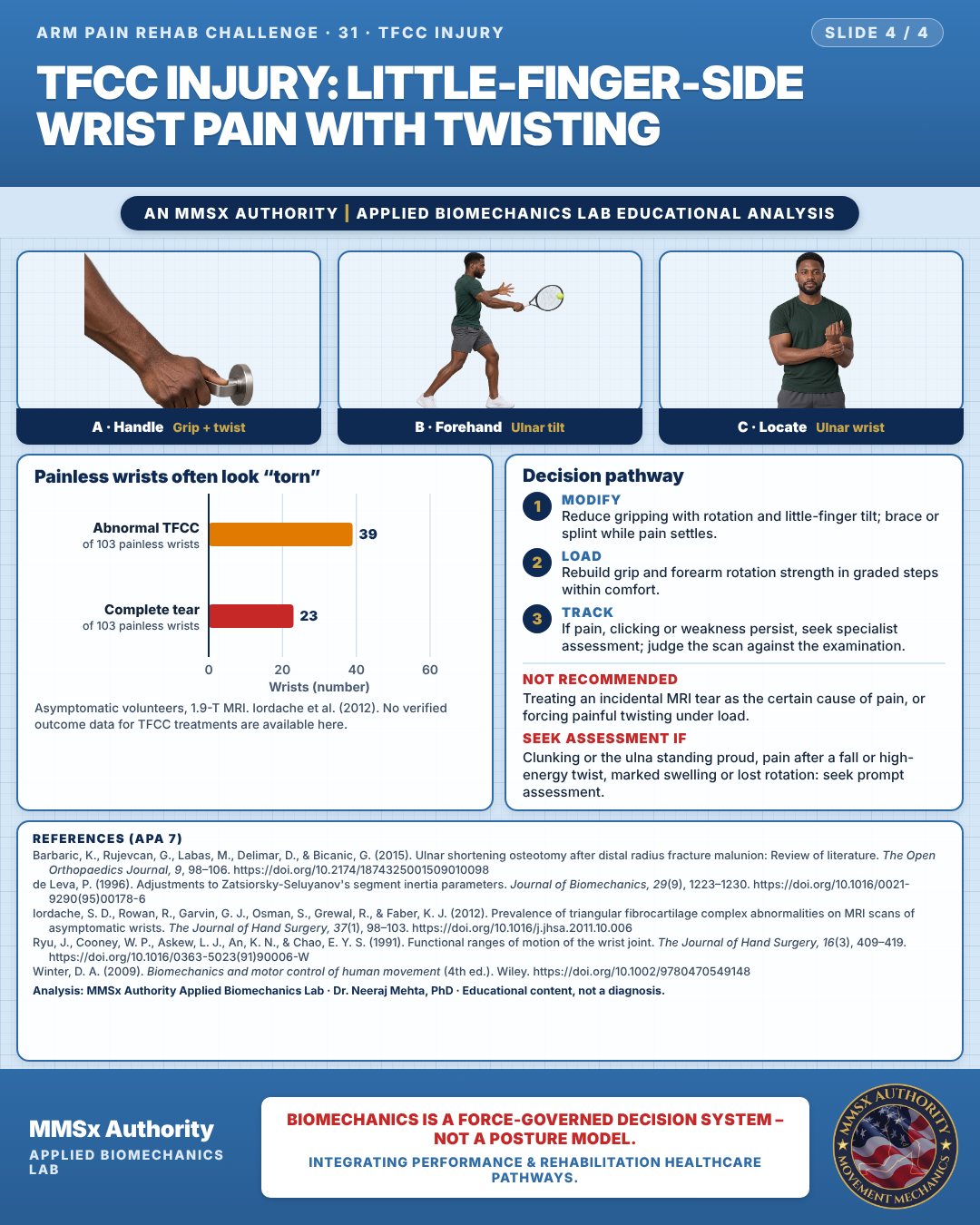
Painless wrists often look “torn”
Modify
Reduce gripping with rotation and little-finger tilt; brace or splint while pain settles.
Load
Rebuild grip and forearm rotation strength in graded steps within comfort.
Track
If pain, clicking or weakness persist, seek specialist assessment; judge the scan against the examination.
What the evidence supports
- Initial care for most ulnar-sided wrist pain is relative rest from provocative rotation/ulnar deviation, splinting or bracing, and graded strengthening; persistent mechanical symptoms or instability need specialist assessment. Treatment decisions should not rest on MRI findings alone (Iordache et al., 2012).
Myth and evidence
Myth“A TFCC tear on MRI explains my pain.”
Evidence23 of 103 people without any wrist pain had complete TFCC tears on MRI (Iordache et al., 2012).
Cautions
Not recommended
Treating an incidental MRI tear as the certain cause of pain, or forcing painful twisting under load.
Seek assessment if
Clunking or the ulna standing proud, pain after a fall or high-energy twist, marked swelling or lost rotation: seek prompt assessment.
Methods note
Angles from landmarks placed on an illustrated figure (2-D, camera-plane); approximate. Forearm axis and turning direction drawn on the figure for teaching. 2-D estimates from pose landmarks on an illustrated figure; CoM (if shown) from de Leva (1996); cm for a 1.70 m adult (Winter, 2009). Elbow angle from pose landmarks in the side view. 2-D estimates from pose landmarks on an illustrated figure (head-to-hip framing); lengths scaled to a 1.70 m adult (Winter, 2009). Anatomy positions marked on the figure for teaching; no angles quoted. Figure holds the left wrist. These are educational estimates, not a diagnosis.
References
- Barbaric, K., Rujevcan, G., Labas, M., Delimar, D., & Bicanic, G. (2015). Ulnar shortening osteotomy after distal radius fracture malunion: Review of literature. The Open Orthopaedics Journal, 9, 98–106. https://doi.org/10.2174/1874325001509010098
- de Leva, P. (1996). Adjustments to Zatsiorsky-Seluyanov's segment inertia parameters. Journal of Biomechanics, 29(9), 1223–1230. https://doi.org/10.1016/0021-9290(95)00178-6
- Iordache, S. D., Rowan, R., Garvin, G. J., Osman, S., Grewal, R., & Faber, K. J. (2012). Prevalence of triangular fibrocartilage complex abnormalities on MRI scans of asymptomatic wrists. The Journal of Hand Surgery, 37(1), 98–103. https://doi.org/10.1016/j.jhsa.2011.10.006
- Ryu, J., Cooney, W. P., Askew, L. J., An, K. N., & Chao, E. Y. S. (1991). Functional ranges of motion of the wrist joint. The Journal of Hand Surgery, 16(3), 409–419. https://doi.org/10.1016/0363-5023(91)90006-W
- Winter, D. A. (2009). Biomechanics and motor control of human movement (4th ed.). Wiley. https://doi.org/10.1002/9780470549148
Cite this article
Mehta, N. (2026, October 28). TFCC injury: little-finger-side wrist pain with twisting. MMSx Authority Applied Biomechanics Lab. https://mmsxauthority.org/edu/analysis/arm/31-tfcc-injury-little-finger-side-wrist-pain-with-twisting/
Part of the collection
Mehta, N. (2026). Elbow, Forearm, Wrist and Hand Rehabilitation: 50 Evidence-Based Biomechanics Analyses [Collection]. MMSx Authority Applied Biomechanics Lab. Zenodo. https://doi.org/10.5281/zenodo.23735910
All Arm Pain Rehab Challenge articles · Rehabilitation Library