Arm Pain Rehab Challenge · 30
Gymnast’s wrist: growth-plate stress in young athletes
Chronic overuse stress injury of the distal radial growth plate (physis) in skeletally immature athletes, caused by repetitive compressive and…
Key points
- Modify. Cut wrist weight-bearing volume when pain persists; no safe weekly-hours limit has been established.
- Load. Coach the T-shape hand position and return to skills gradually, guided by pain.
- Track. Log weekly hours and intensity, which are associated with wrist pain; refer if pain lasts.
What it is
Chronic overuse stress injury of the distal radial growth plate (physis) in skeletally immature athletes, caused by repetitive compressive and extension loading of the wrist (handstands, bridges, vaults, cartwheels); can disturb growth and is associated with positive ulnar variance.
How we analysed the movement
Three movements relevant to this topic were analysed from illustrated reference figures. Joint centres were located with two-dimensional pose estimation where the whole arm was visible; elbow and wrist angles, and the directions of external load and tendon pull, were then drawn on the figure; on hand close-ups, where pose estimation does not apply, the landmarks were placed manually. The figures are educational estimates that show how position changes mechanical demand; they are not measurements of a patient. Every research value quoted below comes from the published source cited beside it.
Movement A: Handstand (side view)
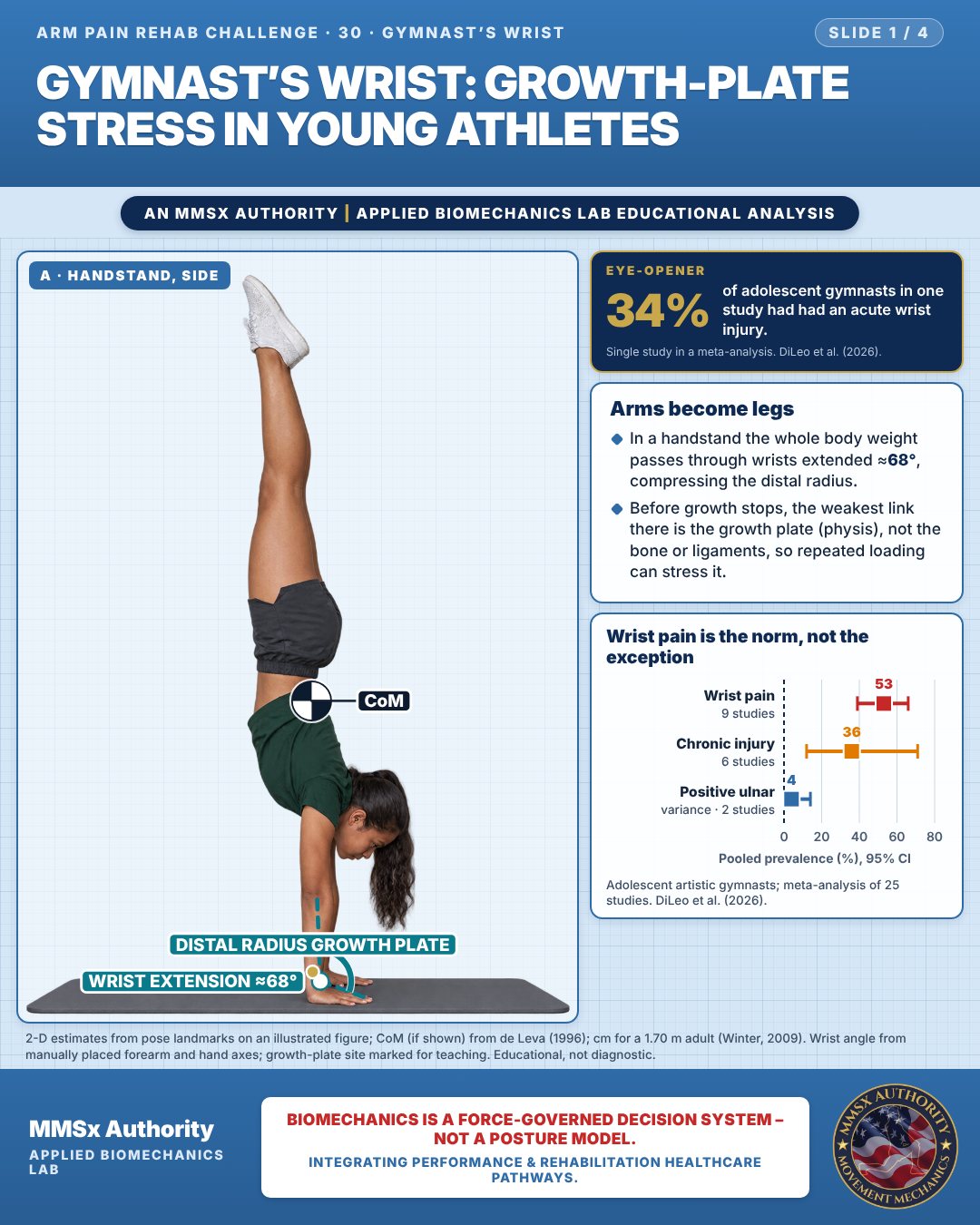
Arms become legs
In a handstand the whole body weight passes through wrists extended ≈68°, compressing the distal radius.
Before growth stops, the weakest link there is the growth plate (physis), not the bone or ligaments, so repeated loading can stress it.
Wrist pain is the norm, not the exception
Movement B: Back bridge (side view)
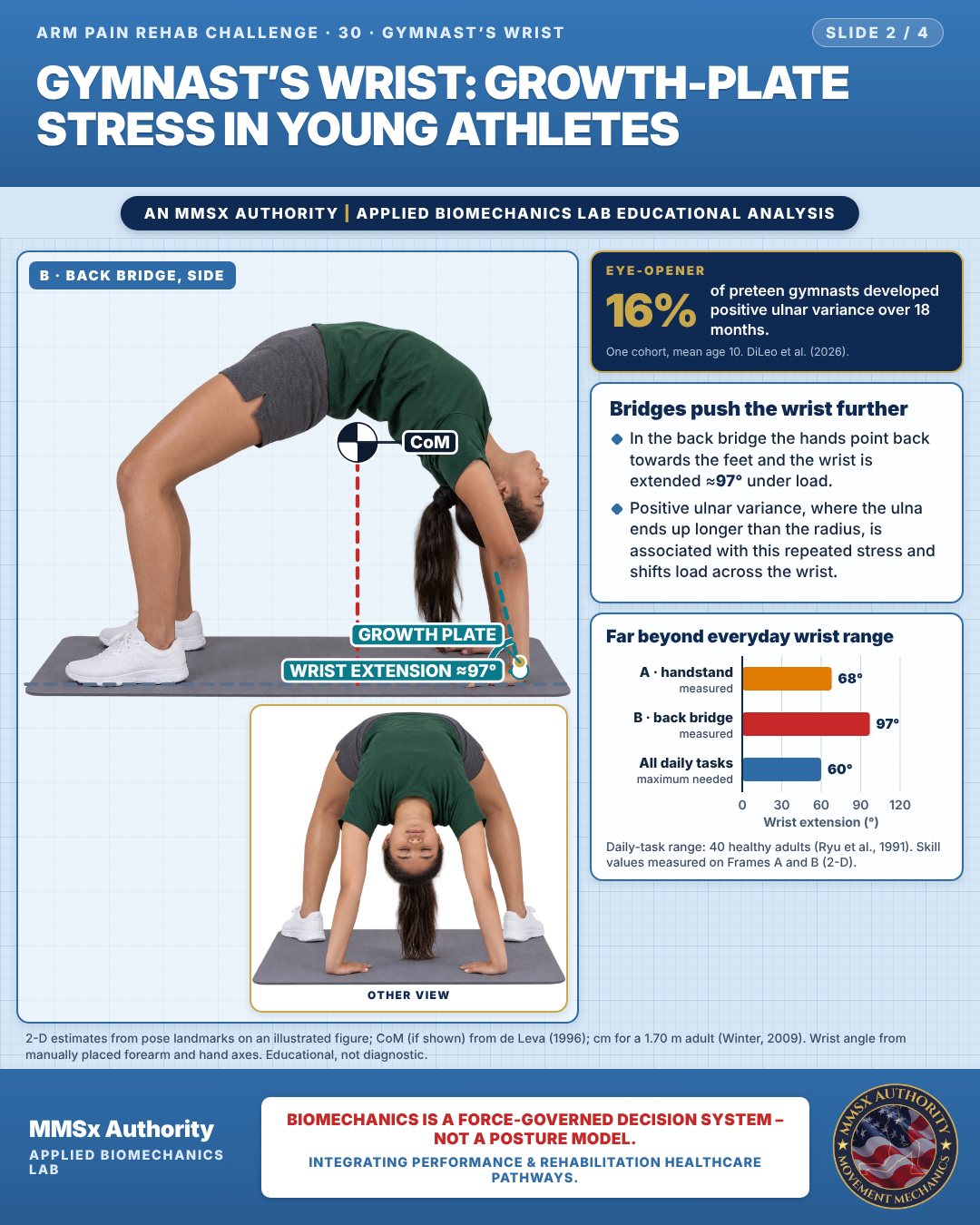
Bridges push the wrist further
In the back bridge the hands point back towards the feet and the wrist is extended ≈97° under load.
Positive ulnar variance, where the ulna ends up longer than the radius, is associated with this repeated stress and shifts load across the wrist.
Far beyond everyday wrist range
Movement C: Cartwheel (front view)
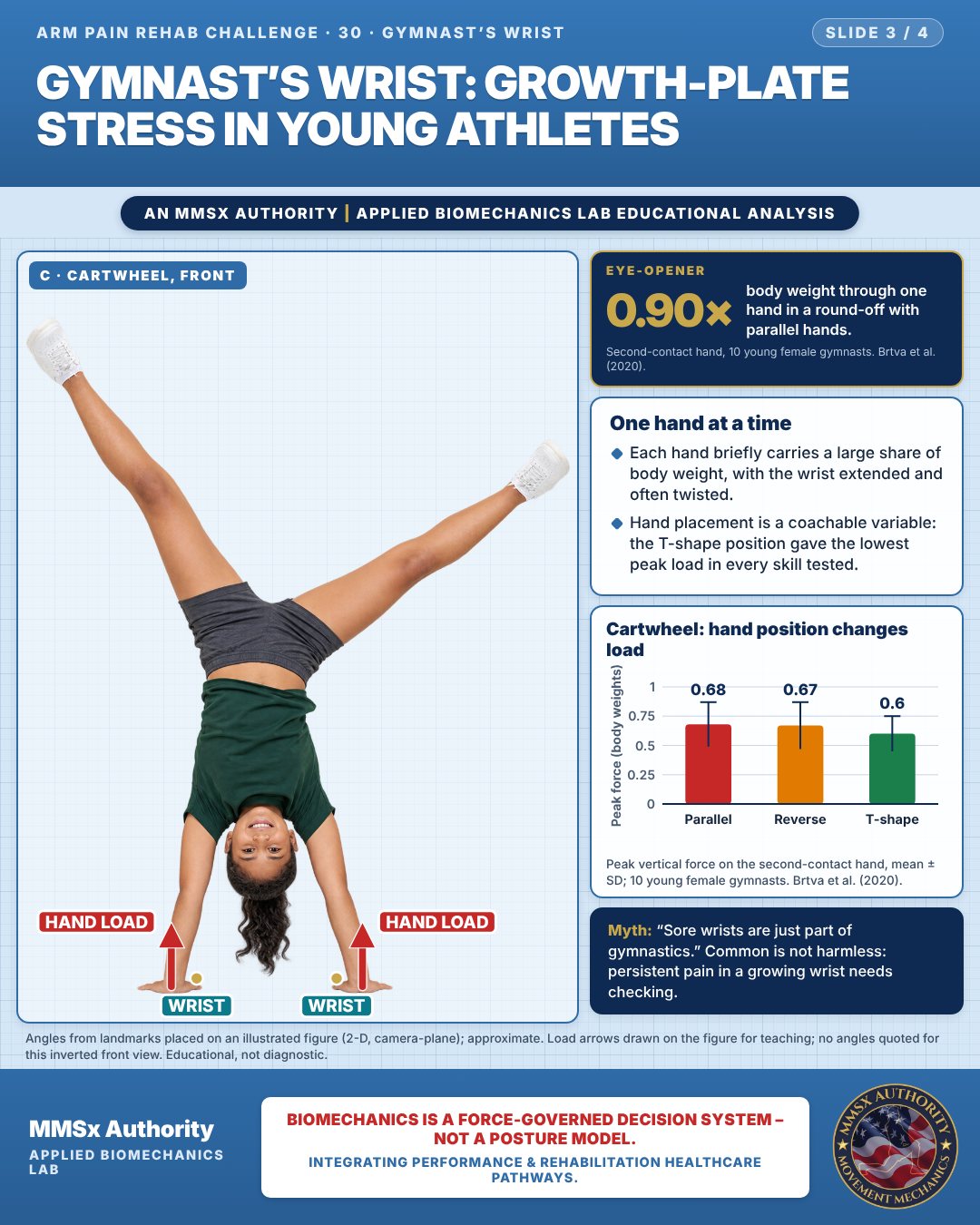
One hand at a time
Each hand briefly carries a large share of body weight, with the wrist extended and often twisted.
Hand placement is a coachable variable: the T-shape position gave the lowest peak load in every skill tested.
Cartwheel: hand position changes load
Decision pathway
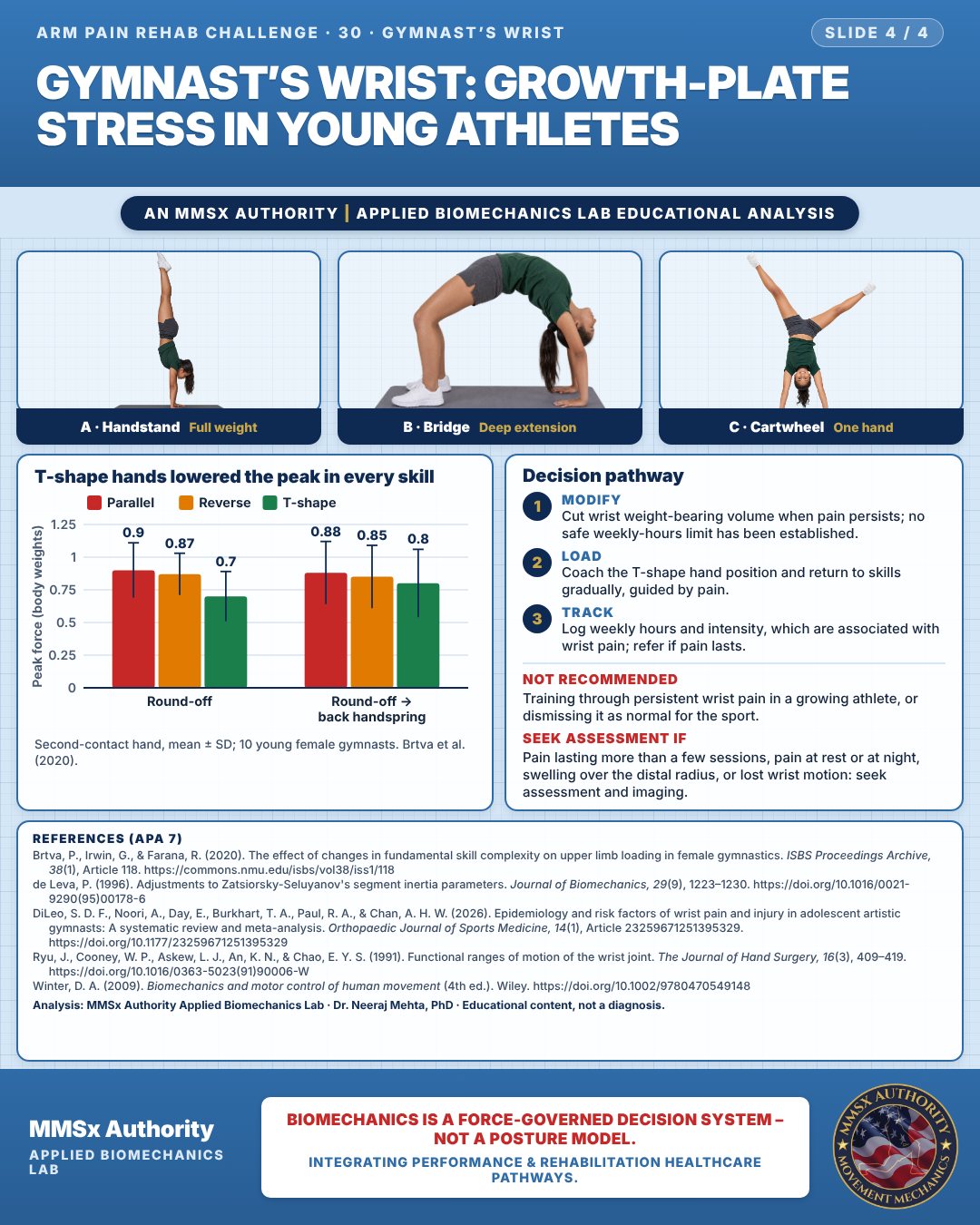
T-shape hands lowered the peak in every skill
Modify
Cut wrist weight-bearing volume when pain persists; no safe weekly-hours limit has been established.
Load
Coach the T-shape hand position and return to skills gradually, guided by pain.
Track
Log weekly hours and intensity, which are associated with wrist pain; refer if pain lasts.
Myth and evidence
Myth“Sore wrists are just part of gymnastics.”
EvidenceAbout half of adolescent gymnasts report wrist pain, and early physeal stress is associated with growth change such as positive ulnar variance (16% new cases over 18 months in one preteen cohort) (DiLeo et al., 2026).
Cautions
Not recommended
Training through persistent wrist pain in a growing athlete, or dismissing it as normal for the sport.
Seek assessment if
Pain lasting more than a few sessions, pain at rest or at night, swelling over the distal radius, or lost wrist motion: seek assessment and imaging.
Methods note
2-D estimates from pose landmarks on an illustrated figure; CoM (if shown) from de Leva (1996); cm for a 1.70 m adult (Winter, 2009). Wrist angle from manually placed forearm and hand axes; growth-plate site marked for teaching. Wrist angle from manually placed forearm and hand axes. Angles from landmarks placed on an illustrated figure (2-D, camera-plane); approximate. Load arrows drawn on the figure for teaching; no angles quoted for this inverted front view. These are educational estimates, not a diagnosis.
References
- Brtva, P., Irwin, G., & Farana, R. (2020). The effect of changes in fundamental skill complexity on upper limb loading in female gymnastics. ISBS Proceedings Archive, 38(1), Article 118. https://commons.nmu.edu/isbs/vol38/iss1/118
- de Leva, P. (1996). Adjustments to Zatsiorsky-Seluyanov's segment inertia parameters. Journal of Biomechanics, 29(9), 1223–1230. https://doi.org/10.1016/0021-9290(95)00178-6
- DiLeo, S. D. F., Noori, A., Day, E., Burkhart, T. A., Paul, R. A., & Chan, A. H. W. (2026). Epidemiology and risk factors of wrist pain and injury in adolescent artistic gymnasts: A systematic review and meta-analysis. Orthopaedic Journal of Sports Medicine, 14(1), Article 23259671251395329. https://doi.org/10.1177/23259671251395329
- Ryu, J., Cooney, W. P., Askew, L. J., An, K. N., & Chao, E. Y. S. (1991). Functional ranges of motion of the wrist joint. The Journal of Hand Surgery, 16(3), 409–419. https://doi.org/10.1016/0363-5023(91)90006-W
- Winter, D. A. (2009). Biomechanics and motor control of human movement (4th ed.). Wiley. https://doi.org/10.1002/9780470549148
Cite this article
Mehta, N. (2026, October 28). Gymnast’s wrist: growth-plate stress in young athletes. MMSx Authority Applied Biomechanics Lab. https://mmsxauthority.org/edu/analysis/arm/30-gymnasts-wrist-growth-plate-stress-in-young-athletes/
Part of the collection
Mehta, N. (2026). Elbow, Forearm, Wrist and Hand Rehabilitation: 50 Evidence-Based Biomechanics Analyses [Collection]. MMSx Authority Applied Biomechanics Lab. Zenodo. https://doi.org/10.5281/zenodo.23735910
All Arm Pain Rehab Challenge articles · Rehabilitation Library