Arm Pain Rehab Challenge · 29
Wrist pain in yoga and handstands: building weight-bearing tolerance
Wrist pain (usually dorsal or ulnar-sided) provoked by weight-bearing on an extended wrist in poses such as downward-facing dog and handstand.
Key points
- Modify. Use a wedge, fists or parallettes to reduce extension, and shorten holds while the wrist is sore.
- Load. Climb the ladder: incline, kneeling, regular, feet raised, then pike and wall handstand.
- Track. Add hold time or a rung only when wrist pain stays settled the next day.
What it is
Wrist pain (usually dorsal or ulnar-sided) provoked by weight-bearing on an extended wrist in poses such as downward-facing dog and handstand; reflects a mismatch between load (share of body weight × end-range extension × time) and current tissue tolerance.
How we analysed the movement
Three movements relevant to this topic were analysed from illustrated reference figures. Joint centres were located with two-dimensional pose estimation where the whole arm was visible; elbow and wrist angles, and the directions of external load and tendon pull, were then drawn on the figure; on hand close-ups, where pose estimation does not apply, the landmarks were placed manually. The figures are educational estimates that show how position changes mechanical demand; they are not measurements of a patient. Every research value quoted below comes from the published source cited beside it.
Movement A: Downward dog (side view)
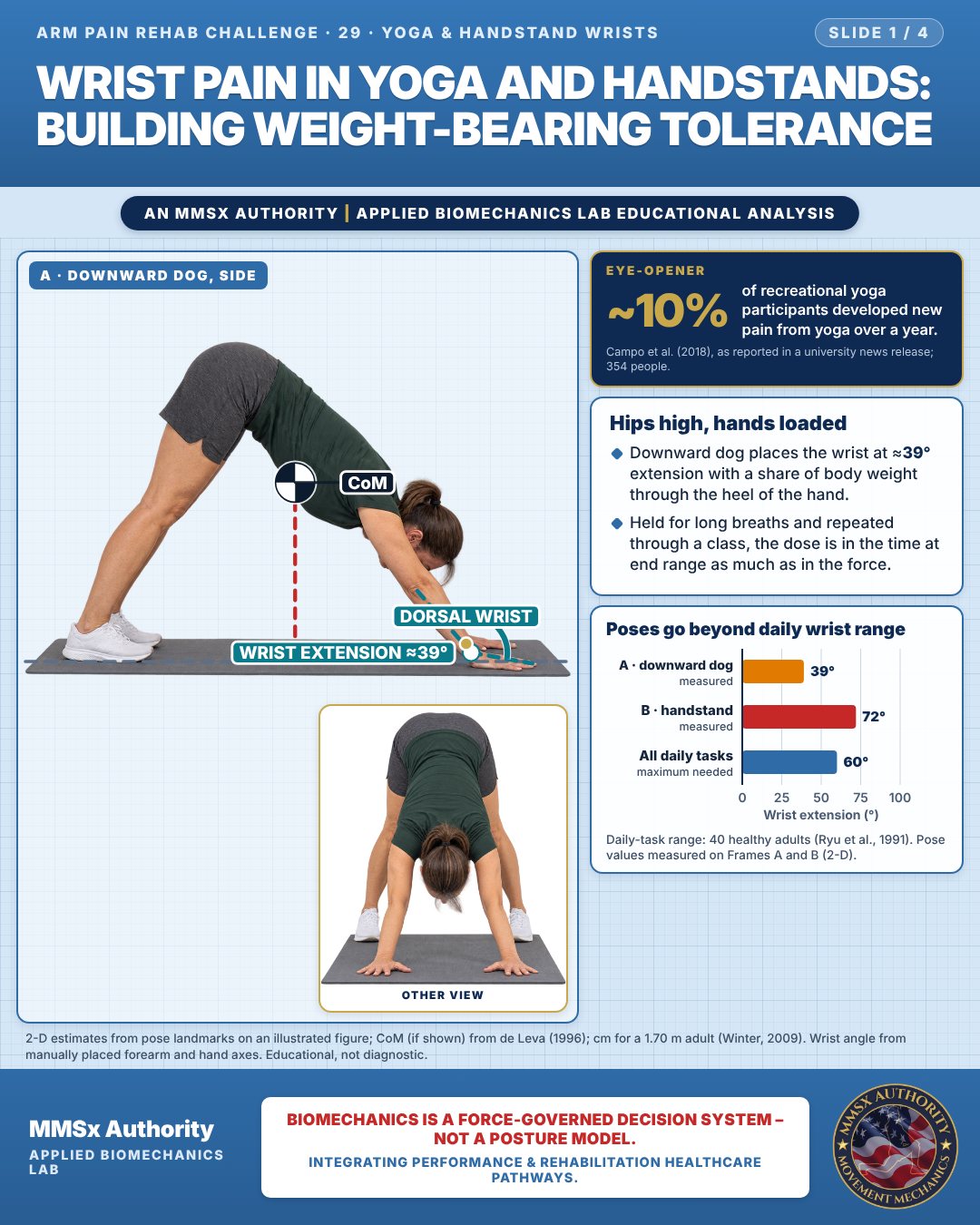
Hips high, hands loaded
Downward dog places the wrist at ≈39° extension with a share of body weight through the heel of the hand.
Held for long breaths and repeated through a class, the dose is in the time at end range as much as in the force.
Poses go beyond daily wrist range
Movement B: Wall handstand (side view)
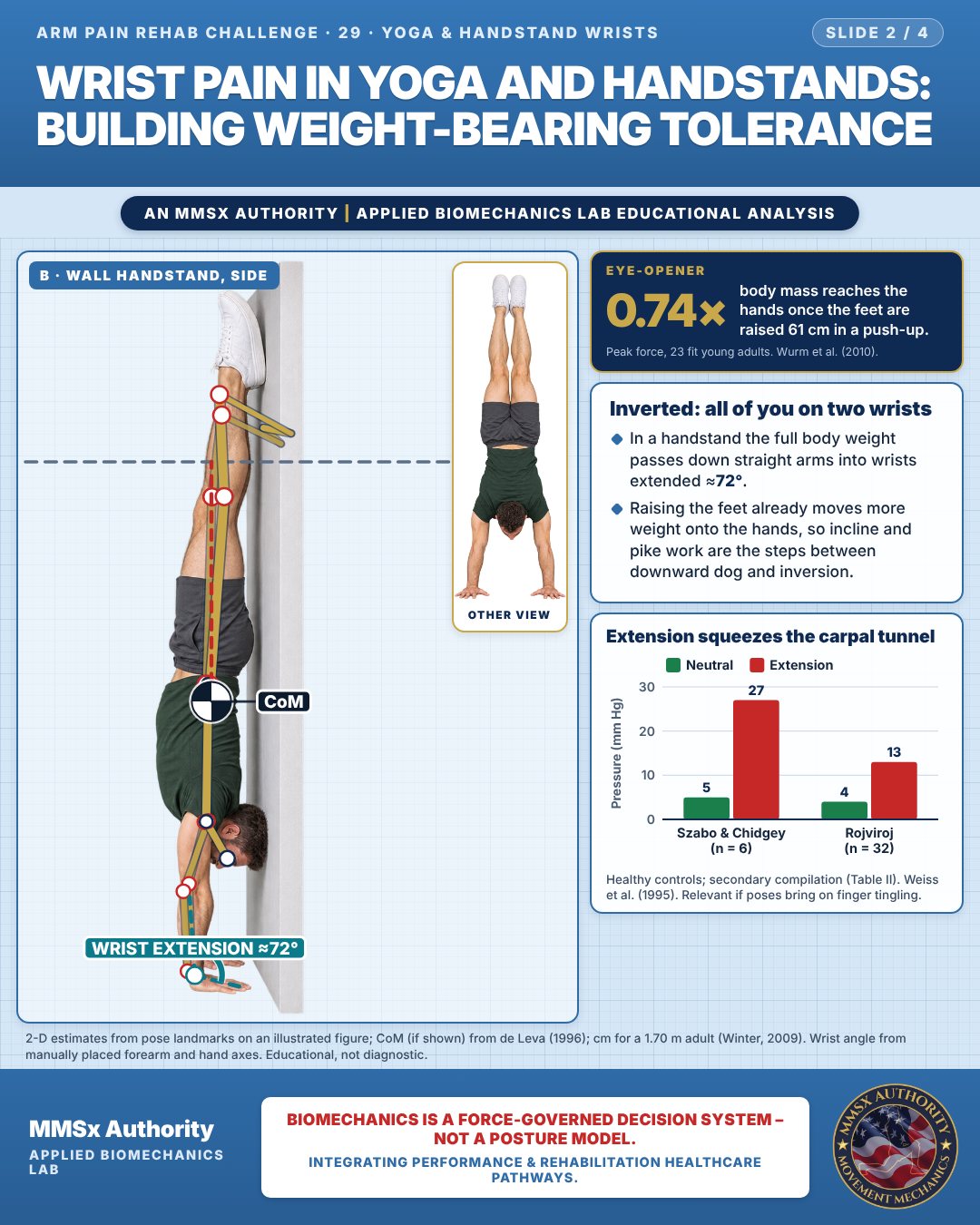
Inverted: all of you on two wrists
In a handstand the full body weight passes down straight arms into wrists extended ≈72°.
Raising the feet already moves more weight onto the hands, so incline and pike work are the steps between downward dog and inversion.
Extension squeezes the carpal tunnel
Movement C: Hand spread, top
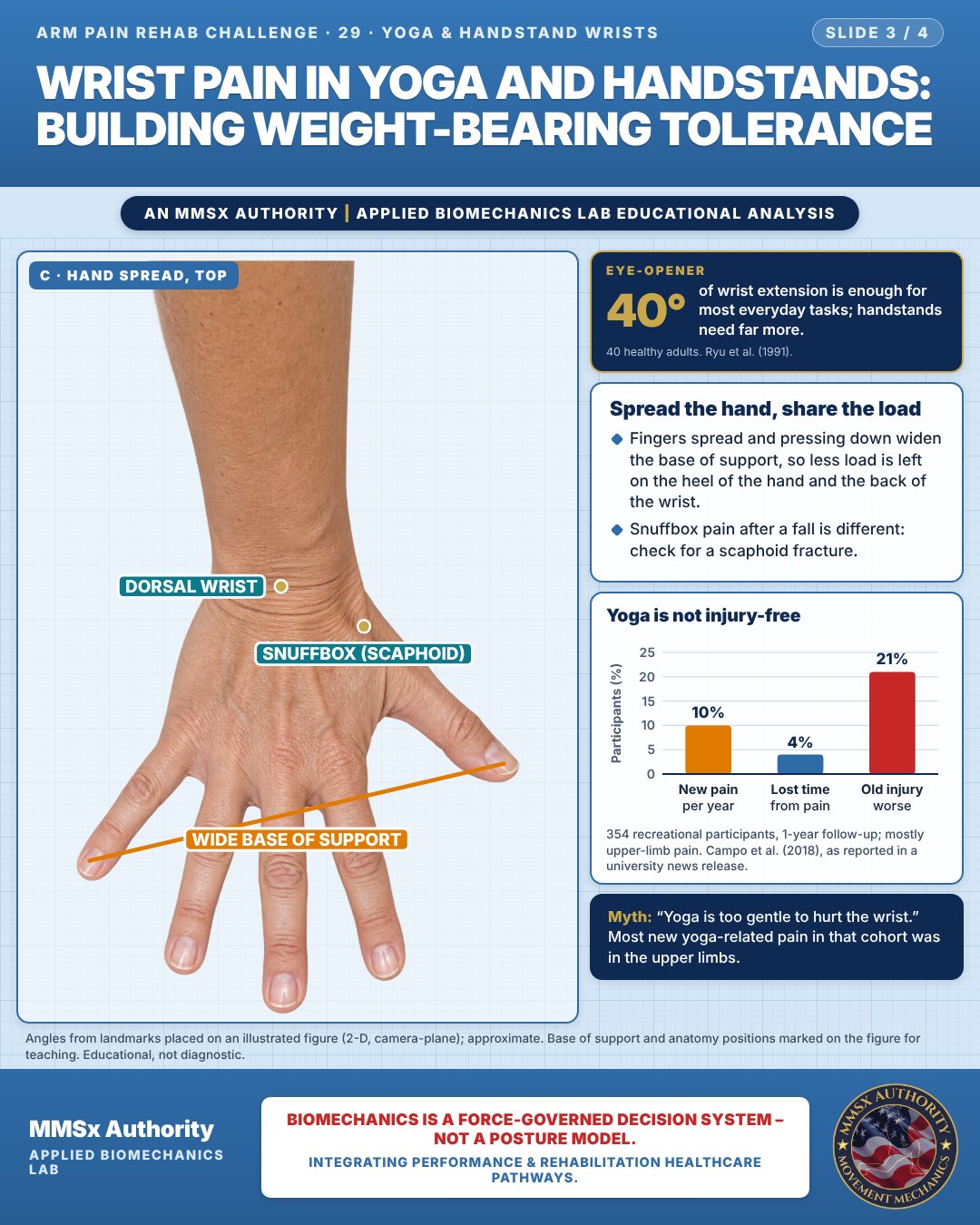
Spread the hand, share the load
Fingers spread and pressing down widen the base of support, so less load is left on the heel of the hand and the back of the wrist.
Snuffbox pain after a fall is different: check for a scaphoid fracture.
Yoga is not injury-free
Decision pathway
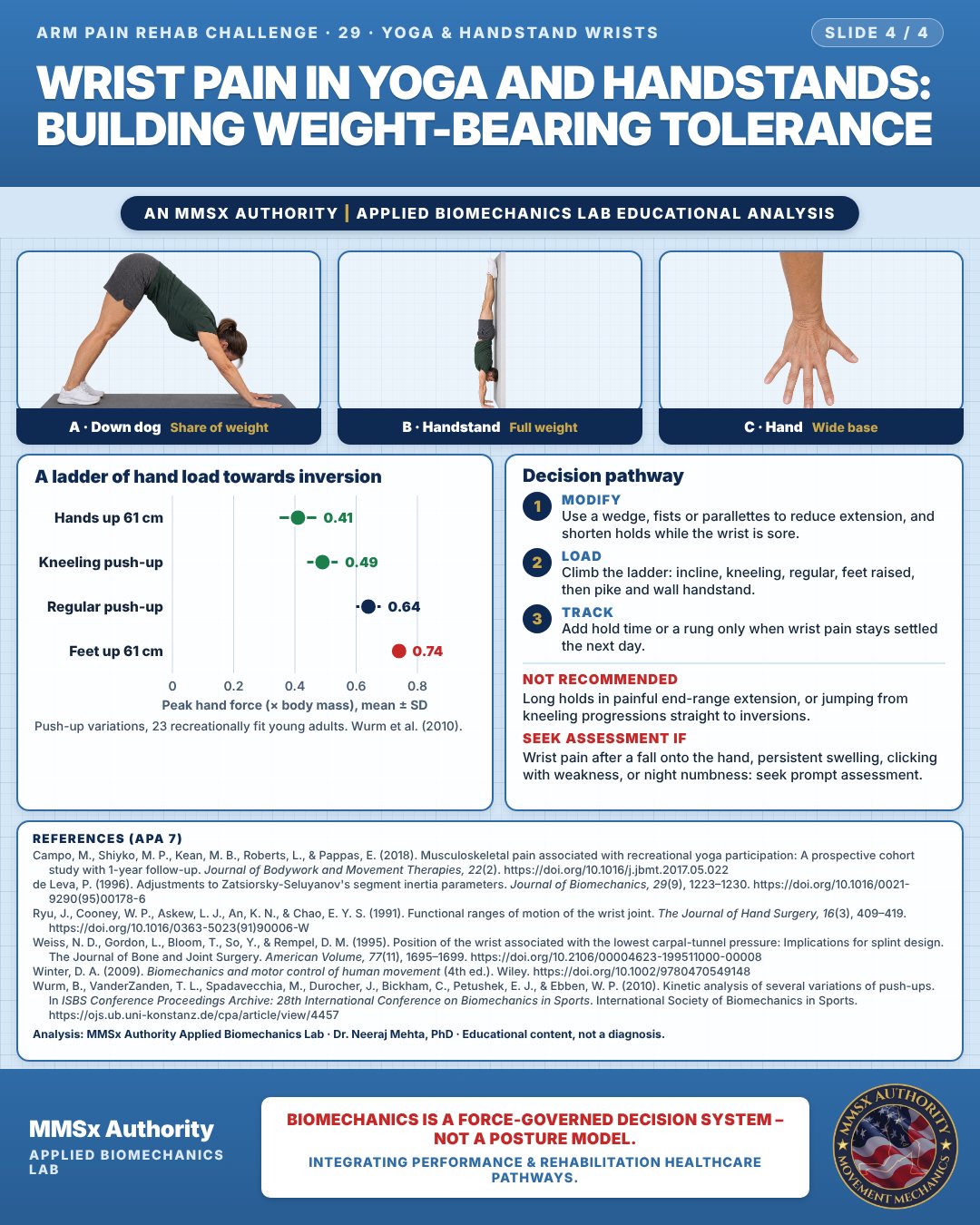
A ladder of hand load towards inversion
Modify
Use a wedge, fists or parallettes to reduce extension, and shorten holds while the wrist is sore.
Load
Climb the ladder: incline, kneeling, regular, feet raised, then pike and wall handstand.
Track
Add hold time or a rung only when wrist pain stays settled the next day.
Myth and evidence
Myth“Yoga is too gentle to injure the wrist.”
EvidenceNew yoga-related pain occurred in about 10% of participants per year, mostly in the upper limbs (Campo et al., 2018, as reported).
Cautions
Not recommended
Long holds in painful end-range extension, or jumping from kneeling progressions straight to inversions.
Seek assessment if
Wrist pain after a fall onto the hand, persistent swelling, clicking with weakness, or night numbness: seek prompt assessment.
Methods note
2-D estimates from pose landmarks on an illustrated figure; CoM (if shown) from de Leva (1996); cm for a 1.70 m adult (Winter, 2009). Wrist angle from manually placed forearm and hand axes. Angles from landmarks placed on an illustrated figure (2-D, camera-plane); approximate. Base of support and anatomy positions marked on the figure for teaching. These are educational estimates, not a diagnosis.
References
- Campo, M., Shiyko, M. P., Kean, M. B., Roberts, L., & Pappas, E. (2018). Musculoskeletal pain associated with recreational yoga participation: A prospective cohort study with 1-year follow-up. Journal of Bodywork and Movement Therapies, 22(2). https://doi.org/10.1016/j.jbmt.2017.05.022
- de Leva, P. (1996). Adjustments to Zatsiorsky-Seluyanov's segment inertia parameters. Journal of Biomechanics, 29(9), 1223–1230. https://doi.org/10.1016/0021-9290(95)00178-6
- Ryu, J., Cooney, W. P., Askew, L. J., An, K. N., & Chao, E. Y. S. (1991). Functional ranges of motion of the wrist joint. The Journal of Hand Surgery, 16(3), 409–419. https://doi.org/10.1016/0363-5023(91)90006-W
- Weiss, N. D., Gordon, L., Bloom, T., So, Y., & Rempel, D. M. (1995). Position of the wrist associated with the lowest carpal-tunnel pressure: Implications for splint design. The Journal of Bone and Joint Surgery. American Volume, 77(11), 1695–1699. https://doi.org/10.2106/00004623-199511000-00008
- Winter, D. A. (2009). Biomechanics and motor control of human movement (4th ed.). Wiley. https://doi.org/10.1002/9780470549148
- Wurm, B., VanderZanden, T. L., Spadavecchia, M., Durocher, J., Bickham, C., Petushek, E. J., & Ebben, W. P. (2010). Kinetic analysis of several variations of push-ups. In ISBS Conference Proceedings Archive: 28th International Conference on Biomechanics in Sports. International Society of Biomechanics in Sports. https://ojs.ub.uni-konstanz.de/cpa/article/view/4457
Cite this article
Mehta, N. (2026, October 28). Wrist pain in yoga and handstands: building weight-bearing tolerance. MMSx Authority Applied Biomechanics Lab. https://mmsxauthority.org/edu/analysis/arm/29-wrist-pain-in-yoga-and-handstands-building-weight-bearing-tolerance/
Part of the collection
Mehta, N. (2026). Elbow, Forearm, Wrist and Hand Rehabilitation: 50 Evidence-Based Biomechanics Analyses [Collection]. MMSx Authority Applied Biomechanics Lab. Zenodo. https://doi.org/10.5281/zenodo.23735910
All Arm Pain Rehab Challenge articles · Rehabilitation Library