Arm Pain Rehab Challenge · 28
Wrist pain in push-ups and planks: extension load and hand position
Dorsal or ulnar-sided wrist pain during weight-bearing on the hands, associated with loading the wrist at end-range extension (flat-hand…
Key points
- Modify. Swap flat hands for fists, handles or a forearm plank while the wrist is sore.
- Load. Lower the hand share first (incline, kneeling), then add flat-hand time in short, pain-free holds.
- Track. Progress extension and volume only when wrist pain stays settled the next day.
What it is
Dorsal or ulnar-sided wrist pain during weight-bearing on the hands, associated with loading the wrist at end-range extension (flat-hand plank/push-up, Movement A). Mechanisms include compressive load concentrated at the dorsal wrist; it is a load-tolerance problem rather than one diagnosis.
How we analysed the movement
Three movements relevant to this topic were analysed from illustrated reference figures. Joint centres were located with two-dimensional pose estimation where the whole arm was visible; elbow and wrist angles, and the directions of external load and tendon pull, were then drawn on the figure; on hand close-ups, where pose estimation does not apply, the landmarks were placed manually. The figures are educational estimates that show how position changes mechanical demand; they are not measurements of a patient. Every research value quoted below comes from the published source cited beside it.
Movement A: Flat-hand plank (side view)
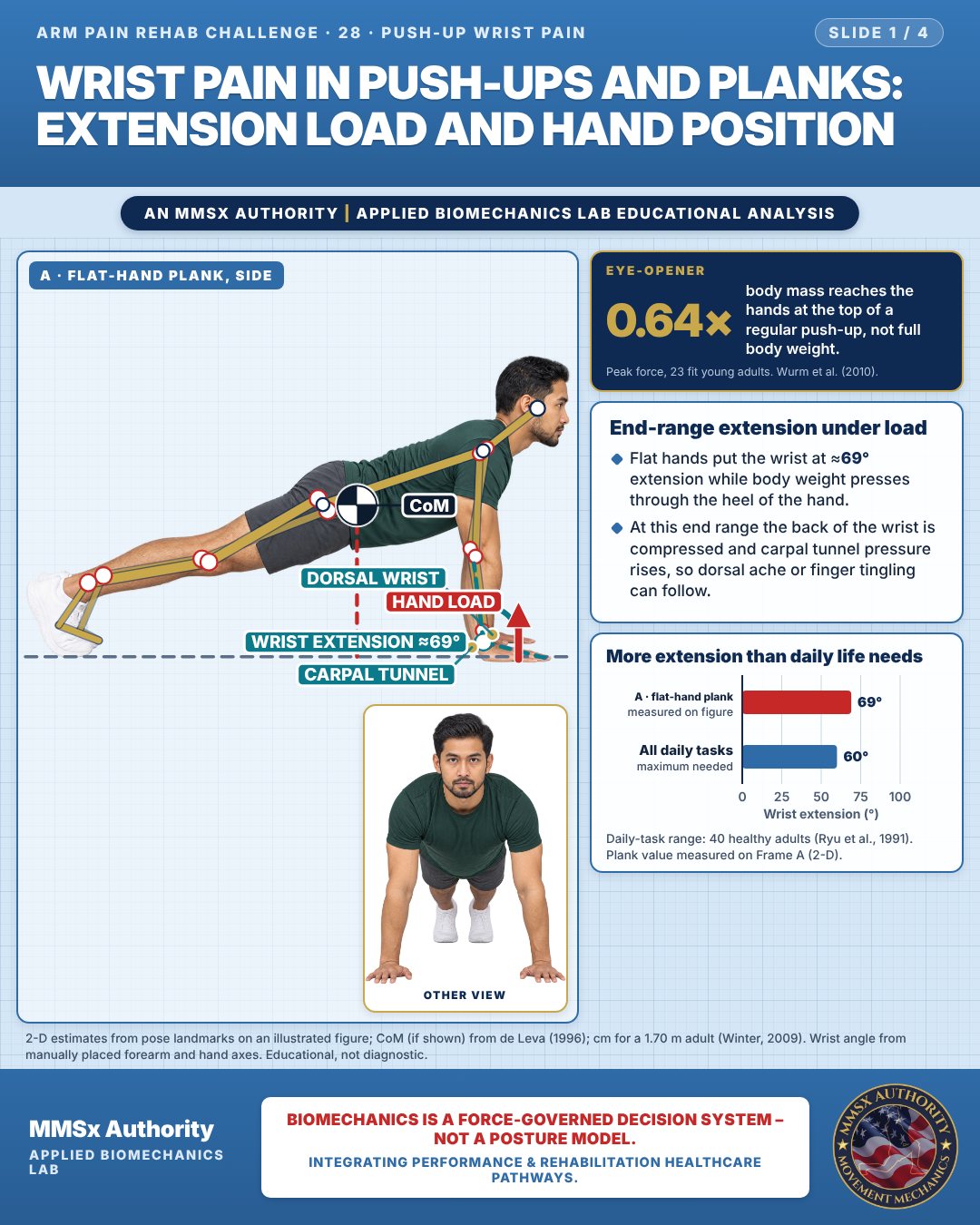
End-range extension under load
Flat hands put the wrist at ≈69° extension while body weight presses through the heel of the hand.
At this end range the back of the wrist is compressed and carpal tunnel pressure rises, so dorsal ache or finger tingling can follow.
More extension than daily life needs
Movement B: Plank on fists (side view)
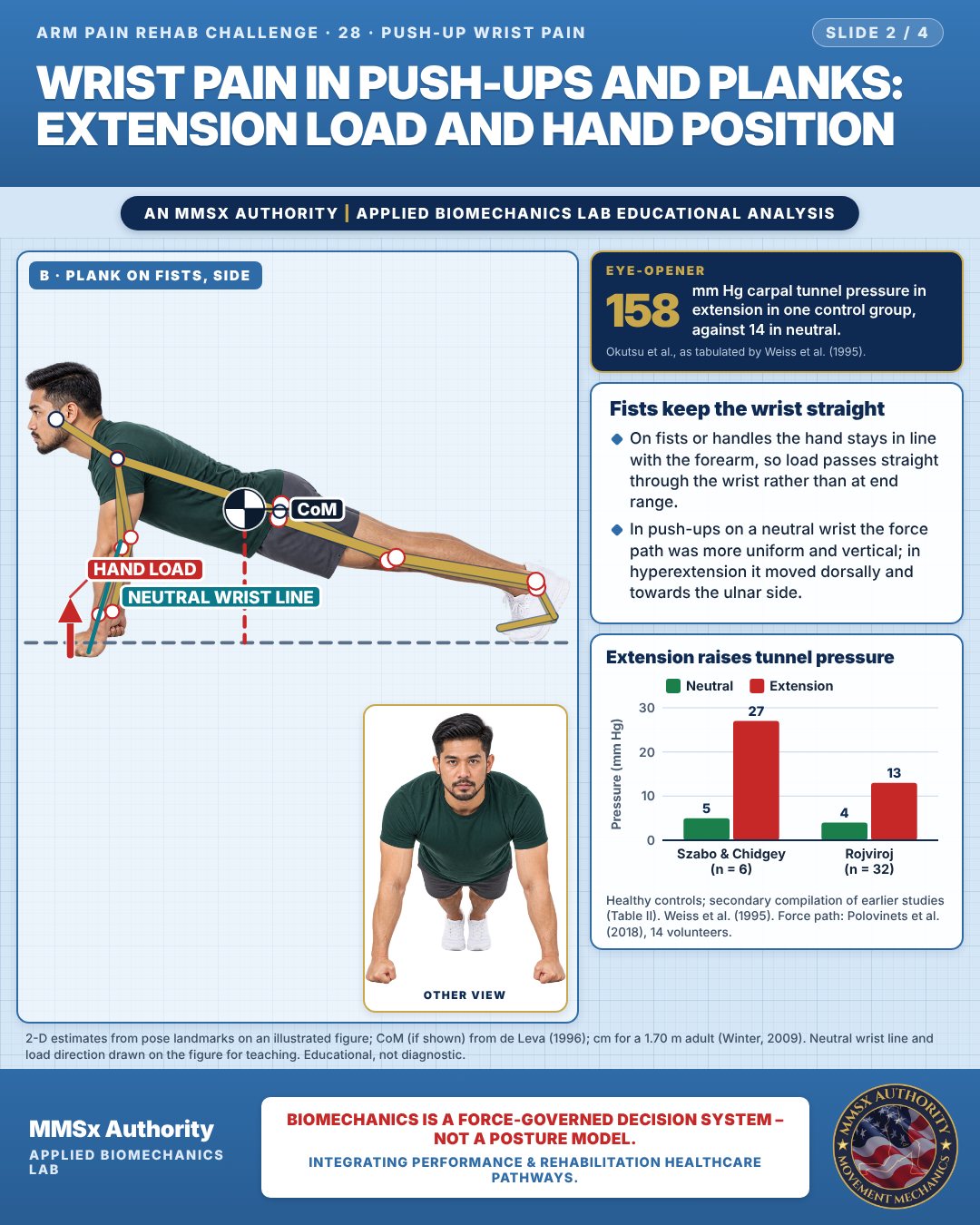
Fists keep the wrist straight
On fists or handles the hand stays in line with the forearm, so load passes straight through the wrist rather than at end range.
In push-ups on a neutral wrist the force path was more uniform and vertical; in hyperextension it moved dorsally and towards the ulnar side.
Extension raises tunnel pressure
Movement C: Forearm plank (side view)
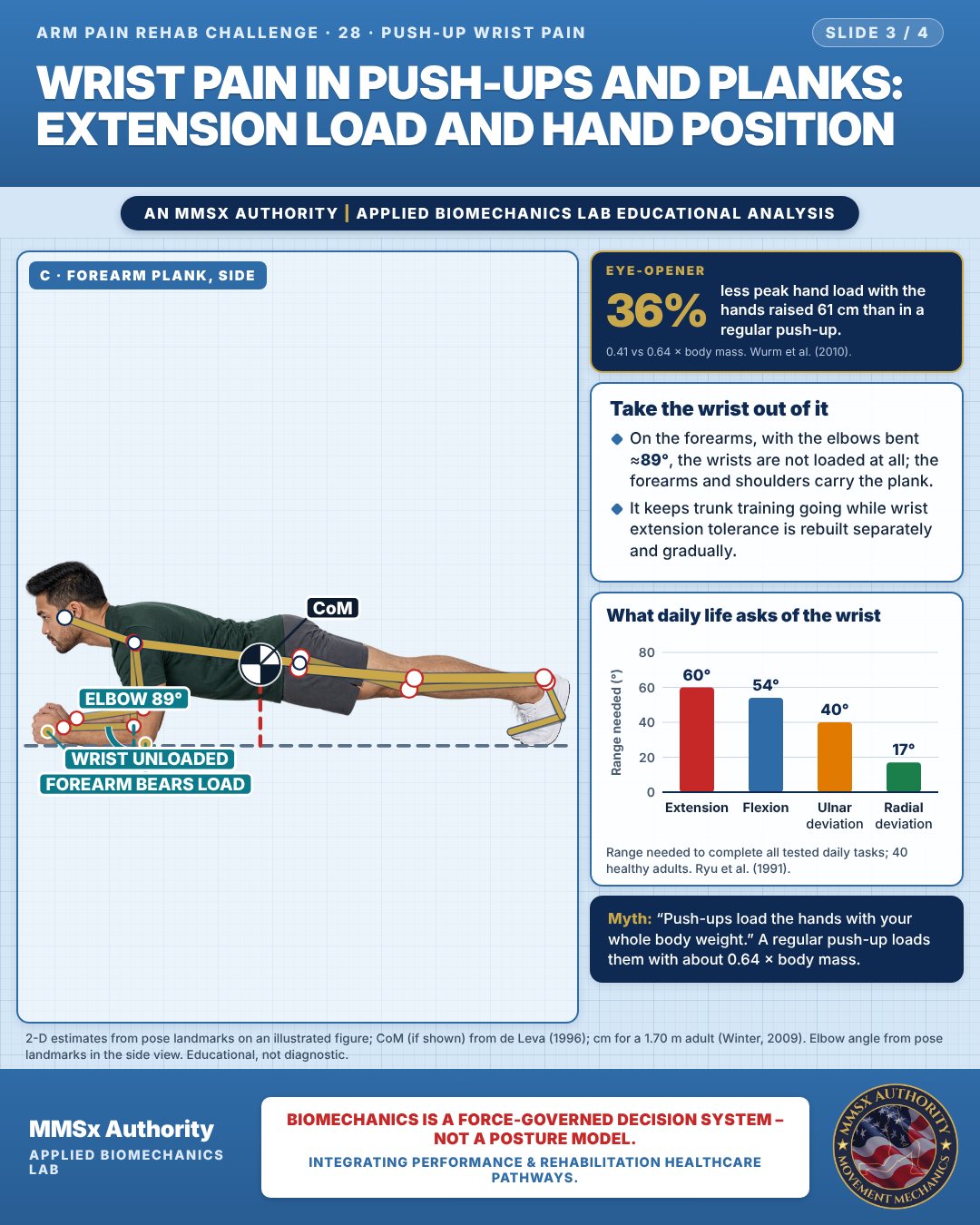
Take the wrist out of it
On the forearms, with the elbows bent ≈89°, the wrists are not loaded at all; the forearms and shoulders carry the plank.
It keeps trunk training going while wrist extension tolerance is rebuilt separately and gradually.
What daily life asks of the wrist
Decision pathway
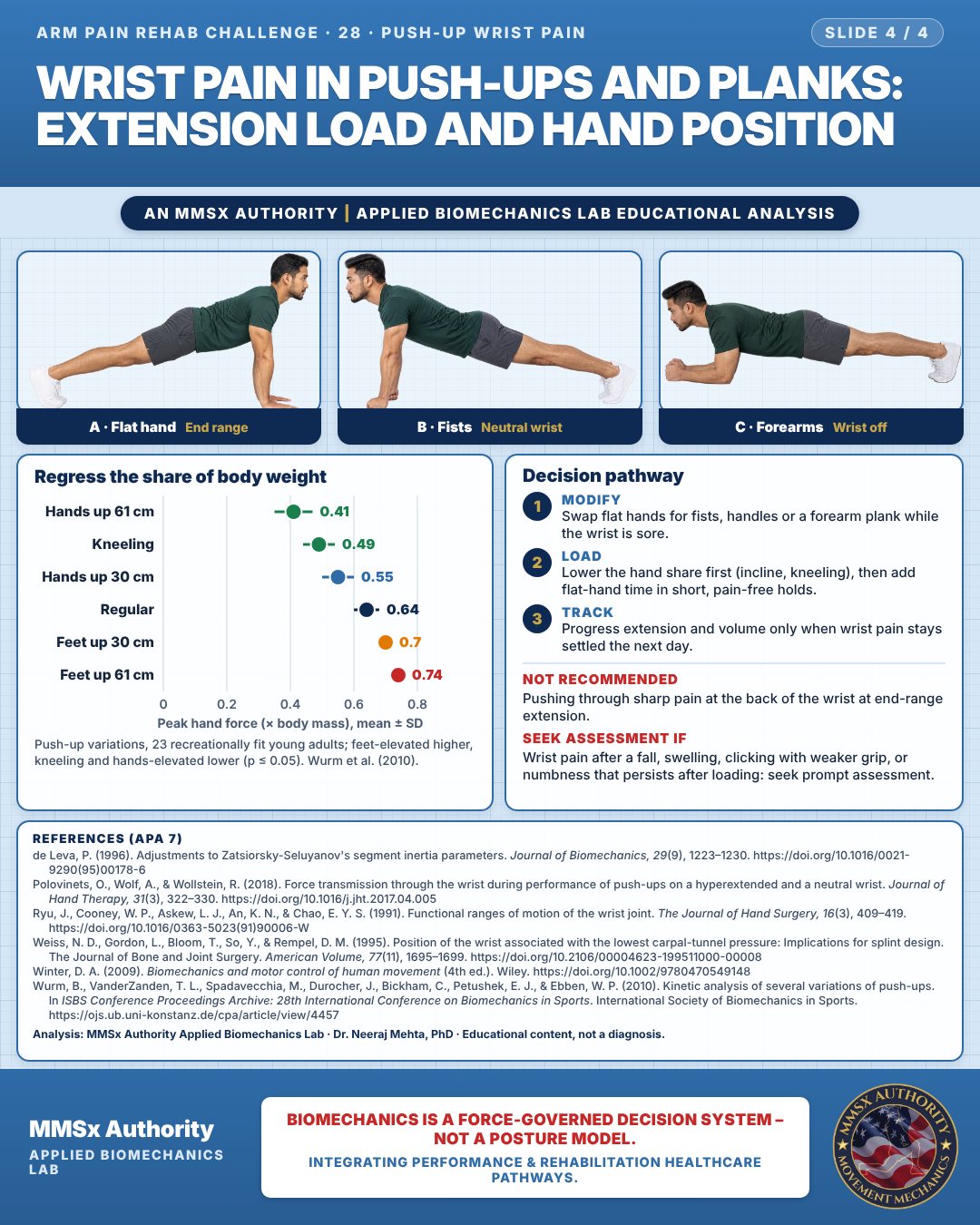
Regress the share of body weight
Modify
Swap flat hands for fists, handles or a forearm plank while the wrist is sore.
Load
Lower the hand share first (incline, kneeling), then add flat-hand time in short, pain-free holds.
Track
Progress extension and volume only when wrist pain stays settled the next day.
Cautions
Not recommended
Pushing through sharp pain at the back of the wrist at end-range extension.
Seek assessment if
Wrist pain after a fall, swelling, clicking with weaker grip, or numbness that persists after loading: seek prompt assessment.
Methods note
2-D estimates from pose landmarks on an illustrated figure; CoM (if shown) from de Leva (1996); cm for a 1.70 m adult (Winter, 2009). Wrist angle from manually placed forearm and hand axes. Neutral wrist line and load direction drawn on the figure for teaching. Elbow angle from pose landmarks in the side view. These are educational estimates, not a diagnosis.
References
- de Leva, P. (1996). Adjustments to Zatsiorsky-Seluyanov's segment inertia parameters. Journal of Biomechanics, 29(9), 1223–1230. https://doi.org/10.1016/0021-9290(95)00178-6
- Polovinets, O., Wolf, A., & Wollstein, R. (2018). Force transmission through the wrist during performance of push-ups on a hyperextended and a neutral wrist. Journal of Hand Therapy, 31(3), 322–330. https://doi.org/10.1016/j.jht.2017.04.005
- Ryu, J., Cooney, W. P., Askew, L. J., An, K. N., & Chao, E. Y. S. (1991). Functional ranges of motion of the wrist joint. The Journal of Hand Surgery, 16(3), 409–419. https://doi.org/10.1016/0363-5023(91)90006-W
- Weiss, N. D., Gordon, L., Bloom, T., So, Y., & Rempel, D. M. (1995). Position of the wrist associated with the lowest carpal-tunnel pressure: Implications for splint design. The Journal of Bone and Joint Surgery. American Volume, 77(11), 1695–1699. https://doi.org/10.2106/00004623-199511000-00008
- Winter, D. A. (2009). Biomechanics and motor control of human movement (4th ed.). Wiley. https://doi.org/10.1002/9780470549148
- Wurm, B., VanderZanden, T. L., Spadavecchia, M., Durocher, J., Bickham, C., Petushek, E. J., & Ebben, W. P. (2010). Kinetic analysis of several variations of push-ups. In ISBS Conference Proceedings Archive: 28th International Conference on Biomechanics in Sports. International Society of Biomechanics in Sports. https://ojs.ub.uni-konstanz.de/cpa/article/view/4457
Cite this article
Mehta, N. (2026, October 28). Wrist pain in push-ups and planks: extension load and hand position. MMSx Authority Applied Biomechanics Lab. https://mmsxauthority.org/edu/analysis/arm/28-wrist-pain-in-push-ups-and-planks-extension-load-and-hand-position/
Part of the collection
Mehta, N. (2026). Elbow, Forearm, Wrist and Hand Rehabilitation: 50 Evidence-Based Biomechanics Analyses [Collection]. MMSx Authority Applied Biomechanics Lab. Zenodo. https://doi.org/10.5281/zenodo.23735910
All Arm Pain Rehab Challenge articles · Rehabilitation Library