Arm Pain Rehab Challenge · 27
De Quervain’s tenosynovitis: thumb-side wrist pain in new parents
Painful stenosing tenosynovitis of the first dorsal extensor compartment (abductor pollicis longus and extensor pollicis brevis) at the radial…
Key points
- Modify. Scoop the baby with palms under the body and the thumbs alongside the fingers, not spread wide.
- Load. Use a thumb splint for flare-ups; discuss a steroid injection, which had the highest pooled cure rate.
- Track. Check pain on lifting and resisted thumb abduction weekly; refer for surgical release if it persists.
What it is
Painful stenosing tenosynovitis of the first dorsal extensor compartment (abductor pollicis longus and extensor pollicis brevis) at the radial styloid, provoked by thumb abduction/extension and wrist ulnar deviation — e.g. lifting a baby under the arms with thumbs spread (Frames A and B).
How we analysed the movement
Three movements relevant to this topic were analysed from illustrated reference figures. Joint centres were located with two-dimensional pose estimation where the whole arm was visible; elbow and wrist angles, and the directions of external load and tendon pull, were then drawn on the figure; on hand close-ups, where pose estimation does not apply, the landmarks were placed manually. The figures are educational estimates that show how position changes mechanical demand; they are not measurements of a patient. Every research value quoted below comes from the published source cited beside it.
Movement A: Lift under arms (front view)
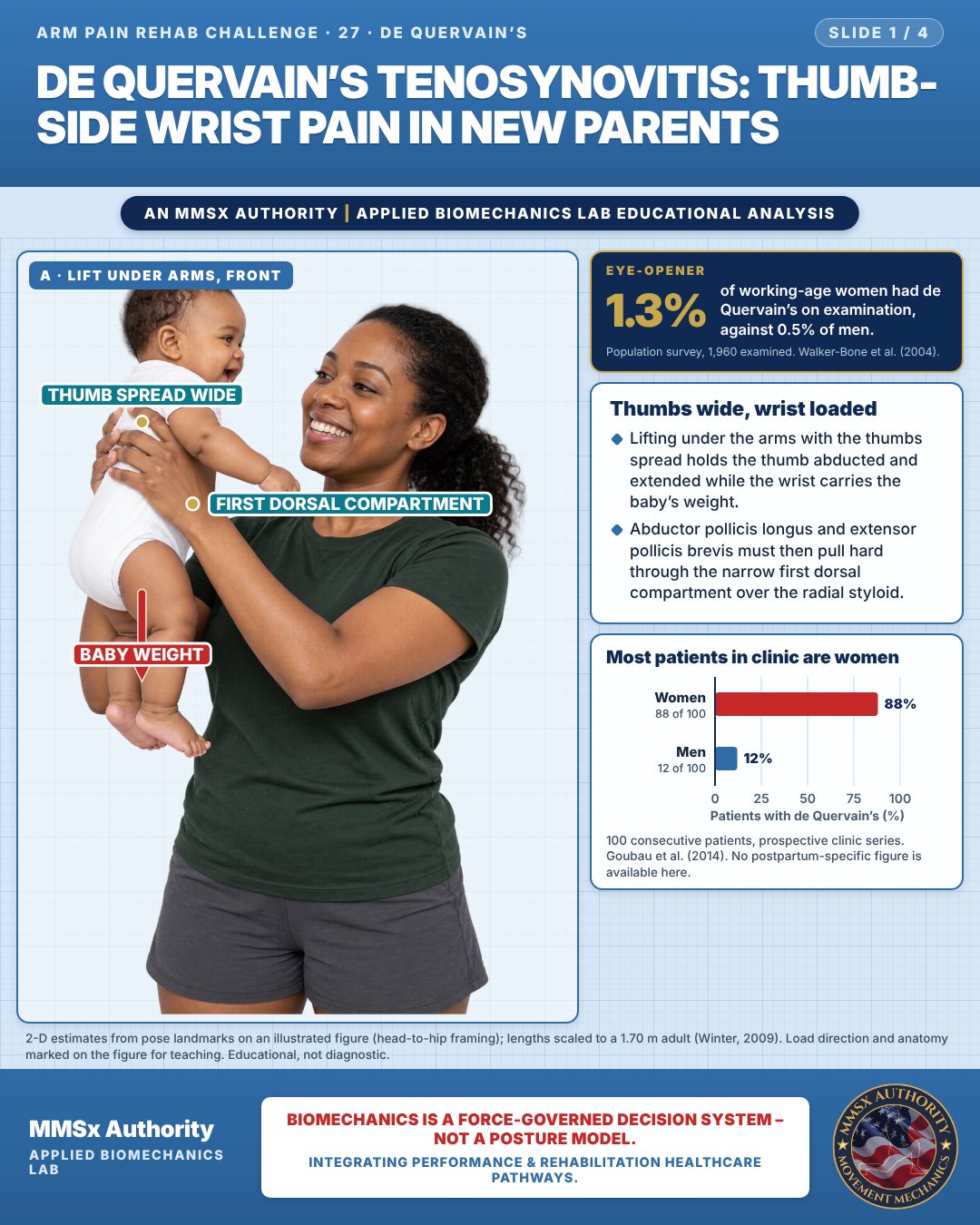
Thumbs wide, wrist loaded
Lifting under the arms with the thumbs spread holds the thumb abducted and extended while the wrist carries the baby’s weight.
Abductor pollicis longus and extensor pollicis brevis must then pull hard through the narrow first dorsal compartment over the radial styloid.
Most patients in clinic are women
Movement B: Cradle hold (side view)
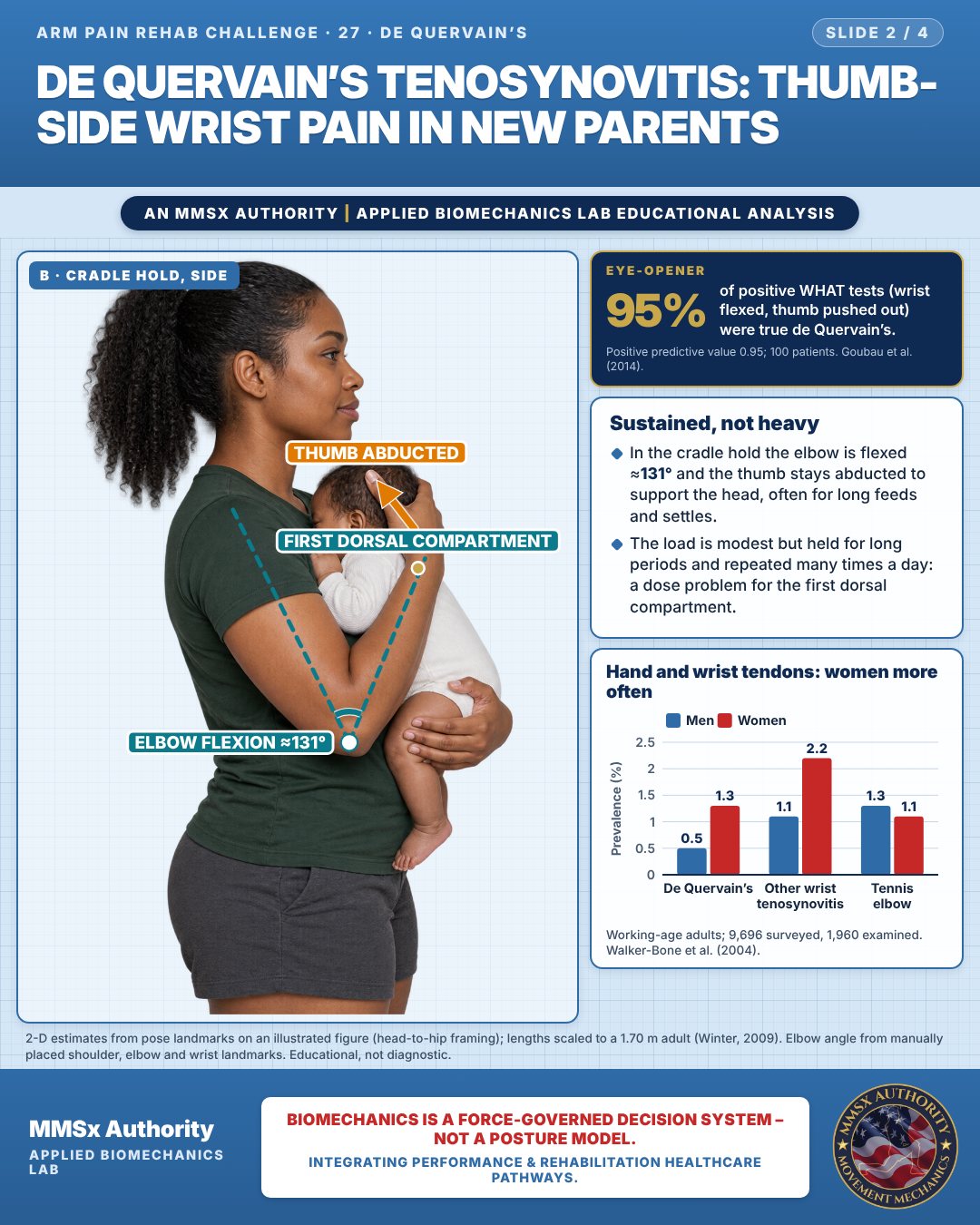
Sustained, not heavy
In the cradle hold the elbow is flexed ≈131° and the thumb stays abducted to support the head, often for long feeds and settles.
The load is modest but held for long periods and repeated many times a day: a dose problem for the first dorsal compartment.
Hand and wrist tendons: women more often
Movement C: Thumb-in-fist test (side view)
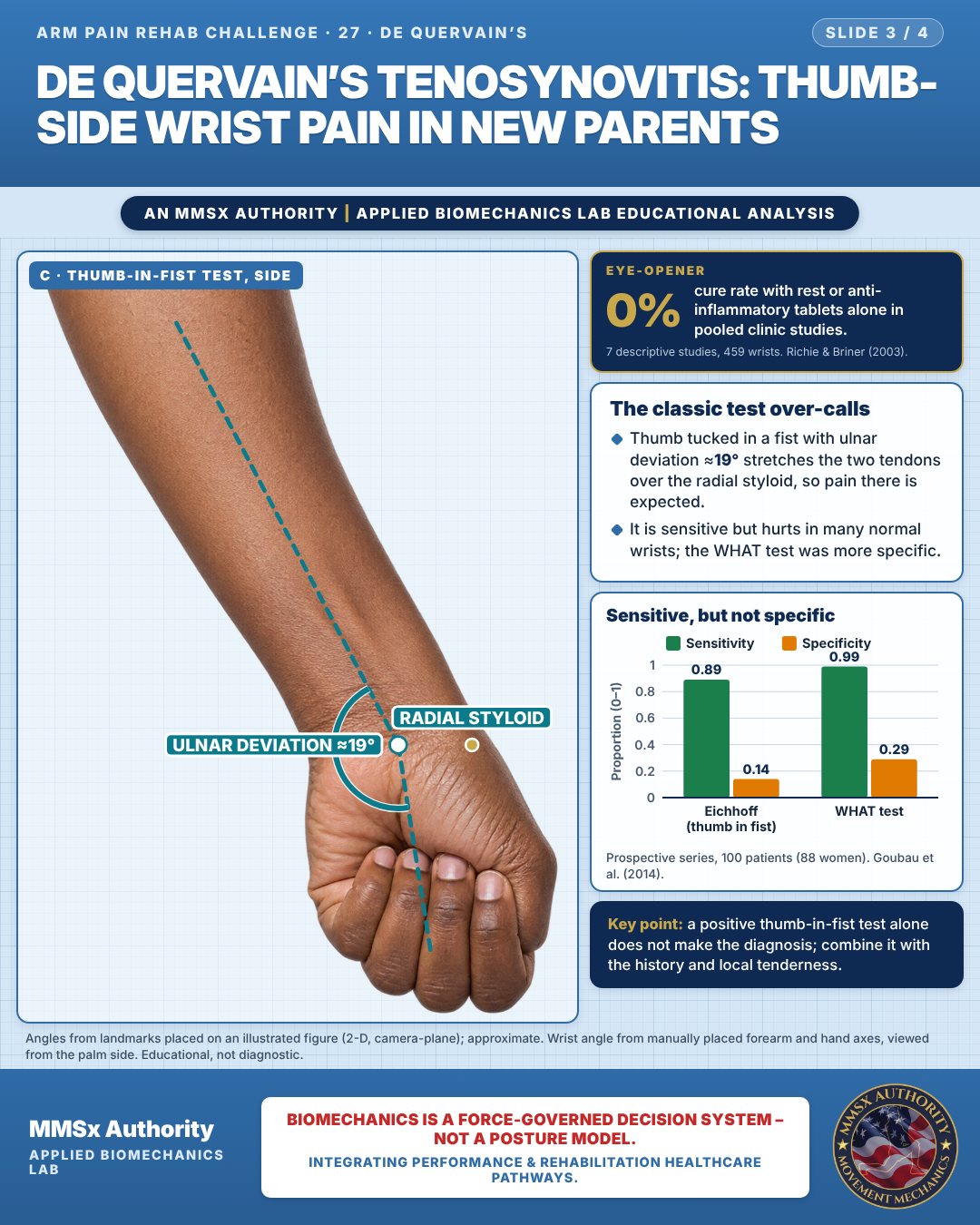
The classic test over-calls
Thumb tucked in a fist with ulnar deviation ≈19° stretches the two tendons over the radial styloid, so pain there is expected.
It is sensitive but hurts in many normal wrists; the WHAT test was more specific.
Sensitive, but not specific
Decision pathway
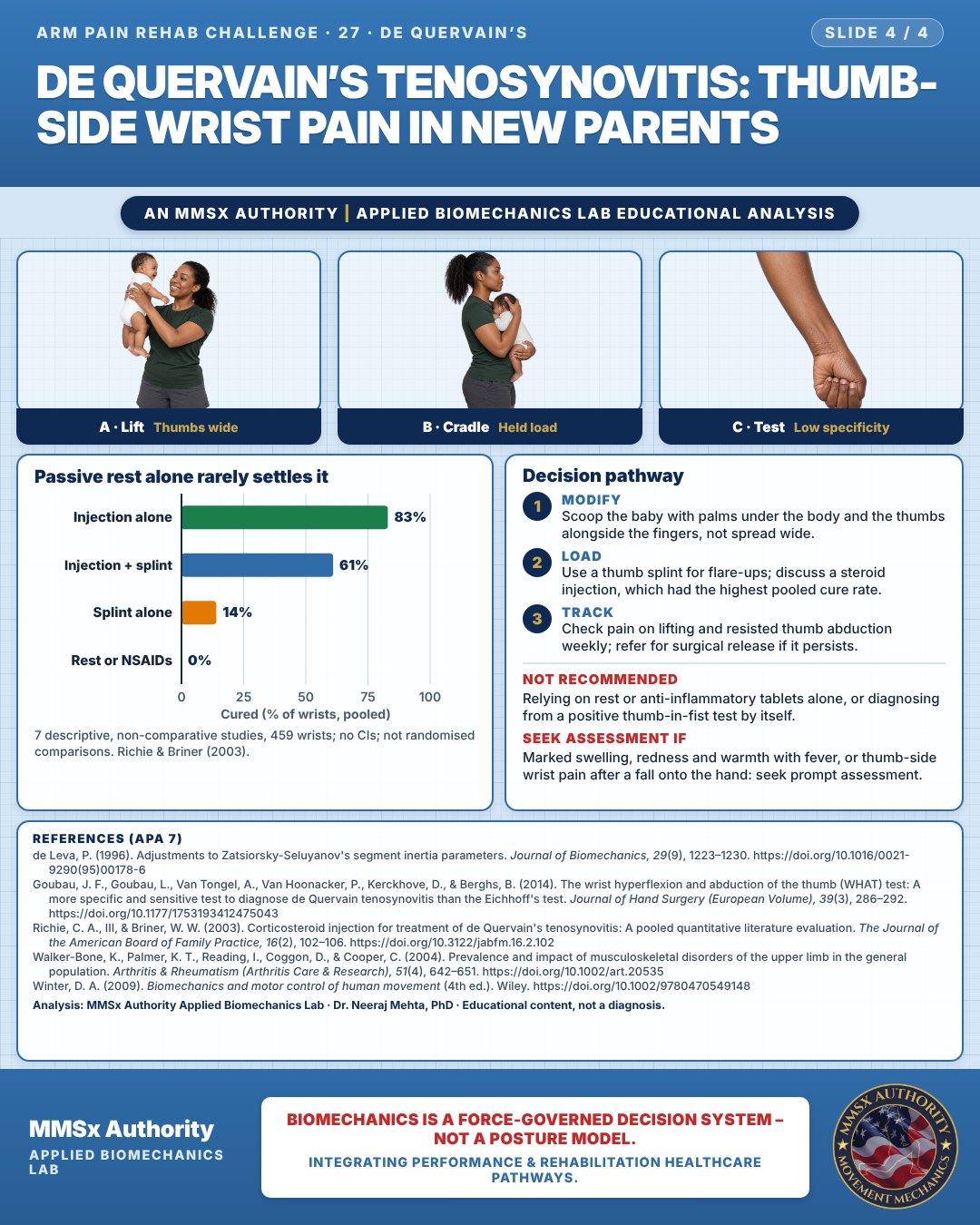
Passive rest alone rarely settles it
Modify
Scoop the baby with palms under the body and the thumbs alongside the fingers, not spread wide.
Load
Use a thumb splint for flare-ups; discuss a steroid injection, which had the highest pooled cure rate.
Track
Check pain on lifting and resisted thumb abduction weekly; refer for surgical release if it persists.
What the evidence supports
- Load modification (reduce sustained thumb abduction with ulnar deviation — e.g. lift the baby with the hands scooped under the body rather than thumbs spread), splinting, and corticosteroid injection, which had the highest pooled cure rate (Richie & Briner, 2003). Surgical release for refractory cases (clinical teaching).
Myth and evidence
Myth“Splint and rest will settle it.”
EvidencePooled data show 14% cure with a splint alone and 0% with rest/NSAIDs, versus 83% with injection (Richie & Briner, 2003) — load modification still matters, but passive rest alone rarely resolves it.
Cautions
Not recommended
Relying on rest or anti-inflammatory tablets alone, or diagnosing from a positive thumb-in-fist test by itself.
Seek assessment if
Marked swelling, redness and warmth with fever, or thumb-side wrist pain after a fall onto the hand: seek prompt assessment.
Methods note
2-D estimates from pose landmarks on an illustrated figure (head-to-hip framing); lengths scaled to a 1.70 m adult (Winter, 2009). Load direction and anatomy marked on the figure for teaching. Elbow angle from manually placed shoulder, elbow and wrist landmarks. Angles from landmarks placed on an illustrated figure (2-D, camera-plane); approximate. Wrist angle from manually placed forearm and hand axes, viewed from the palm side. These are educational estimates, not a diagnosis.
References
- de Leva, P. (1996). Adjustments to Zatsiorsky-Seluyanov's segment inertia parameters. Journal of Biomechanics, 29(9), 1223–1230. https://doi.org/10.1016/0021-9290(95)00178-6
- Goubau, J. F., Goubau, L., Van Tongel, A., Van Hoonacker, P., Kerckhove, D., & Berghs, B. (2014). The wrist hyperflexion and abduction of the thumb (WHAT) test: A more specific and sensitive test to diagnose de Quervain tenosynovitis than the Eichhoff's test. Journal of Hand Surgery (European Volume), 39(3), 286–292. https://doi.org/10.1177/1753193412475043
- Richie, C. A., III, & Briner, W. W. (2003). Corticosteroid injection for treatment of de Quervain's tenosynovitis: A pooled quantitative literature evaluation. The Journal of the American Board of Family Practice, 16(2), 102–106. https://doi.org/10.3122/jabfm.16.2.102
- Walker-Bone, K., Palmer, K. T., Reading, I., Coggon, D., & Cooper, C. (2004). Prevalence and impact of musculoskeletal disorders of the upper limb in the general population. Arthritis & Rheumatism (Arthritis Care & Research), 51(4), 642–651. https://doi.org/10.1002/art.20535
- Winter, D. A. (2009). Biomechanics and motor control of human movement (4th ed.). Wiley. https://doi.org/10.1002/9780470549148
Cite this article
Mehta, N. (2026, October 28). De Quervain’s tenosynovitis: thumb-side wrist pain in new parents. MMSx Authority Applied Biomechanics Lab. https://mmsxauthority.org/edu/analysis/arm/27-de-quervains-tenosynovitis-thumb-side-wrist-pain-in-new-parents/
Part of the collection
Mehta, N. (2026). Elbow, Forearm, Wrist and Hand Rehabilitation: 50 Evidence-Based Biomechanics Analyses [Collection]. MMSx Authority Applied Biomechanics Lab. Zenodo. https://doi.org/10.5281/zenodo.23735910
All Arm Pain Rehab Challenge articles · Rehabilitation Library