Arm Pain Rehab Challenge · 26
Carpal tunnel: splints, exercise or surgery? Reading the evidence
Wrist extension ≈ 79° with the fingers and thumb straight moves the median nerve through the carpal tunnel at the front of the wrist. A “slider”…
Key points
- Modify. Wear a neutral night splint and cut sustained end-range wrist positions; expect a small, short-term benefit.
- Load. Add gentle nerve sliders and tendon glides as low-risk extras, not as a proven cure.
- Track. If symptoms persist or progress, ask for nerve testing and a surgical opinion: release succeeded more often.
What it is
As Title 25: median nerve compression at the wrist. This title compares the main management options — splinting, exercise/nerve and tendon gliding, and surgical release.
How we analysed the movement
Three movements relevant to this topic were analysed from illustrated reference figures. Joint centres were located with two-dimensional pose estimation where the whole arm was visible; elbow and wrist angles, and the directions of external load and tendon pull, were then drawn on the figure; on hand close-ups, where pose estimation does not apply, the landmarks were placed manually. The figures are educational estimates that show how position changes mechanical demand; they are not measurements of a patient. Every research value quoted below comes from the published source cited beside it.
Movement A: Nerve glide (side view)
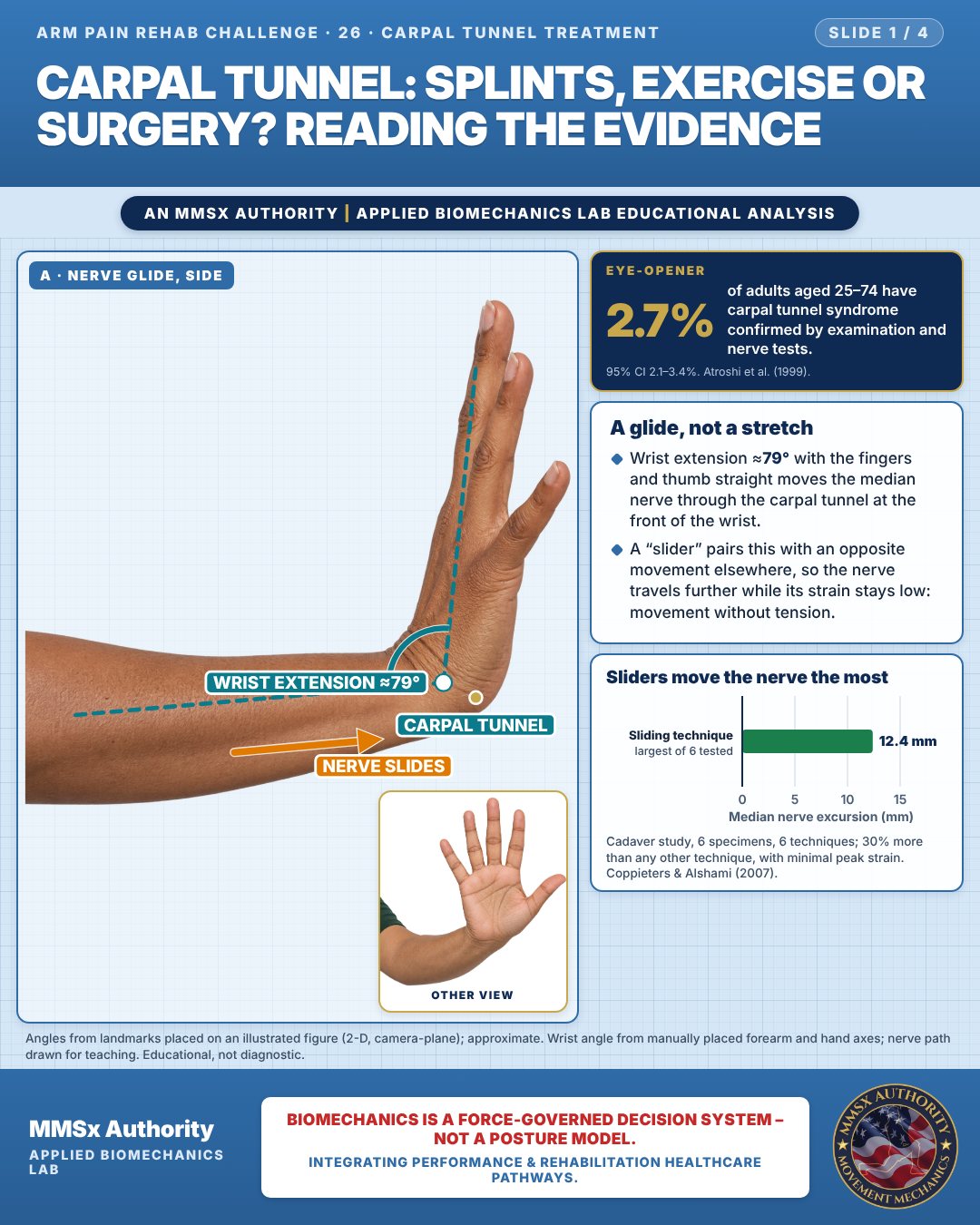
A glide, not a stretch
Wrist extension ≈79° with the fingers and thumb straight moves the median nerve through the carpal tunnel at the front of the wrist.
A “slider” pairs this with an opposite movement elsewhere, so the nerve travels further while its strain stays low: movement without tension.
Sliders move the nerve the most
Movement B: Fist glide (side view)
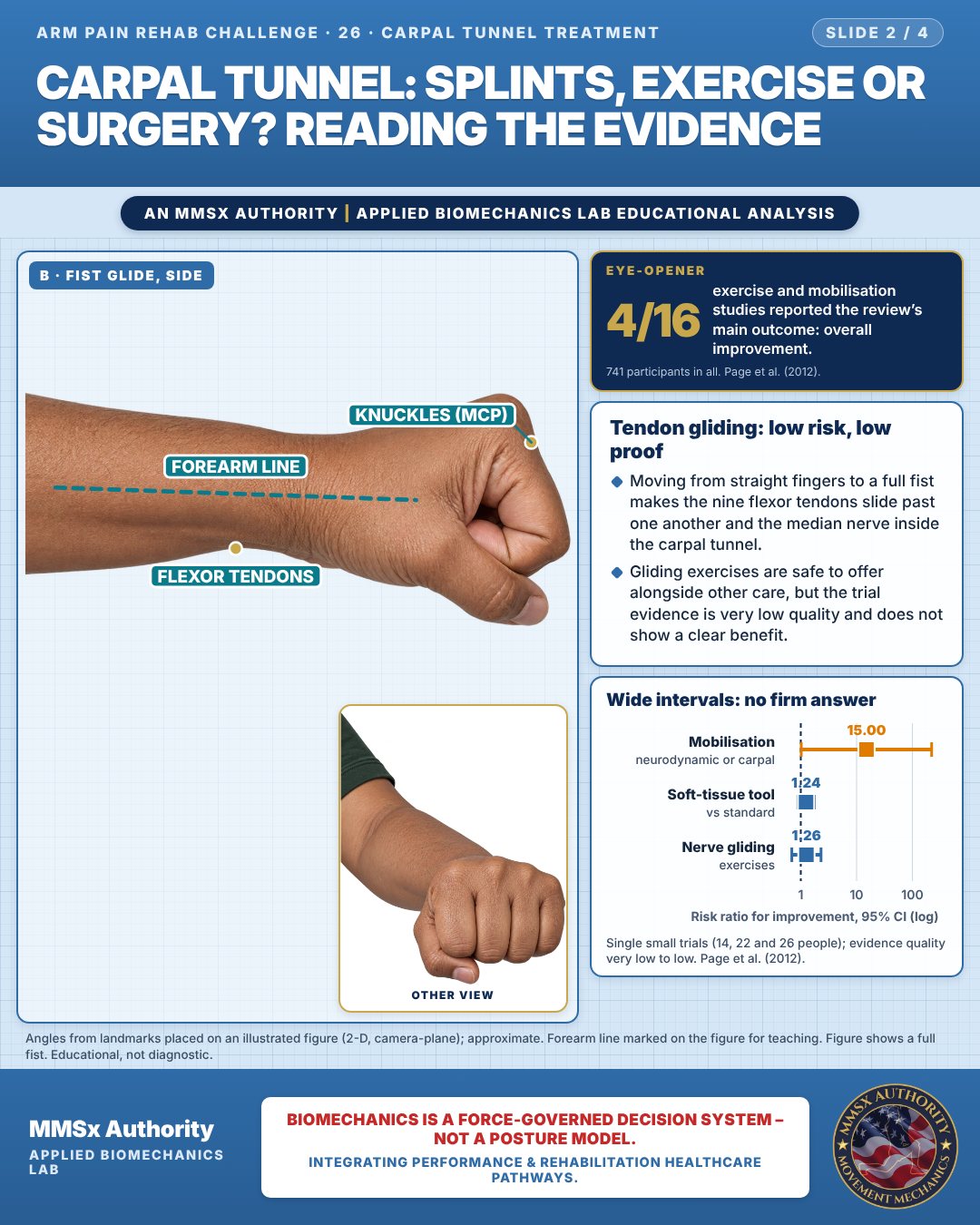
Tendon gliding: low risk, low proof
Moving from straight fingers to a full fist makes the nine flexor tendons slide past one another and the median nerve inside the carpal tunnel.
Gliding exercises are safe to offer alongside other care, but the trial evidence is very low quality and does not show a clear benefit.
Wide intervals: no firm answer
Movement C: Palm up, top
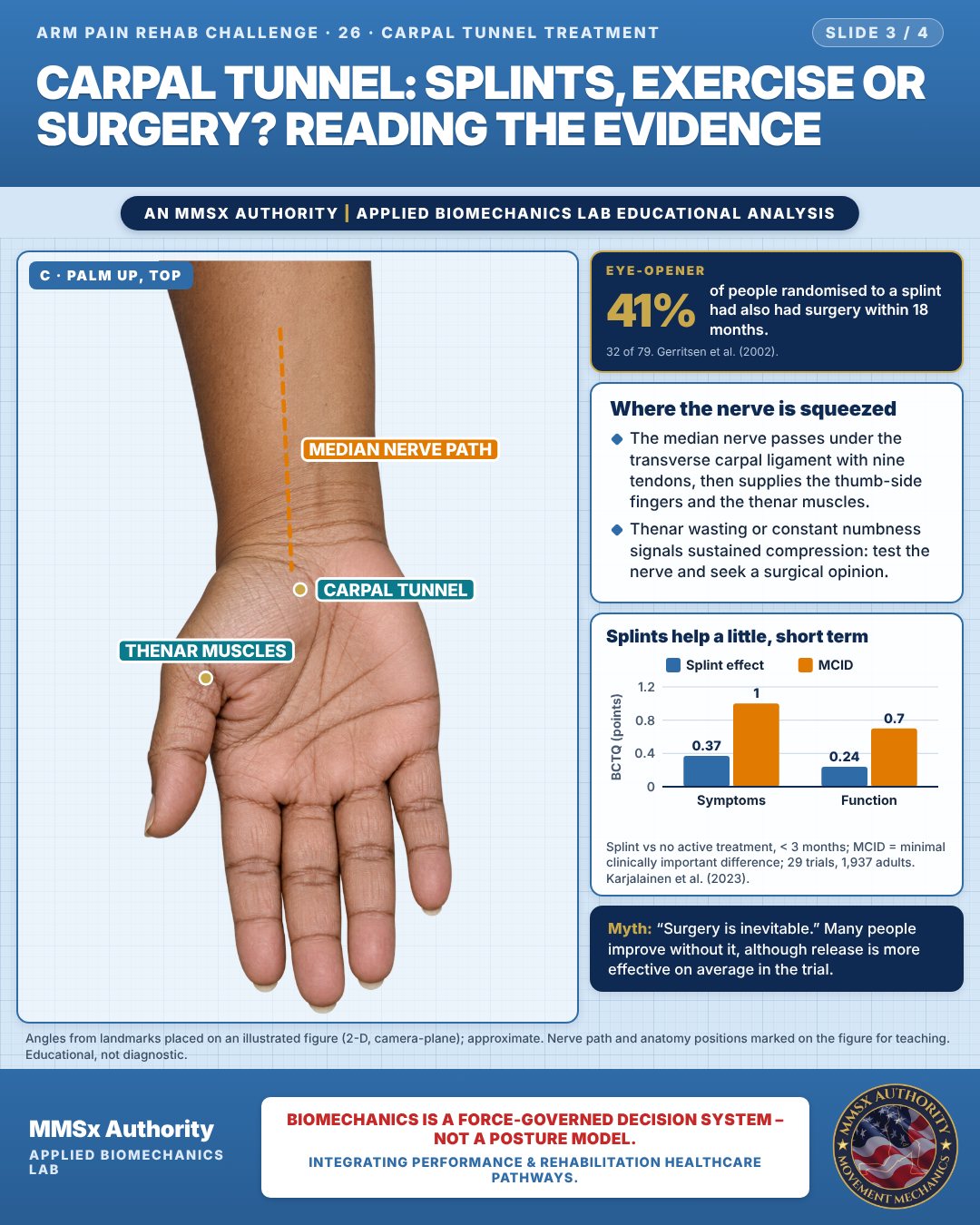
Where the nerve is squeezed
The median nerve passes under the transverse carpal ligament with nine tendons, then supplies the thumb-side fingers and the thenar muscles.
Thenar wasting or constant numbness signals sustained compression: test the nerve and seek a surgical opinion.
Splints help a little, short term
Decision pathway
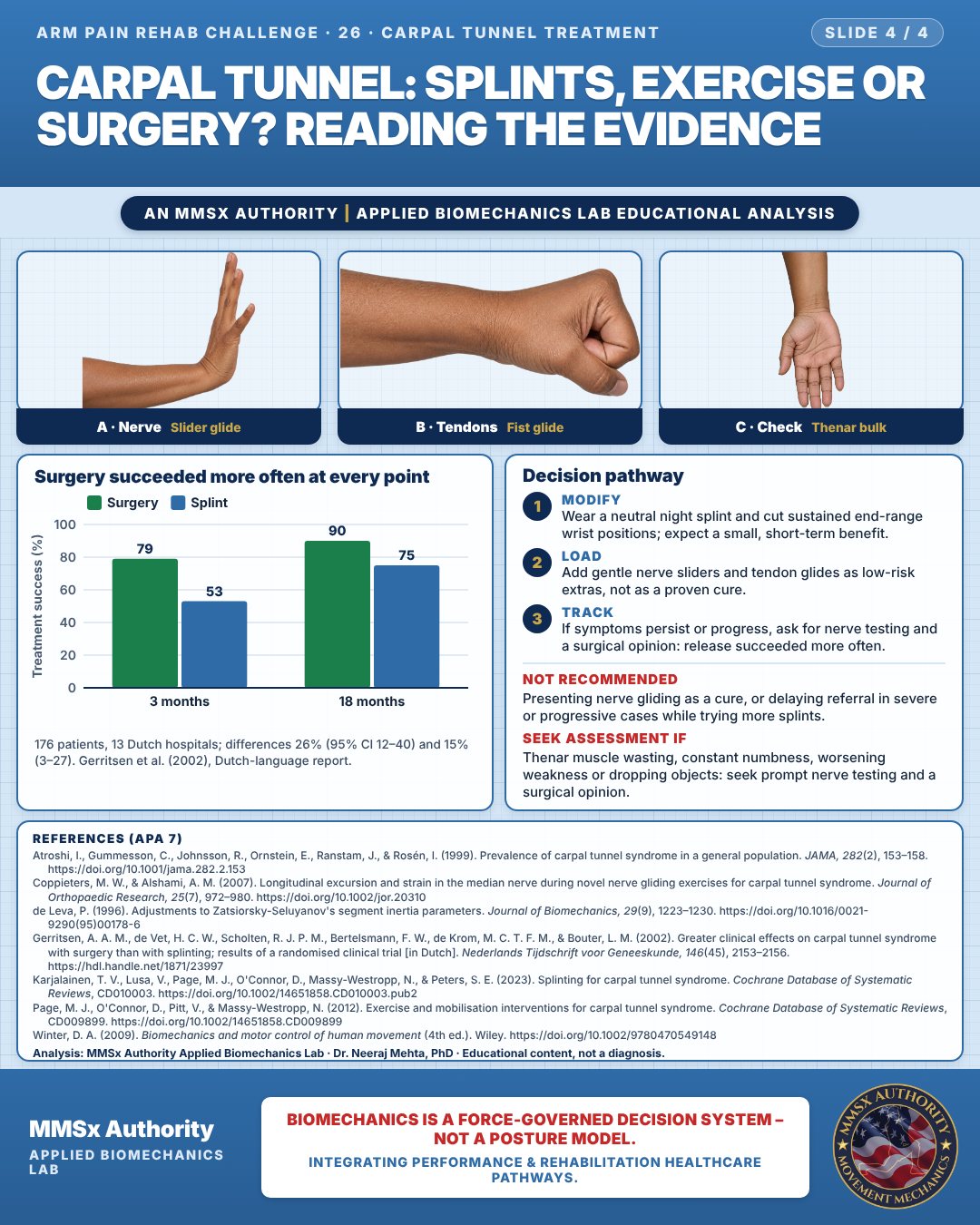
Surgery succeeded more often at every point
Modify
Wear a neutral night splint and cut sustained end-range wrist positions; expect a small, short-term benefit.
Load
Add gentle nerve sliders and tendon glides as low-risk extras, not as a proven cure.
Track
If symptoms persist or progress, ask for nerve testing and a surgical opinion: release succeeded more often.
What the evidence supports
- Splinting gives small, uncertain short-term benefit (Karjalainen et al., 2023). Exercise and mobilisation evidence is very low quality (Page et al., 2012) — gliding exercises can be offered as low-risk adjuncts but not as proven treatment. Surgery produced higher success rates than splinting at every time point up to 18 months (Gerritsen et al., 2002), and is the decision for persistent or more severe cases.
Myth and evidence
Myth“Everyone with carpal tunnel ends up needing surgery.”
EvidenceAt 18 months, 75% of the splint group had a successful outcome, although 41% of that group had also had surgery (Gerritsen et al., 2002) — many improve without it, while surgery is more effective on average.
Cautions
Not recommended
Presenting nerve gliding as a cure, or delaying referral in severe or progressive cases while trying more splints.
Seek assessment if
Thenar muscle wasting, constant numbness, worsening weakness or dropping objects: seek prompt nerve testing and a surgical opinion.
Methods note
Angles from landmarks placed on an illustrated figure (2-D, camera-plane); approximate. Wrist angle from manually placed forearm and hand axes; nerve path drawn for teaching. Forearm line marked on the figure for teaching. Figure shows a full fist. Nerve path and anatomy positions marked on the figure for teaching. These are educational estimates, not a diagnosis.
References
- Atroshi, I., Gummesson, C., Johnsson, R., Ornstein, E., Ranstam, J., & Rosén, I. (1999). Prevalence of carpal tunnel syndrome in a general population. JAMA, 282(2), 153–158. https://doi.org/10.1001/jama.282.2.153
- Coppieters, M. W., & Alshami, A. M. (2007). Longitudinal excursion and strain in the median nerve during novel nerve gliding exercises for carpal tunnel syndrome. Journal of Orthopaedic Research, 25(7), 972–980. https://doi.org/10.1002/jor.20310
- de Leva, P. (1996). Adjustments to Zatsiorsky-Seluyanov's segment inertia parameters. Journal of Biomechanics, 29(9), 1223–1230. https://doi.org/10.1016/0021-9290(95)00178-6
- Gerritsen, A. A. M., de Vet, H. C. W., Scholten, R. J. P. M., Bertelsmann, F. W., de Krom, M. C. T. F. M., & Bouter, L. M. (2002). Greater clinical effects on carpal tunnel syndrome with surgery than with splinting; results of a randomised clinical trial [in Dutch]. Nederlands Tijdschrift voor Geneeskunde, 146(45), 2153–2156. https://hdl.handle.net/1871/23997
- Karjalainen, T. V., Lusa, V., Page, M. J., O'Connor, D., Massy-Westropp, N., & Peters, S. E. (2023). Splinting for carpal tunnel syndrome. Cochrane Database of Systematic Reviews, CD010003. https://doi.org/10.1002/14651858.CD010003.pub2
- Page, M. J., O'Connor, D., Pitt, V., & Massy-Westropp, N. (2012). Exercise and mobilisation interventions for carpal tunnel syndrome. Cochrane Database of Systematic Reviews, CD009899. https://doi.org/10.1002/14651858.CD009899
- Winter, D. A. (2009). Biomechanics and motor control of human movement (4th ed.). Wiley. https://doi.org/10.1002/9780470549148
Cite this article
Mehta, N. (2026, October 28). Carpal tunnel: splints, exercise or surgery? Reading the evidence. MMSx Authority Applied Biomechanics Lab. https://mmsxauthority.org/edu/analysis/arm/26-carpal-tunnel-splints-exercise-or-surgery-reading-the-evidence/
Part of the collection
Mehta, N. (2026). Elbow, Forearm, Wrist and Hand Rehabilitation: 50 Evidence-Based Biomechanics Analyses [Collection]. MMSx Authority Applied Biomechanics Lab. Zenodo. https://doi.org/10.5281/zenodo.23735910
All Arm Pain Rehab Challenge articles · Rehabilitation Library