Arm Pain Rehab Challenge · 25
Carpal tunnel syndrome: night tingling and wrist position
Compression neuropathy of the median nerve at the wrist causing pain, numbness and/or tingling in the median nerve distribution of the hand (thumb,…
Key points
- Position. Wear a night splint that holds the wrist near straight, not bent back.
- Reduce. Break up long periods of strong wrist bending by day, and avoid sleeping with curled wrists.
- Review. Expect modest change; if symptoms persist, review further options with a clinician.
What it is
Compression neuropathy of the median nerve at the wrist causing pain, numbness and/or tingling in the median nerve distribution of the hand (thumb, index, middle and part of the ring finger), often worse at night; confirmed by clinical examination with or without nerve conduction testing.
How we analysed the movement
Three movements relevant to this topic were analysed from illustrated reference figures. Joint centres were located with two-dimensional pose estimation where the whole arm was visible; elbow and wrist angles, and the directions of external load and tendon pull, were then drawn on the figure; on hand close-ups, where pose estimation does not apply, the landmarks were placed manually. The figures are educational estimates that show how position changes mechanical demand; they are not measurements of a patient. Every research value quoted below comes from the published source cited beside it.
Movement A: Wrists tucked (side view)
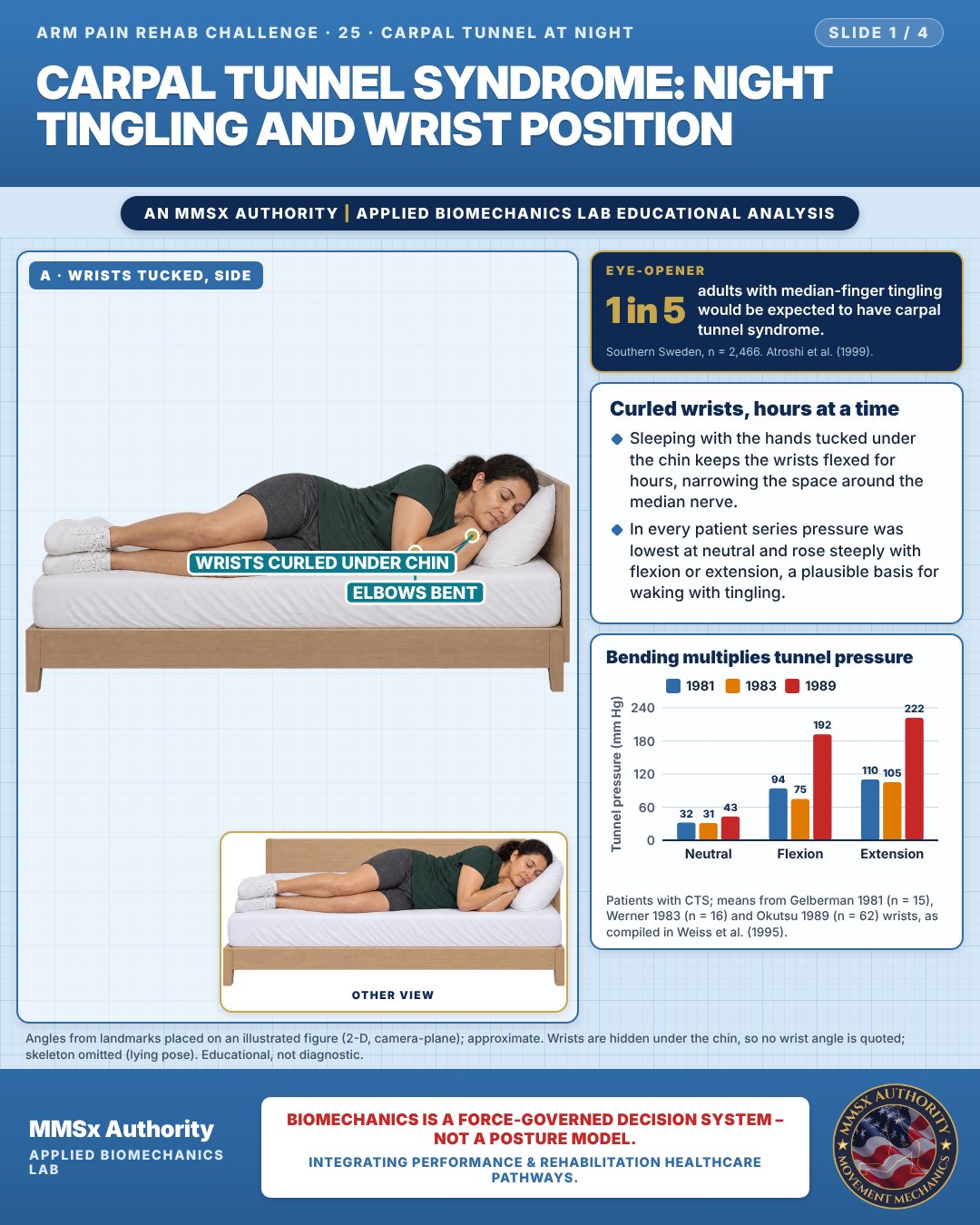
Curled wrists, hours at a time
Sleeping with the hands tucked under the chin keeps the wrists flexed for hours, narrowing the space around the median nerve.
In every patient series pressure was lowest at neutral and rose steeply with flexion or extension, a plausible basis for waking with tingling.
Bending multiplies tunnel pressure
Movement B: Neutral splint (side view)
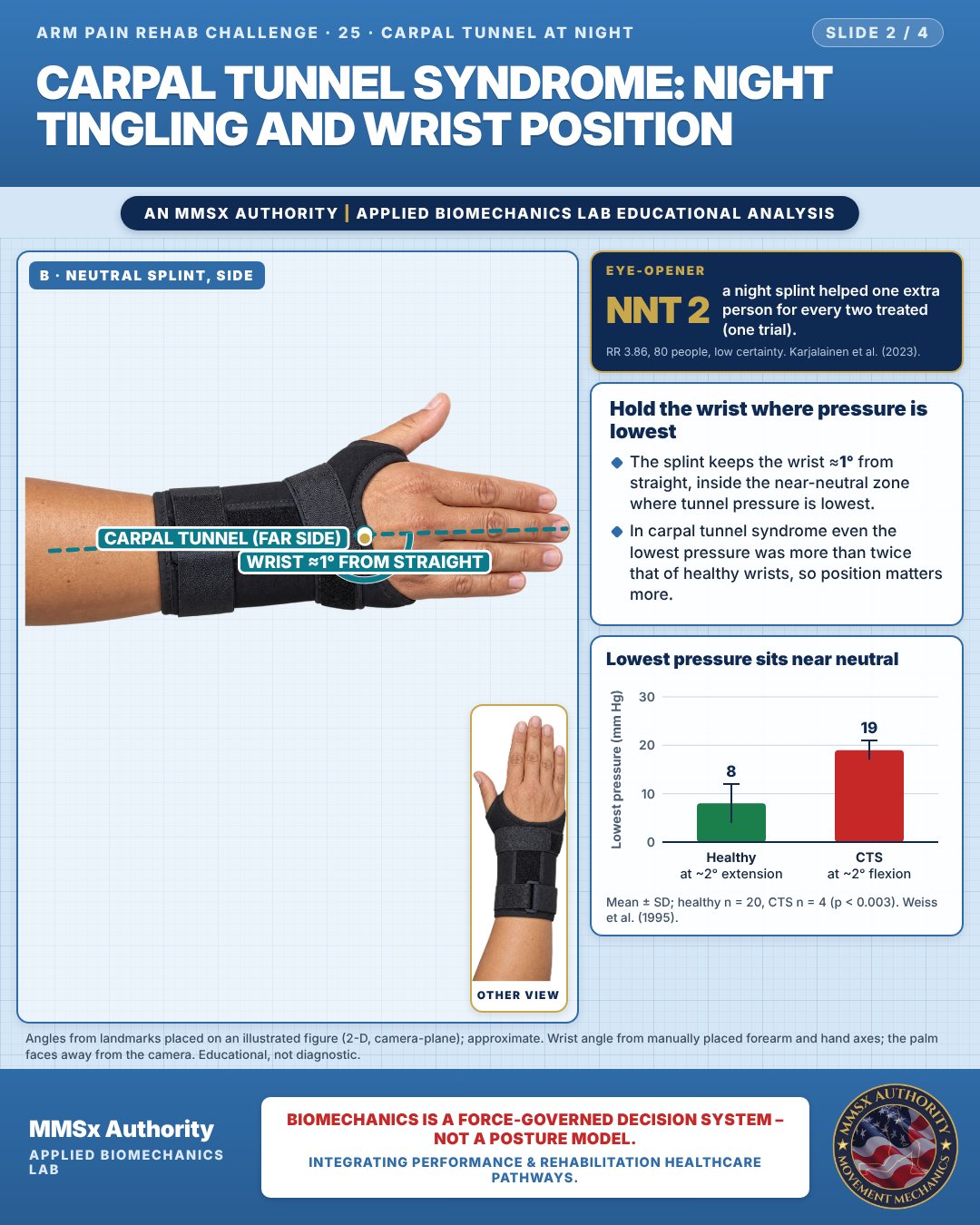
Hold the wrist where pressure is lowest
The splint keeps the wrist ≈1° from straight, inside the near-neutral zone where tunnel pressure is lowest.
In carpal tunnel syndrome even the lowest pressure was more than twice that of healthy wrists, so position matters more.
Lowest pressure sits near neutral
Movement C: Palm forward (front view)
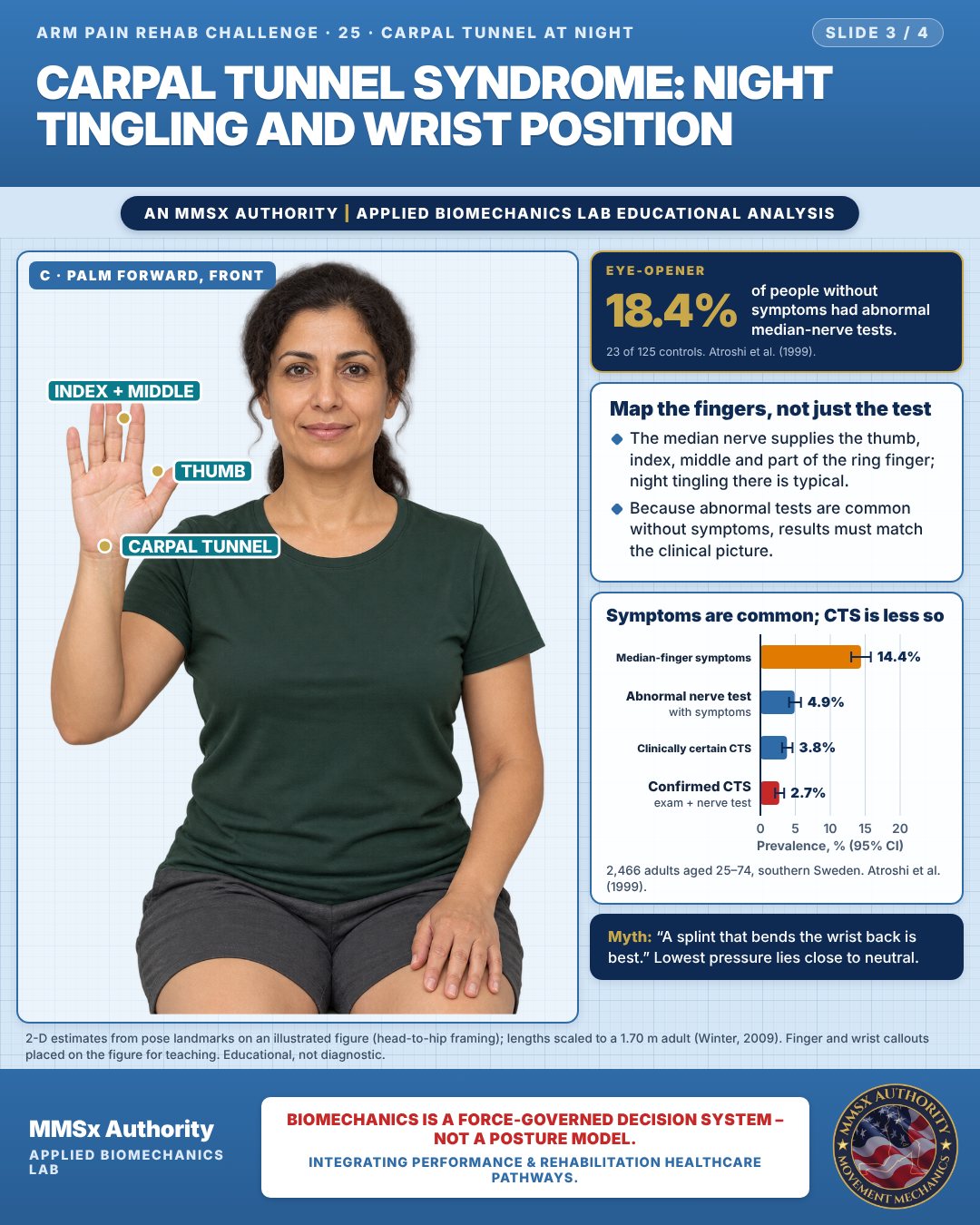
Map the fingers, not just the test
The median nerve supplies the thumb, index, middle and part of the ring finger; night tingling there is typical.
Because abnormal tests are common without symptoms, results must match the clinical picture.
Symptoms are common; CTS is less so
Decision pathway
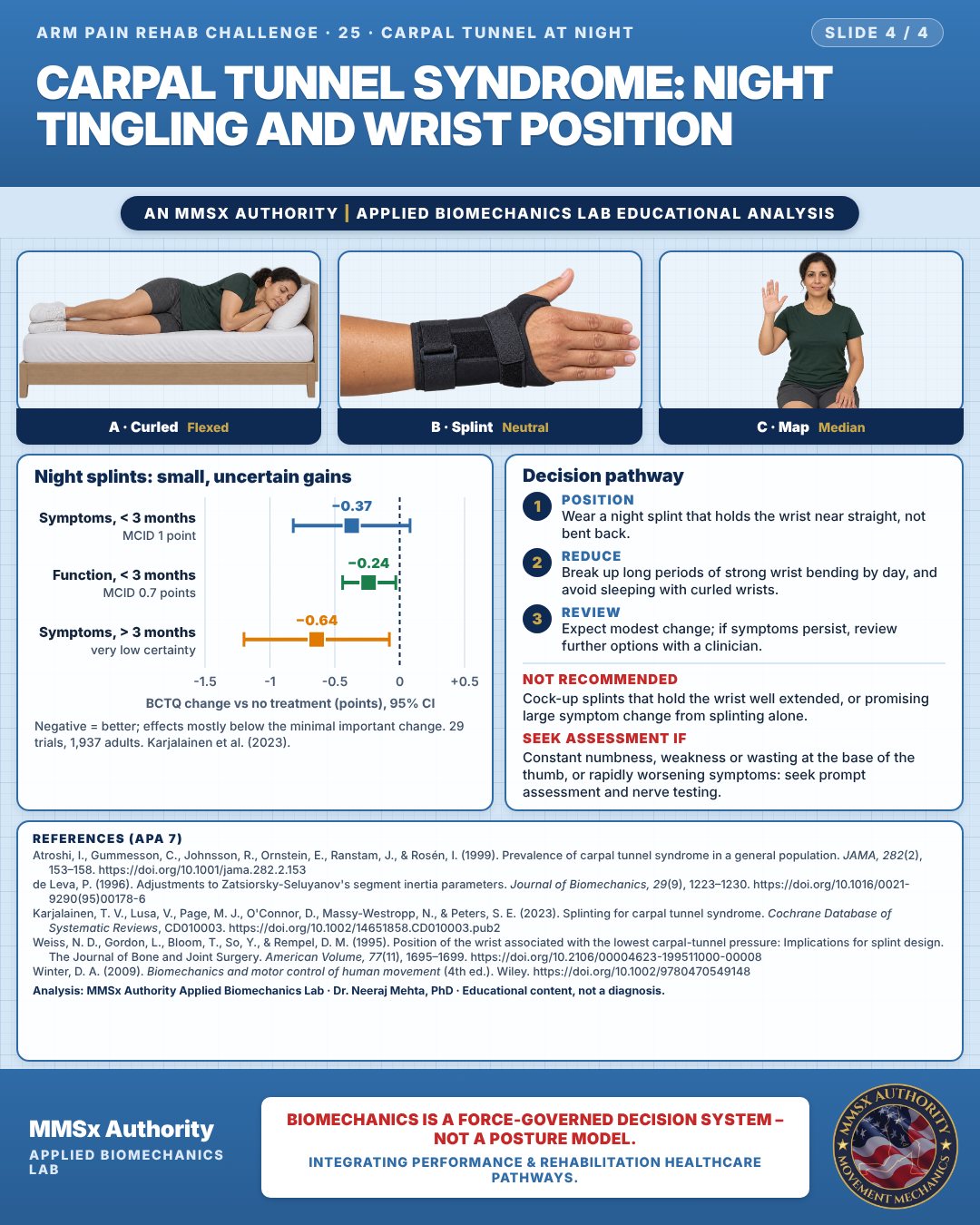
Night splints: small, uncertain gains
Position
Wear a night splint that holds the wrist near straight, not bent back.
Reduce
Break up long periods of strong wrist bending by day, and avoid sleeping with curled wrists.
Review
Expect modest change; if symptoms persist, review further options with a clinician.
What the evidence supports
- Night splinting in a near-neutral wrist position is a reasonable first-line option with small, uncertain benefits; splinting may not add benefit to corticosteroid injection (Karjalainen et al., 2023). Neutral is chosen because pressure is lowest near 0° (Weiss et al., 1995).
Myth and evidence
Myth“A splint that holds the wrist bent back is best.”
EvidenceLowest pressure occurs close to neutral (≈2° extension in controls, ≈2° flexion in patients) (Weiss et al., 1995).
Cautions
Not recommended
Cock-up splints that hold the wrist well extended, or promising large symptom change from splinting alone.
Seek assessment if
Constant numbness, weakness or wasting at the base of the thumb, or rapidly worsening symptoms: seek prompt assessment and nerve testing.
Methods note
Angles from landmarks placed on an illustrated figure (2-D, camera-plane); approximate. Wrists are hidden under the chin, so no wrist angle is quoted; skeleton omitted (lying pose). Wrist angle from manually placed forearm and hand axes; the palm faces away from the camera. 2-D estimates from pose landmarks on an illustrated figure (head-to-hip framing); lengths scaled to a 1.70 m adult (Winter, 2009). Finger and wrist callouts placed on the figure for teaching. These are educational estimates, not a diagnosis.
References
- Atroshi, I., Gummesson, C., Johnsson, R., Ornstein, E., Ranstam, J., & Rosén, I. (1999). Prevalence of carpal tunnel syndrome in a general population. JAMA, 282(2), 153–158. https://doi.org/10.1001/jama.282.2.153
- de Leva, P. (1996). Adjustments to Zatsiorsky-Seluyanov's segment inertia parameters. Journal of Biomechanics, 29(9), 1223–1230. https://doi.org/10.1016/0021-9290(95)00178-6
- Karjalainen, T. V., Lusa, V., Page, M. J., O'Connor, D., Massy-Westropp, N., & Peters, S. E. (2023). Splinting for carpal tunnel syndrome. Cochrane Database of Systematic Reviews, CD010003. https://doi.org/10.1002/14651858.CD010003.pub2
- Weiss, N. D., Gordon, L., Bloom, T., So, Y., & Rempel, D. M. (1995). Position of the wrist associated with the lowest carpal-tunnel pressure: Implications for splint design. The Journal of Bone and Joint Surgery. American Volume, 77(11), 1695–1699. https://doi.org/10.2106/00004623-199511000-00008
- Winter, D. A. (2009). Biomechanics and motor control of human movement (4th ed.). Wiley. https://doi.org/10.1002/9780470549148
Cite this article
Mehta, N. (2026, October 28). Carpal tunnel syndrome: night tingling and wrist position. MMSx Authority Applied Biomechanics Lab. https://mmsxauthority.org/edu/analysis/arm/25-carpal-tunnel-syndrome-night-tingling-and-wrist-position/
Part of the collection
Mehta, N. (2026). Elbow, Forearm, Wrist and Hand Rehabilitation: 50 Evidence-Based Biomechanics Analyses [Collection]. MMSx Authority Applied Biomechanics Lab. Zenodo. https://doi.org/10.5281/zenodo.23735910
All Arm Pain Rehab Challenge articles · Rehabilitation Library