Arm Pain Rehab Challenge · 24
Grip strength: why it predicts health, not just hand function
Maximal isometric handgrip force measured with a dynamometer (typically elbow at 90° by the side, as in Movement A).
Key points
- Measure. Use a standard dynamometer protocol, elbow bent by the side, and record the best effort.
- Interpret. Below 27 kg (men) or 16 kg (women): assess for sarcopenia, including muscle quantity and physical performance.
- Build. Treat grip as a marker: build overall strength and activity, then retest with the same protocol.
What it is
Maximal isometric handgrip force measured with a dynamometer (typically elbow at 90° by the side, as in Movement A). It is used as a simple marker of overall muscle strength; low grip is the key screening criterion for probable sarcopenia in the revised European consensus (Cruz-Jentoft et al., 2019 — consensus focuses on low muscle strength).
How we analysed the movement
Three movements relevant to this topic were analysed from illustrated reference figures. Joint centres were located with two-dimensional pose estimation where the whole arm was visible; elbow and wrist angles, and the directions of external load and tendon pull, were then drawn on the figure; on hand close-ups, where pose estimation does not apply, the landmarks were placed manually. The figures are educational estimates that show how position changes mechanical demand; they are not measurements of a patient. Every research value quoted below comes from the published source cited beside it.
Movement A: Hand grip test (front view)
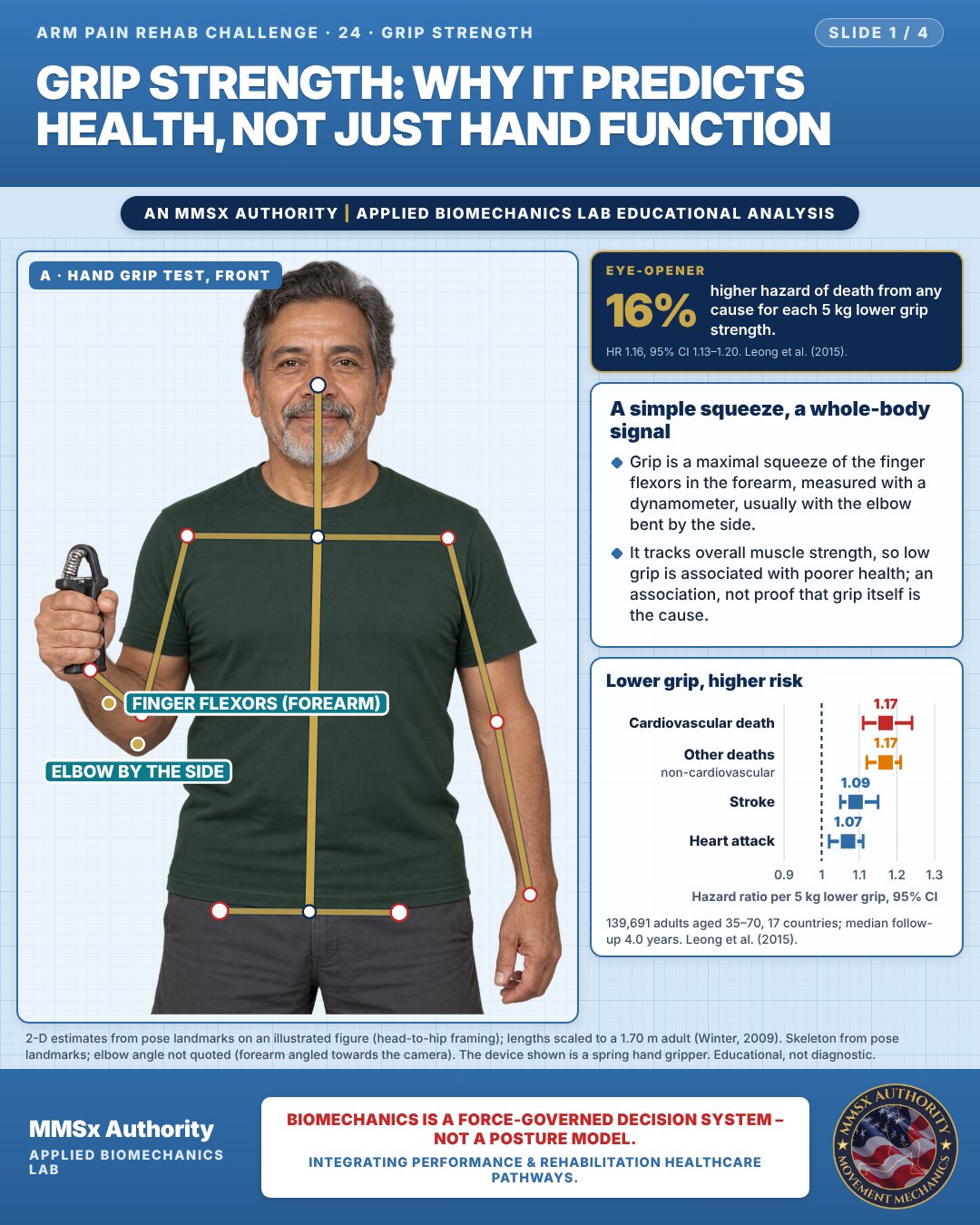
A simple squeeze, a whole-body signal
Grip is a maximal squeeze of the finger flexors in the forearm, measured with a dynamometer, usually with the elbow bent by the side.
It tracks overall muscle strength, so low grip is associated with poorer health; an association, not proof that grip itself is the cause.
Lower grip, higher risk
Movement B: Two-bag carry (side view)
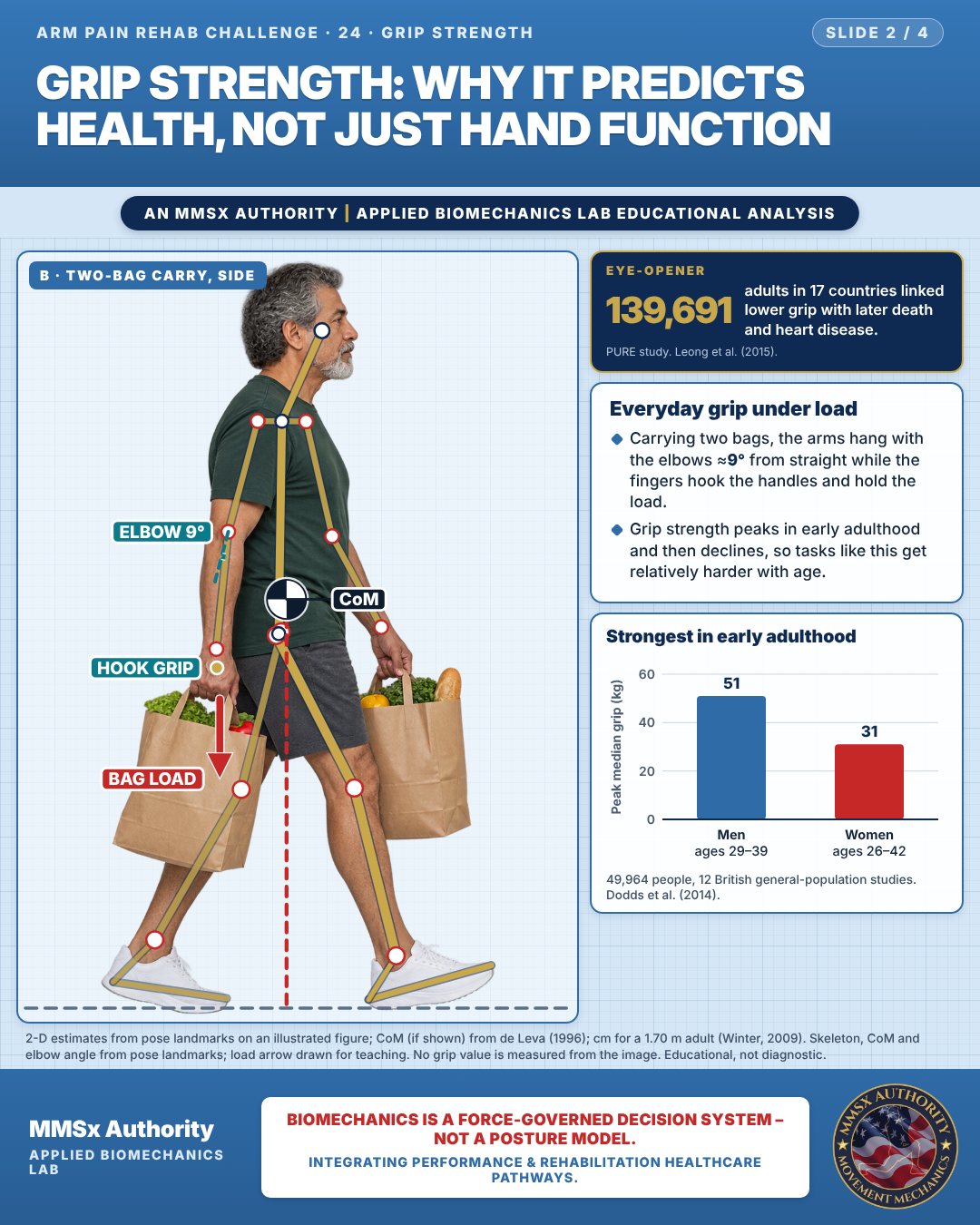
Everyday grip under load
Carrying two bags, the arms hang with the elbows ≈9° from straight while the fingers hook the handles and hold the load.
Grip strength peaks in early adulthood and then declines, so tasks like this get relatively harder with age.
Strongest in early adulthood
Movement C: Opening a jar (front view)
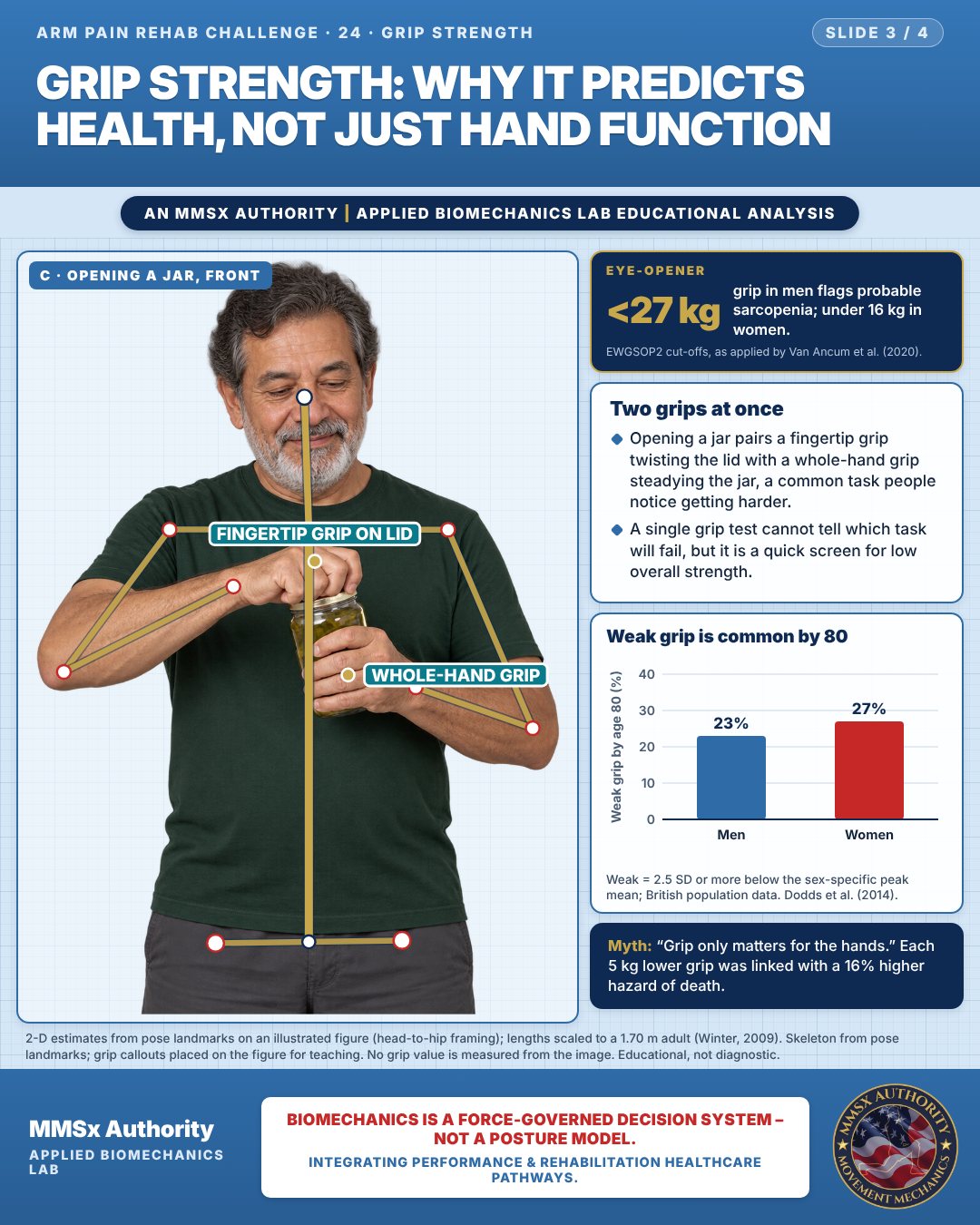
Two grips at once
Opening a jar pairs a fingertip grip twisting the lid with a whole-hand grip steadying the jar, a common task people notice getting harder.
A single grip test cannot tell which task will fail, but it is a quick screen for low overall strength.
Weak grip is common by 80
Decision pathway
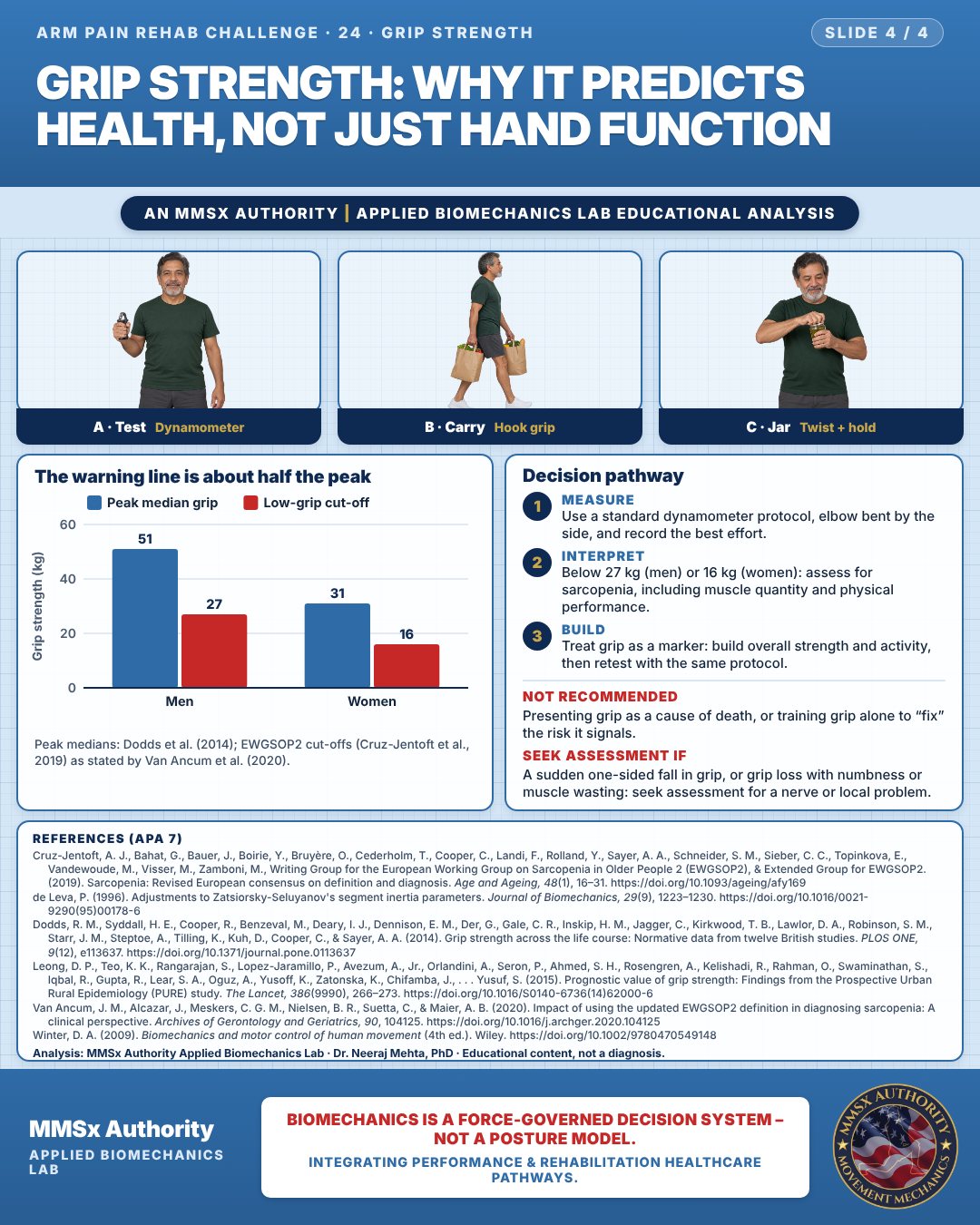
The warning line is about half the peak
Measure
Use a standard dynamometer protocol, elbow bent by the side, and record the best effort.
Interpret
Below 27 kg (men) or 16 kg (women): assess for sarcopenia, including muscle quantity and physical performance.
Build
Treat grip as a marker: build overall strength and activity, then retest with the same protocol.
What the evidence supports
- Measure grip with a standardised dynamometer protocol; low grip should prompt assessment for sarcopenia (Cruz-Jentoft et al., 2019).
Myth and evidence
Myth“Grip strength only matters for hand function.”
EvidenceEach 5 kg lower grip was associated with a 16% higher hazard of all-cause death in 139,691 adults across 17 countries (Leong et al., 2015).
Cautions
Not recommended
Presenting grip as a cause of death, or training grip alone to “fix” the risk it signals.
Seek assessment if
A sudden one-sided fall in grip, or grip loss with numbness or muscle wasting: seek assessment for a nerve or local problem.
Methods note
2-D estimates from pose landmarks on an illustrated figure (head-to-hip framing); lengths scaled to a 1.70 m adult (Winter, 2009). Skeleton from pose landmarks; elbow angle not quoted (forearm angled towards the camera). The device shown is a spring hand gripper. 2-D estimates from pose landmarks on an illustrated figure; CoM (if shown) from de Leva (1996); cm for a 1.70 m adult (Winter, 2009). Skeleton, CoM and elbow angle from pose landmarks; load arrow drawn for teaching. No grip value is measured from the image. Skeleton from pose landmarks; grip callouts placed on the figure for teaching. These are educational estimates, not a diagnosis.
References
- Cruz-Jentoft, A. J., Bahat, G., Bauer, J., Boirie, Y., Bruyère, O., Cederholm, T., Cooper, C., Landi, F., Rolland, Y., Sayer, A. A., Schneider, S. M., Sieber, C. C., Topinkova, E., Vandewoude, M., Visser, M., Zamboni, M., Writing Group for the European Working Group on Sarcopenia in Older People 2 (EWGSOP2), & Extended Group for EWGSOP2. (2019). Sarcopenia: Revised European consensus on definition and diagnosis. Age and Ageing, 48(1), 16–31. https://doi.org/10.1093/ageing/afy169
- de Leva, P. (1996). Adjustments to Zatsiorsky-Seluyanov's segment inertia parameters. Journal of Biomechanics, 29(9), 1223–1230. https://doi.org/10.1016/0021-9290(95)00178-6
- Dodds, R. M., Syddall, H. E., Cooper, R., Benzeval, M., Deary, I. J., Dennison, E. M., Der, G., Gale, C. R., Inskip, H. M., Jagger, C., Kirkwood, T. B., Lawlor, D. A., Robinson, S. M., Starr, J. M., Steptoe, A., Tilling, K., Kuh, D., Cooper, C., & Sayer, A. A. (2014). Grip strength across the life course: Normative data from twelve British studies. PLOS ONE, 9(12), e113637. https://doi.org/10.1371/journal.pone.0113637
- Leong, D. P., Teo, K. K., Rangarajan, S., Lopez-Jaramillo, P., Avezum, A., Jr., Orlandini, A., Seron, P., Ahmed, S. H., Rosengren, A., Kelishadi, R., Rahman, O., Swaminathan, S., Iqbal, R., Gupta, R., Lear, S. A., Oguz, A., Yusoff, K., Zatonska, K., Chifamba, J., . . . Yusuf, S. (2015). Prognostic value of grip strength: Findings from the Prospective Urban Rural Epidemiology (PURE) study. The Lancet, 386(9990), 266–273. https://doi.org/10.1016/S0140-6736(14)62000-6
- Van Ancum, J. M., Alcazar, J., Meskers, C. G. M., Nielsen, B. R., Suetta, C., & Maier, A. B. (2020). Impact of using the updated EWGSOP2 definition in diagnosing sarcopenia: A clinical perspective. Archives of Gerontology and Geriatrics, 90, 104125. https://doi.org/10.1016/j.archger.2020.104125
- Winter, D. A. (2009). Biomechanics and motor control of human movement (4th ed.). Wiley. https://doi.org/10.1002/9780470549148
Cite this article
Mehta, N. (2026, October 28). Grip strength: why it predicts health, not just hand function. MMSx Authority Applied Biomechanics Lab. https://mmsxauthority.org/edu/analysis/arm/24-grip-strength-why-it-predicts-health-not-just-hand-function/
Part of the collection
Mehta, N. (2026). Elbow, Forearm, Wrist and Hand Rehabilitation: 50 Evidence-Based Biomechanics Analyses [Collection]. MMSx Authority Applied Biomechanics Lab. Zenodo. https://doi.org/10.5281/zenodo.23735910
All Arm Pain Rehab Challenge articles · Rehabilitation Library