Arm Pain Rehab Challenge · 22
Intersection syndrome: forearm pain in rowers and paddlers
Painful tenosynovitis/peritendinitis where the first dorsal compartment muscles (abductor pollicis longus, extensor pollicis brevis) cross over the…
Key points
- Unload. Reduce rowing or paddling volume; splint the wrist in about 20° extension for 2–3 weeks.
- Load. Then progress stretching and strengthening over 4–6 weeks, rebuilding stroke volume gradually.
- Escalate. If symptoms persist after 2–3 weeks, discuss an injection; surgery is for refractory cases.
What it is
Painful tenosynovitis/peritendinitis where the first dorsal compartment muscles (abductor pollicis longus, extensor pollicis brevis) cross over the second compartment wrist extensors (extensor carpi radialis longus and brevis) on the dorsoradial distal forearm, typically with swelling and sometimes crepitus during repetitive wrist extension and gripping (Balakatounis et al., 2017; Hoy et al., 2019 describe it as tendinitis of the second wrist compartment).
How we analysed the movement
Three movements relevant to this topic were analysed from illustrated reference figures. Joint centres were located with two-dimensional pose estimation where the whole arm was visible; elbow and wrist angles, and the directions of external load and tendon pull, were then drawn on the figure; on hand close-ups, where pose estimation does not apply, the landmarks were placed manually. The figures are educational estimates that show how position changes mechanical demand; they are not measurements of a patient. Every research value quoted below comes from the published source cited beside it.
Movement A: Rowing finish (side view)
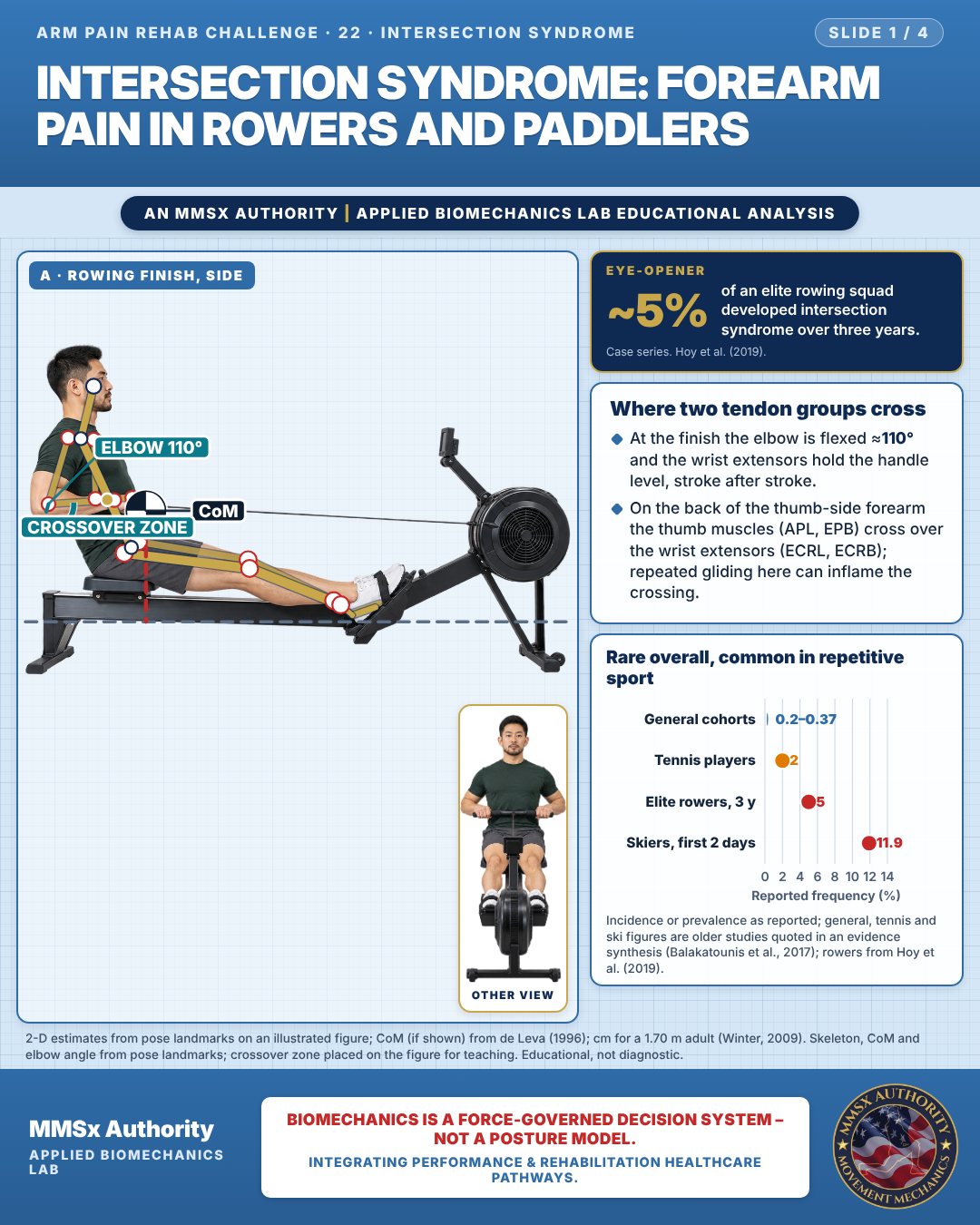
Where two tendon groups cross
At the finish the elbow is flexed ≈110° and the wrist extensors hold the handle level, stroke after stroke.
On the back of the thumb-side forearm the thumb muscles (APL, EPB) cross over the wrist extensors (ECRL, ECRB); repeated gliding here can inflame the crossing.
Rare overall, common in repetitive sport
Movement B: Paddle stroke (side view)
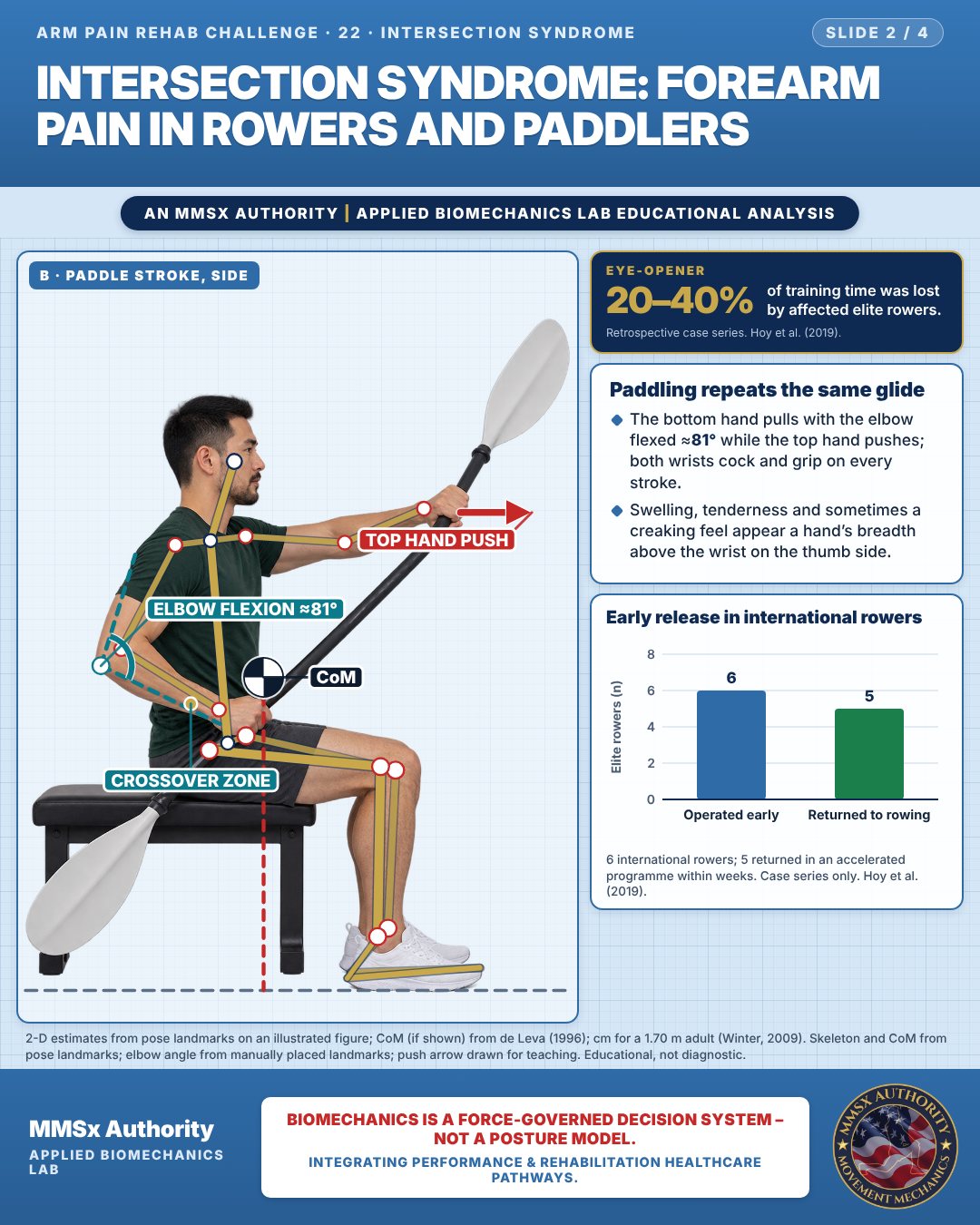
Paddling repeats the same glide
The bottom hand pulls with the elbow flexed ≈81° while the top hand pushes; both wrists cock and grip on every stroke.
Swelling, tenderness and sometimes a creaking feel appear a hand’s breadth above the wrist on the thumb side.
Early release in international rowers
Movement C: Wrist back, thumb side
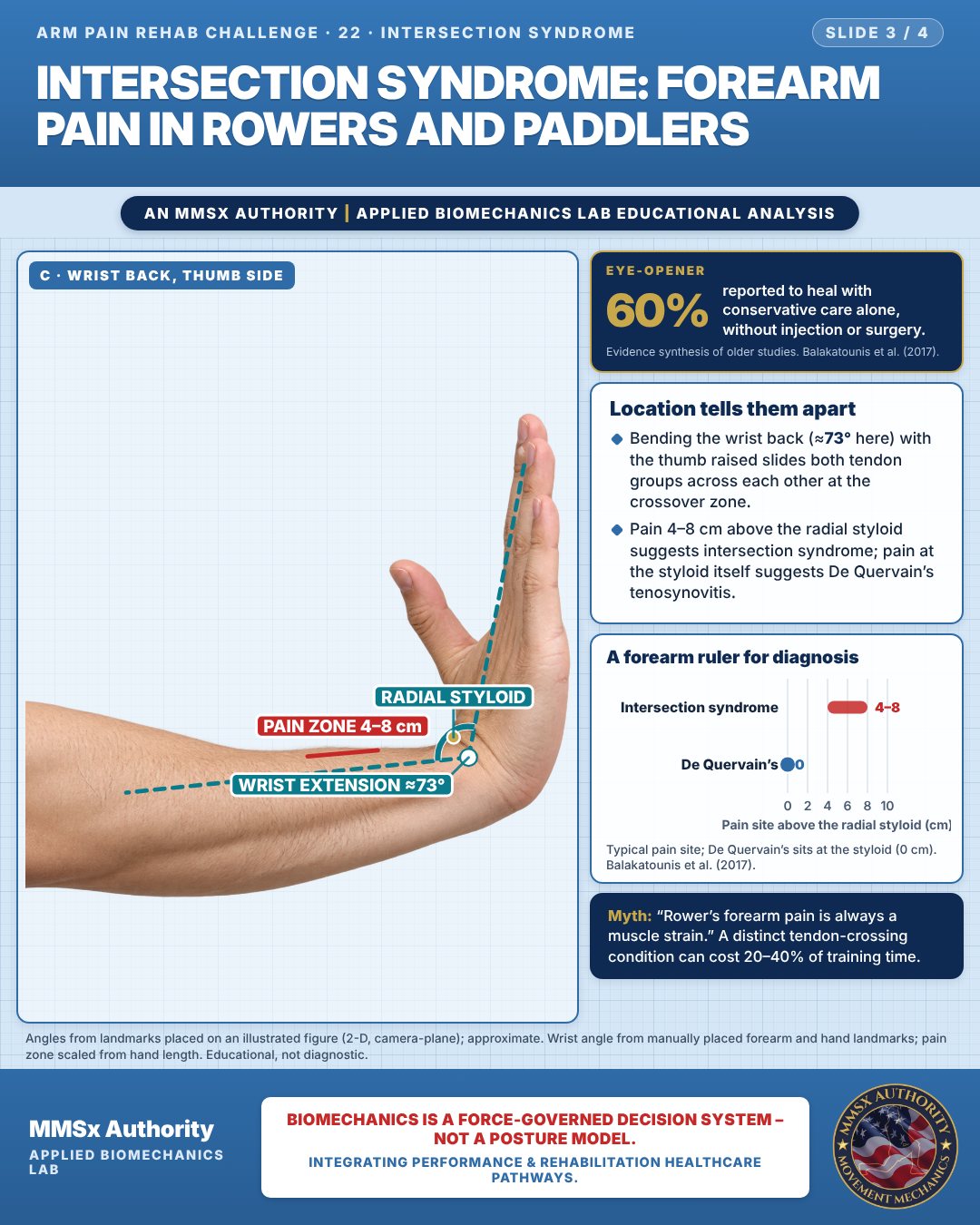
Location tells them apart
Bending the wrist back (≈73° here) with the thumb raised slides both tendon groups across each other at the crossover zone.
Pain 4–8 cm above the radial styloid suggests intersection syndrome; pain at the styloid itself suggests De Quervain’s tenosynovitis.
A forearm ruler for diagnosis
Decision pathway
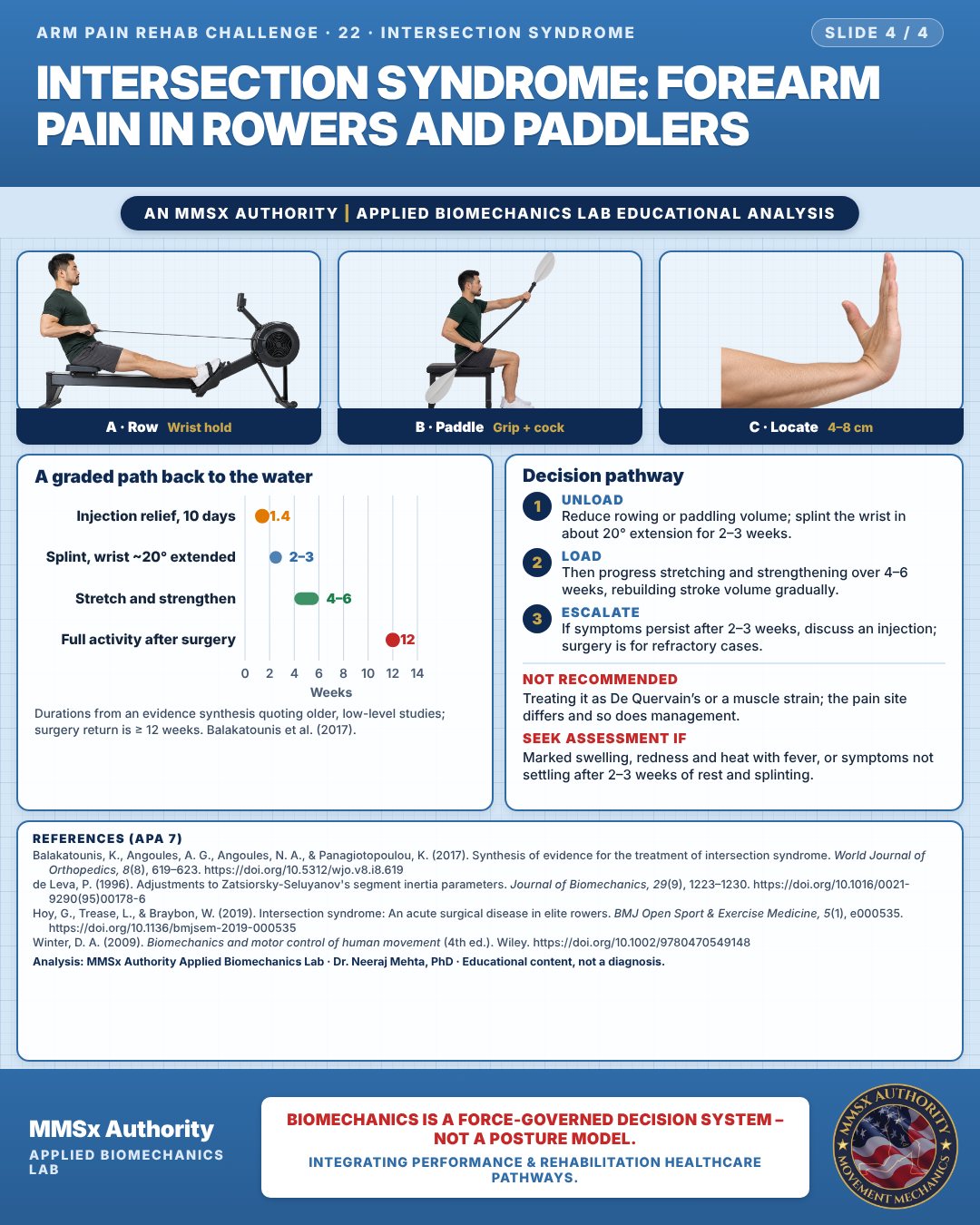
A graded path back to the water
Unload
Reduce rowing or paddling volume; splint the wrist in about 20° extension for 2–3 weeks.
Load
Then progress stretching and strengthening over 4–6 weeks, rebuilding stroke volume gradually.
Escalate
If symptoms persist after 2–3 weeks, discuss an injection; surgery is for refractory cases.
What the evidence supports
- Activity modification and relative rest, splinting in ~20° wrist extension for 2–3 weeks, then progressive stretching and strengthening; corticosteroid injection if symptoms persist after 2–3 weeks; surgical release for refractory cases. In elite rowers early surgery has been used to limit lost training (Hoy et al., 2019; case series only).
Myth and evidence
Myth“Forearm pain in rowers is always a muscle strain.”
EvidenceA distinct tendon-crossing condition can remove 20–40% of training time in elite rowers (Hoy et al., 2019).
Cautions
Not recommended
Treating it as De Quervain’s or a muscle strain; the pain site differs and so does management.
Seek assessment if
Marked swelling, redness and heat with fever, or symptoms not settling after 2–3 weeks of rest and splinting.
Methods note
2-D estimates from pose landmarks on an illustrated figure; CoM (if shown) from de Leva (1996); cm for a 1.70 m adult (Winter, 2009). Skeleton, CoM and elbow angle from pose landmarks; crossover zone placed on the figure for teaching. Skeleton and CoM from pose landmarks; elbow angle from manually placed landmarks; push arrow drawn for teaching. Angles from landmarks placed on an illustrated figure (2-D, camera-plane); approximate. Wrist angle from manually placed forearm and hand landmarks; pain zone scaled from hand length. These are educational estimates, not a diagnosis.
References
- Balakatounis, K., Angoules, A. G., Angoules, N. A., & Panagiotopoulou, K. (2017). Synthesis of evidence for the treatment of intersection syndrome. World Journal of Orthopedics, 8(8), 619–623. https://doi.org/10.5312/wjo.v8.i8.619
- de Leva, P. (1996). Adjustments to Zatsiorsky-Seluyanov's segment inertia parameters. Journal of Biomechanics, 29(9), 1223–1230. https://doi.org/10.1016/0021-9290(95)00178-6
- Hoy, G., Trease, L., & Braybon, W. (2019). Intersection syndrome: An acute surgical disease in elite rowers. BMJ Open Sport & Exercise Medicine, 5(1), e000535. https://doi.org/10.1136/bmjsem-2019-000535
- Winter, D. A. (2009). Biomechanics and motor control of human movement (4th ed.). Wiley. https://doi.org/10.1002/9780470549148
Cite this article
Mehta, N. (2026, October 28). Intersection syndrome: forearm pain in rowers and paddlers. MMSx Authority Applied Biomechanics Lab. https://mmsxauthority.org/edu/analysis/arm/22-intersection-syndrome-forearm-pain-in-rowers-and-paddlers/
Part of the collection
Mehta, N. (2026). Elbow, Forearm, Wrist and Hand Rehabilitation: 50 Evidence-Based Biomechanics Analyses [Collection]. MMSx Authority Applied Biomechanics Lab. Zenodo. https://doi.org/10.5281/zenodo.23735910
All Arm Pain Rehab Challenge articles · Rehabilitation Library