Arm Pain Rehab Challenge · 21
Forearm pain in climbers: finger flexor overload and pulley strain
Overload of the finger flexor tendons (flexor digitorum profundus and superficialis) and their annular pulleys (especially A2 and A4) from high…
Key points
- Reduce. Cut crimp-grip and fingerboard volume while the fingers or forearm are sore.
- Reorder. Reintroduce open-hand loading first, then build crimp loading gradually as symptoms allow.
- Monitor. Track pain at the finger base the next day; tape may modestly limit bowstringing.
What it is
Overload of the finger flexor tendons (flexor digitorum profundus and superficialis) and their annular pulleys (especially A2 and A4) from high fingertip loads on small holds; ranges from forearm flexor muscle/tendon pain to partial or complete pulley rupture.
How we analysed the movement
Three movements relevant to this topic were analysed from illustrated reference figures. Joint centres were located with two-dimensional pose estimation where the whole arm was visible; elbow and wrist angles, and the directions of external load and tendon pull, were then drawn on the figure; on hand close-ups, where pose estimation does not apply, the landmarks were placed manually. The figures are educational estimates that show how position changes mechanical demand; they are not measurements of a patient. Every research value quoted below comes from the published source cited beside it.
Movement A: Half-crimp hang (front view)
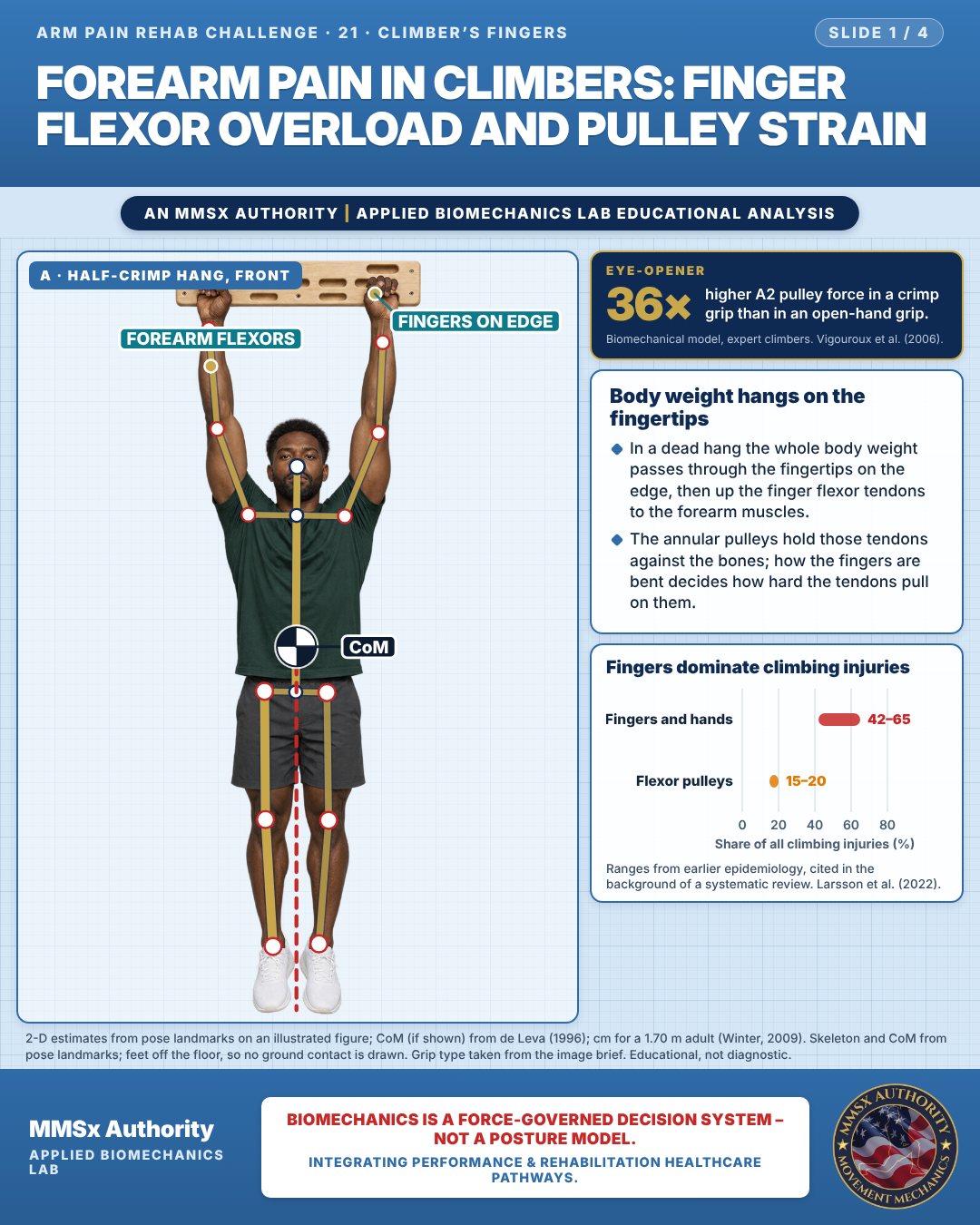
Body weight hangs on the fingertips
In a dead hang the whole body weight passes through the fingertips on the edge, then up the finger flexor tendons to the forearm muscles.
The annular pulleys hold those tendons against the bones; how the fingers are bent decides how hard the tendons pull on them.
Fingers dominate climbing injuries
Movement B: Crimp grip (side view)
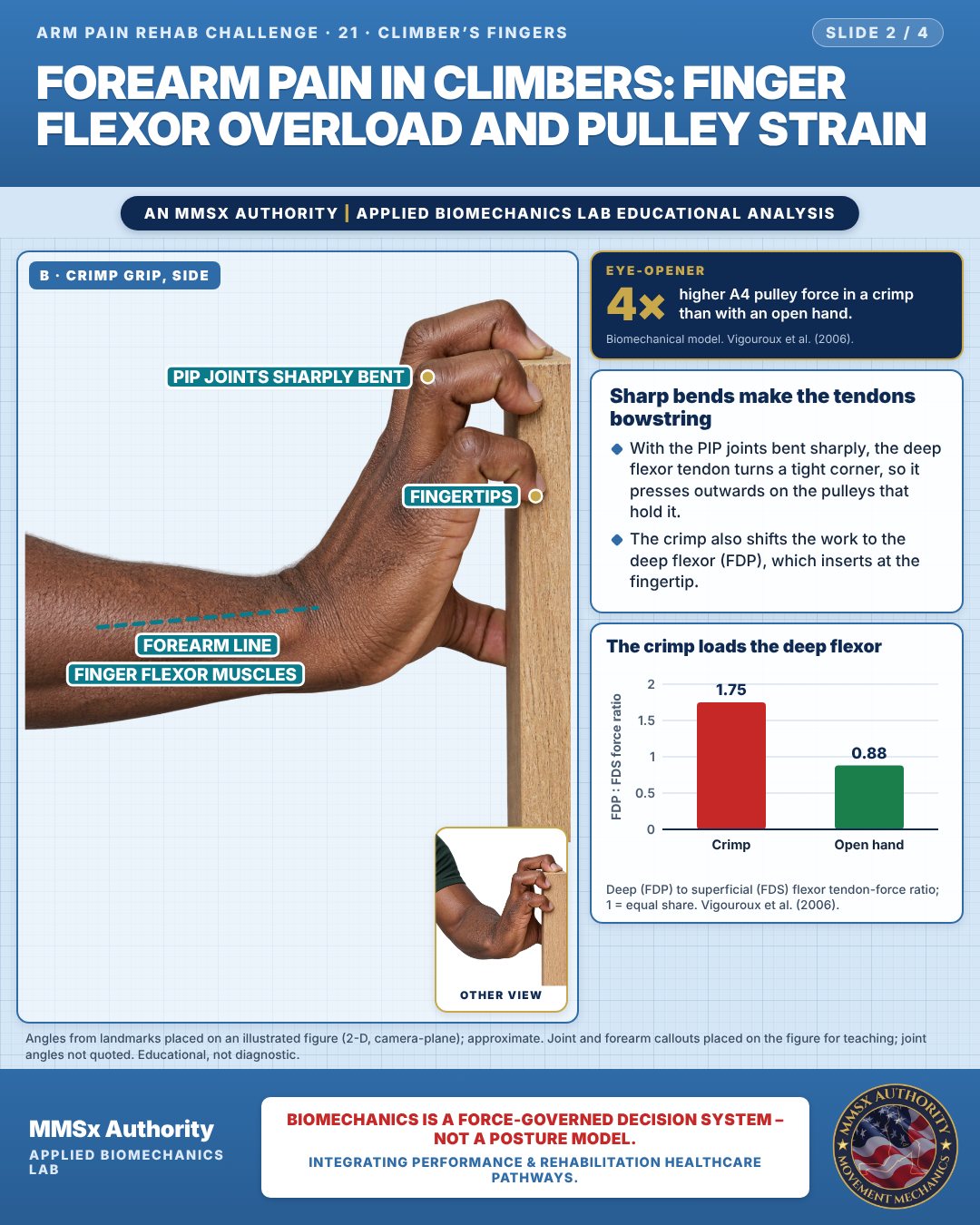
Sharp bends make the tendons bowstring
With the PIP joints bent sharply, the deep flexor tendon turns a tight corner, so it presses outwards on the pulleys that hold it.
The crimp also shifts the work to the deep flexor (FDP), which inserts at the fingertip.
The crimp loads the deep flexor
Movement C: Open-hand hang (side view)
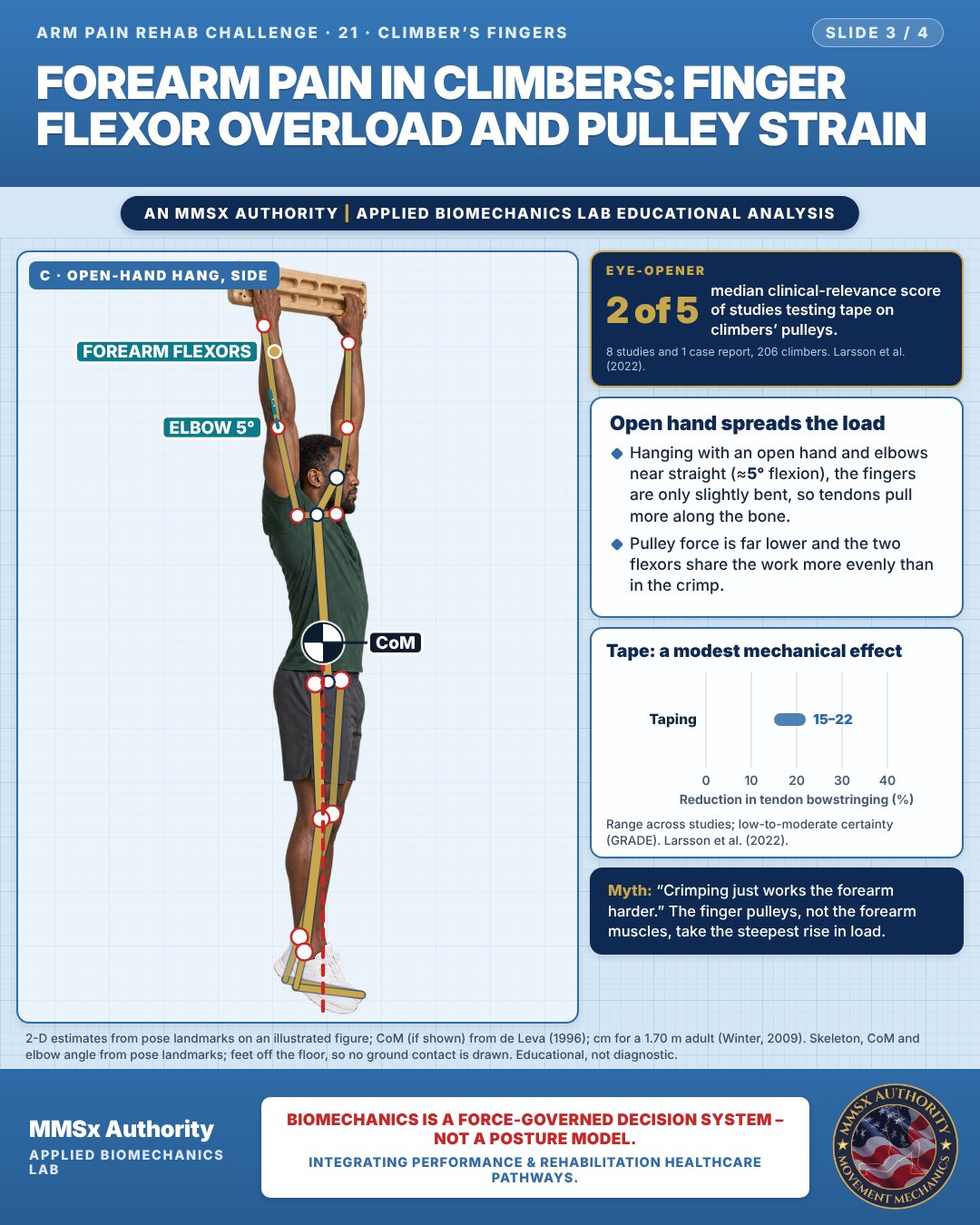
Open hand spreads the load
Hanging with an open hand and elbows near straight (≈5° flexion), the fingers are only slightly bent, so tendons pull more along the bone.
Pulley force is far lower and the two flexors share the work more evenly than in the crimp.
Tape: a modest mechanical effect
Decision pathway
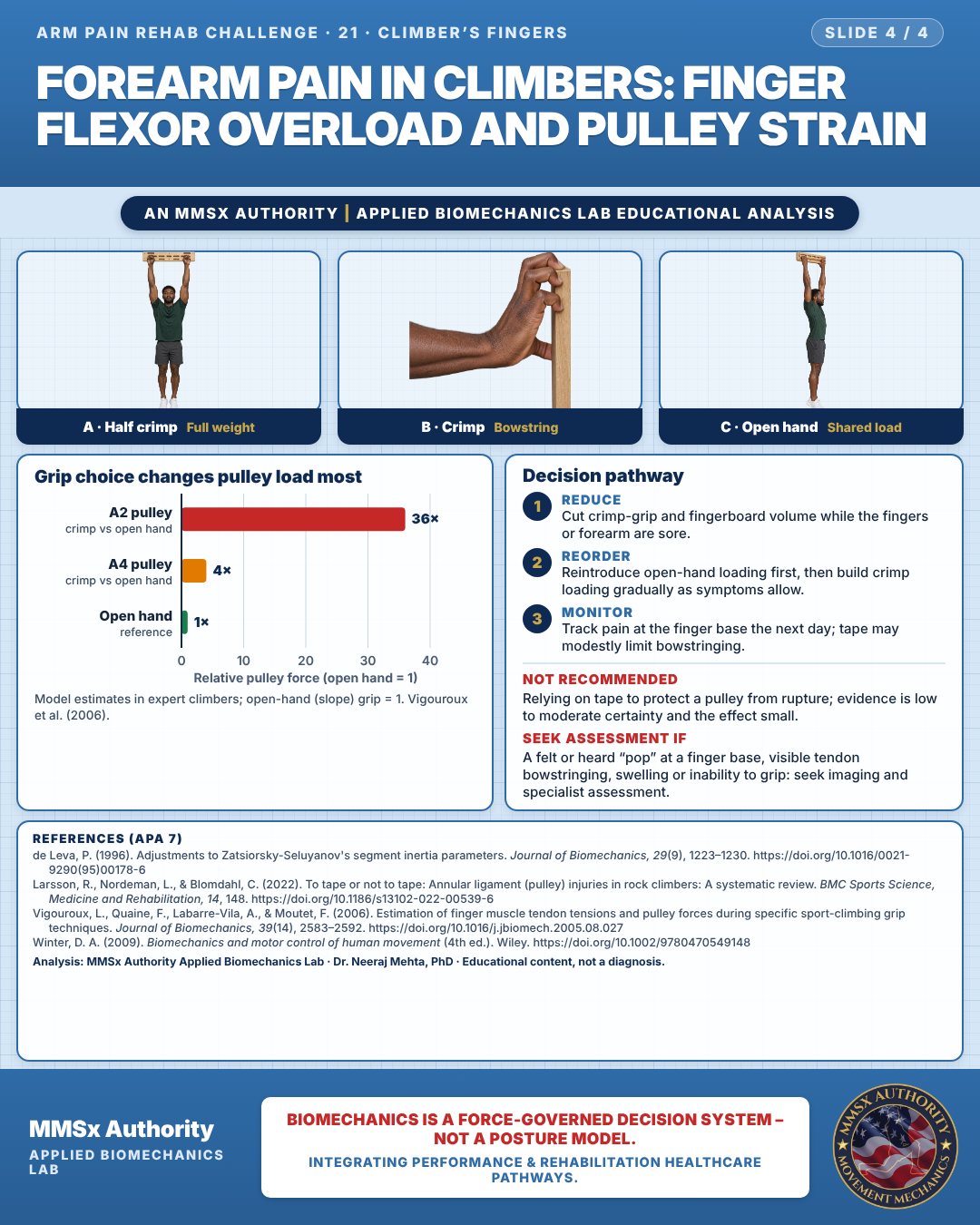
Grip choice changes pulley load most
Reduce
Cut crimp-grip and fingerboard volume while the fingers or forearm are sore.
Reorder
Reintroduce open-hand loading first, then build crimp loading gradually as symptoms allow.
Monitor
Track pain at the finger base the next day; tape may modestly limit bowstringing.
Myth and evidence
Myth“Crimping just uses the forearm harder.”
EvidenceThe crimp raises A2 pulley force about 36-fold relative to an open-hand (slope) grip — the pulley, not the forearm muscle, is the structure most at risk (Vigouroux et al., 2006).
Cautions
Not recommended
Relying on tape to protect a pulley from rupture; evidence is low to moderate certainty and the effect small.
Seek assessment if
A felt or heard “pop” at a finger base, visible tendon bowstringing, swelling or inability to grip: seek imaging and specialist assessment.
Methods note
2-D estimates from pose landmarks on an illustrated figure; CoM (if shown) from de Leva (1996); cm for a 1.70 m adult (Winter, 2009). Skeleton and CoM from pose landmarks; feet off the floor, so no ground contact is drawn. Grip type taken from the image brief. Angles from landmarks placed on an illustrated figure (2-D, camera-plane); approximate. Joint and forearm callouts placed on the figure for teaching; joint angles not quoted. Skeleton, CoM and elbow angle from pose landmarks; feet off the floor, so no ground contact is drawn. These are educational estimates, not a diagnosis.
References
- de Leva, P. (1996). Adjustments to Zatsiorsky-Seluyanov's segment inertia parameters. Journal of Biomechanics, 29(9), 1223–1230. https://doi.org/10.1016/0021-9290(95)00178-6
- Larsson, R., Nordeman, L., & Blomdahl, C. (2022). To tape or not to tape: Annular ligament (pulley) injuries in rock climbers: A systematic review. BMC Sports Science, Medicine and Rehabilitation, 14, 148. https://doi.org/10.1186/s13102-022-00539-6
- Vigouroux, L., Quaine, F., Labarre-Vila, A., & Moutet, F. (2006). Estimation of finger muscle tendon tensions and pulley forces during specific sport-climbing grip techniques. Journal of Biomechanics, 39(14), 2583–2592. https://doi.org/10.1016/j.jbiomech.2005.08.027
- Winter, D. A. (2009). Biomechanics and motor control of human movement (4th ed.). Wiley. https://doi.org/10.1002/9780470549148
Cite this article
Mehta, N. (2026, October 28). Forearm pain in climbers: finger flexor overload and pulley strain. MMSx Authority Applied Biomechanics Lab. https://mmsxauthority.org/edu/analysis/arm/21-forearm-pain-in-climbers-finger-flexor-overload-and-pulley-strain/
Part of the collection
Mehta, N. (2026). Elbow, Forearm, Wrist and Hand Rehabilitation: 50 Evidence-Based Biomechanics Analyses [Collection]. MMSx Authority Applied Biomechanics Lab. Zenodo. https://doi.org/10.5281/zenodo.23735910
All Arm Pain Rehab Challenge articles · Rehabilitation Library