Arm Pain Rehab Challenge · 20
Radial tunnel syndrome: when “tennis elbow” is really a nerve
Lateral proximal forearm pain attributed to compression of the posterior interosseous nerve (deep branch of the radial nerve) in the radial tunnel,…
Key points
- Differentiate. Find where it is tender: on the epicondyle, or in the muscle below it; test resisted middle-finger extension.
- Modify. Reduce repeated forearm rotation and hard gripping with the elbow straight while symptoms settle.
- Review. If pain persists, a clinician may use a diagnostic injection; surgery is reserved for persistent cases.
What it is
Lateral proximal forearm pain attributed to compression of the posterior interosseous nerve (deep branch of the radial nerve) in the radial tunnel, typically without motor weakness; tenderness lies a few centimetres distal to the lateral epicondyle rather than on it. Diagnosis is clinical and remains debated.
How we analysed the movement
Three movements relevant to this topic were analysed from illustrated reference figures. Joint centres were located with two-dimensional pose estimation where the whole arm was visible; elbow and wrist angles, and the directions of external load and tendon pull, were then drawn on the figure; on hand close-ups, where pose estimation does not apply, the landmarks were placed manually. The figures are educational estimates that show how position changes mechanical demand; they are not measurements of a patient. Every research value quoted below comes from the published source cited beside it.
Movement A: Screwdriver turn (side view)
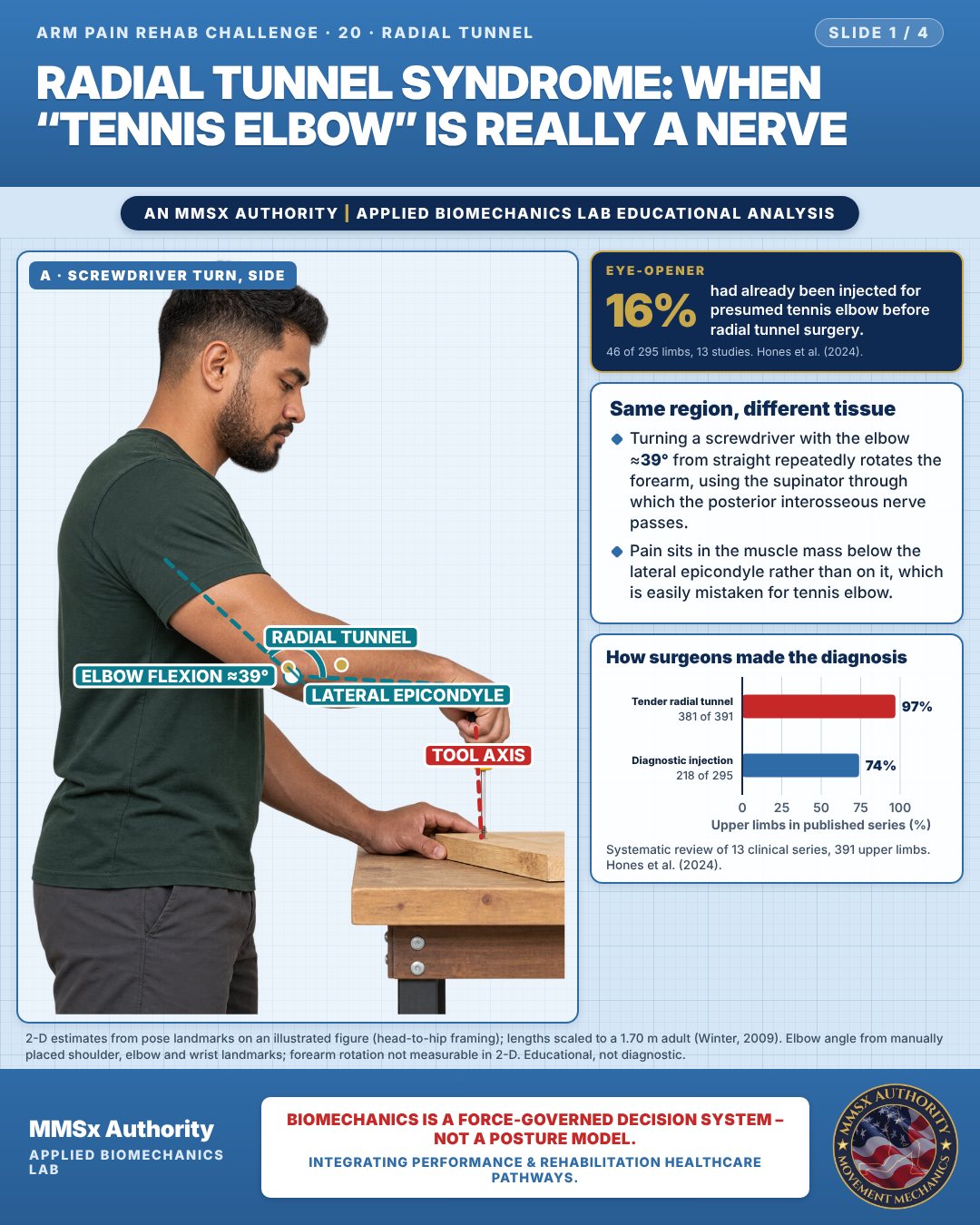
Same region, different tissue
Turning a screwdriver with the elbow ≈39° from straight repeatedly rotates the forearm, using the supinator through which the posterior interosseous nerve passes.
Pain sits in the muscle mass below the lateral epicondyle rather than on it, which is easily mistaken for tennis elbow.
How surgeons made the diagnosis
Movement B: Middle-finger test (front view)
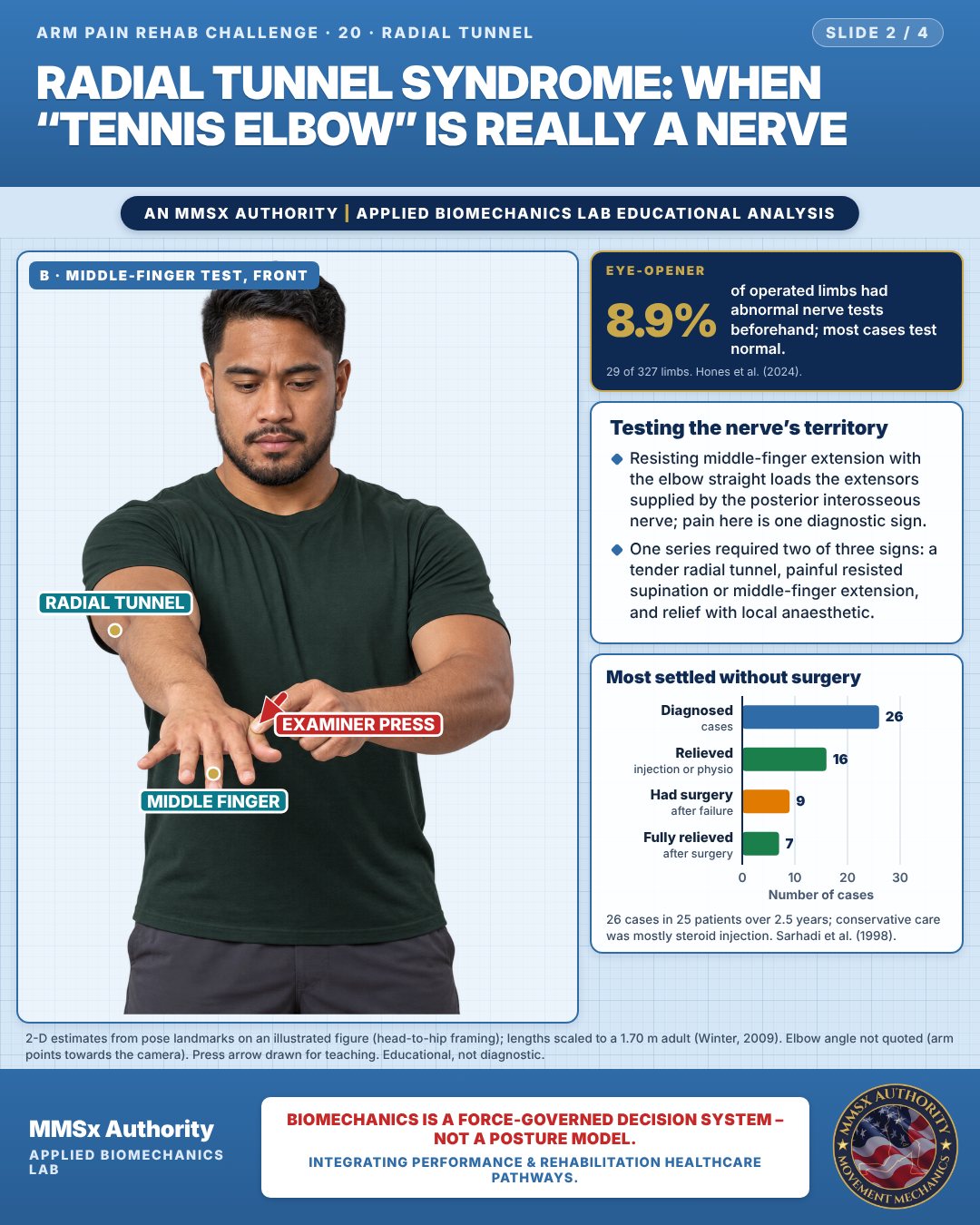
Testing the nerve’s territory
Resisting middle-finger extension with the elbow straight loads the extensors supplied by the posterior interosseous nerve; pain here is one diagnostic sign.
One series required two of three signs: a tender radial tunnel, painful resisted supination or middle-finger extension, and relief with local anaesthetic.
Most settled without surgery
Movement C: Pressing forearm (front view)
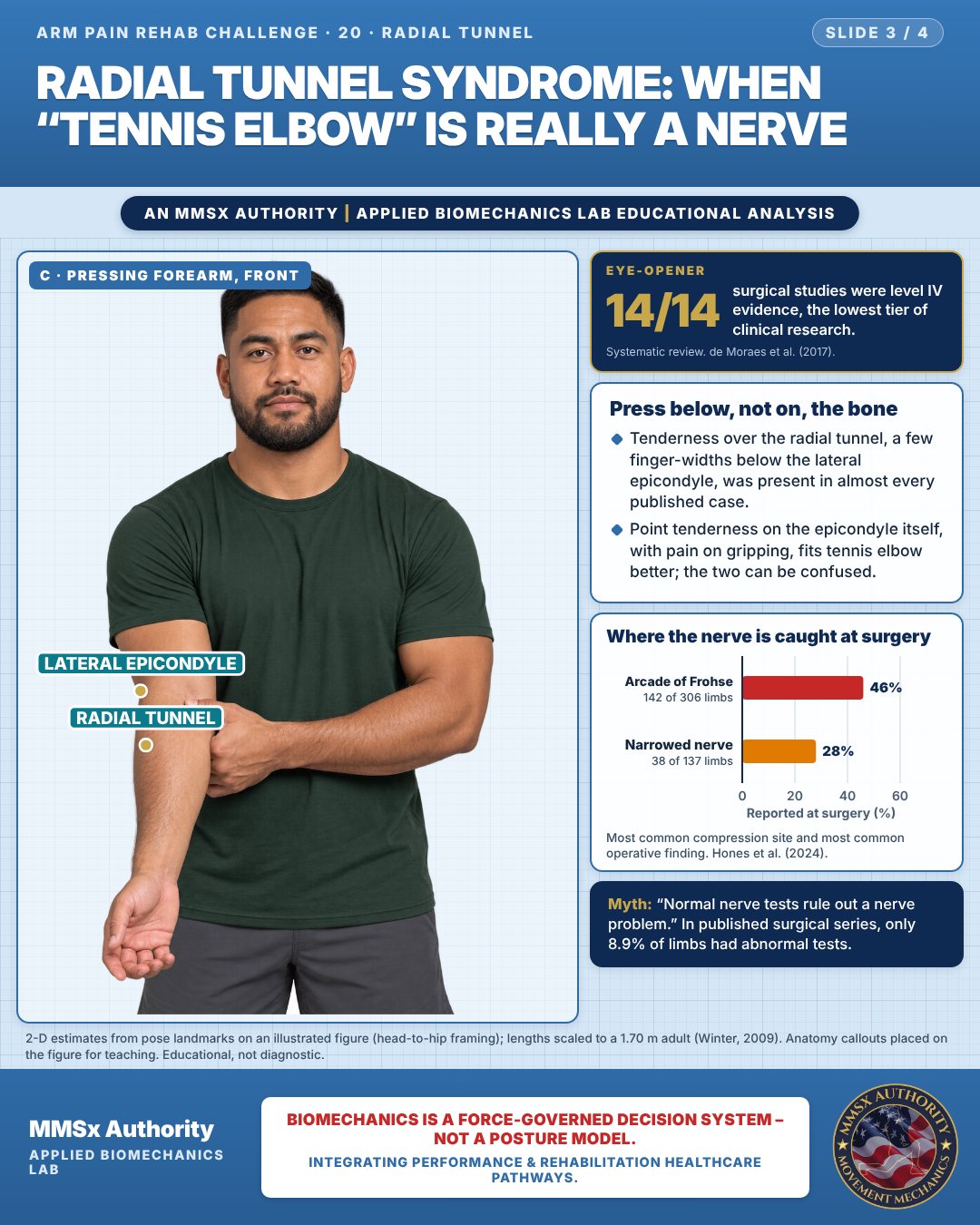
Press below, not on, the bone
Tenderness over the radial tunnel, a few finger-widths below the lateral epicondyle, was present in almost every published case.
Point tenderness on the epicondyle itself, with pain on gripping, fits tennis elbow better; the two can be confused.
Where the nerve is caught at surgery
Decision pathway
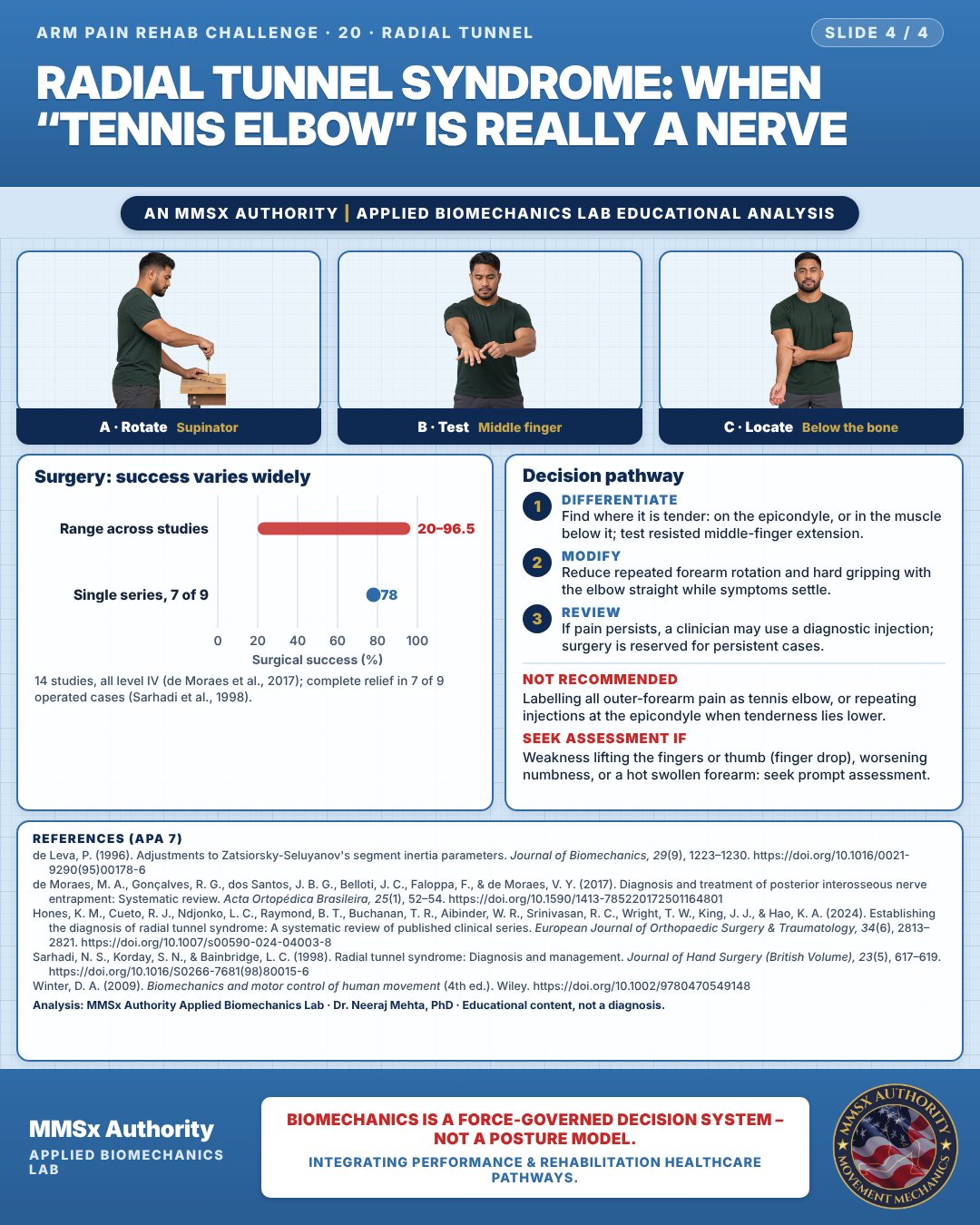
Surgery: success varies widely
Differentiate
Find where it is tender: on the epicondyle, or in the muscle below it; test resisted middle-finger extension.
Modify
Reduce repeated forearm rotation and hard gripping with the elbow straight while symptoms settle.
Review
If pain persists, a clinician may use a diagnostic injection; surgery is reserved for persistent cases.
Myth and evidence
Myth“Normal nerve tests rule out a nerve problem.”
EvidenceAbnormal EMG/nerve conduction was found in only 8.9% of limbs in published surgical series (Hones et al., 2024).
Cautions
Not recommended
Labelling all outer-forearm pain as tennis elbow, or repeating injections at the epicondyle when tenderness lies lower.
Seek assessment if
Weakness lifting the fingers or thumb (finger drop), worsening numbness, or a hot swollen forearm: seek prompt assessment.
Methods note
2-D estimates from pose landmarks on an illustrated figure (head-to-hip framing); lengths scaled to a 1.70 m adult (Winter, 2009). Elbow angle from manually placed shoulder, elbow and wrist landmarks; forearm rotation not measurable in 2-D. Elbow angle not quoted (arm points towards the camera). Press arrow drawn for teaching. Anatomy callouts placed on the figure for teaching. These are educational estimates, not a diagnosis.
References
- de Leva, P. (1996). Adjustments to Zatsiorsky-Seluyanov's segment inertia parameters. Journal of Biomechanics, 29(9), 1223–1230. https://doi.org/10.1016/0021-9290(95)00178-6
- de Moraes, M. A., Gonçalves, R. G., dos Santos, J. B. G., Belloti, J. C., Faloppa, F., & de Moraes, V. Y. (2017). Diagnosis and treatment of posterior interosseous nerve entrapment: Systematic review. Acta Ortopédica Brasileira, 25(1), 52–54. https://doi.org/10.1590/1413-785220172501164801
- Hones, K. M., Cueto, R. J., Ndjonko, L. C., Raymond, B. T., Buchanan, T. R., Aibinder, W. R., Srinivasan, R. C., Wright, T. W., King, J. J., & Hao, K. A. (2024). Establishing the diagnosis of radial tunnel syndrome: A systematic review of published clinical series. European Journal of Orthopaedic Surgery & Traumatology, 34(6), 2813–2821. https://doi.org/10.1007/s00590-024-04003-8
- Sarhadi, N. S., Korday, S. N., & Bainbridge, L. C. (1998). Radial tunnel syndrome: Diagnosis and management. Journal of Hand Surgery (British Volume), 23(5), 617–619. https://doi.org/10.1016/S0266-7681(98)80015-6
- Winter, D. A. (2009). Biomechanics and motor control of human movement (4th ed.). Wiley. https://doi.org/10.1002/9780470549148
Cite this article
Mehta, N. (2026, October 28). Radial tunnel syndrome: when “tennis elbow” is really a nerve. MMSx Authority Applied Biomechanics Lab. https://mmsxauthority.org/edu/analysis/arm/20-radial-tunnel-syndrome-when-tennis-elbow-is-really-a-nerve/
Part of the collection
Mehta, N. (2026). Elbow, Forearm, Wrist and Hand Rehabilitation: 50 Evidence-Based Biomechanics Analyses [Collection]. MMSx Authority Applied Biomechanics Lab. Zenodo. https://doi.org/10.5281/zenodo.23735910
All Arm Pain Rehab Challenge articles · Rehabilitation Library