Arm Pain Rehab Challenge · 19
Sleeping with a bent elbow: how the ulnar nerve is compressed
Nocturnal symptoms of ulnar neuropathy at the elbow (numbness/tingling in the little and ring fingers on waking) linked to sustained deep elbow…
Key points
- Position. Sleep with elbows straighter; avoid tucking the hand under the head or pillow.
- Advise. Explain the nerve’s path and give written advice on positions to avoid (Dutch guideline, 2011).
- Trial. A night splint or towel wrap may be tried for comfort; review symptoms after a few weeks.
What it is
Nocturnal symptoms of ulnar neuropathy at the elbow (numbness/tingling in the little and ring fingers on waking) linked to sustained deep elbow flexion during sleep, which narrows the cubital tunnel and stretches the ulnar nerve.
How we analysed the movement
Three movements relevant to this topic were analysed from illustrated reference figures. Joint centres were located with two-dimensional pose estimation where the whole arm was visible; elbow and wrist angles, and the directions of external load and tendon pull, were then drawn on the figure; on hand close-ups, where pose estimation does not apply, the landmarks were placed manually. The figures are educational estimates that show how position changes mechanical demand; they are not measurements of a patient. Every research value quoted below comes from the published source cited beside it.
Movement A: Arm under head (side view)
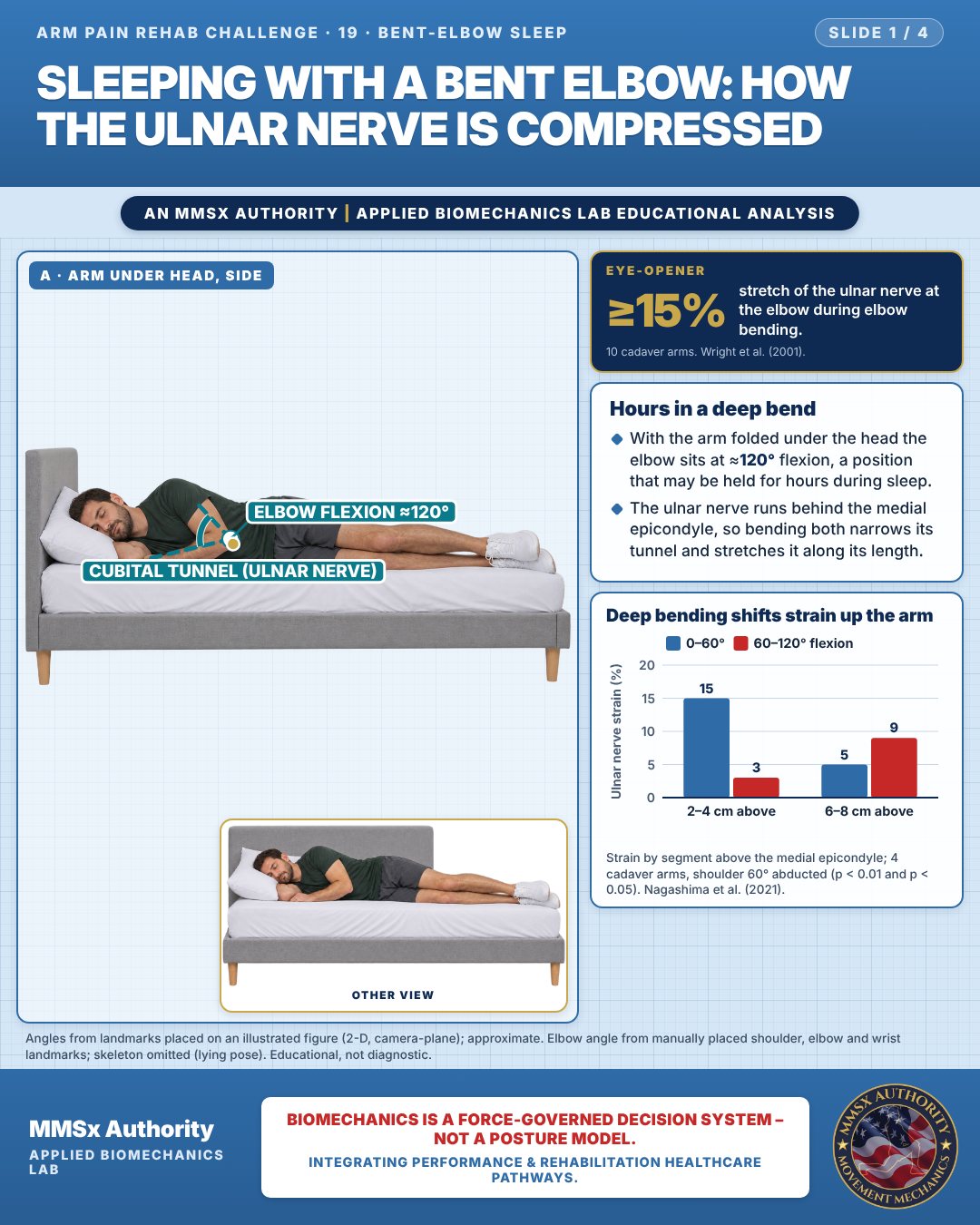
Hours in a deep bend
With the arm folded under the head the elbow sits at ≈120° flexion, a position that may be held for hours during sleep.
The ulnar nerve runs behind the medial epicondyle, so bending both narrows its tunnel and stretches it along its length.
Deep bending shifts strain up the arm
Movement B: Hands on chest (side view)
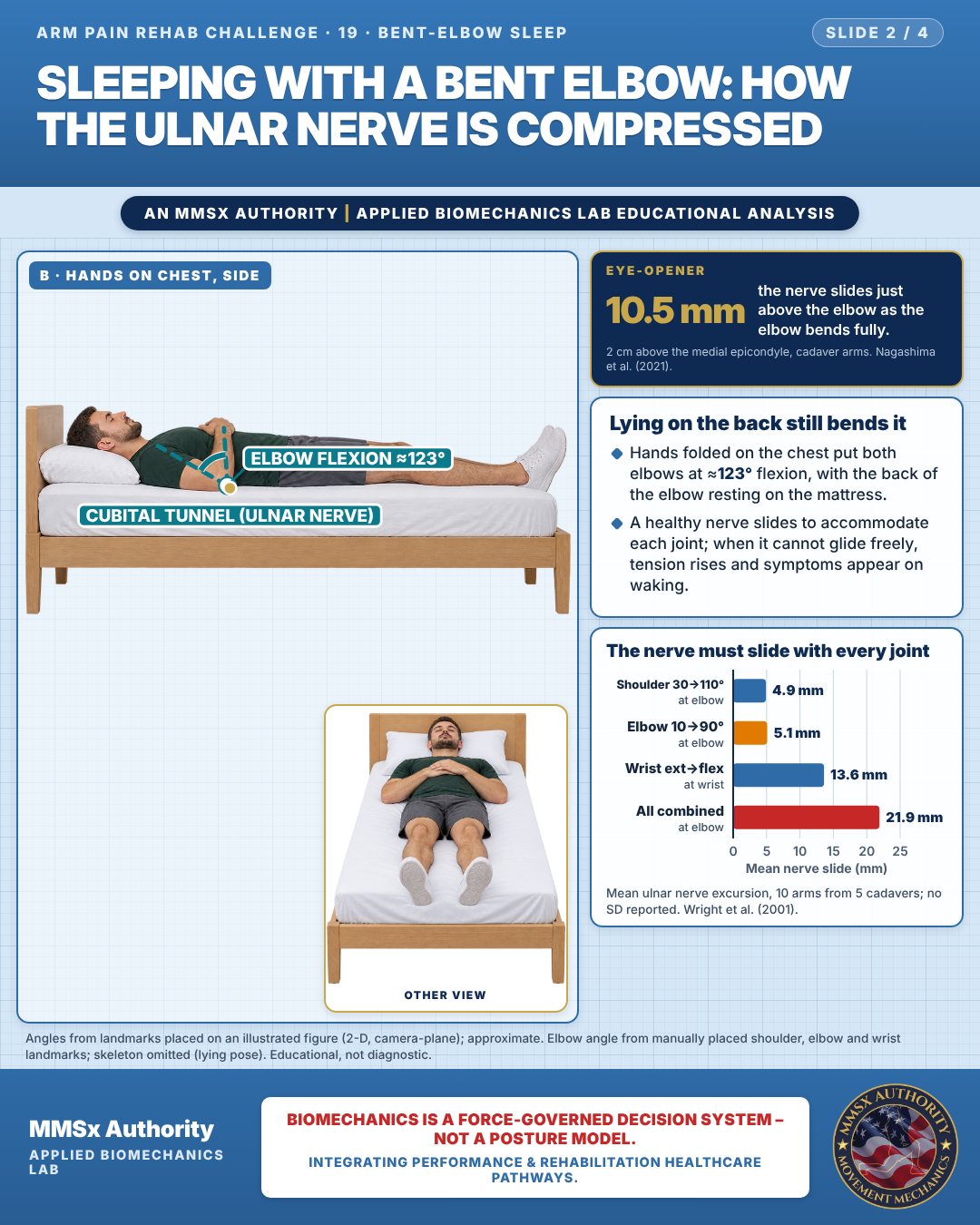
Lying on the back still bends it
Hands folded on the chest put both elbows at ≈123° flexion, with the back of the elbow resting on the mattress.
A healthy nerve slides to accommodate each joint; when it cannot glide freely, tension rises and symptoms appear on waking.
The nerve must slide with every joint
Movement C: Arms straight (side view)
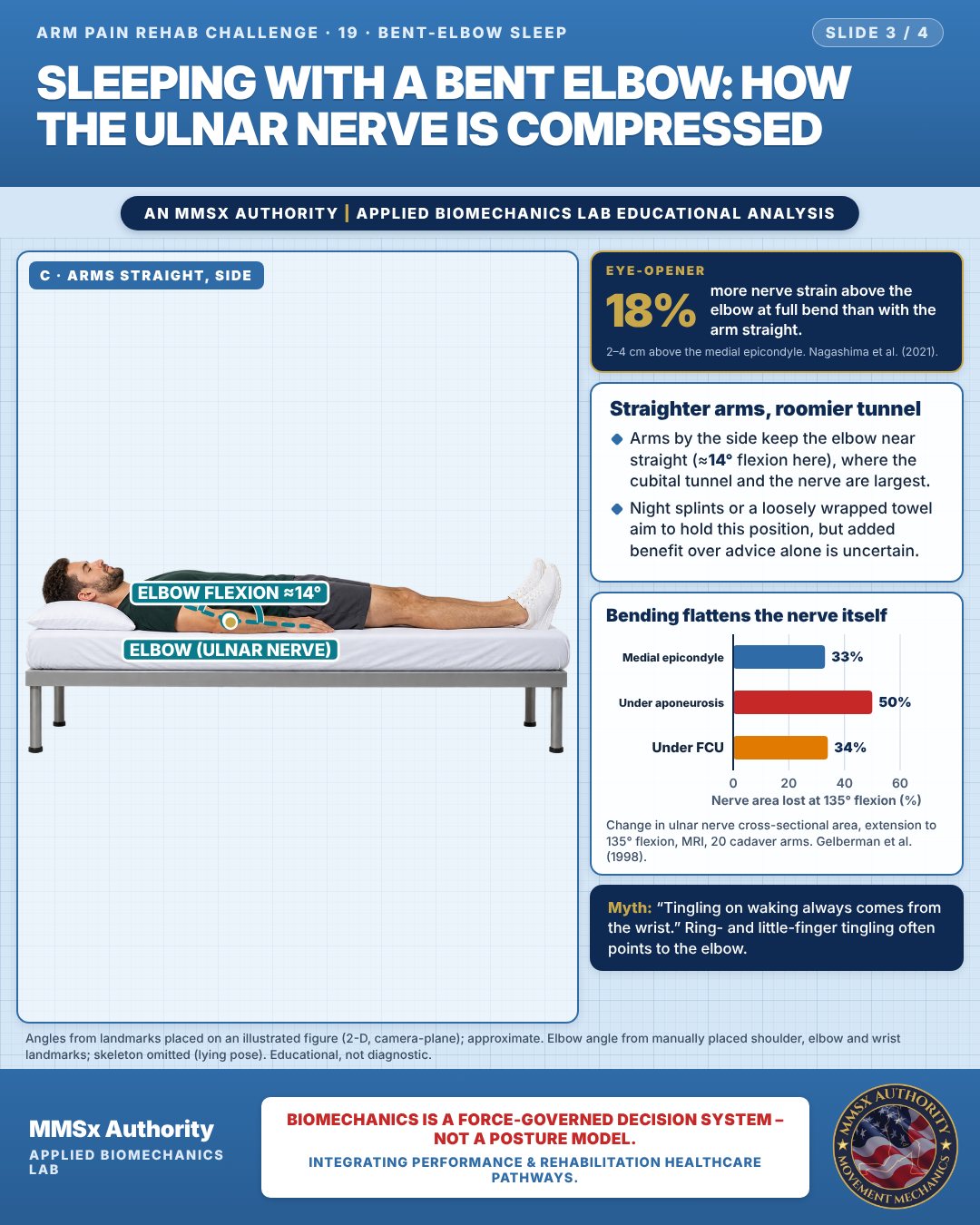
Straighter arms, roomier tunnel
Arms by the side keep the elbow near straight (≈14° flexion here), where the cubital tunnel and the nerve are largest.
Night splints or a loosely wrapped towel aim to hold this position, but added benefit over advice alone is uncertain.
Bending flattens the nerve itself
Decision pathway
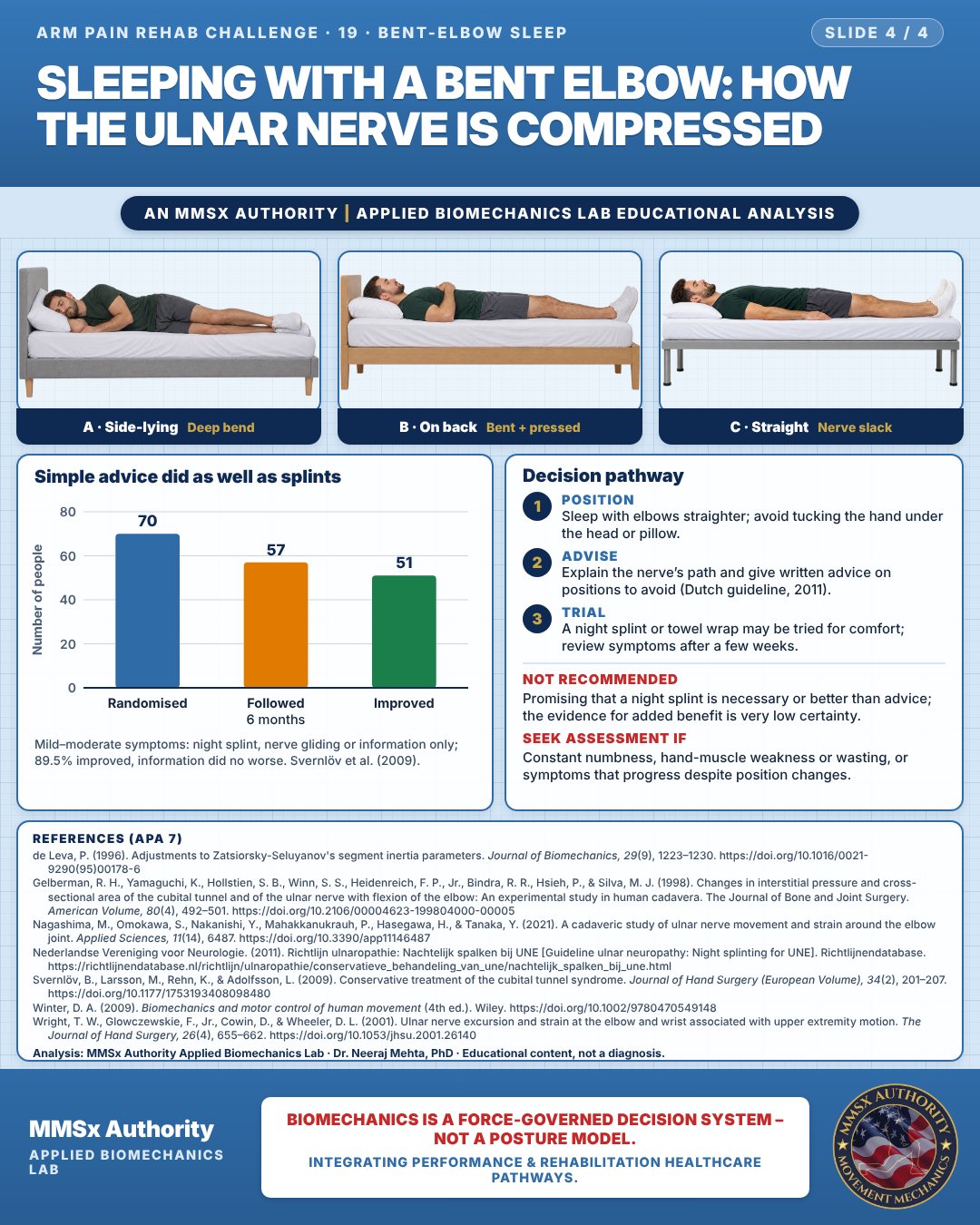
Simple advice did as well as splints
Position
Sleep with elbows straighter; avoid tucking the hand under the head or pillow.
Advise
Explain the nerve’s path and give written advice on positions to avoid (Dutch guideline, 2011).
Trial
A night splint or towel wrap may be tried for comfort; review symptoms after a few weeks.
Myth and evidence
Myth“Tingling on waking means the nerve is being pinched only at the wrist.”
EvidenceDeep elbow flexion alone narrows the cubital tunnel by 30–41% and nerve area by 33–50% (Gelberman et al., 1998) and strains the nerve ≥15% (Wright et al., 2001).
Cautions
Not recommended
Promising that a night splint is necessary or better than advice; the evidence for added benefit is very low certainty.
Seek assessment if
Constant numbness, hand-muscle weakness or wasting, or symptoms that progress despite position changes.
Methods note
Angles from landmarks placed on an illustrated figure (2-D, camera-plane); approximate. Elbow angle from manually placed shoulder, elbow and wrist landmarks; skeleton omitted (lying pose). These are educational estimates, not a diagnosis.
References
- de Leva, P. (1996). Adjustments to Zatsiorsky-Seluyanov's segment inertia parameters. Journal of Biomechanics, 29(9), 1223–1230. https://doi.org/10.1016/0021-9290(95)00178-6
- Gelberman, R. H., Yamaguchi, K., Hollstien, S. B., Winn, S. S., Heidenreich, F. P., Jr., Bindra, R. R., Hsieh, P., & Silva, M. J. (1998). Changes in interstitial pressure and cross-sectional area of the cubital tunnel and of the ulnar nerve with flexion of the elbow: An experimental study in human cadavera. The Journal of Bone and Joint Surgery. American Volume, 80(4), 492–501. https://doi.org/10.2106/00004623-199804000-00005
- Nagashima, M., Omokawa, S., Nakanishi, Y., Mahakkanukrauh, P., Hasegawa, H., & Tanaka, Y. (2021). A cadaveric study of ulnar nerve movement and strain around the elbow joint. Applied Sciences, 11(14), 6487. https://doi.org/10.3390/app11146487
- Nederlandse Vereniging voor Neurologie. (2011). Richtlijn ulnaropathie: Nachtelijk spalken bij UNE [Guideline ulnar neuropathy: Night splinting for UNE]. Richtlijnendatabase. https://richtlijnendatabase.nl/richtlijn/ulnaropathie/conservatieve_behandeling_van_une/nachtelijk_spalken_bij_une.html
- Svernlöv, B., Larsson, M., Rehn, K., & Adolfsson, L. (2009). Conservative treatment of the cubital tunnel syndrome. Journal of Hand Surgery (European Volume), 34(2), 201–207. https://doi.org/10.1177/1753193408098480
- Winter, D. A. (2009). Biomechanics and motor control of human movement (4th ed.). Wiley. https://doi.org/10.1002/9780470549148
- Wright, T. W., Glowczewskie, F., Jr., Cowin, D., & Wheeler, D. L. (2001). Ulnar nerve excursion and strain at the elbow and wrist associated with upper extremity motion. The Journal of Hand Surgery, 26(4), 655–662. https://doi.org/10.1053/jhsu.2001.26140
Cite this article
Mehta, N. (2026, October 28). Sleeping with a bent elbow: how the ulnar nerve is compressed. MMSx Authority Applied Biomechanics Lab. https://mmsxauthority.org/edu/analysis/arm/19-sleeping-with-a-bent-elbow-how-the-ulnar-nerve-is-compressed/
Part of the collection
Mehta, N. (2026). Elbow, Forearm, Wrist and Hand Rehabilitation: 50 Evidence-Based Biomechanics Analyses [Collection]. MMSx Authority Applied Biomechanics Lab. Zenodo. https://doi.org/10.5281/zenodo.23735910
All Arm Pain Rehab Challenge articles · Rehabilitation Library