Arm Pain Rehab Challenge · 17
Elbow osteoarthritis: pain, locking and loss of range
Primary elbow osteoarthritis: degenerative joint disease of the elbow, typically in middle-aged men with heavy upper-limb use, presenting with…
Key points
- Modify. Avoid repeated forceful end-range extension; lift close to the body and within the pain-free arc.
- Load. Keep range moving daily and strengthen with paced, tolerable loading of the elbow and grip.
- Track. Record extension, flexion and locking episodes; a persistent block may warrant a surgical opinion.
What it is
Primary elbow osteoarthritis: degenerative joint disease of the elbow, typically in middle-aged men with heavy upper-limb use, presenting with end-range pain, osteophyte-related loss of extension/flexion and sometimes locking from loose bodies.
How we analysed the movement
Three movements relevant to this topic were analysed from illustrated reference figures. Joint centres were located with two-dimensional pose estimation where the whole arm was visible; elbow and wrist angles, and the directions of external load and tendon pull, were then drawn on the figure; on hand close-ups, where pose estimation does not apply, the landmarks were placed manually. The figures are educational estimates that show how position changes mechanical demand; they are not measurements of a patient. Every research value quoted below comes from the published source cited beside it.
Movement A: Kettle lift (side view)
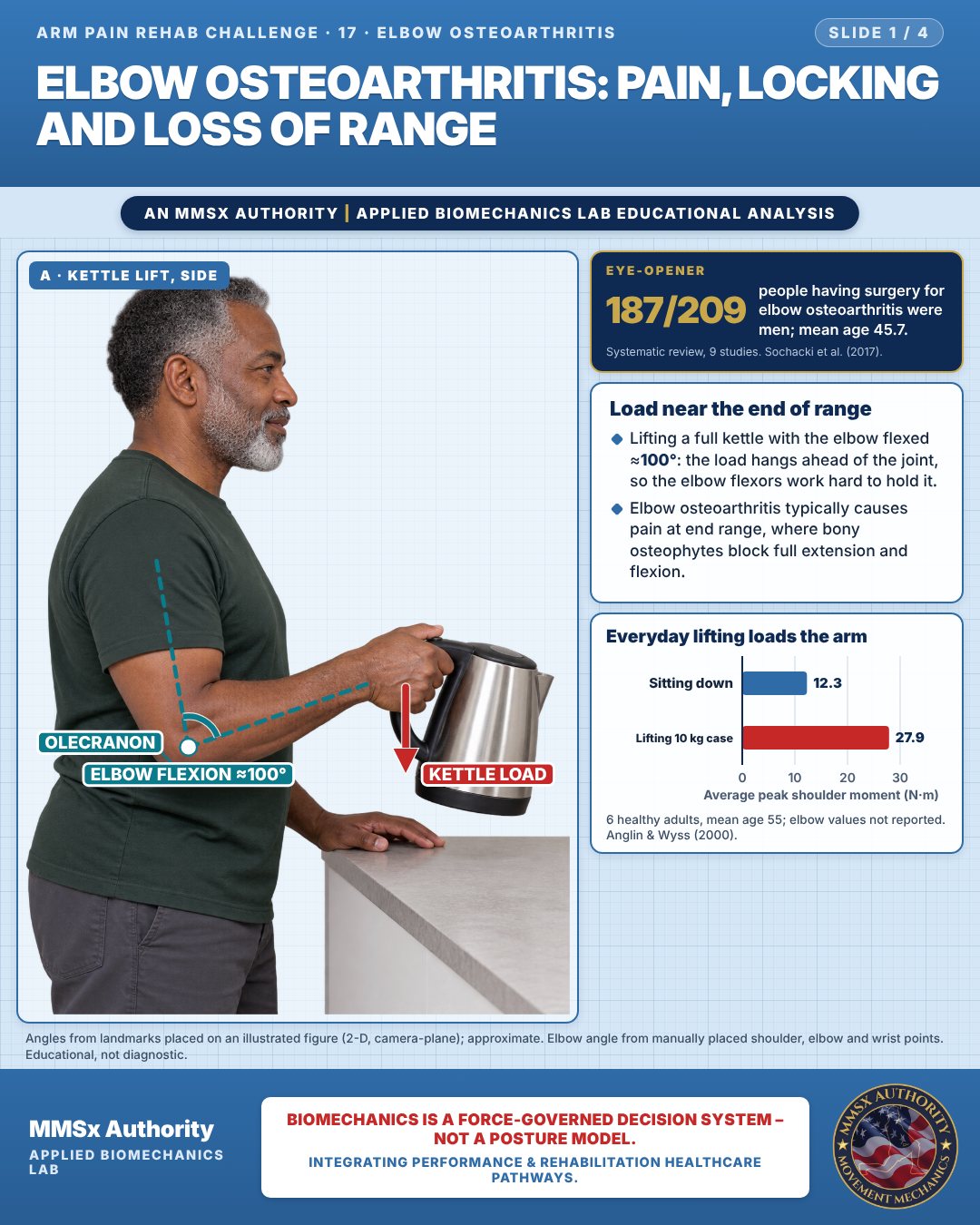
Load near the end of range
Lifting a full kettle with the elbow flexed ≈100°: the load hangs ahead of the joint, so the elbow flexors work hard to hold it.
Elbow osteoarthritis typically causes pain at end range, where bony osteophytes block full extension and flexion.
Everyday lifting loads the arm
Movement B: Cup to mouth (front view)
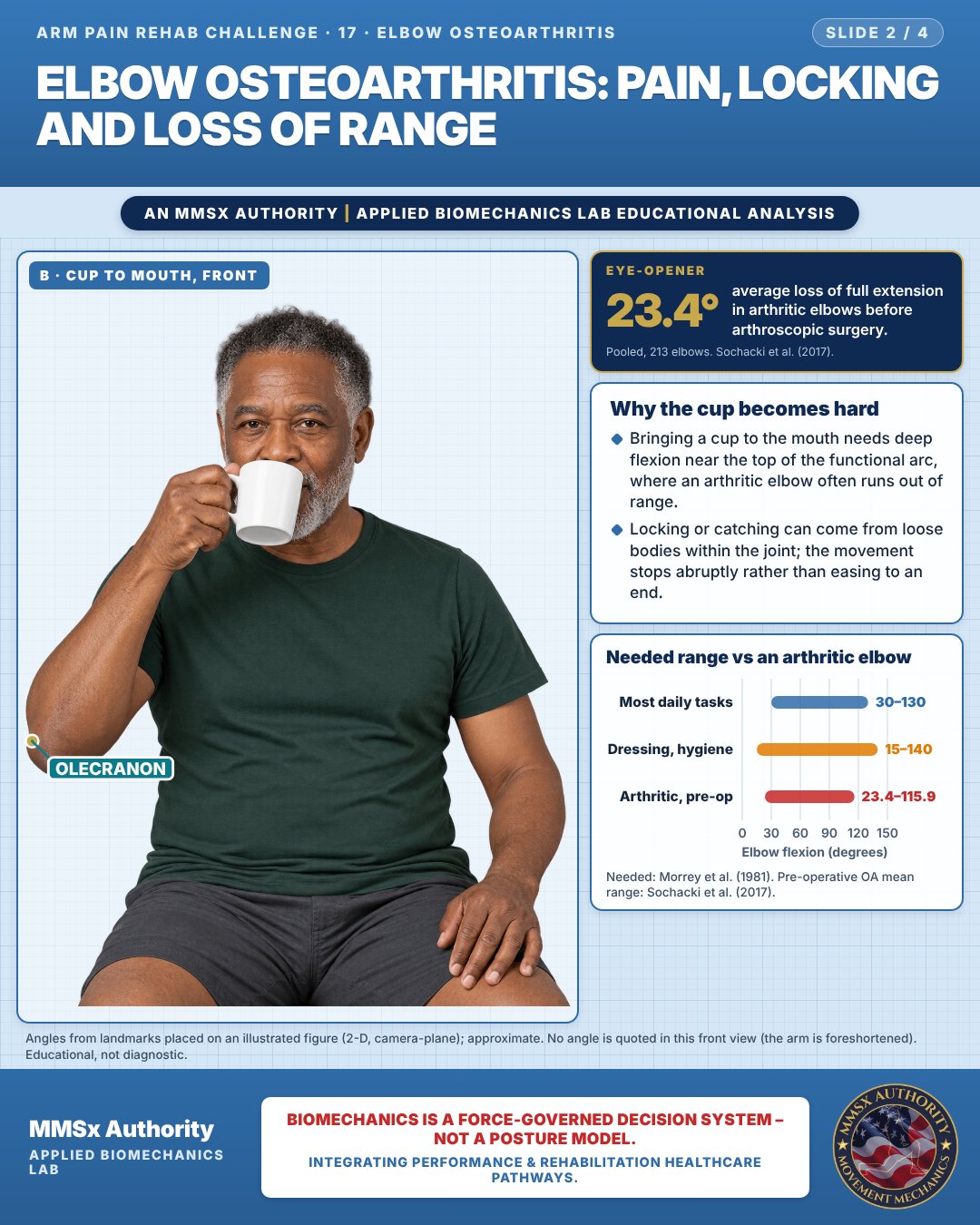
Why the cup becomes hard
Bringing a cup to the mouth needs deep flexion near the top of the functional arc, where an arthritic elbow often runs out of range.
Locking or catching can come from loose bodies within the joint; the movement stops abruptly rather than easing to an end.
Needed range vs an arthritic elbow
Movement C: Armchair push (side view)
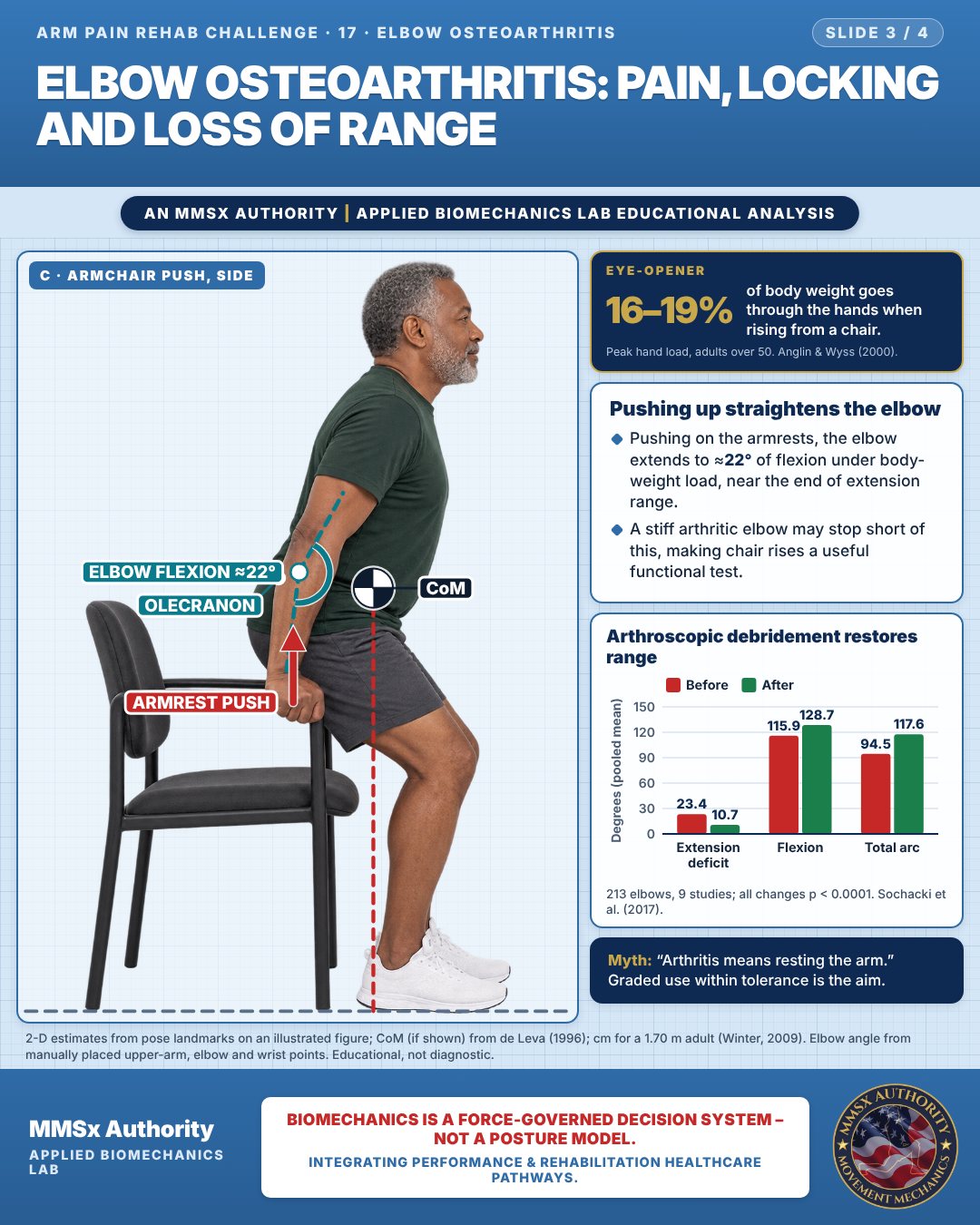
Pushing up straightens the elbow
Pushing on the armrests, the elbow extends to ≈22° of flexion under body-weight load, near the end of extension range.
A stiff arthritic elbow may stop short of this, making chair rises a useful functional test.
Arthroscopic debridement restores range
Decision pathway
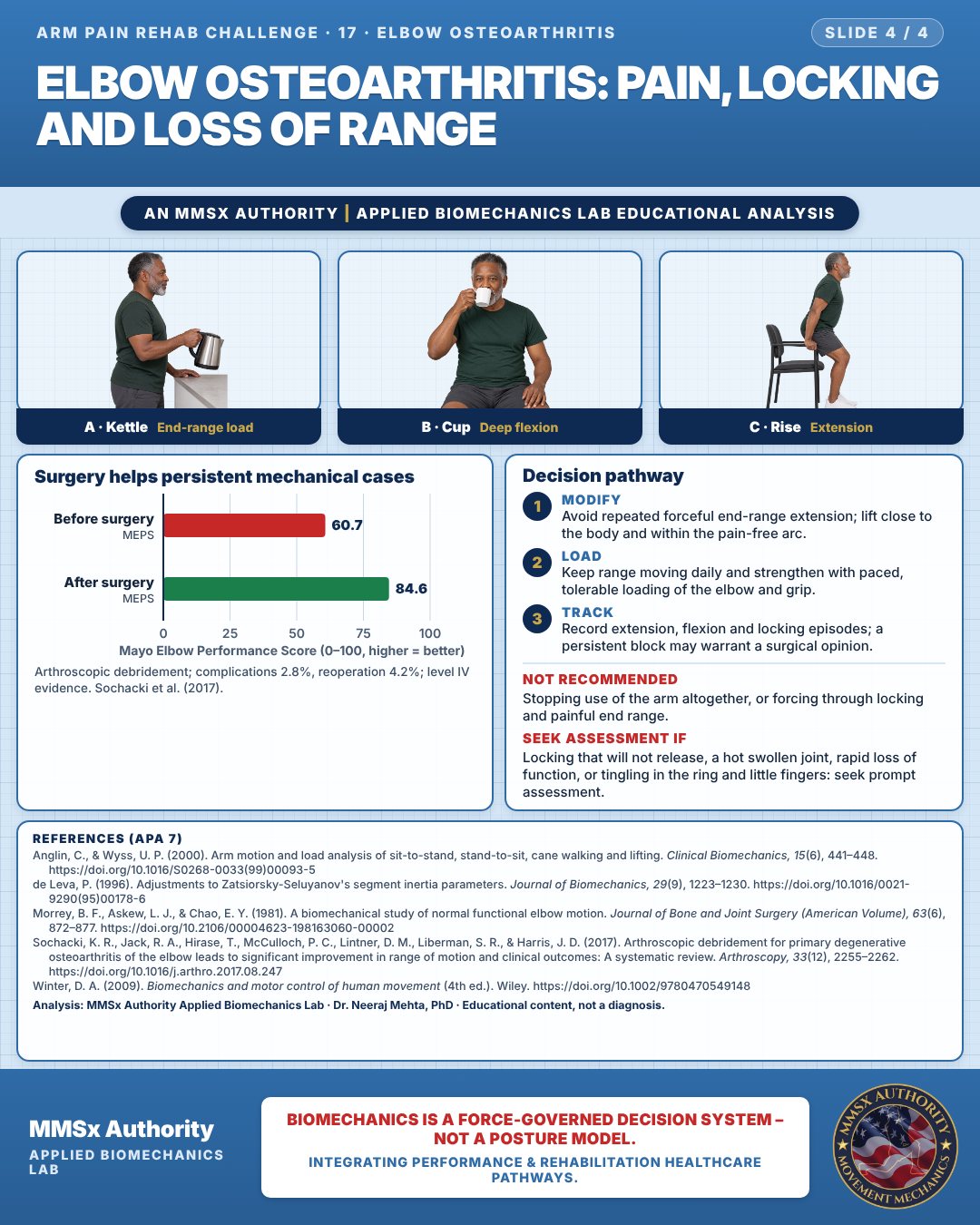
Surgery helps persistent mechanical cases
Modify
Avoid repeated forceful end-range extension; lift close to the body and within the pain-free arc.
Load
Keep range moving daily and strengthen with paced, tolerable loading of the elbow and grip.
Track
Record extension, flexion and locking episodes; a persistent block may warrant a surgical opinion.
Myth and evidence
Myth“Arthritis means you must stop using the arm.”
EvidenceDaily tasks such as rising from a chair already place 16–19% of body weight through the hands (Anglin & Wyss, 2000); graded use within tolerance is the aim, and when mechanical blocks persist, debridement improves the arc by about 23° (Sochacki et al., 2017).
Cautions
Not recommended
Stopping use of the arm altogether, or forcing through locking and painful end range.
Seek assessment if
Locking that will not release, a hot swollen joint, rapid loss of function, or tingling in the ring and little fingers: seek prompt assessment.
Methods note
Angles from landmarks placed on an illustrated figure (2-D, camera-plane); approximate. Elbow angle from manually placed shoulder, elbow and wrist points. No angle is quoted in this front view (the arm is foreshortened). 2-D estimates from pose landmarks on an illustrated figure; CoM (if shown) from de Leva (1996); cm for a 1.70 m adult (Winter, 2009). Elbow angle from manually placed upper-arm, elbow and wrist points. These are educational estimates, not a diagnosis.
References
- Anglin, C., & Wyss, U. P. (2000). Arm motion and load analysis of sit-to-stand, stand-to-sit, cane walking and lifting. Clinical Biomechanics, 15(6), 441–448. https://doi.org/10.1016/S0268-0033(99)00093-5
- de Leva, P. (1996). Adjustments to Zatsiorsky-Seluyanov's segment inertia parameters. Journal of Biomechanics, 29(9), 1223–1230. https://doi.org/10.1016/0021-9290(95)00178-6
- Morrey, B. F., Askew, L. J., & Chao, E. Y. (1981). A biomechanical study of normal functional elbow motion. Journal of Bone and Joint Surgery (American Volume), 63(6), 872–877. https://doi.org/10.2106/00004623-198163060-00002
- Sochacki, K. R., Jack, R. A., Hirase, T., McCulloch, P. C., Lintner, D. M., Liberman, S. R., & Harris, J. D. (2017). Arthroscopic debridement for primary degenerative osteoarthritis of the elbow leads to significant improvement in range of motion and clinical outcomes: A systematic review. Arthroscopy, 33(12), 2255–2262. https://doi.org/10.1016/j.arthro.2017.08.247
- Winter, D. A. (2009). Biomechanics and motor control of human movement (4th ed.). Wiley. https://doi.org/10.1002/9780470549148
Cite this article
Mehta, N. (2026, October 28). Elbow osteoarthritis: pain, locking and loss of range. MMSx Authority Applied Biomechanics Lab. https://mmsxauthority.org/edu/analysis/arm/17-elbow-osteoarthritis-pain-locking-and-loss-of-range/
Part of the collection
Mehta, N. (2026). Elbow, Forearm, Wrist and Hand Rehabilitation: 50 Evidence-Based Biomechanics Analyses [Collection]. MMSx Authority Applied Biomechanics Lab. Zenodo. https://doi.org/10.5281/zenodo.23735910
All Arm Pain Rehab Challenge articles · Rehabilitation Library