Arm Pain Rehab Challenge · 16
Elbow dislocation and fracture rehab: restoring motion safely
Rehabilitation after elbow dislocation (simple = no fracture) and elbow fractures, aiming to restore stable, functional motion while protecting…
Key points
- Move. With stability confirmed, start early active bending and straightening inside the stable arc.
- Rotate. Add palm-up and palm-down turns with the elbow at the side, aiming towards 50° each way.
- Load. Begin weight-bearing at the wall and progress the incline only as the clinician advises.
What it is
Rehabilitation after elbow dislocation (simple = no fracture) and elbow fractures, aiming to restore stable, functional motion while protecting healing structures.
How we analysed the movement
Three movements relevant to this topic were analysed from illustrated reference figures. Joint centres were located with two-dimensional pose estimation where the whole arm was visible; elbow and wrist angles, and the directions of external load and tendon pull, were then drawn on the figure; on hand close-ups, where pose estimation does not apply, the landmarks were placed manually. The figures are educational estimates that show how position changes mechanical demand; they are not measurements of a patient. Every research value quoted below comes from the published source cited beside it.
Movement A: Active elbow bend (side view)
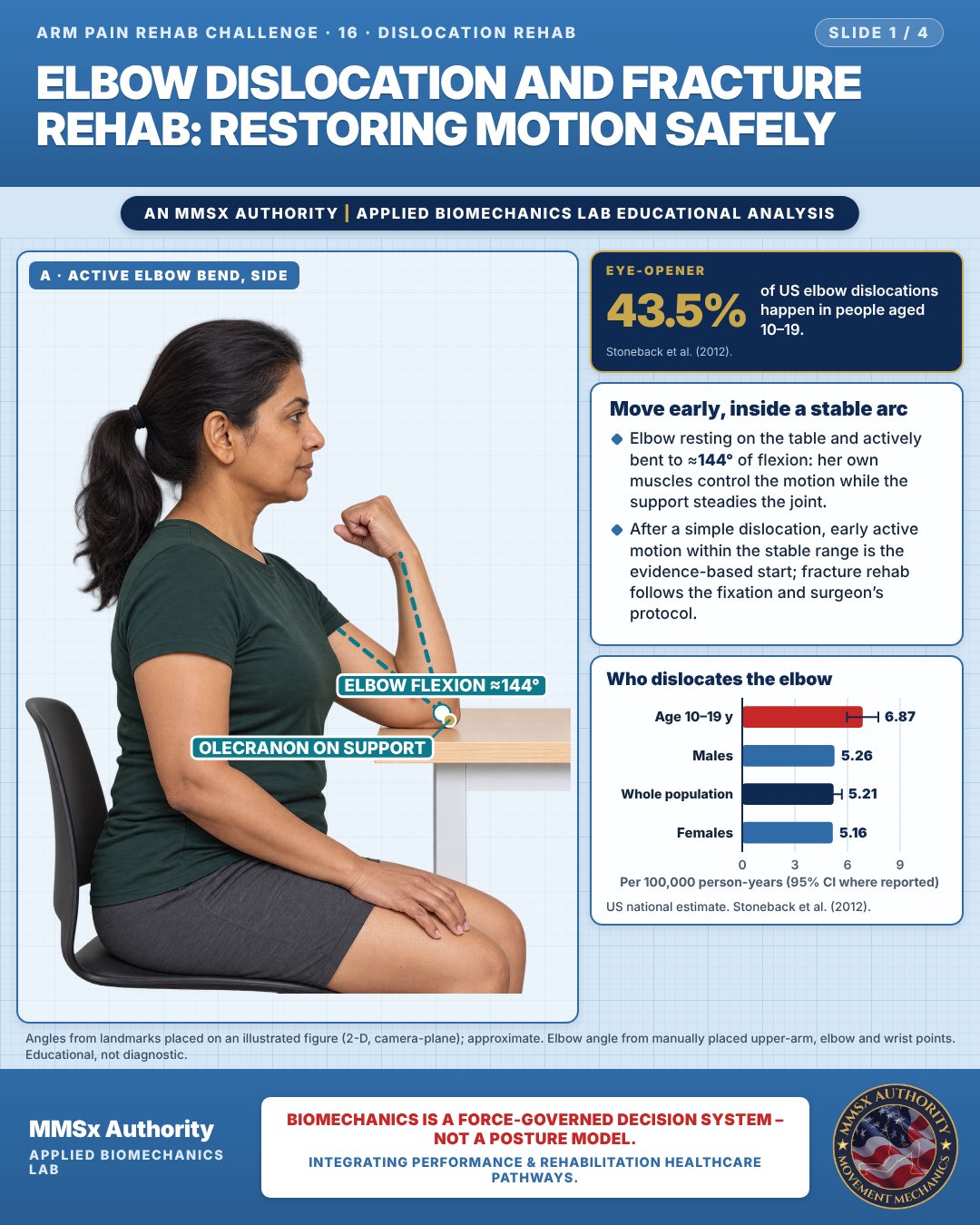
Move early, inside a stable arc
Elbow resting on the table and actively bent to ≈144° of flexion: her own muscles control the motion while the support steadies the joint.
After a simple dislocation, early active motion within the stable range is the evidence-based start; fracture rehab follows the fixation and surgeon’s protocol.
Who dislocates the elbow
Movement B: Rod rotation (front view)
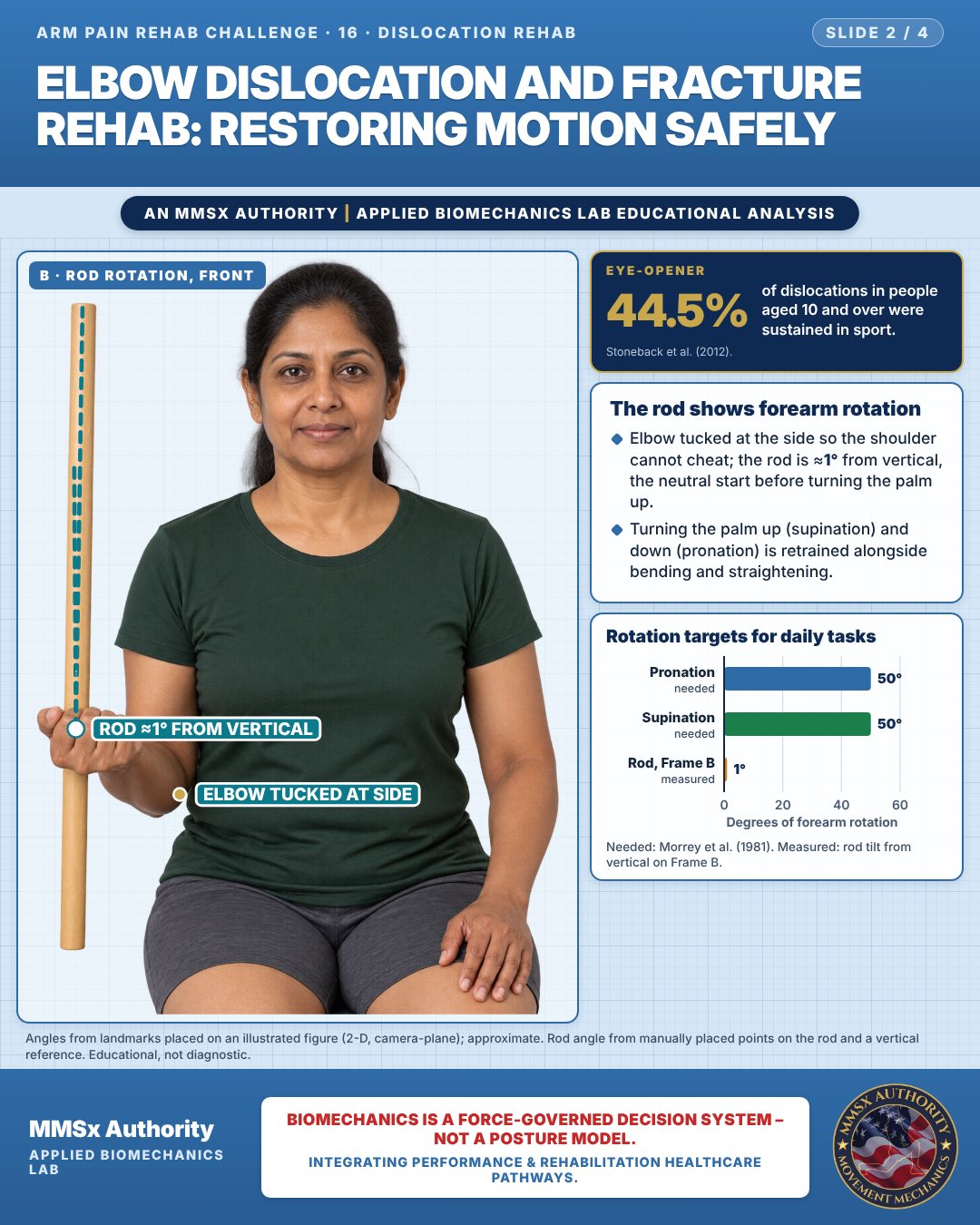
The rod shows forearm rotation
Elbow tucked at the side so the shoulder cannot cheat; the rod is ≈1° from vertical, the neutral start before turning the palm up.
Turning the palm up (supination) and down (pronation) is retrained alongside bending and straightening.
Rotation targets for daily tasks
Movement C: Wall push-up (side view)
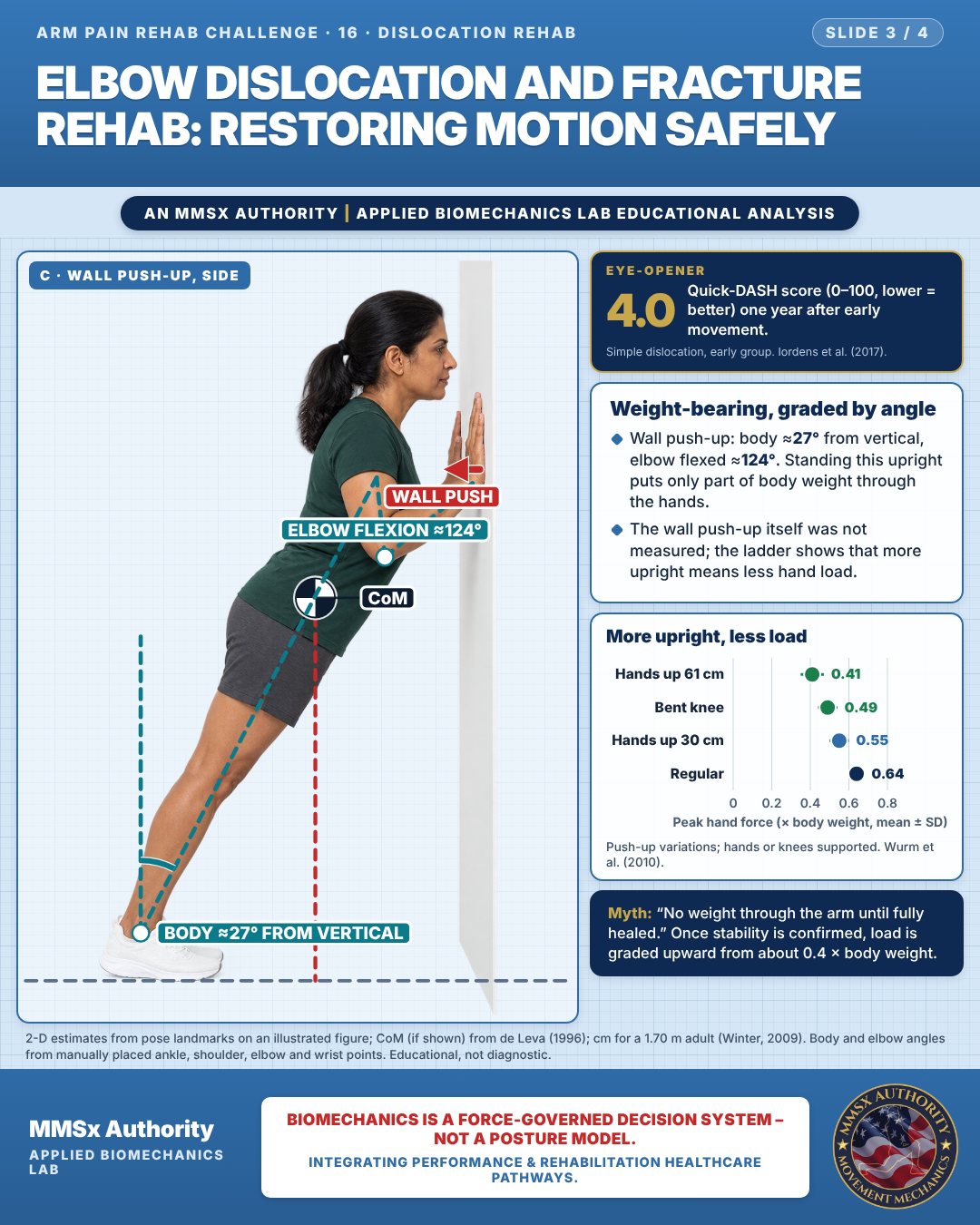
Weight-bearing, graded by angle
Wall push-up: body ≈27° from vertical, elbow flexed ≈124°. Standing this upright puts only part of body weight through the hands.
The wall push-up itself was not measured; the ladder shows that more upright means less hand load.
More upright, less load
Decision pathway
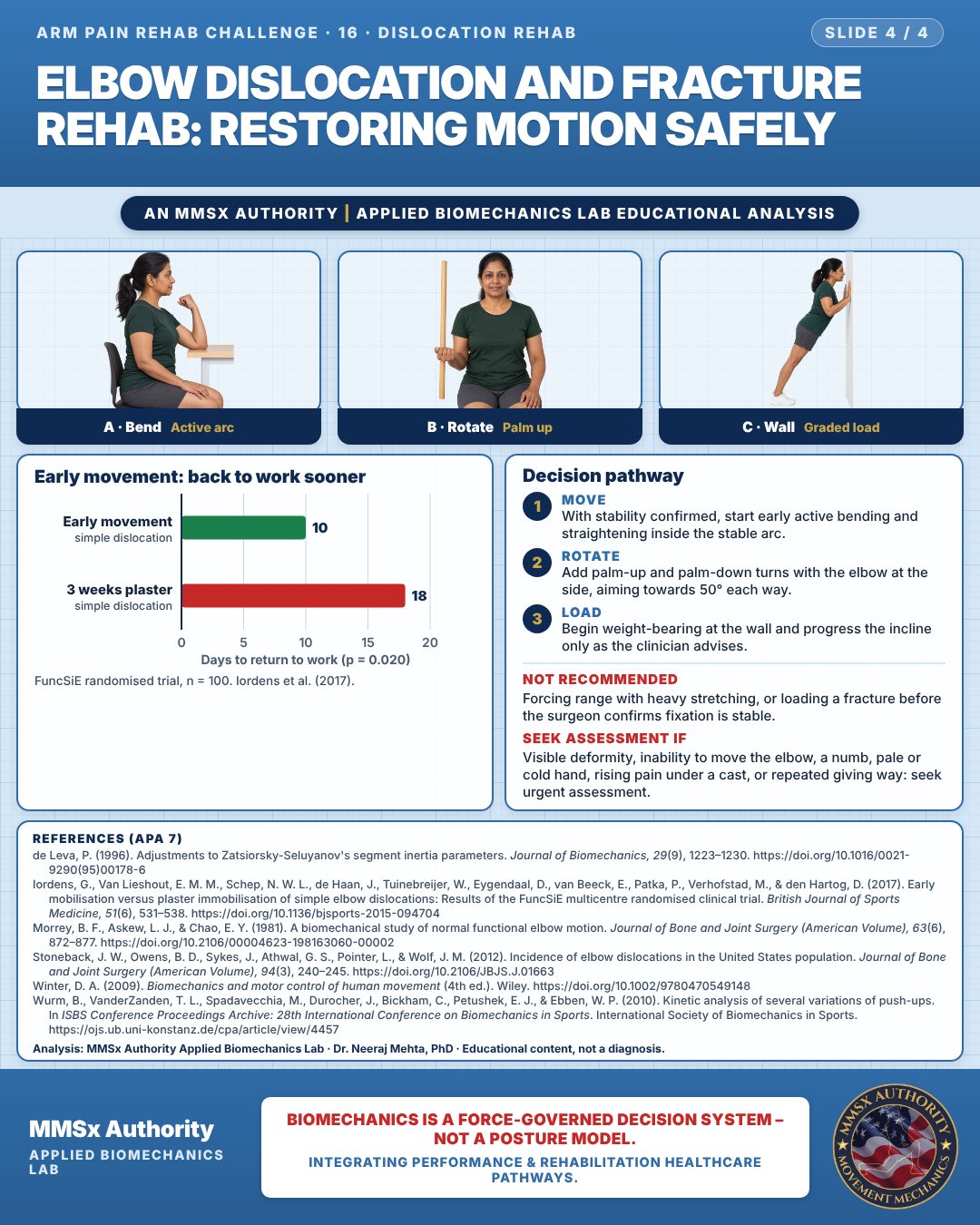
Early movement: back to work sooner
Move
With stability confirmed, start early active bending and straightening inside the stable arc.
Rotate
Add palm-up and palm-down turns with the elbow at the side, aiming towards 50° each way.
Load
Begin weight-bearing at the wall and progress the incline only as the clinician advises.
What the evidence supports
- For simple dislocations: early active motion within a stable arc, forearm rotation work, and graded weight-bearing as stability allows (Iordens et al., 2017). Fracture rehabilitation follows the fixation's stability and the surgeon's protocol.
Cautions
Not recommended
Forcing range with heavy stretching, or loading a fracture before the surgeon confirms fixation is stable.
Seek assessment if
Visible deformity, inability to move the elbow, a numb, pale or cold hand, rising pain under a cast, or repeated giving way: seek urgent assessment.
Methods note
Angles from landmarks placed on an illustrated figure (2-D, camera-plane); approximate. Elbow angle from manually placed upper-arm, elbow and wrist points. Rod angle from manually placed points on the rod and a vertical reference. 2-D estimates from pose landmarks on an illustrated figure; CoM (if shown) from de Leva (1996); cm for a 1.70 m adult (Winter, 2009). Body and elbow angles from manually placed ankle, shoulder, elbow and wrist points. These are educational estimates, not a diagnosis.
References
- de Leva, P. (1996). Adjustments to Zatsiorsky-Seluyanov's segment inertia parameters. Journal of Biomechanics, 29(9), 1223–1230. https://doi.org/10.1016/0021-9290(95)00178-6
- Iordens, G., Van Lieshout, E. M. M., Schep, N. W. L., de Haan, J., Tuinebreijer, W., Eygendaal, D., van Beeck, E., Patka, P., Verhofstad, M., & den Hartog, D. (2017). Early mobilisation versus plaster immobilisation of simple elbow dislocations: Results of the FuncSiE multicentre randomised clinical trial. British Journal of Sports Medicine, 51(6), 531–538. https://doi.org/10.1136/bjsports-2015-094704
- Morrey, B. F., Askew, L. J., & Chao, E. Y. (1981). A biomechanical study of normal functional elbow motion. Journal of Bone and Joint Surgery (American Volume), 63(6), 872–877. https://doi.org/10.2106/00004623-198163060-00002
- Stoneback, J. W., Owens, B. D., Sykes, J., Athwal, G. S., Pointer, L., & Wolf, J. M. (2012). Incidence of elbow dislocations in the United States population. Journal of Bone and Joint Surgery (American Volume), 94(3), 240–245. https://doi.org/10.2106/JBJS.J.01663
- Winter, D. A. (2009). Biomechanics and motor control of human movement (4th ed.). Wiley. https://doi.org/10.1002/9780470549148
- Wurm, B., VanderZanden, T. L., Spadavecchia, M., Durocher, J., Bickham, C., Petushek, E. J., & Ebben, W. P. (2010). Kinetic analysis of several variations of push-ups. In ISBS Conference Proceedings Archive: 28th International Conference on Biomechanics in Sports. International Society of Biomechanics in Sports. https://ojs.ub.uni-konstanz.de/cpa/article/view/4457
Cite this article
Mehta, N. (2026, October 28). Elbow dislocation and fracture rehab: restoring motion safely. MMSx Authority Applied Biomechanics Lab. https://mmsxauthority.org/edu/analysis/arm/16-elbow-dislocation-and-fracture-rehab-restoring-motion-safely/
Part of the collection
Mehta, N. (2026). Elbow, Forearm, Wrist and Hand Rehabilitation: 50 Evidence-Based Biomechanics Analyses [Collection]. MMSx Authority Applied Biomechanics Lab. Zenodo. https://doi.org/10.5281/zenodo.23735910
All Arm Pain Rehab Challenge articles · Rehabilitation Library