Arm Pain Rehab Challenge · 15
Elbow stiffness after injury: why losing full extension matters
Post-traumatic elbow stiffness: loss of elbow flexion–extension arc (and/or forearm rotation) after fracture, dislocation or surgery.
Key points
- Move early. Once the clinician confirms the elbow is stable, start protected active motion rather than long immobilisation.
- Position. Use low-load, long-duration positioning to regain extension; build towards the 30°–130° functional arc.
- Track. Measure extension deficit and flexion weekly; link targets to tasks such as reaching the mouth.
What it is
Post-traumatic elbow stiffness: loss of elbow flexion–extension arc (and/or forearm rotation) after fracture, dislocation or surgery; loss of terminal extension is common.
How we analysed the movement
Three movements relevant to this topic were analysed from illustrated reference figures. Joint centres were located with two-dimensional pose estimation where the whole arm was visible; elbow and wrist angles, and the directions of external load and tendon pull, were then drawn on the figure; on hand close-ups, where pose estimation does not apply, the landmarks were placed manually. The figures are educational estimates that show how position changes mechanical demand; they are not measurements of a patient. Every research value quoted below comes from the published source cited beside it.
Movement A: Full extension (side view)
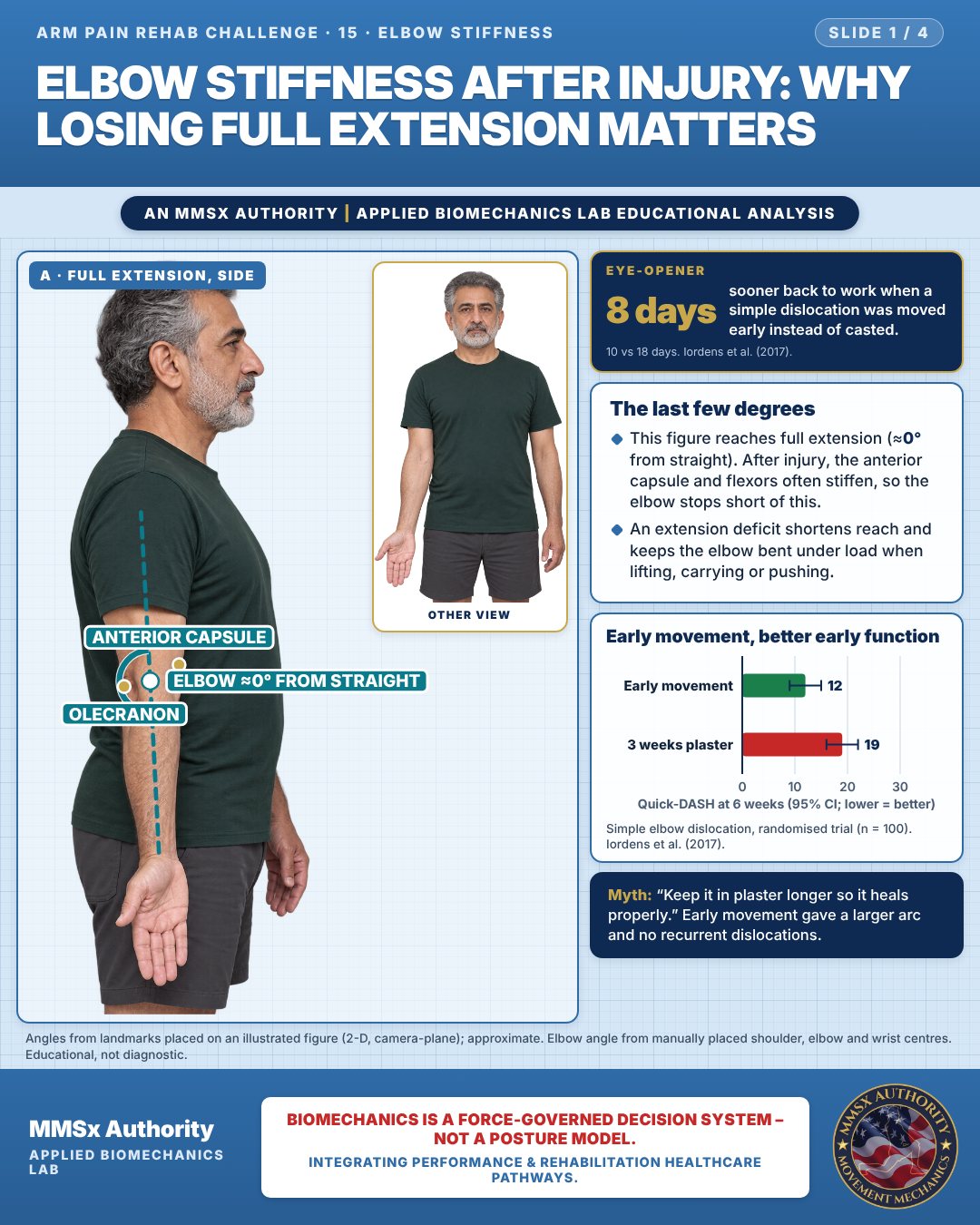
The last few degrees
This figure reaches full extension (≈0° from straight). After injury, the anterior capsule and flexors often stiffen, so the elbow stops short of this.
An extension deficit shortens reach and keeps the elbow bent under load when lifting, carrying or pushing.
Early movement, better early function
Movement B: Supported stretch (side view)
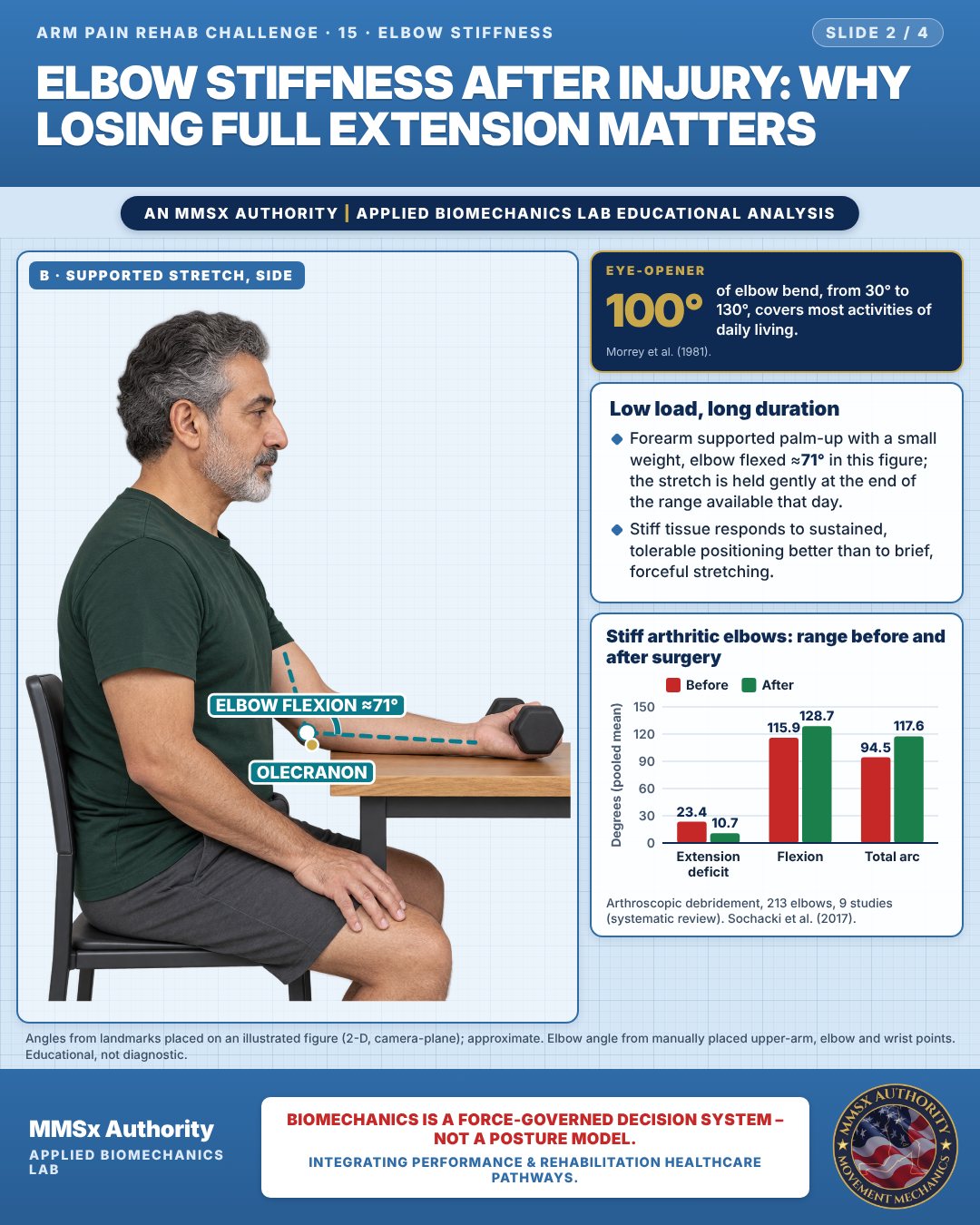
Low load, long duration
Forearm supported palm-up with a small weight, elbow flexed ≈71° in this figure; the stretch is held gently at the end of the range available that day.
Stiff tissue responds to sustained, tolerable positioning better than to brief, forceful stretching.
Stiff arthritic elbows: range before and after surgery
Movement C: Cup to mouth (front view)
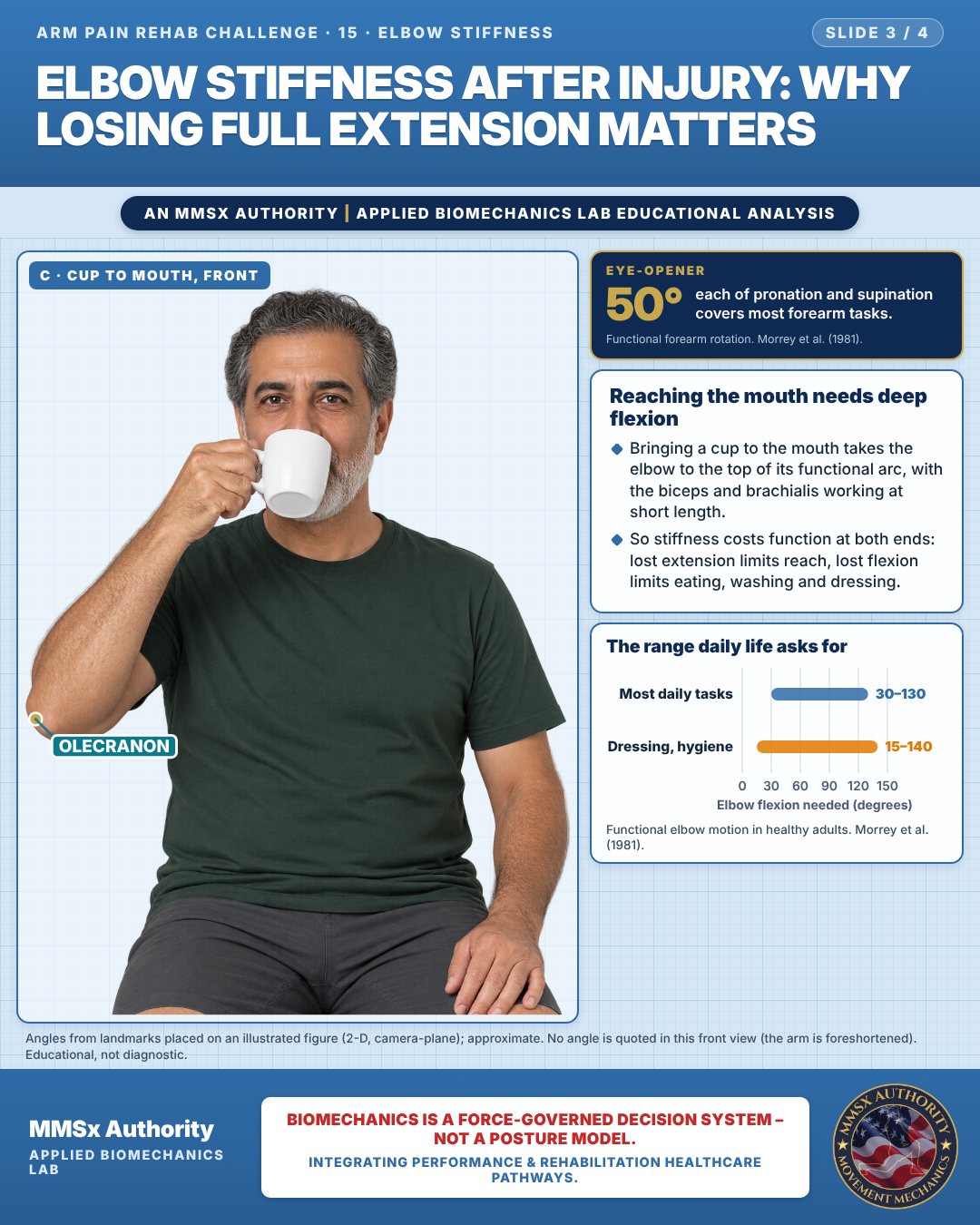
Reaching the mouth needs deep flexion
Bringing a cup to the mouth takes the elbow to the top of its functional arc, with the biceps and brachialis working at short length.
So stiffness costs function at both ends: lost extension limits reach, lost flexion limits eating, washing and dressing.
The range daily life asks for
Decision pathway
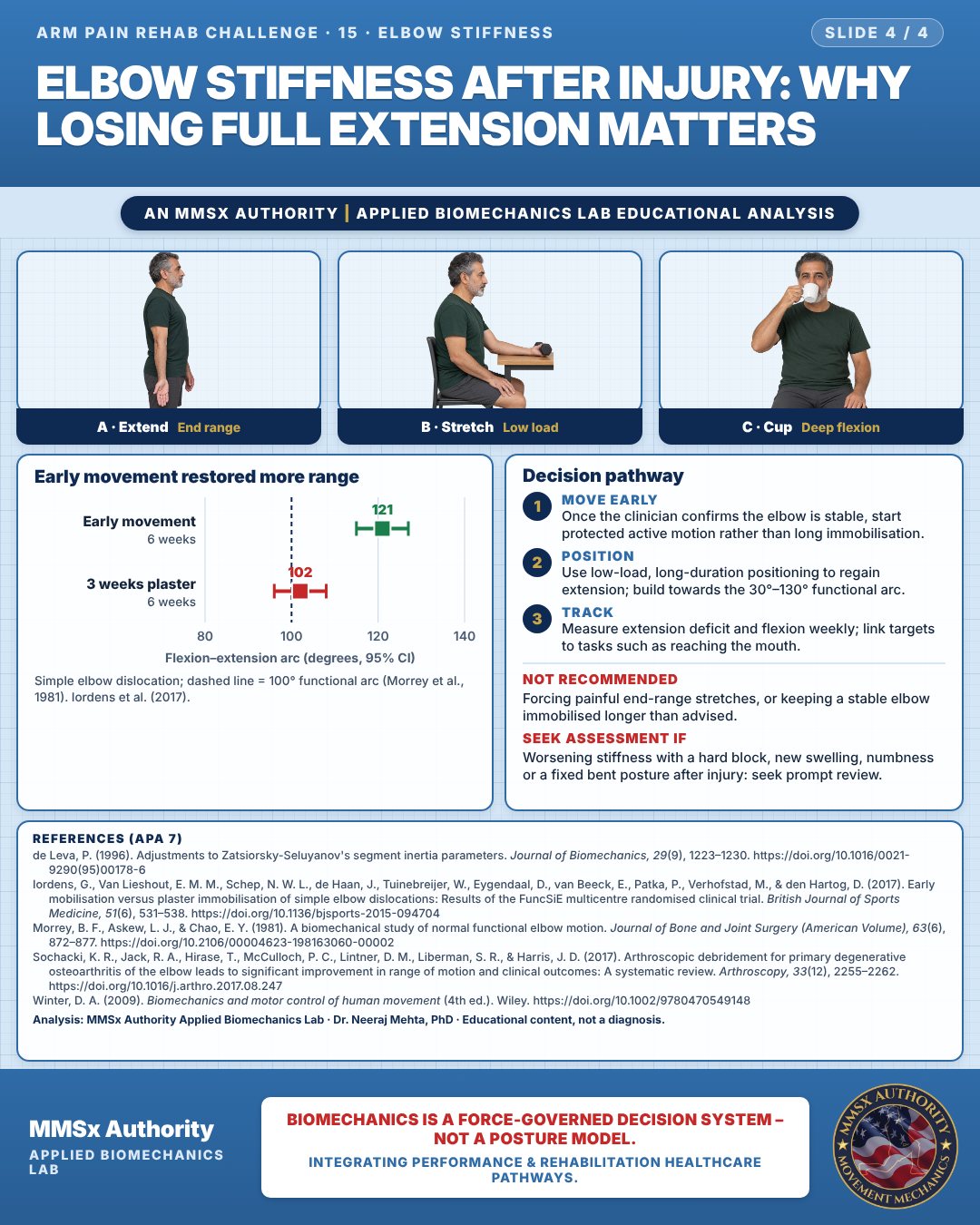
Early movement restored more range
Move early
Once the clinician confirms the elbow is stable, start protected active motion rather than long immobilisation.
Position
Use low-load, long-duration positioning to regain extension; build towards the 30°–130° functional arc.
Track
Measure extension deficit and flexion weekly; link targets to tasks such as reaching the mouth.
What the evidence supports
- Early, protected active motion where the injury is stable (Iordens et al., 2017); low-load, long-duration positioning for extension; daily-function goals anchored to the 30°–130° arc.
Myth and evidence
Myth“Keep it in plaster longer so it heals properly.”
EvidenceAfter simple dislocation, early mobilisation gave a larger arc, better function at 6 weeks and return to work 8 days sooner, with no recurrent dislocations (Iordens et al., 2017).
Cautions
Not recommended
Forcing painful end-range stretches, or keeping a stable elbow immobilised longer than advised.
Seek assessment if
Worsening stiffness with a hard block, new swelling, numbness or a fixed bent posture after injury: seek prompt review.
Methods note
Angles from landmarks placed on an illustrated figure (2-D, camera-plane); approximate. Elbow angle from manually placed shoulder, elbow and wrist centres. Elbow angle from manually placed upper-arm, elbow and wrist points. No angle is quoted in this front view (the arm is foreshortened). These are educational estimates, not a diagnosis.
References
- de Leva, P. (1996). Adjustments to Zatsiorsky-Seluyanov's segment inertia parameters. Journal of Biomechanics, 29(9), 1223–1230. https://doi.org/10.1016/0021-9290(95)00178-6
- Iordens, G., Van Lieshout, E. M. M., Schep, N. W. L., de Haan, J., Tuinebreijer, W., Eygendaal, D., van Beeck, E., Patka, P., Verhofstad, M., & den Hartog, D. (2017). Early mobilisation versus plaster immobilisation of simple elbow dislocations: Results of the FuncSiE multicentre randomised clinical trial. British Journal of Sports Medicine, 51(6), 531–538. https://doi.org/10.1136/bjsports-2015-094704
- Morrey, B. F., Askew, L. J., & Chao, E. Y. (1981). A biomechanical study of normal functional elbow motion. Journal of Bone and Joint Surgery (American Volume), 63(6), 872–877. https://doi.org/10.2106/00004623-198163060-00002
- Sochacki, K. R., Jack, R. A., Hirase, T., McCulloch, P. C., Lintner, D. M., Liberman, S. R., & Harris, J. D. (2017). Arthroscopic debridement for primary degenerative osteoarthritis of the elbow leads to significant improvement in range of motion and clinical outcomes: A systematic review. Arthroscopy, 33(12), 2255–2262. https://doi.org/10.1016/j.arthro.2017.08.247
- Winter, D. A. (2009). Biomechanics and motor control of human movement (4th ed.). Wiley. https://doi.org/10.1002/9780470549148
Cite this article
Mehta, N. (2026, October 28). Elbow stiffness after injury: why losing full extension matters. MMSx Authority Applied Biomechanics Lab. https://mmsxauthority.org/edu/analysis/arm/15-elbow-stiffness-after-injury-why-losing-full-extension-matters/
Part of the collection
Mehta, N. (2026). Elbow, Forearm, Wrist and Hand Rehabilitation: 50 Evidence-Based Biomechanics Analyses [Collection]. MMSx Authority Applied Biomechanics Lab. Zenodo. https://doi.org/10.5281/zenodo.23735910
All Arm Pain Rehab Challenge articles · Rehabilitation Library