Arm Pain Rehab Challenge · 14
Elbow pain in the bench press and push-ups: forearm angle and joint load
Load-related elbow pain in pressing (lateral, medial or posterior), linked to hand position, grip width and the forearm angle relative to the bar or floor.
Key points
- Modify. Use a medium grip that keeps the forearm close to vertical under the bar while the elbow is irritable.
- Load. Regress push-ups by raising the hands, then lower the incline and rebuild volume step by step.
- Track. Note which side of the elbow hurts and the next-day response; progress only when it is stable.
What it is
Load-related elbow pain in pressing (lateral, medial or posterior), linked to hand position, grip width and the forearm angle relative to the bar or floor.
How we analysed the movement
Three movements relevant to this topic were analysed from illustrated reference figures. Joint centres were located with two-dimensional pose estimation where the whole arm was visible; elbow and wrist angles, and the directions of external load and tendon pull, were then drawn on the figure; on hand close-ups, where pose estimation does not apply, the landmarks were placed manually. The figures are educational estimates that show how position changes mechanical demand; they are not measurements of a patient. Every research value quoted below comes from the published source cited beside it.
Movement A: Bench press (side view)
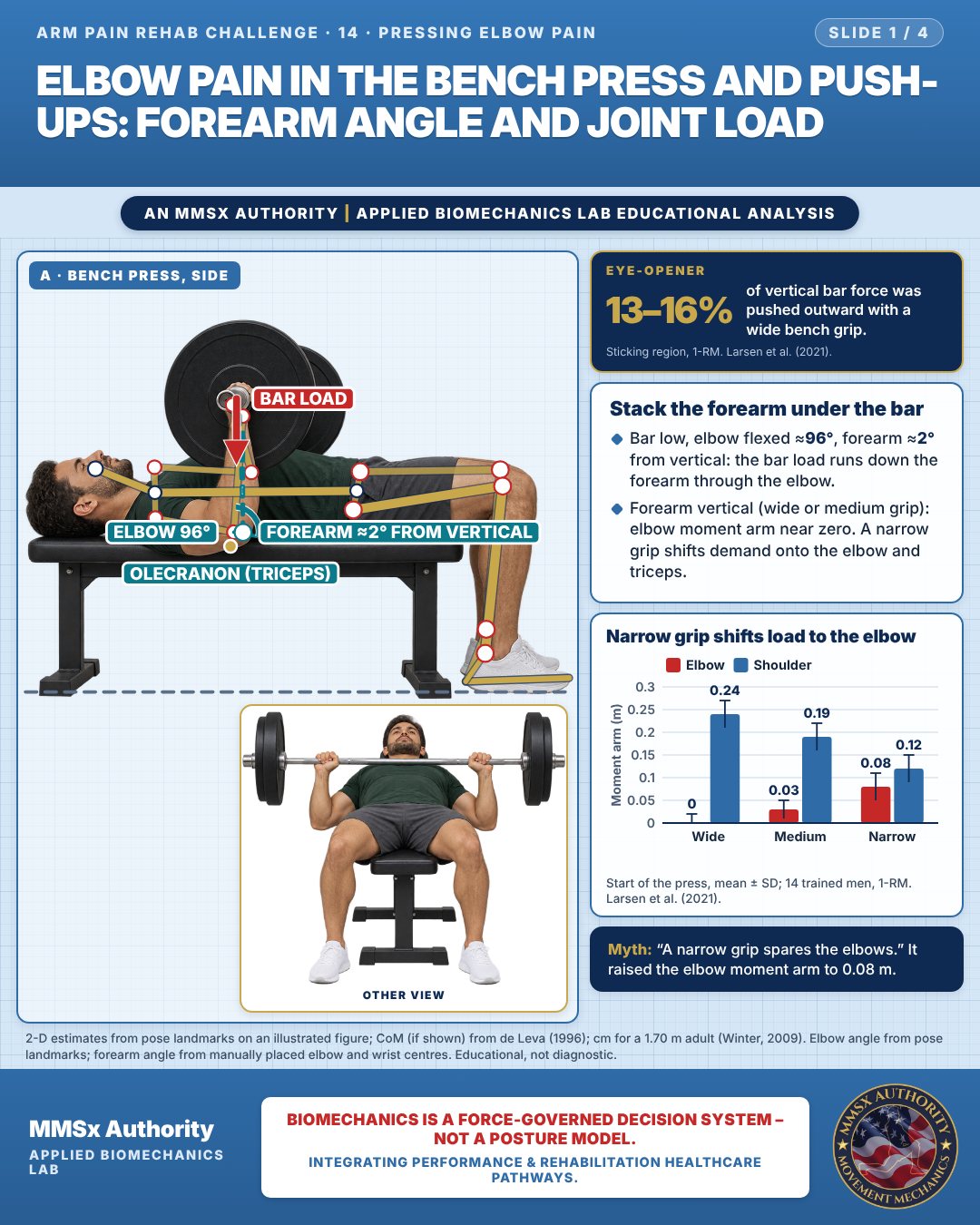
Stack the forearm under the bar
Bar low, elbow flexed ≈96°, forearm ≈2° from vertical: the bar load runs down the forearm through the elbow.
Forearm vertical (wide or medium grip): elbow moment arm near zero. A narrow grip shifts demand onto the elbow and triceps.
Narrow grip shifts load to the elbow
Movement B: Hands near shoulders (front view)
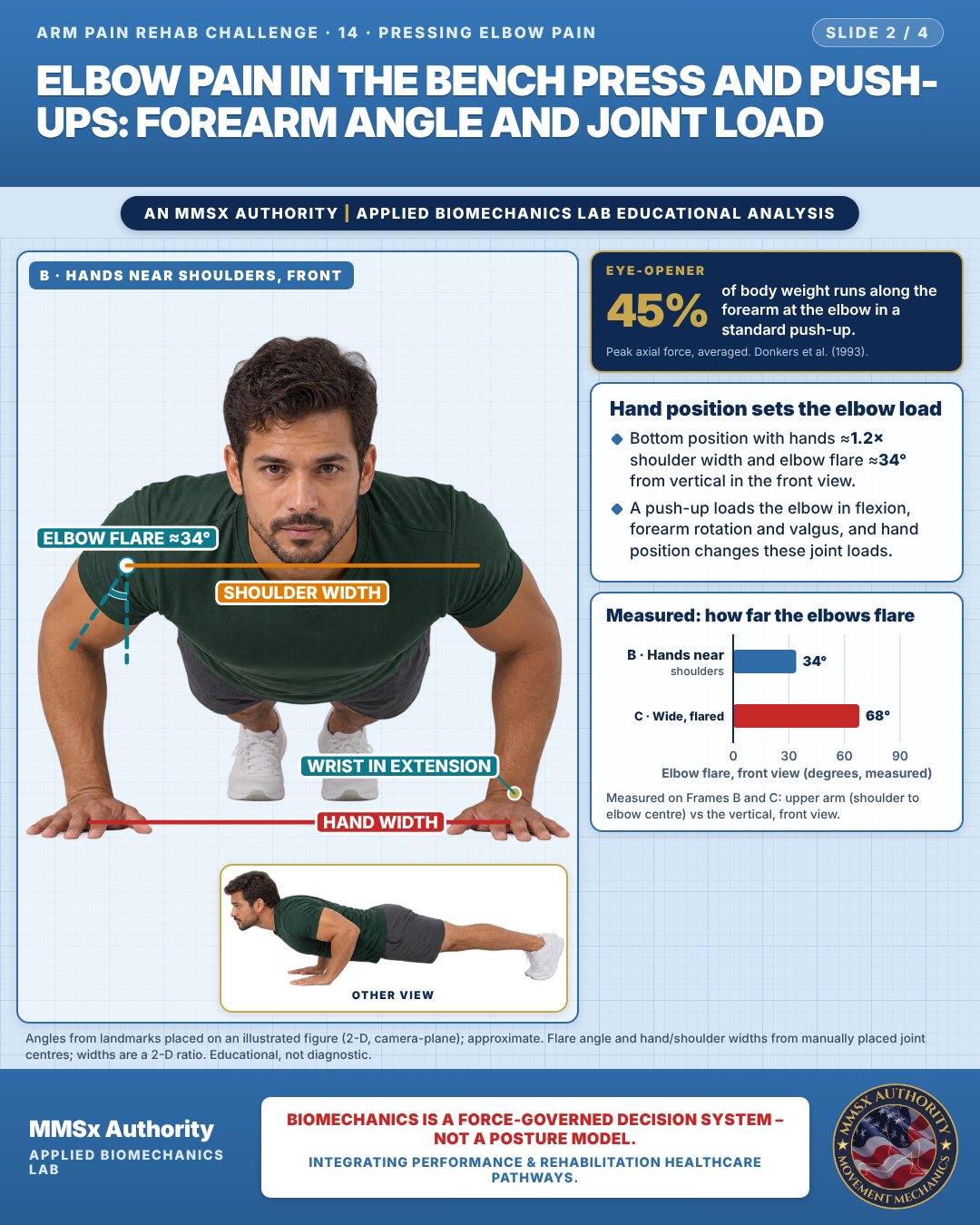
Hand position sets the elbow load
Bottom position with hands ≈1.2× shoulder width and elbow flare ≈34° from vertical in the front view.
A push-up loads the elbow in flexion, forearm rotation and valgus, and hand position changes these joint loads.
Measured: how far the elbows flare
Movement C: Wide, flared (front view)
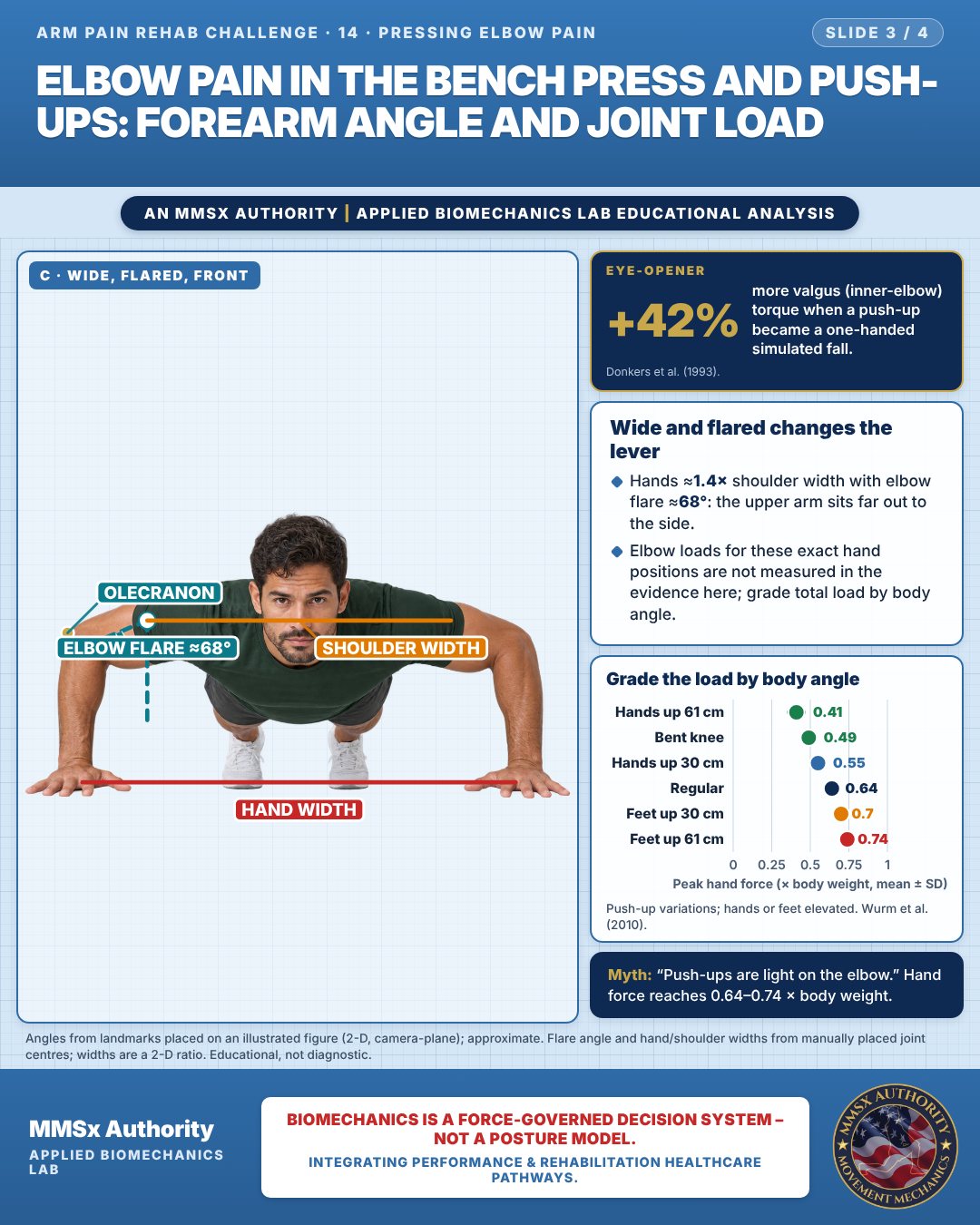
Wide and flared changes the lever
Hands ≈1.4× shoulder width with elbow flare ≈68°: the upper arm sits far out to the side.
Elbow loads for these exact hand positions are not measured in the evidence here; grade total load by body angle.
Grade the load by body angle
Decision pathway
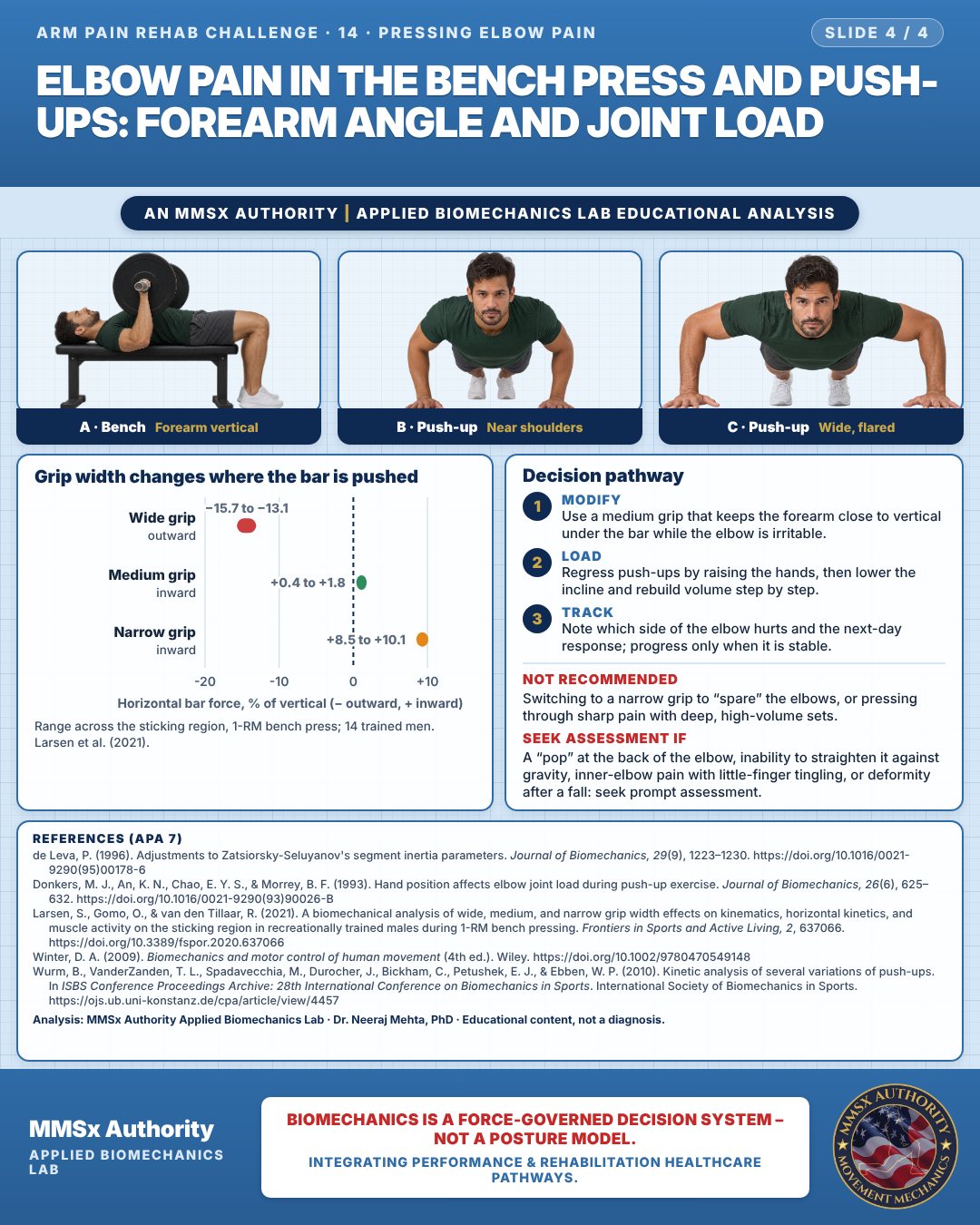
Grip width changes where the bar is pushed
Modify
Use a medium grip that keeps the forearm close to vertical under the bar while the elbow is irritable.
Load
Regress push-ups by raising the hands, then lower the incline and rebuild volume step by step.
Track
Note which side of the elbow hurts and the next-day response; progress only when it is stable.
Myth and evidence
Myth“A narrow grip is easier on the elbows.”
EvidenceNarrow grip increased the elbow moment arm from ~0.00–0.03 m to 0.08 m at the start of the press (Larsen et al., 2021).
Cautions
Not recommended
Switching to a narrow grip to “spare” the elbows, or pressing through sharp pain with deep, high-volume sets.
Seek assessment if
A “pop” at the back of the elbow, inability to straighten it against gravity, inner-elbow pain with little-finger tingling, or deformity after a fall: seek prompt assessment.
Methods note
2-D estimates from pose landmarks on an illustrated figure; CoM (if shown) from de Leva (1996); cm for a 1.70 m adult (Winter, 2009). Elbow angle from pose landmarks; forearm angle from manually placed elbow and wrist centres. Angles from landmarks placed on an illustrated figure (2-D, camera-plane); approximate. Flare angle and hand/shoulder widths from manually placed joint centres; widths are a 2-D ratio. These are educational estimates, not a diagnosis.
References
- de Leva, P. (1996). Adjustments to Zatsiorsky-Seluyanov's segment inertia parameters. Journal of Biomechanics, 29(9), 1223–1230. https://doi.org/10.1016/0021-9290(95)00178-6
- Donkers, M. J., An, K. N., Chao, E. Y. S., & Morrey, B. F. (1993). Hand position affects elbow joint load during push-up exercise. Journal of Biomechanics, 26(6), 625–632. https://doi.org/10.1016/0021-9290(93)90026-B
- Larsen, S., Gomo, O., & van den Tillaar, R. (2021). A biomechanical analysis of wide, medium, and narrow grip width effects on kinematics, horizontal kinetics, and muscle activity on the sticking region in recreationally trained males during 1-RM bench pressing. Frontiers in Sports and Active Living, 2, 637066. https://doi.org/10.3389/fspor.2020.637066
- Winter, D. A. (2009). Biomechanics and motor control of human movement (4th ed.). Wiley. https://doi.org/10.1002/9780470549148
- Wurm, B., VanderZanden, T. L., Spadavecchia, M., Durocher, J., Bickham, C., Petushek, E. J., & Ebben, W. P. (2010). Kinetic analysis of several variations of push-ups. In ISBS Conference Proceedings Archive: 28th International Conference on Biomechanics in Sports. International Society of Biomechanics in Sports. https://ojs.ub.uni-konstanz.de/cpa/article/view/4457
Cite this article
Mehta, N. (2026, October 28). Elbow pain in the bench press and push-ups: forearm angle and joint load. MMSx Authority Applied Biomechanics Lab. https://mmsxauthority.org/edu/analysis/arm/14-elbow-pain-in-the-bench-press-and-push-ups-forearm-angle-and-joint/
Part of the collection
Mehta, N. (2026). Elbow, Forearm, Wrist and Hand Rehabilitation: 50 Evidence-Based Biomechanics Analyses [Collection]. MMSx Authority Applied Biomechanics Lab. Zenodo. https://doi.org/10.5281/zenodo.23735910
All Arm Pain Rehab Challenge articles · Rehabilitation Library