Arm Pain Rehab Challenge · 13
Elbow pain in pull-ups and chin-ups: grip width and load path
Activity-related elbow pain in vertical pulling — commonly medial (flexor–pronator), lateral (extensor) or anterior (distal biceps/brachialis) —…
Key points
- Modify. Note which grip and which side of the elbow hurts; swap to a less provocative grip and cut sets while pain settles.
- Load. Use assisted or partial-range pulls, then rebuild full range and volume step by step (expert principle).
- Track. Progress only when pain during and the morning after training stays stable.
What it is
Activity-related elbow pain in vertical pulling — commonly medial (flexor–pronator), lateral (extensor) or anterior (distal biceps/brachialis) — influenced by grip orientation and width.
How we analysed the movement
Three movements relevant to this topic were analysed from illustrated reference figures. Joint centres were located with two-dimensional pose estimation where the whole arm was visible; elbow and wrist angles, and the directions of external load and tendon pull, were then drawn on the figure; on hand close-ups, where pose estimation does not apply, the landmarks were placed manually. The figures are educational estimates that show how position changes mechanical demand; they are not measurements of a patient. Every research value quoted below comes from the published source cited beside it.
Movement A: Wide overhand pull (front view)
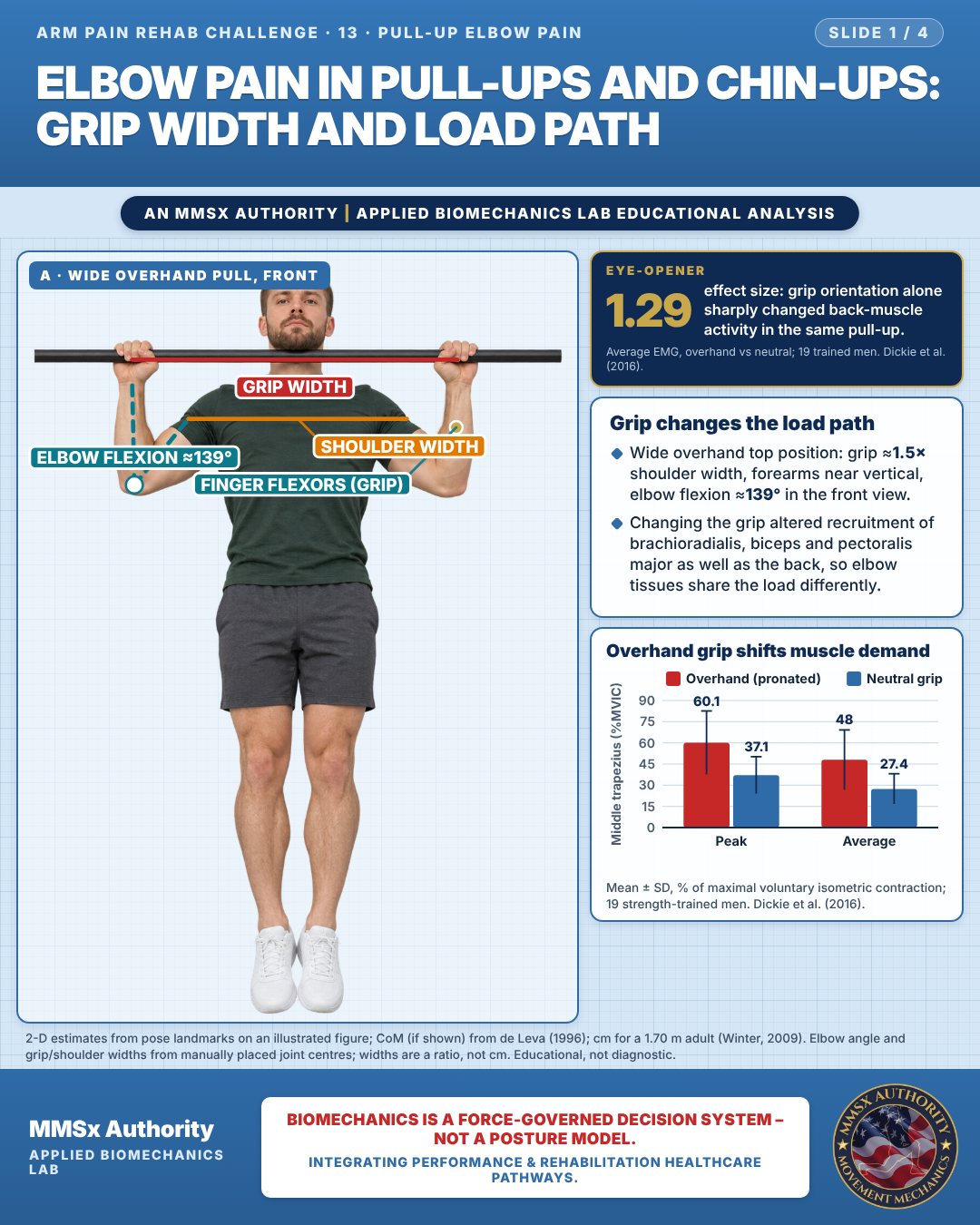
Grip changes the load path
Wide overhand top position: grip ≈1.5× shoulder width, forearms near vertical, elbow flexion ≈139° in the front view.
Changing the grip altered recruitment of brachioradialis, biceps and pectoralis major as well as the back, so elbow tissues share the load differently.
Overhand grip shifts muscle demand
Movement B: Narrow underhand (front view)
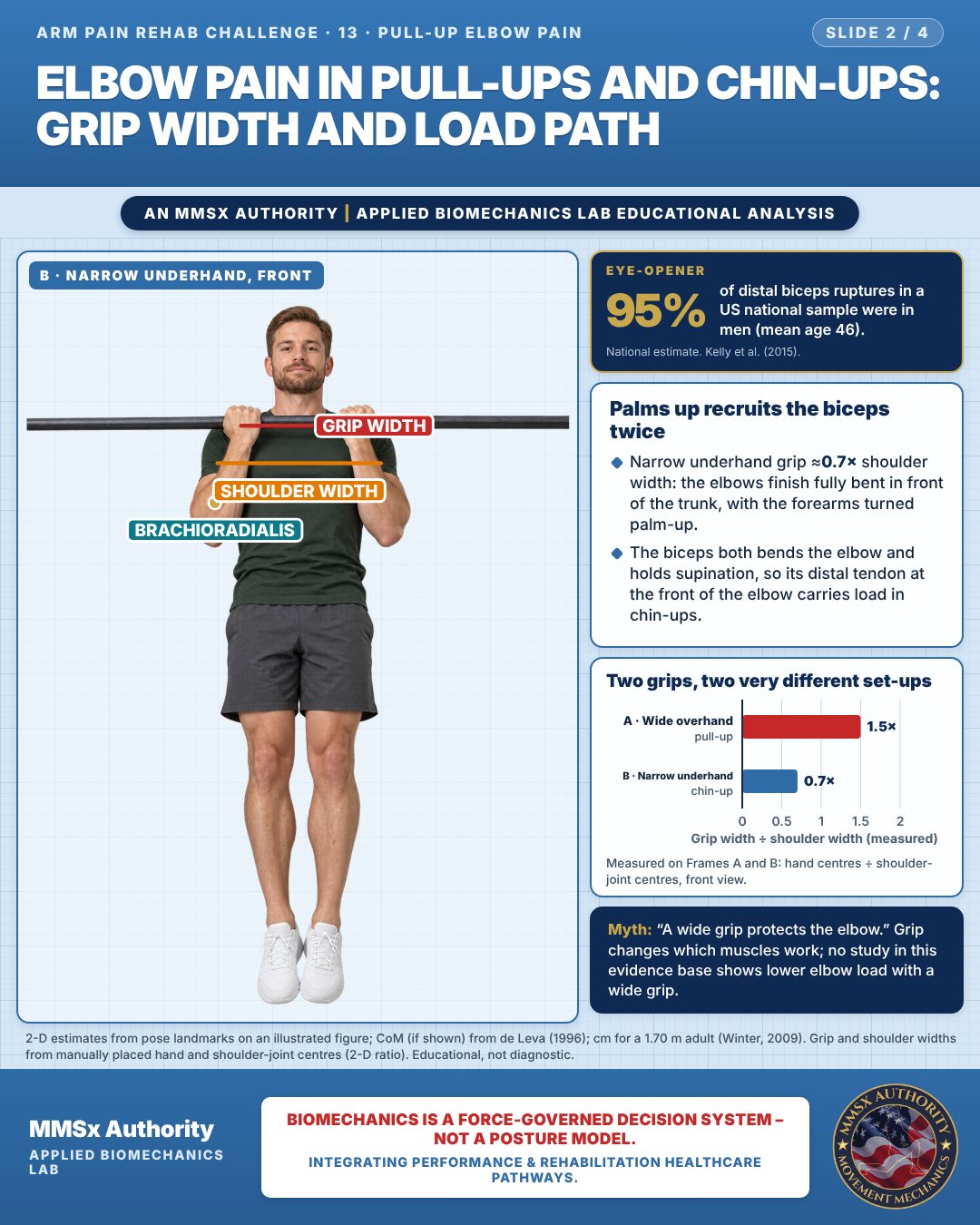
Palms up recruits the biceps twice
Narrow underhand grip ≈0.7× shoulder width: the elbows finish fully bent in front of the trunk, with the forearms turned palm-up.
The biceps both bends the elbow and holds supination, so its distal tendon at the front of the elbow carries load in chin-ups.
Two grips, two very different set-ups
Movement C: Dead hang (side view)
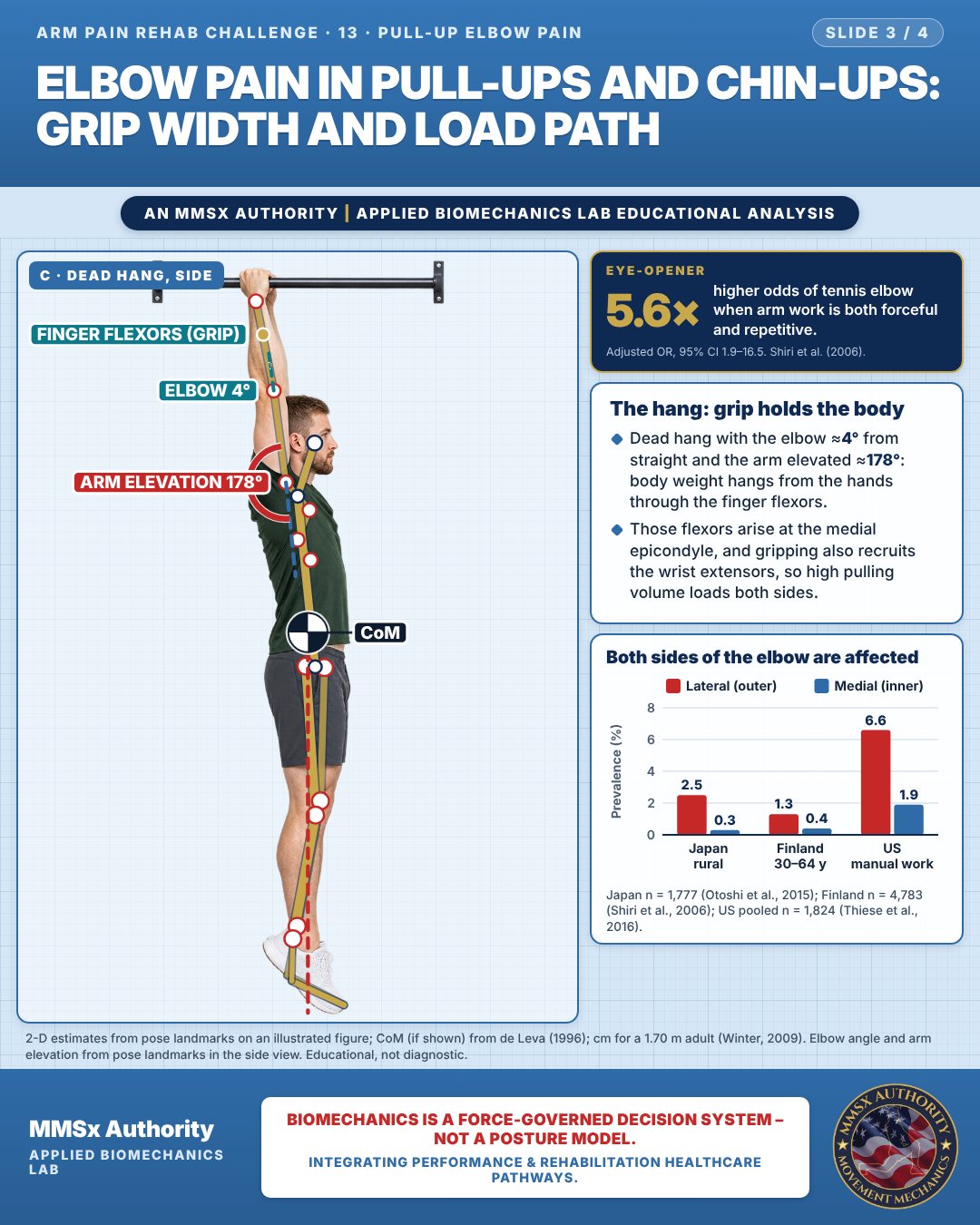
The hang: grip holds the body
Dead hang with the elbow ≈4° from straight and the arm elevated ≈178°: body weight hangs from the hands through the finger flexors.
Those flexors arise at the medial epicondyle, and gripping also recruits the wrist extensors, so high pulling volume loads both sides.
Both sides of the elbow are affected
Decision pathway
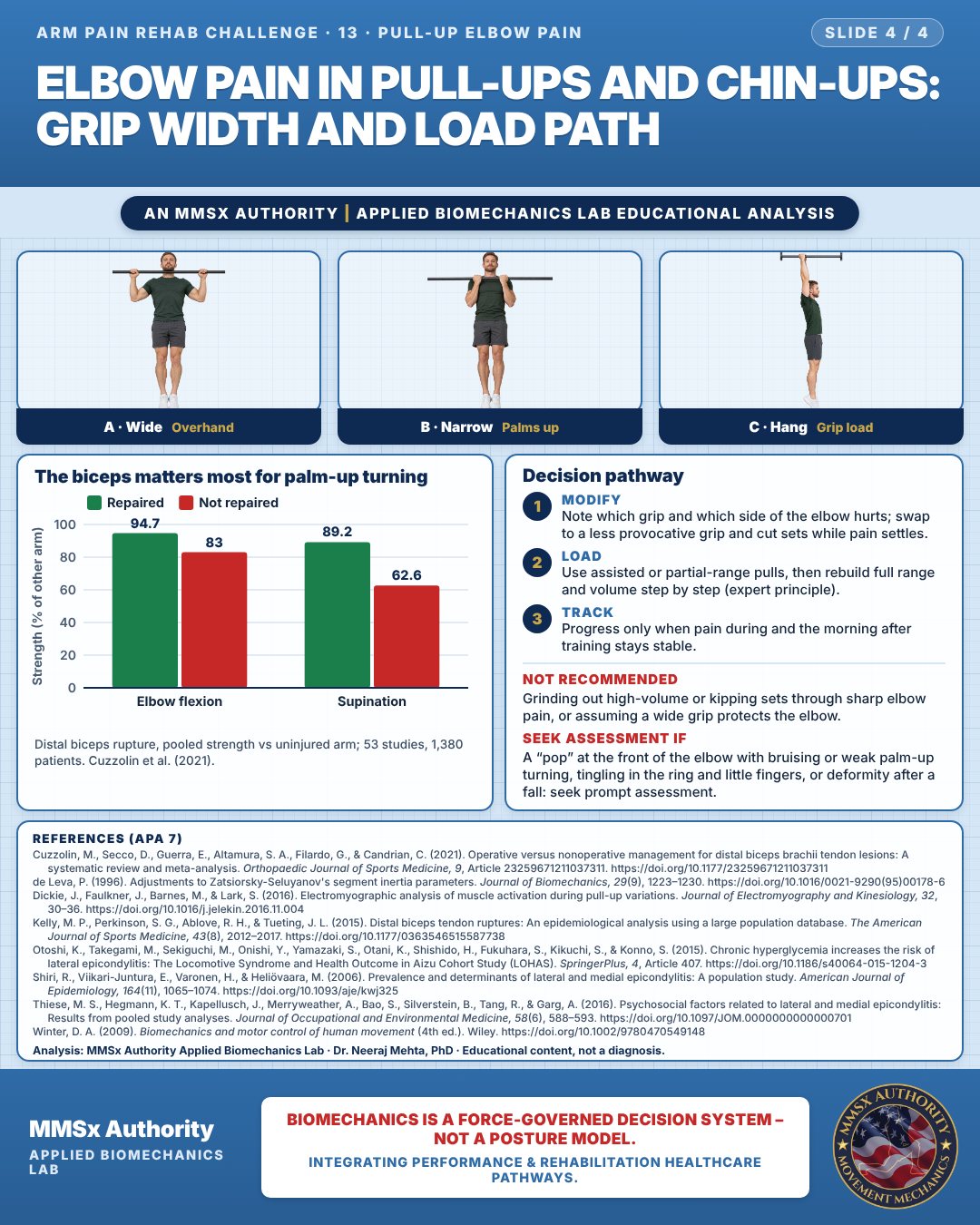
The biceps matters most for palm-up turning
Modify
Note which grip and which side of the elbow hurts; swap to a less provocative grip and cut sets while pain settles.
Load
Use assisted or partial-range pulls, then rebuild full range and volume step by step (expert principle).
Track
Progress only when pain during and the morning after training stays stable.
Cautions
Not recommended
Grinding out high-volume or kipping sets through sharp elbow pain, or assuming a wide grip protects the elbow.
Seek assessment if
A “pop” at the front of the elbow with bruising or weak palm-up turning, tingling in the ring and little fingers, or deformity after a fall: seek prompt assessment.
Methods note
2-D estimates from pose landmarks on an illustrated figure; CoM (if shown) from de Leva (1996); cm for a 1.70 m adult (Winter, 2009). Elbow angle and grip/shoulder widths from manually placed joint centres; widths are a ratio, not cm. Grip and shoulder widths from manually placed hand and shoulder-joint centres (2-D ratio). Elbow angle and arm elevation from pose landmarks in the side view. These are educational estimates, not a diagnosis.
References
- Cuzzolin, M., Secco, D., Guerra, E., Altamura, S. A., Filardo, G., & Candrian, C. (2021). Operative versus nonoperative management for distal biceps brachii tendon lesions: A systematic review and meta-analysis. Orthopaedic Journal of Sports Medicine, 9, Article 23259671211037311. https://doi.org/10.1177/23259671211037311
- de Leva, P. (1996). Adjustments to Zatsiorsky-Seluyanov's segment inertia parameters. Journal of Biomechanics, 29(9), 1223–1230. https://doi.org/10.1016/0021-9290(95)00178-6
- Dickie, J., Faulkner, J., Barnes, M., & Lark, S. (2016). Electromyographic analysis of muscle activation during pull-up variations. Journal of Electromyography and Kinesiology, 32, 30–36. https://doi.org/10.1016/j.jelekin.2016.11.004
- Kelly, M. P., Perkinson, S. G., Ablove, R. H., & Tueting, J. L. (2015). Distal biceps tendon ruptures: An epidemiological analysis using a large population database. The American Journal of Sports Medicine, 43(8), 2012–2017. https://doi.org/10.1177/0363546515587738
- Otoshi, K., Takegami, M., Sekiguchi, M., Onishi, Y., Yamazaki, S., Otani, K., Shishido, H., Fukuhara, S., Kikuchi, S., & Konno, S. (2015). Chronic hyperglycemia increases the risk of lateral epicondylitis: The Locomotive Syndrome and Health Outcome in Aizu Cohort Study (LOHAS). SpringerPlus, 4, Article 407. https://doi.org/10.1186/s40064-015-1204-3
- Shiri, R., Viikari-Juntura, E., Varonen, H., & Heliövaara, M. (2006). Prevalence and determinants of lateral and medial epicondylitis: A population study. American Journal of Epidemiology, 164(11), 1065–1074. https://doi.org/10.1093/aje/kwj325
- Thiese, M. S., Hegmann, K. T., Kapellusch, J., Merryweather, A., Bao, S., Silverstein, B., Tang, R., & Garg, A. (2016). Psychosocial factors related to lateral and medial epicondylitis: Results from pooled study analyses. Journal of Occupational and Environmental Medicine, 58(6), 588–593. https://doi.org/10.1097/JOM.0000000000000701
- Winter, D. A. (2009). Biomechanics and motor control of human movement (4th ed.). Wiley. https://doi.org/10.1002/9780470549148
Cite this article
Mehta, N. (2026, October 28). Elbow pain in pull-ups and chin-ups: grip width and load path. MMSx Authority Applied Biomechanics Lab. https://mmsxauthority.org/edu/analysis/arm/13-elbow-pain-in-pull-ups-and-chin-ups-grip-width-and-load-path/
Part of the collection
Mehta, N. (2026). Elbow, Forearm, Wrist and Hand Rehabilitation: 50 Evidence-Based Biomechanics Analyses [Collection]. MMSx Authority Applied Biomechanics Lab. Zenodo. https://doi.org/10.5281/zenodo.23735910
All Arm Pain Rehab Challenge articles · Rehabilitation Library