Arm Pain Rehab Challenge · 12
Little league elbow: why young throwers need pitch counts
Medial elbow overuse injury in skeletally immature throwers — chiefly medial epicondyle apophysitis/stress injury from repetitive valgus traction.
Key points
- Count. Keep pitch counts and innings limits, e.g. the suggested 75 per game and 600 per season (secondary report).
- Rest. Build in rest days and avoid year-round pitching or more than 100 innings in a year.
- Teach. Use easy, short throws to teach sound mechanics early, while joint loads are lower.
What it is
Medial elbow overuse injury in skeletally immature throwers — chiefly medial epicondyle apophysitis/stress injury from repetitive valgus traction.
How we analysed the movement
Three movements relevant to this topic were analysed from illustrated reference figures. Joint centres were located with two-dimensional pose estimation where the whole arm was visible; elbow and wrist angles, and the directions of external load and tendon pull, were then drawn on the figure; on hand close-ups, where pose estimation does not apply, the landmarks were placed manually. The figures are educational estimates that show how position changes mechanical demand; they are not measurements of a patient. Every research value quoted below comes from the published source cited beside it.
Movement A: Youth arm cocking (side view)
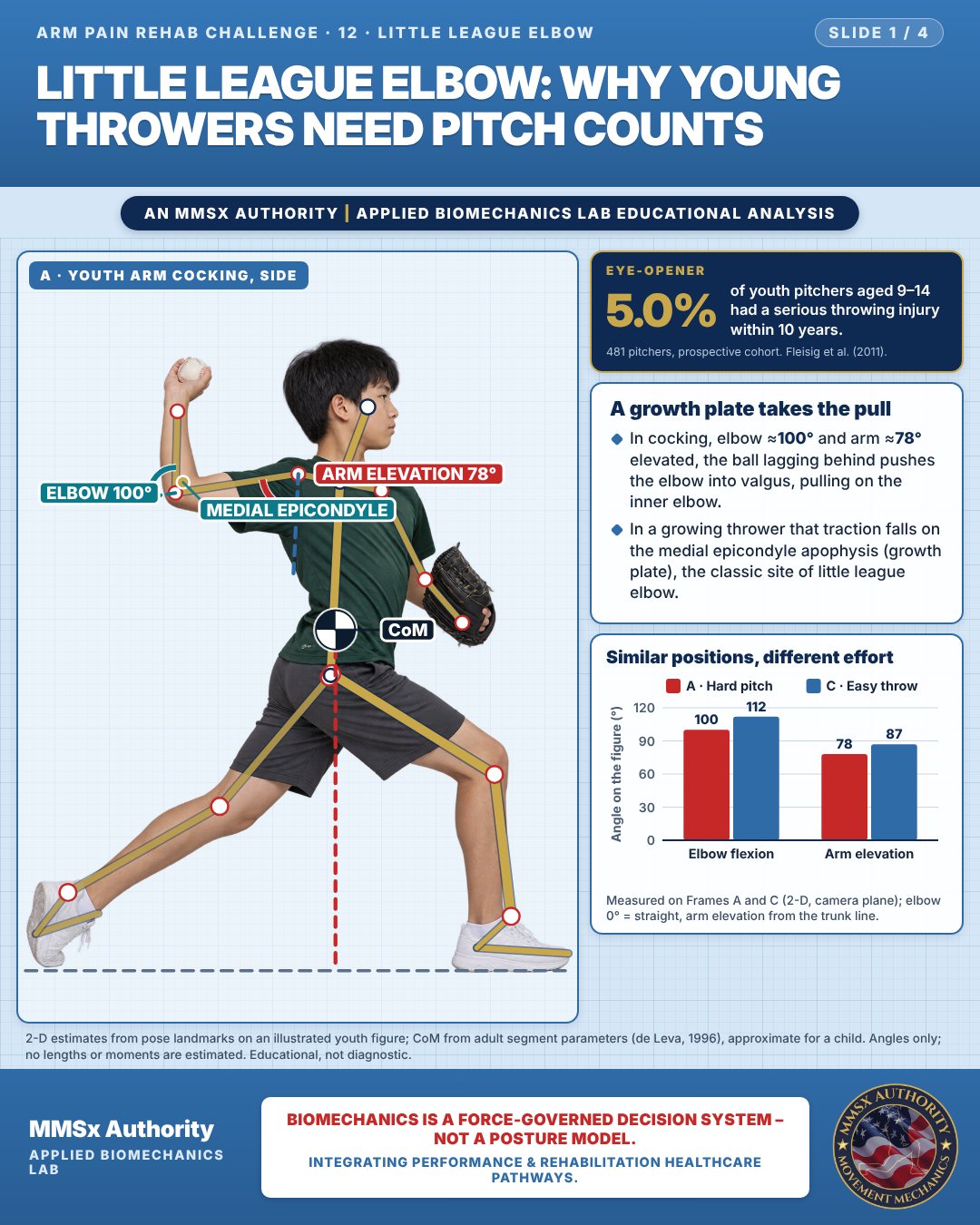
A growth plate takes the pull
In cocking, elbow ≈100° and arm ≈78° elevated, the ball lagging behind pushes the elbow into valgus, pulling on the inner elbow.
In a growing thrower that traction falls on the medial epicondyle apophysis (growth plate), the classic site of little league elbow.
Similar positions, different effort
Movement B: Ball in hand (front view)
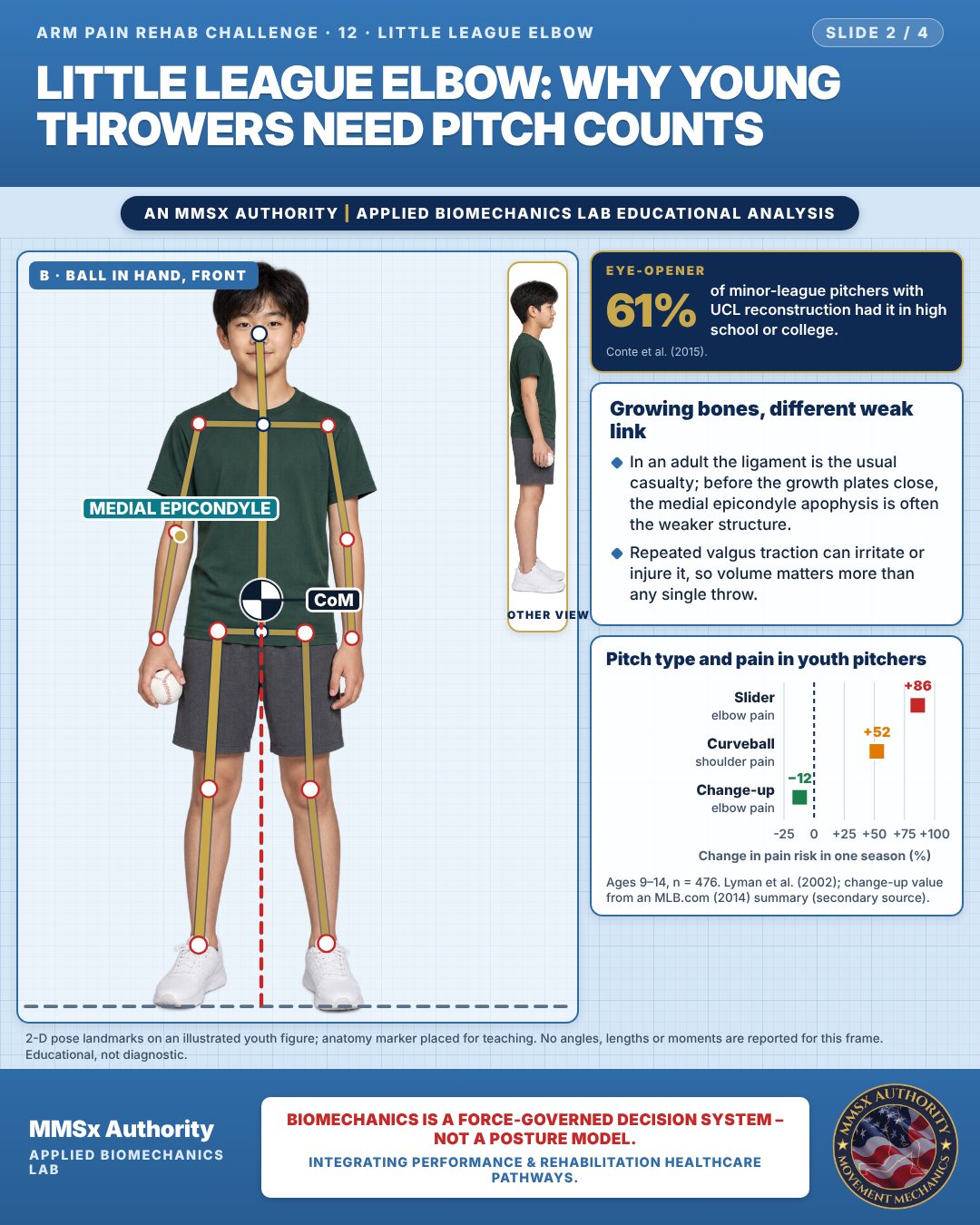
Growing bones, different weak link
In an adult the ligament is the usual casualty; before the growth plates close, the medial epicondyle apophysis is often the weaker structure.
Repeated valgus traction can irritate or injure it, so volume matters more than any single throw.
Pitch type and pain in youth pitchers
Movement C: Easy warm-up throw (side view)
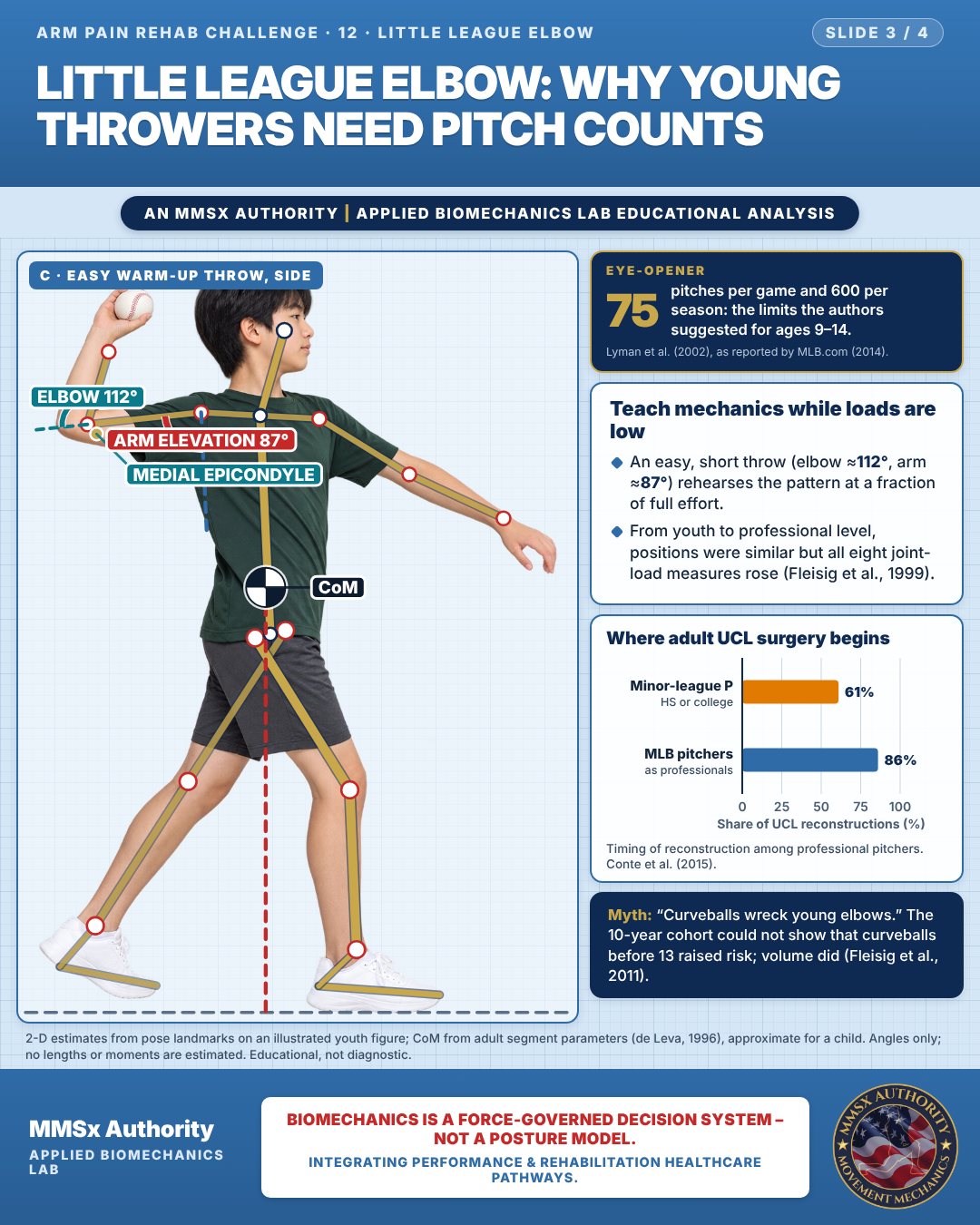
Teach mechanics while loads are low
An easy, short throw (elbow ≈112°, arm ≈87°) rehearses the pattern at a fraction of full effort.
From youth to professional level, positions were similar but all eight joint-load measures rose (Fleisig et al., 1999).
Where adult UCL surgery begins
Decision pathway
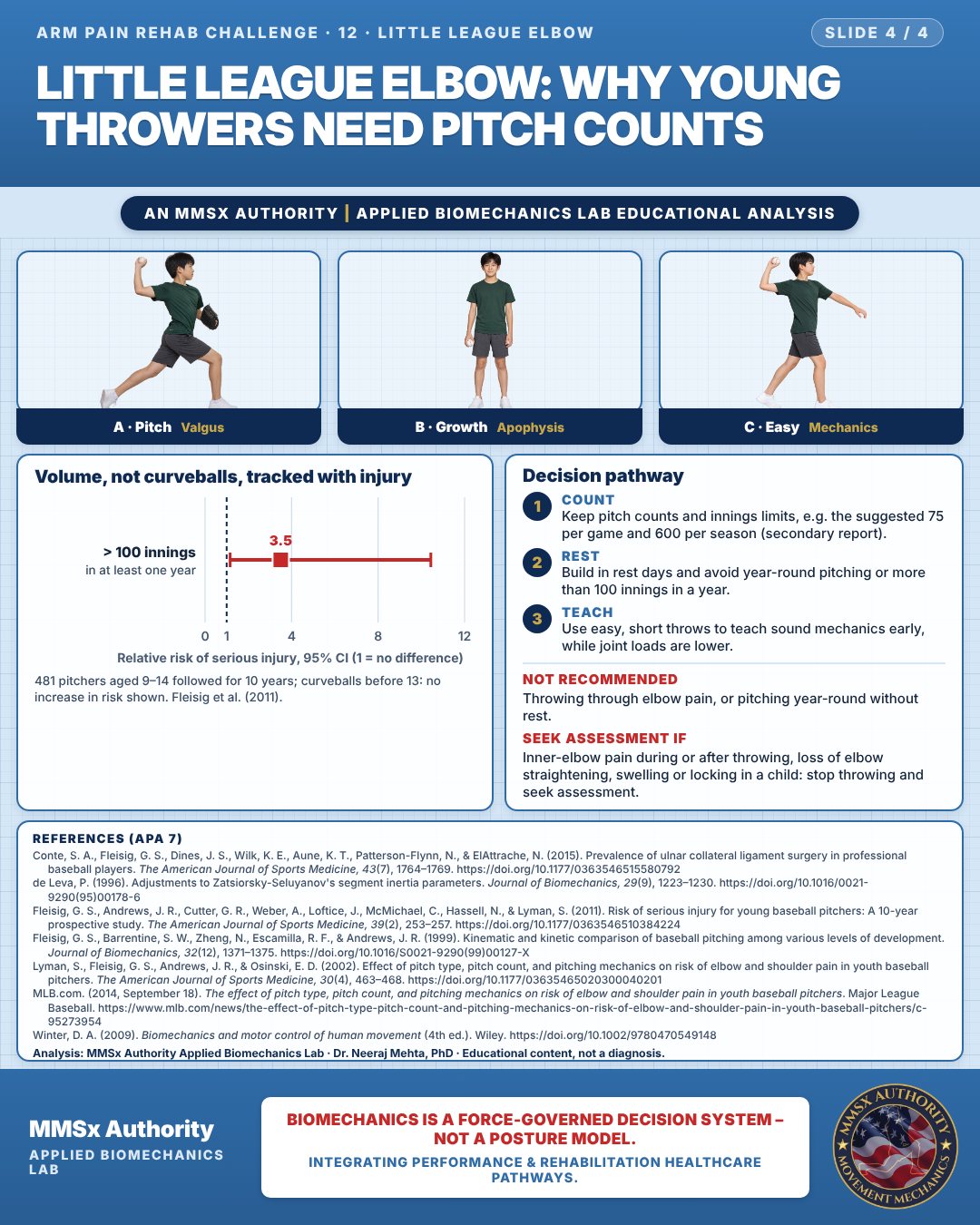
Volume, not curveballs, tracked with injury
Count
Keep pitch counts and innings limits, e.g. the suggested 75 per game and 600 per season (secondary report).
Rest
Build in rest days and avoid year-round pitching or more than 100 innings in a year.
Teach
Use easy, short throws to teach sound mechanics early, while joint loads are lower.
Cautions
Not recommended
Throwing through elbow pain, or pitching year-round without rest.
Seek assessment if
Inner-elbow pain during or after throwing, loss of elbow straightening, swelling or locking in a child: stop throwing and seek assessment.
Methods note
2-D estimates from pose landmarks on an illustrated youth figure; CoM from adult segment parameters (de Leva, 1996), approximate for a child. Angles only; no lengths or moments are estimated. 2-D pose landmarks on an illustrated youth figure; anatomy marker placed for teaching. No angles, lengths or moments are reported for this frame. These are educational estimates, not a diagnosis.
References
- Conte, S. A., Fleisig, G. S., Dines, J. S., Wilk, K. E., Aune, K. T., Patterson-Flynn, N., & ElAttrache, N. (2015). Prevalence of ulnar collateral ligament surgery in professional baseball players. The American Journal of Sports Medicine, 43(7), 1764–1769. https://doi.org/10.1177/0363546515580792
- de Leva, P. (1996). Adjustments to Zatsiorsky-Seluyanov's segment inertia parameters. Journal of Biomechanics, 29(9), 1223–1230. https://doi.org/10.1016/0021-9290(95)00178-6
- Fleisig, G. S., Andrews, J. R., Cutter, G. R., Weber, A., Loftice, J., McMichael, C., Hassell, N., & Lyman, S. (2011). Risk of serious injury for young baseball pitchers: A 10-year prospective study. The American Journal of Sports Medicine, 39(2), 253–257. https://doi.org/10.1177/0363546510384224
- Fleisig, G. S., Barrentine, S. W., Zheng, N., Escamilla, R. F., & Andrews, J. R. (1999). Kinematic and kinetic comparison of baseball pitching among various levels of development. Journal of Biomechanics, 32(12), 1371–1375. https://doi.org/10.1016/S0021-9290(99)00127-X
- Lyman, S., Fleisig, G. S., Andrews, J. R., & Osinski, E. D. (2002). Effect of pitch type, pitch count, and pitching mechanics on risk of elbow and shoulder pain in youth baseball pitchers. The American Journal of Sports Medicine, 30(4), 463–468. https://doi.org/10.1177/03635465020300040201
- MLB.com. (2014, September 18). The effect of pitch type, pitch count, and pitching mechanics on risk of elbow and shoulder pain in youth baseball pitchers. Major League Baseball. https://www.mlb.com/news/the-effect-of-pitch-type-pitch-count-and-pitching-mechanics-on-risk-of-elbow-and-shoulder-pain-in-youth-baseball-pitchers/c-95273954
- Winter, D. A. (2009). Biomechanics and motor control of human movement (4th ed.). Wiley. https://doi.org/10.1002/9780470549148
Cite this article
Mehta, N. (2026, October 28). Little league elbow: why young throwers need pitch counts. MMSx Authority Applied Biomechanics Lab. https://mmsxauthority.org/edu/analysis/arm/12-little-league-elbow-why-young-throwers-need-pitch-counts/
Part of the collection
Mehta, N. (2026). Elbow, Forearm, Wrist and Hand Rehabilitation: 50 Evidence-Based Biomechanics Analyses [Collection]. MMSx Authority Applied Biomechanics Lab. Zenodo. https://doi.org/10.5281/zenodo.23735910
All Arm Pain Rehab Challenge articles · Rehabilitation Library