Arm Pain Rehab Challenge · 11
Thrower’s elbow: valgus load and the ulnar collateral ligament
Valgus extension overload of the medial elbow in overhead throwing, stressing the ulnar collateral ligament (UCL).
Key points
- Control. Track throwing workload and rest; medial pain is a signal to reduce volume, not to throw through.
- Build. Strengthen the whole chain (trunk, hips, shoulder, forearm flexor–pronators) and review mechanics (expert principle).
- Decide. For a complete tear in an athlete who wants to keep throwing, discuss reconstruction and the long return.
What it is
Valgus extension overload of the medial elbow in overhead throwing, stressing the ulnar collateral ligament (UCL); spectrum from medial elbow pain and partial tears to complete UCL rupture.
How we analysed the movement
Three movements relevant to this topic were analysed from illustrated reference figures. Joint centres were located with two-dimensional pose estimation where the whole arm was visible; elbow and wrist angles, and the directions of external load and tendon pull, were then drawn on the figure; on hand close-ups, where pose estimation does not apply, the landmarks were placed manually. The figures are educational estimates that show how position changes mechanical demand; they are not measurements of a patient. Every research value quoted below comes from the published source cited beside it.
Movement A: Arm cocking (side view)
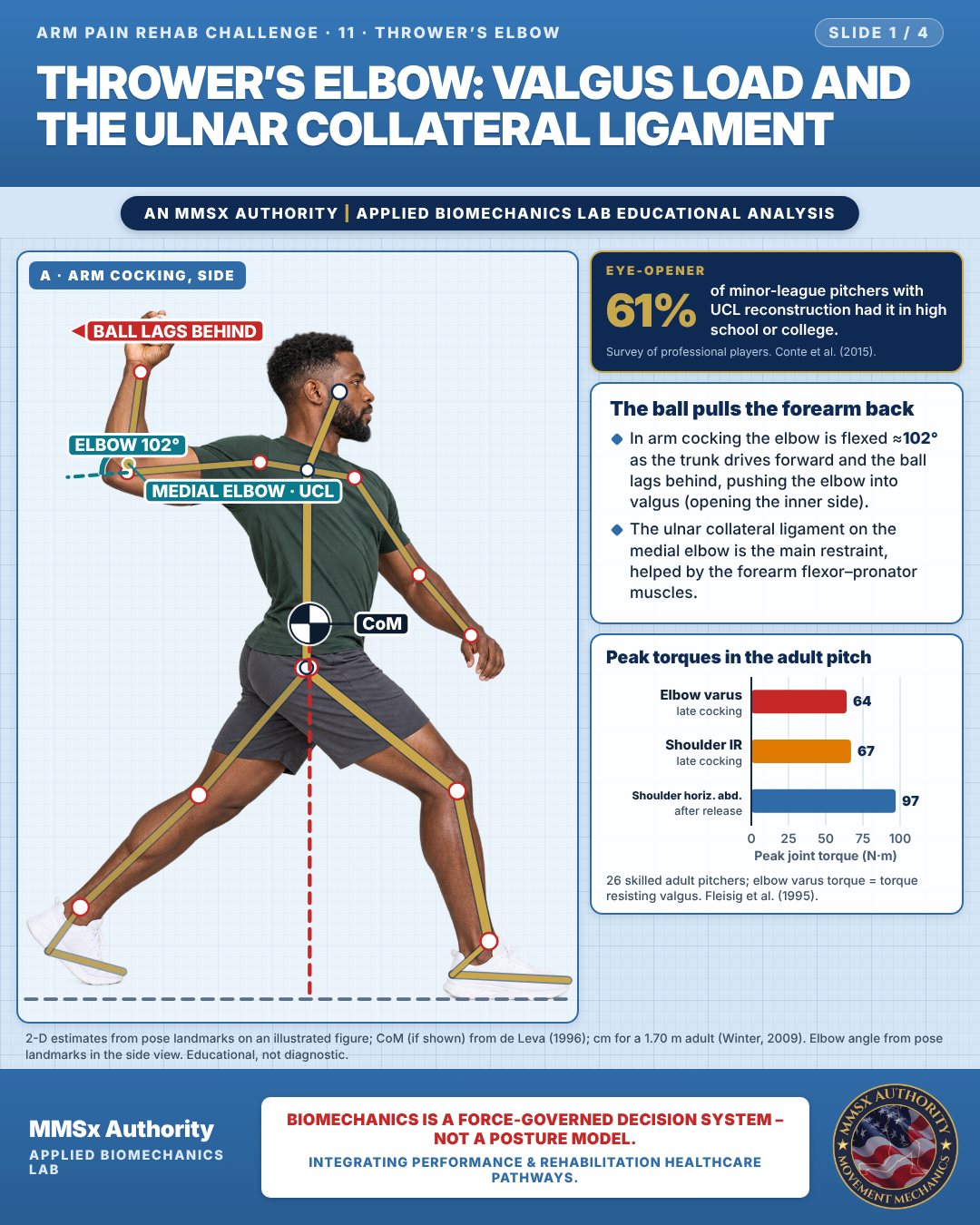
The ball pulls the forearm back
In arm cocking the elbow is flexed ≈102° as the trunk drives forward and the ball lags behind, pushing the elbow into valgus (opening the inner side).
The ulnar collateral ligament on the medial elbow is the main restraint, helped by the forearm flexor–pronator muscles.
Peak torques in the adult pitch
Movement B: Ball release (front view)
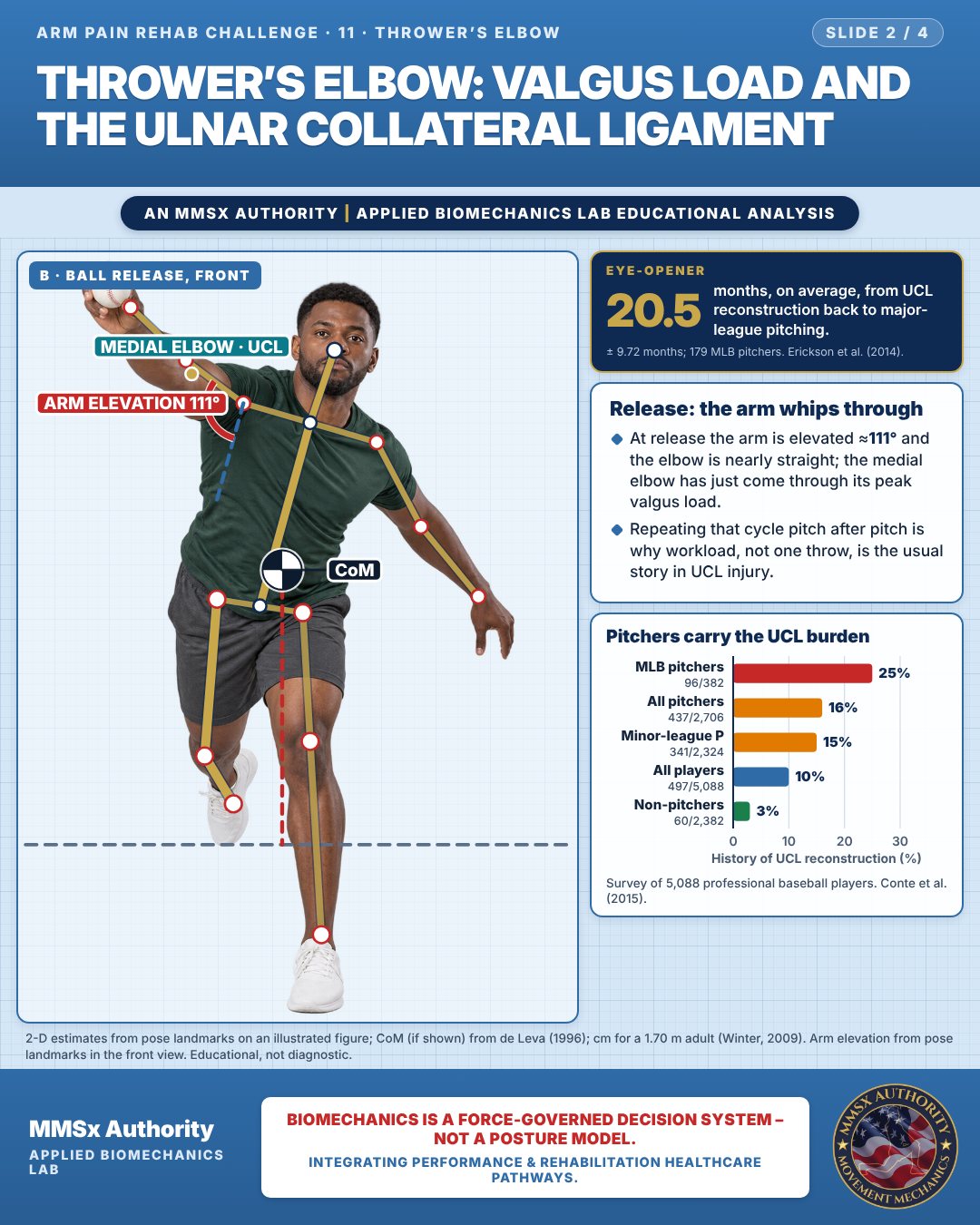
Release: the arm whips through
At release the arm is elevated ≈111° and the elbow is nearly straight; the medial elbow has just come through its peak valgus load.
Repeating that cycle pitch after pitch is why workload, not one throw, is the usual story in UCL injury.
Pitchers carry the UCL burden
Movement C: Follow-through (side view)
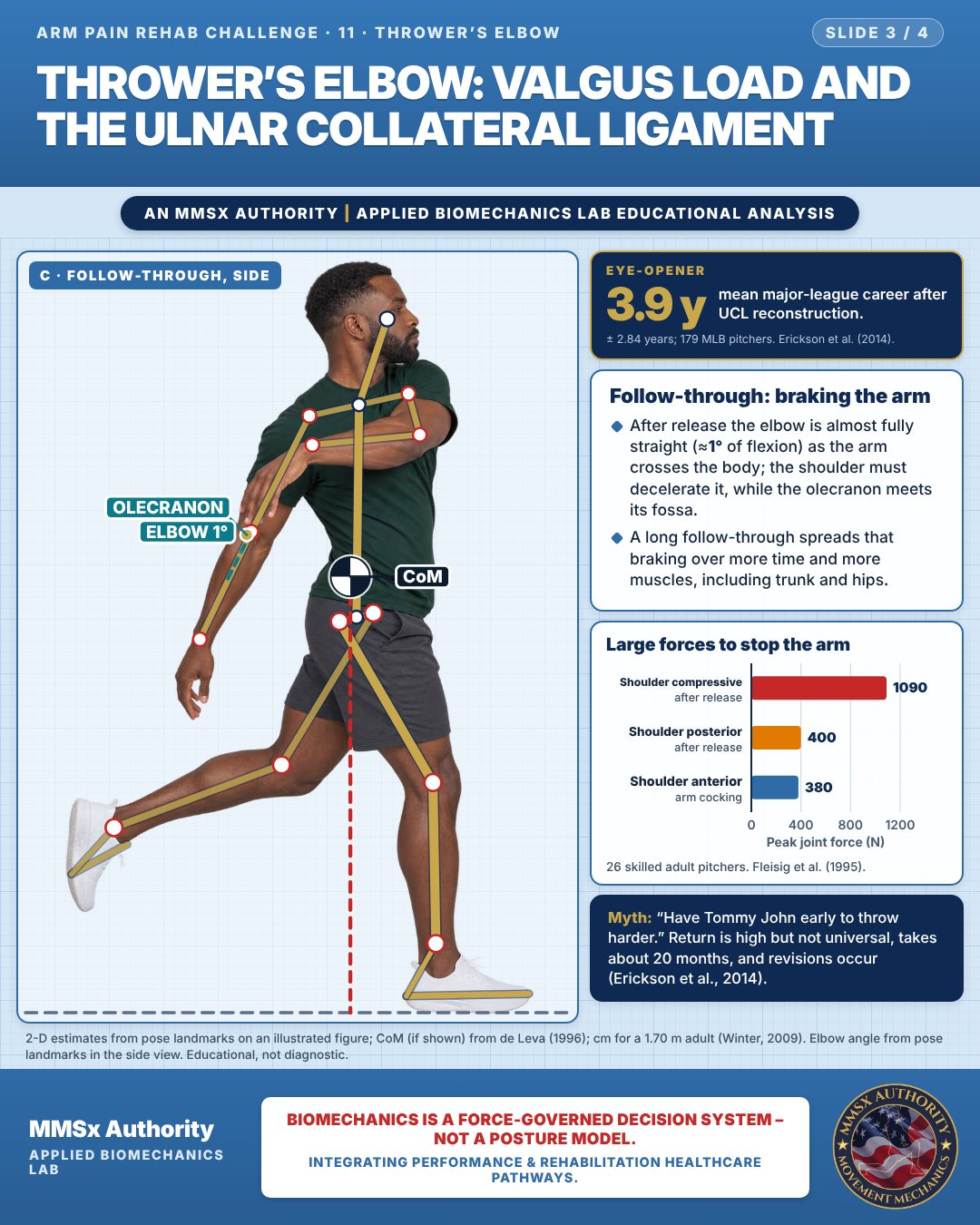
Follow-through: braking the arm
After release the elbow is almost fully straight (≈1° of flexion) as the arm crosses the body; the shoulder must decelerate it, while the olecranon meets its fossa.
A long follow-through spreads that braking over more time and more muscles, including trunk and hips.
Large forces to stop the arm
Decision pathway
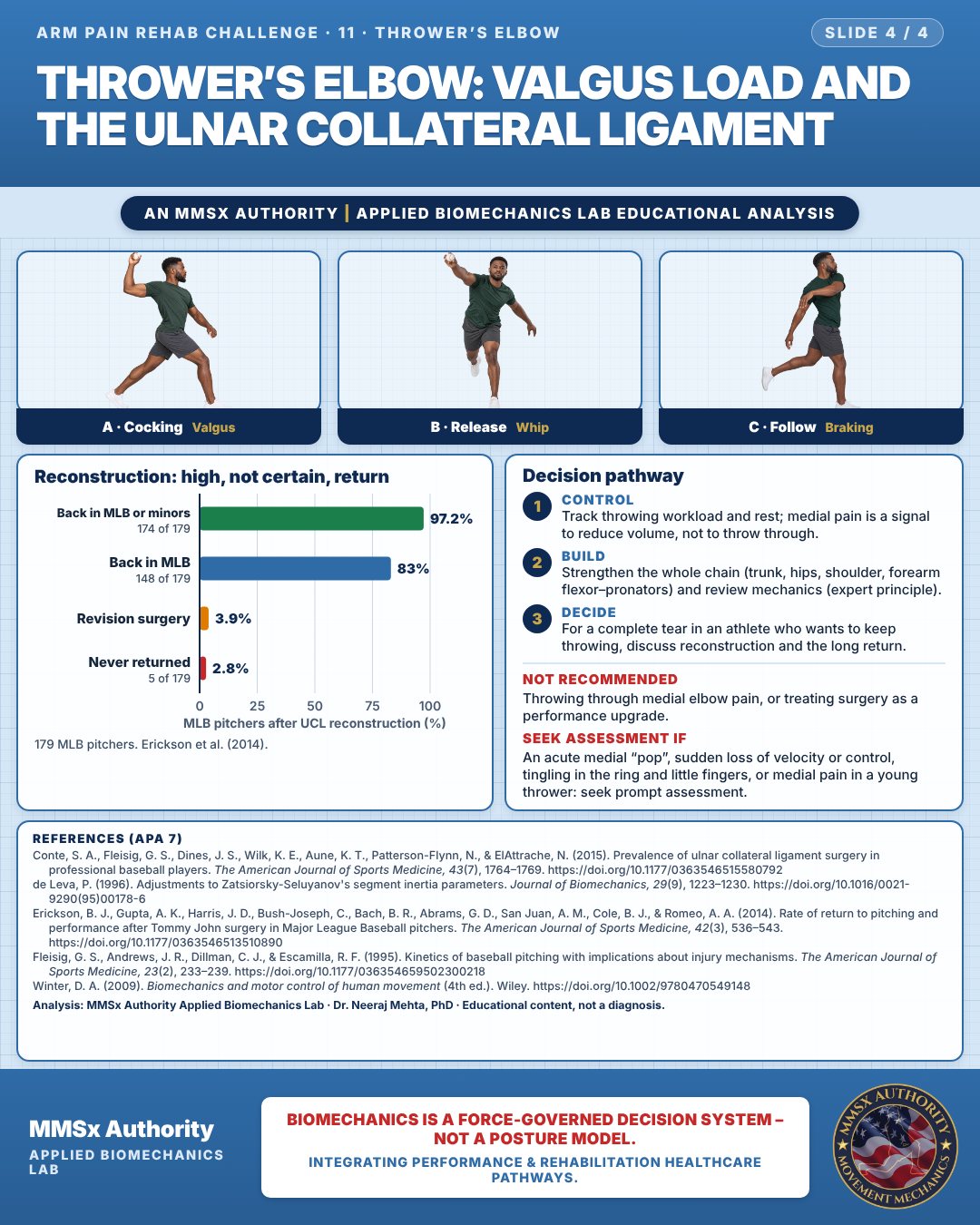
Reconstruction: high, not certain, return
Control
Track throwing workload and rest; medial pain is a signal to reduce volume, not to throw through.
Build
Strengthen the whole chain (trunk, hips, shoulder, forearm flexor–pronators) and review mechanics (expert principle).
Decide
For a complete tear in an athlete who wants to keep throwing, discuss reconstruction and the long return.
Myth and evidence
Myth“Tommy John surgery makes pitchers throw harder — have it early.”
EvidenceReturn is high but not universal (83% to MLB) and takes about 20 months; revision is needed in 3.9% (Erickson et al., 2014).
Cautions
Not recommended
Throwing through medial elbow pain, or treating surgery as a performance upgrade.
Seek assessment if
An acute medial “pop”, sudden loss of velocity or control, tingling in the ring and little fingers, or medial pain in a young thrower: seek prompt assessment.
Methods note
2-D estimates from pose landmarks on an illustrated figure; CoM (if shown) from de Leva (1996); cm for a 1.70 m adult (Winter, 2009). Elbow angle from pose landmarks in the side view. Arm elevation from pose landmarks in the front view. These are educational estimates, not a diagnosis.
References
- Conte, S. A., Fleisig, G. S., Dines, J. S., Wilk, K. E., Aune, K. T., Patterson-Flynn, N., & ElAttrache, N. (2015). Prevalence of ulnar collateral ligament surgery in professional baseball players. The American Journal of Sports Medicine, 43(7), 1764–1769. https://doi.org/10.1177/0363546515580792
- de Leva, P. (1996). Adjustments to Zatsiorsky-Seluyanov's segment inertia parameters. Journal of Biomechanics, 29(9), 1223–1230. https://doi.org/10.1016/0021-9290(95)00178-6
- Erickson, B. J., Gupta, A. K., Harris, J. D., Bush-Joseph, C., Bach, B. R., Abrams, G. D., San Juan, A. M., Cole, B. J., & Romeo, A. A. (2014). Rate of return to pitching and performance after Tommy John surgery in Major League Baseball pitchers. The American Journal of Sports Medicine, 42(3), 536–543. https://doi.org/10.1177/0363546513510890
- Fleisig, G. S., Andrews, J. R., Dillman, C. J., & Escamilla, R. F. (1995). Kinetics of baseball pitching with implications about injury mechanisms. The American Journal of Sports Medicine, 23(2), 233–239. https://doi.org/10.1177/036354659502300218
- Winter, D. A. (2009). Biomechanics and motor control of human movement (4th ed.). Wiley. https://doi.org/10.1002/9780470549148
Cite this article
Mehta, N. (2026, October 28). Thrower’s elbow: valgus load and the ulnar collateral ligament. MMSx Authority Applied Biomechanics Lab. https://mmsxauthority.org/edu/analysis/arm/11-throwers-elbow-valgus-load-and-the-ulnar-collateral-ligament/
Part of the collection
Mehta, N. (2026). Elbow, Forearm, Wrist and Hand Rehabilitation: 50 Evidence-Based Biomechanics Analyses [Collection]. MMSx Authority Applied Biomechanics Lab. Zenodo. https://doi.org/10.5281/zenodo.23735910
All Arm Pain Rehab Challenge articles · Rehabilitation Library