Arm Pain Rehab Challenge · 10
Olecranon bursitis: swelling at the point of the elbow
Inflammation (aseptic) or infection (septic) of the superficial bursa over the olecranon, causing a fluctuant swelling at the point of the elbow.
Key points
- Protect. Stop leaning on the elbow; pad desks, armrests and kneeling-type tasks so the point of the elbow hangs free.
- Settle. For non-infected bursitis use compression and time; non-surgical care resolved more often than surgery.
- Check. Watch daily for redness, heat or fever, which change the plan to same-day medical assessment.
What it is
Inflammation (aseptic) or infection (septic) of the superficial bursa over the olecranon, causing a fluctuant swelling at the point of the elbow; leaning on the elbows (Movement A) is a recognised provocation.
How we analysed the movement
Three movements relevant to this topic were analysed from illustrated reference figures. Joint centres were located with two-dimensional pose estimation where the whole arm was visible; elbow and wrist angles, and the directions of external load and tendon pull, were then drawn on the figure; on hand close-ups, where pose estimation does not apply, the landmarks were placed manually. The figures are educational estimates that show how position changes mechanical demand; they are not measurements of a patient. Every research value quoted below comes from the published source cited beside it.
Movement A: Leaning on elbows (side view)
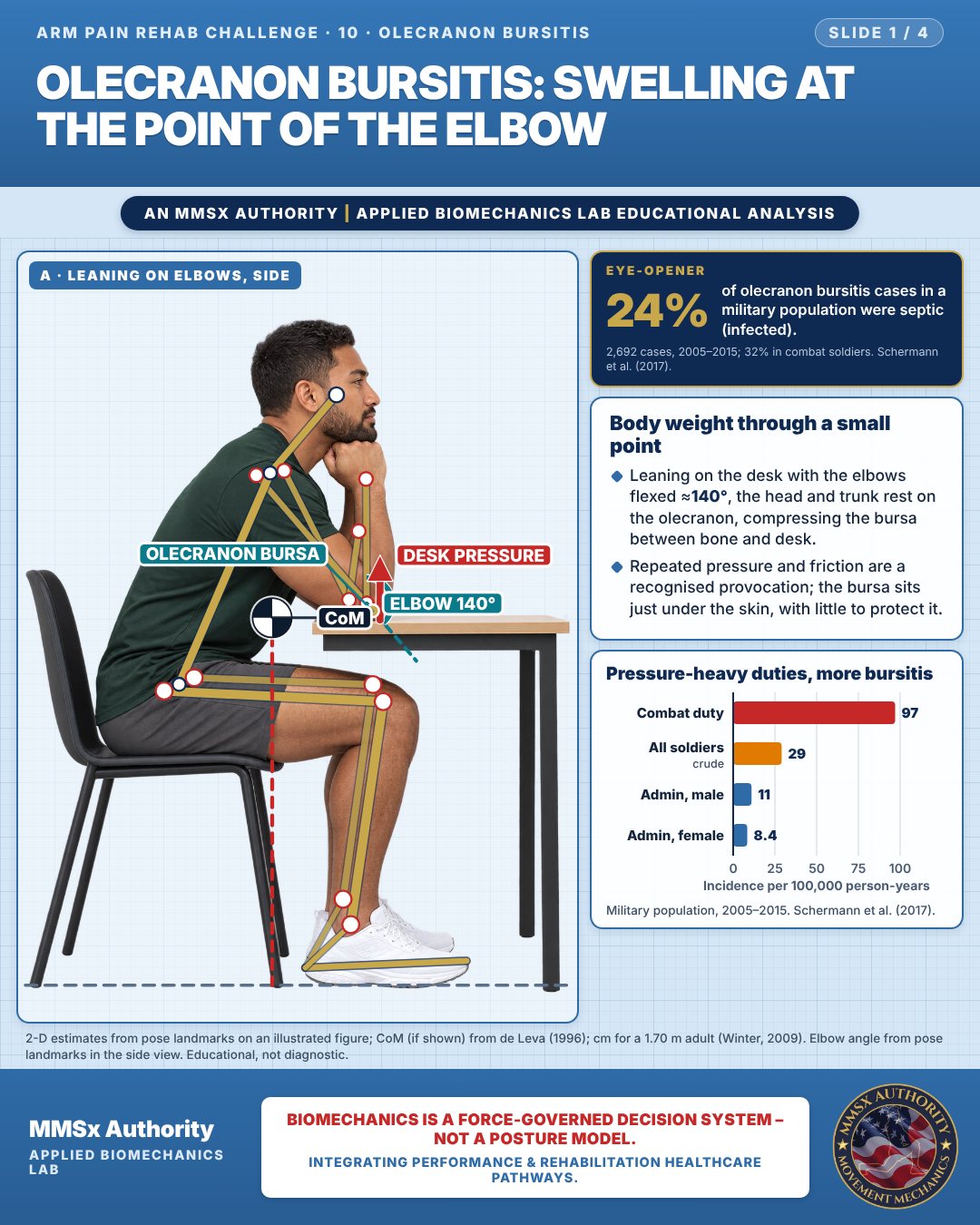
Body weight through a small point
Leaning on the desk with the elbows flexed ≈140°, the head and trunk rest on the olecranon, compressing the bursa between bone and desk.
Repeated pressure and friction are a recognised provocation; the bursa sits just under the skin, with little to protect it.
Pressure-heavy duties, more bursitis
Movement B: Point of elbow (rear view)
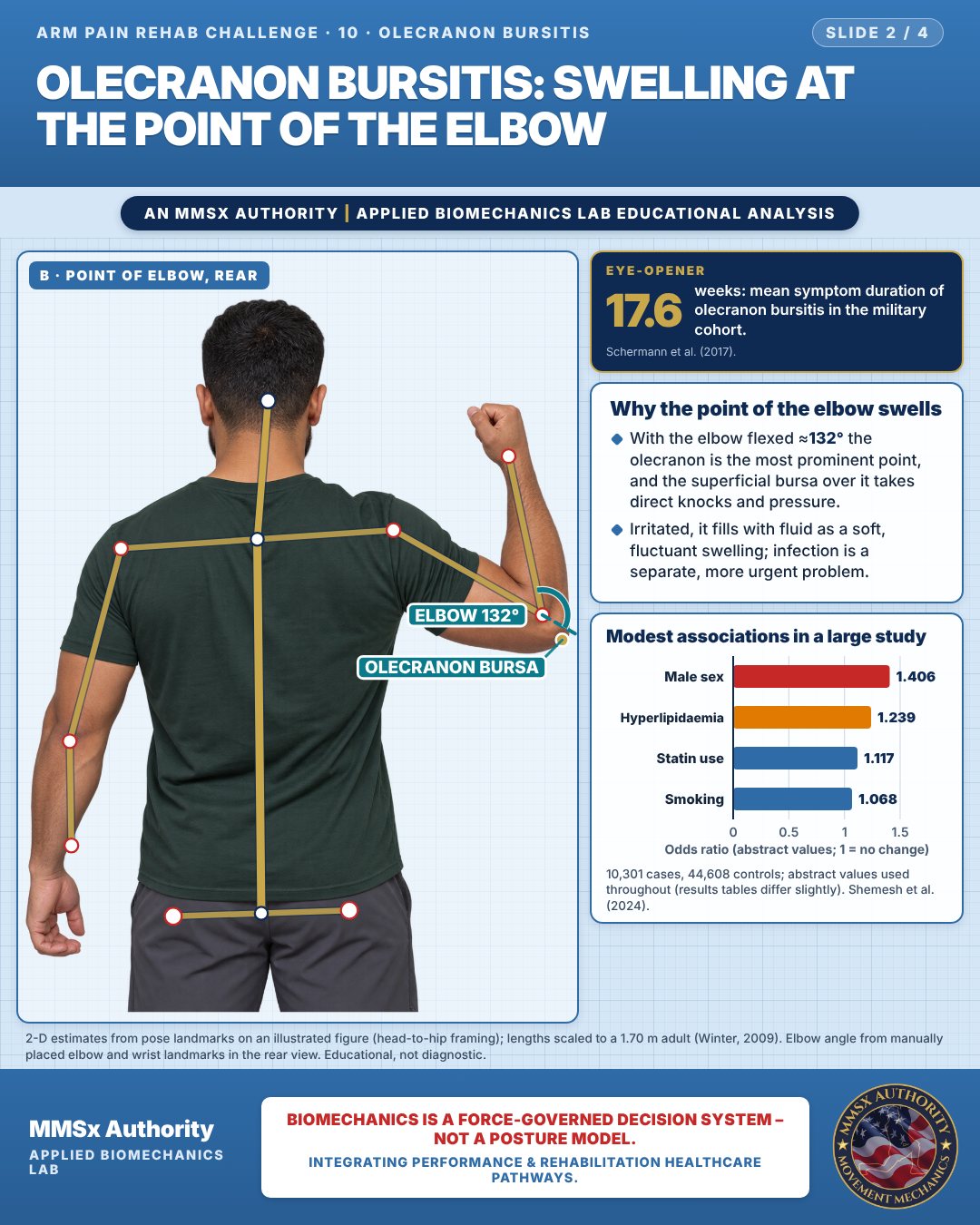
Why the point of the elbow swells
With the elbow flexed ≈132° the olecranon is the most prominent point, and the superficial bursa over it takes direct knocks and pressure.
Irritated, it fills with fluid as a soft, fluctuant swelling; infection is a separate, more urgent problem.
Modest associations in a large study
Movement C: Elbow off-loaded (side view)
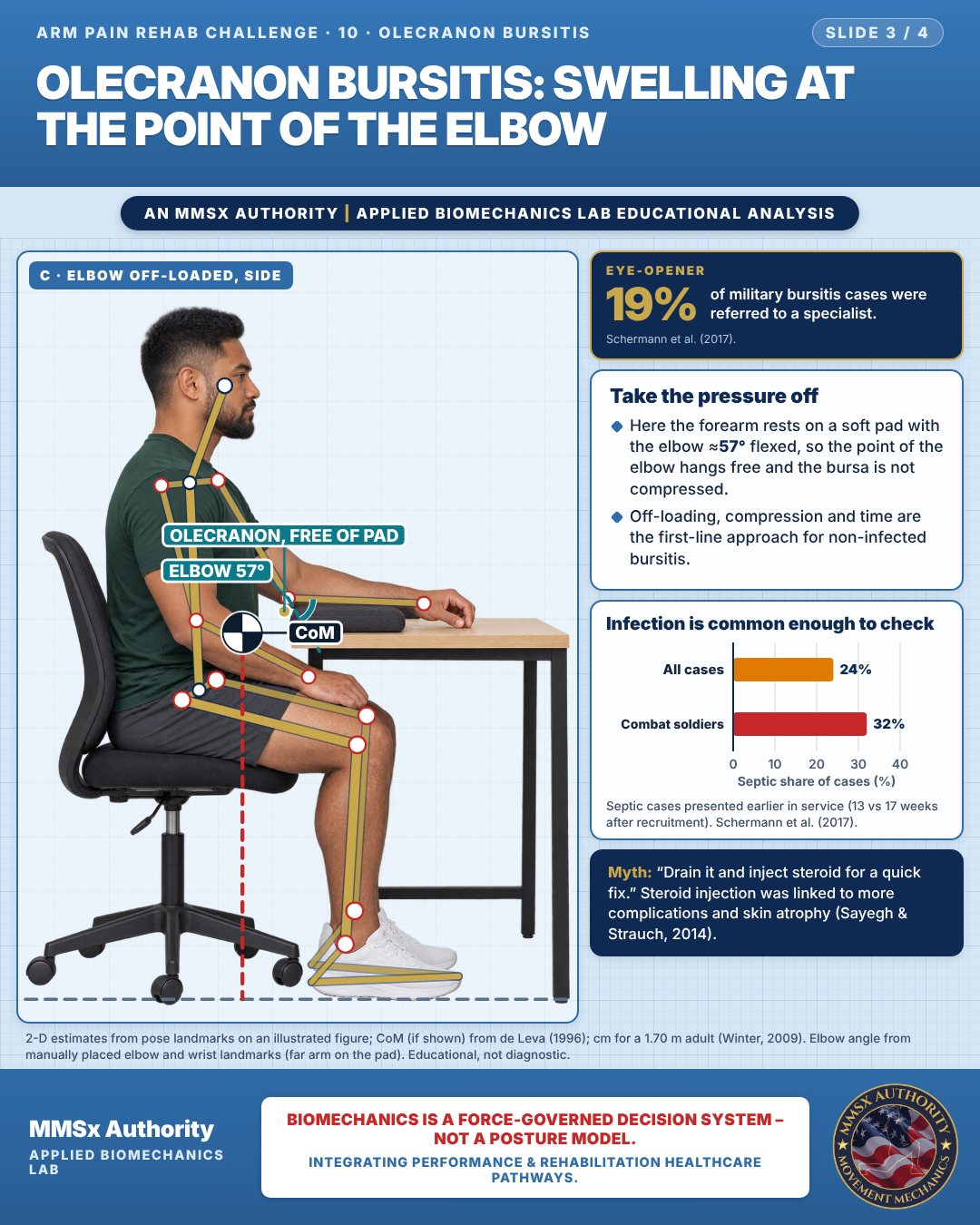
Take the pressure off
Here the forearm rests on a soft pad with the elbow ≈57° flexed, so the point of the elbow hangs free and the bursa is not compressed.
Off-loading, compression and time are the first-line approach for non-infected bursitis.
Infection is common enough to check
Decision pathway
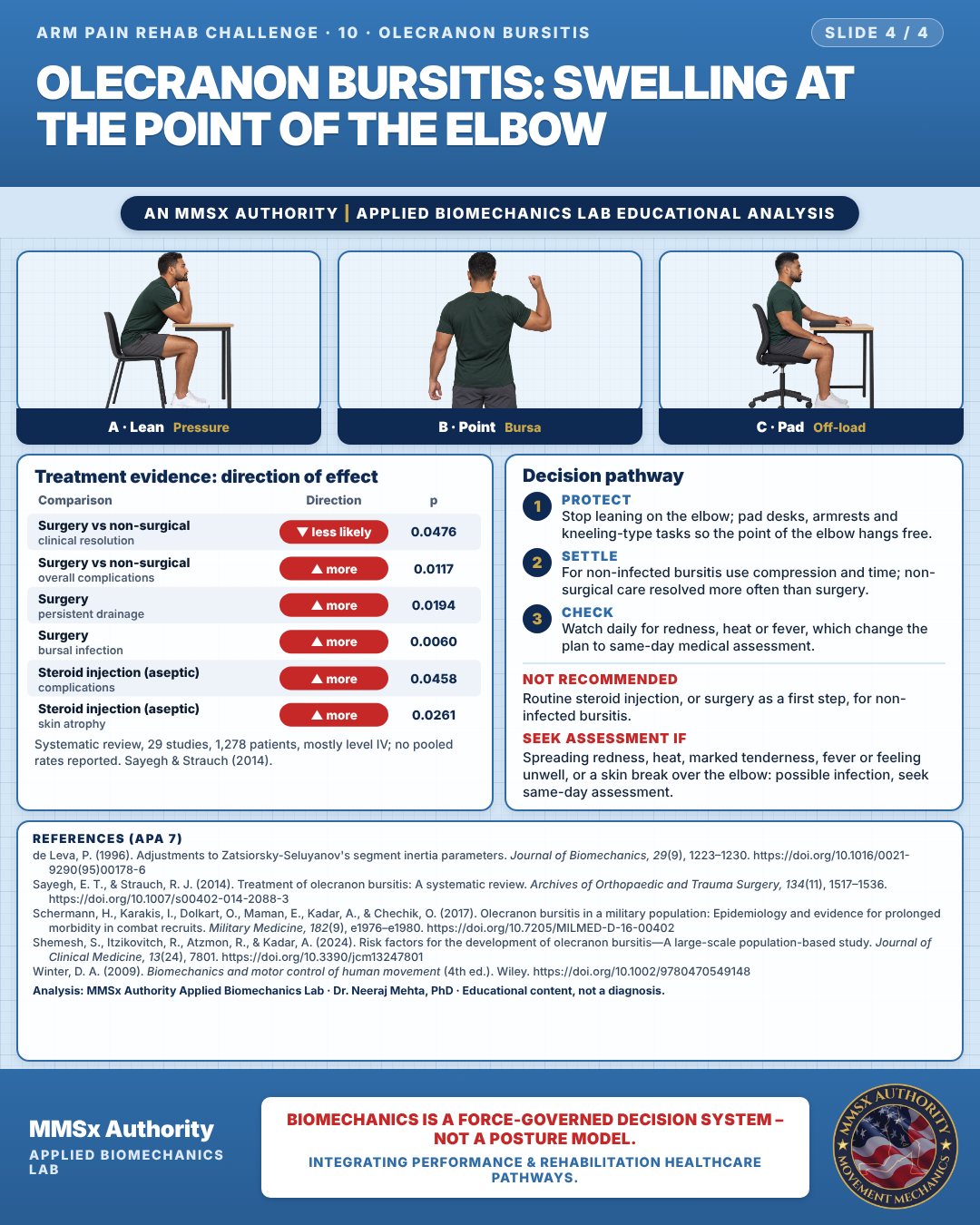
Treatment evidence: direction of effect
Protect
Stop leaning on the elbow; pad desks, armrests and kneeling-type tasks so the point of the elbow hangs free.
Settle
For non-infected bursitis use compression and time; non-surgical care resolved more often than surgery.
Check
Watch daily for redness, heat or fever, which change the plan to same-day medical assessment.
What the evidence supports
- Non-surgical first: protect from pressure, compression and time for aseptic bursitis; avoid routine steroid injection (complications, skin atrophy); suspected septic bursitis needs medical assessment (aspiration/antibiotics as indicated). Surgery is reserved for refractory cases (Sayegh & Strauch, 2014).
Myth and evidence
Myth“Drain it and inject steroid for a quick fix.”
EvidenceSteroid injection for aseptic bursitis was associated with more complications and skin atrophy, and surgery with more complications and lower resolution than non-surgical care (Sayegh & Strauch, 2014).
Cautions
Not recommended
Routine steroid injection, or surgery as a first step, for non-infected bursitis.
Seek assessment if
Spreading redness, heat, marked tenderness, fever or feeling unwell, or a skin break over the elbow: possible infection, seek same-day assessment.
Methods note
2-D estimates from pose landmarks on an illustrated figure; CoM (if shown) from de Leva (1996); cm for a 1.70 m adult (Winter, 2009). Elbow angle from pose landmarks in the side view. 2-D estimates from pose landmarks on an illustrated figure (head-to-hip framing); lengths scaled to a 1.70 m adult (Winter, 2009). Elbow angle from manually placed elbow and wrist landmarks in the rear view. Elbow angle from manually placed elbow and wrist landmarks (far arm on the pad). These are educational estimates, not a diagnosis.
References
- de Leva, P. (1996). Adjustments to Zatsiorsky-Seluyanov's segment inertia parameters. Journal of Biomechanics, 29(9), 1223–1230. https://doi.org/10.1016/0021-9290(95)00178-6
- Sayegh, E. T., & Strauch, R. J. (2014). Treatment of olecranon bursitis: A systematic review. Archives of Orthopaedic and Trauma Surgery, 134(11), 1517–1536. https://doi.org/10.1007/s00402-014-2088-3
- Schermann, H., Karakis, I., Dolkart, O., Maman, E., Kadar, A., & Chechik, O. (2017). Olecranon bursitis in a military population: Epidemiology and evidence for prolonged morbidity in combat recruits. Military Medicine, 182(9), e1976–e1980. https://doi.org/10.7205/MILMED-D-16-00402
- Shemesh, S., Itzikovitch, R., Atzmon, R., & Kadar, A. (2024). Risk factors for the development of olecranon bursitis—A large-scale population-based study. Journal of Clinical Medicine, 13(24), 7801. https://doi.org/10.3390/jcm13247801
- Winter, D. A. (2009). Biomechanics and motor control of human movement (4th ed.). Wiley. https://doi.org/10.1002/9780470549148
Cite this article
Mehta, N. (2026, October 28). Olecranon bursitis: swelling at the point of the elbow. MMSx Authority Applied Biomechanics Lab. https://mmsxauthority.org/edu/analysis/arm/10-olecranon-bursitis-swelling-at-the-point-of-the-elbow/
Part of the collection
Mehta, N. (2026). Elbow, Forearm, Wrist and Hand Rehabilitation: 50 Evidence-Based Biomechanics Analyses [Collection]. MMSx Authority Applied Biomechanics Lab. Zenodo. https://doi.org/10.5281/zenodo.23735910
All Arm Pain Rehab Challenge articles · Rehabilitation Library