Arm Pain Rehab Challenge · 09
Triceps tendon pain: back-of-elbow load in pressing and dips
Distal triceps tendinopathy or partial tear: pain at the olecranon insertion, provoked by loaded elbow extension from a deeply flexed position (dips,…
Key points
- Modify. Reduce dip depth and volume and pause overhead extensions while the back of the elbow is sensitive.
- Load. Climb the push-up ladder from hands elevated to regular, then feet elevated, as pain allows (expert principle).
- Return. Reintroduce dips and heavier pressing last, building depth before load.
What it is
Distal triceps tendinopathy or partial tear: pain at the olecranon insertion, provoked by loaded elbow extension from a deeply flexed position (dips, overhead extensions, push-ups).
How we analysed the movement
Three movements relevant to this topic were analysed from illustrated reference figures. Joint centres were located with two-dimensional pose estimation where the whole arm was visible; elbow and wrist angles, and the directions of external load and tendon pull, were then drawn on the figure; on hand close-ups, where pose estimation does not apply, the landmarks were placed manually. The figures are educational estimates that show how position changes mechanical demand; they are not measurements of a patient. Every research value quoted below comes from the published source cited beside it.
Movement A: Dip, bottom (side view)
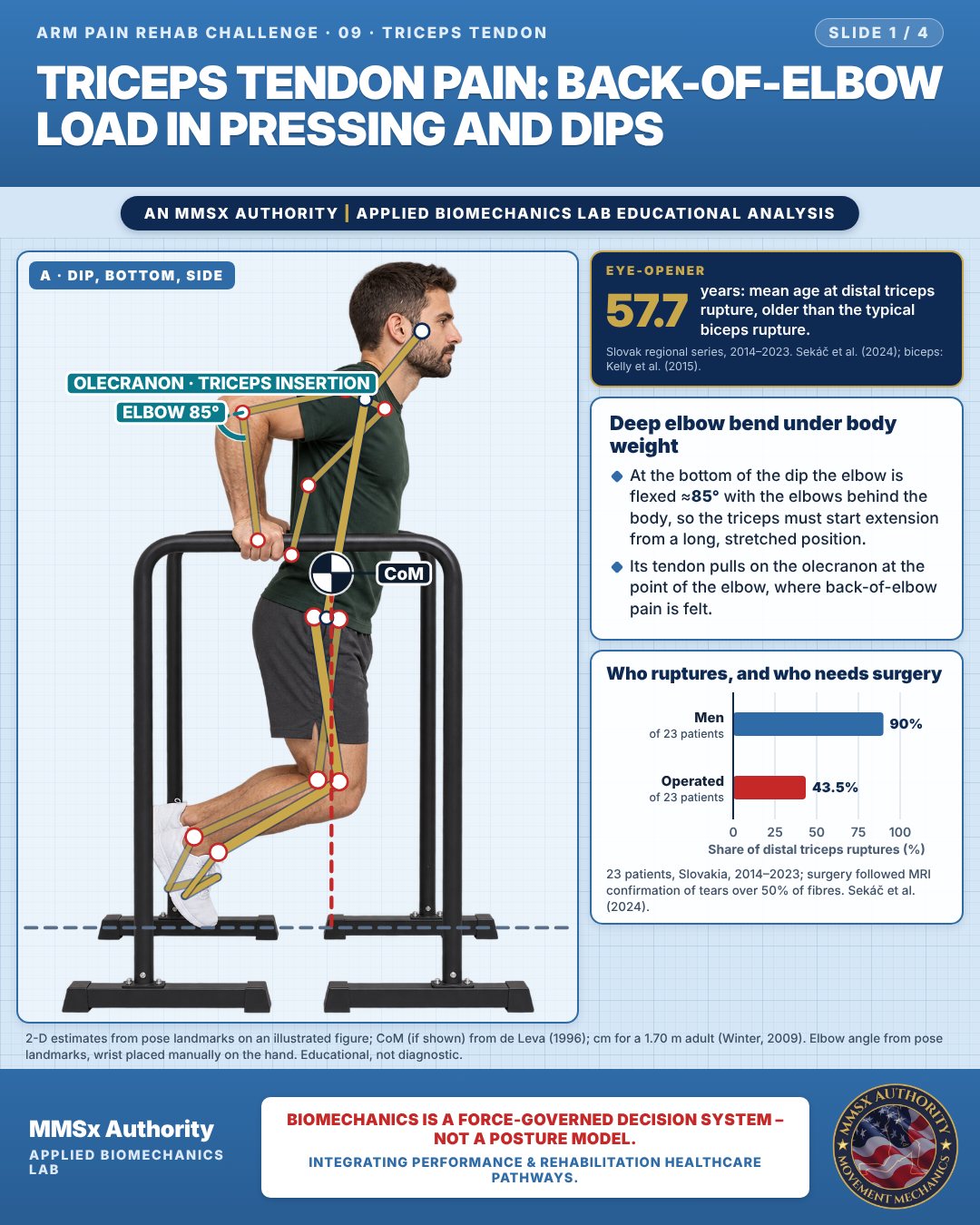
Deep elbow bend under body weight
At the bottom of the dip the elbow is flexed ≈85° with the elbows behind the body, so the triceps must start extension from a long, stretched position.
Its tendon pulls on the olecranon at the point of the elbow, where back-of-elbow pain is felt.
Who ruptures, and who needs surgery
Movement B: Overhead extension (side view)
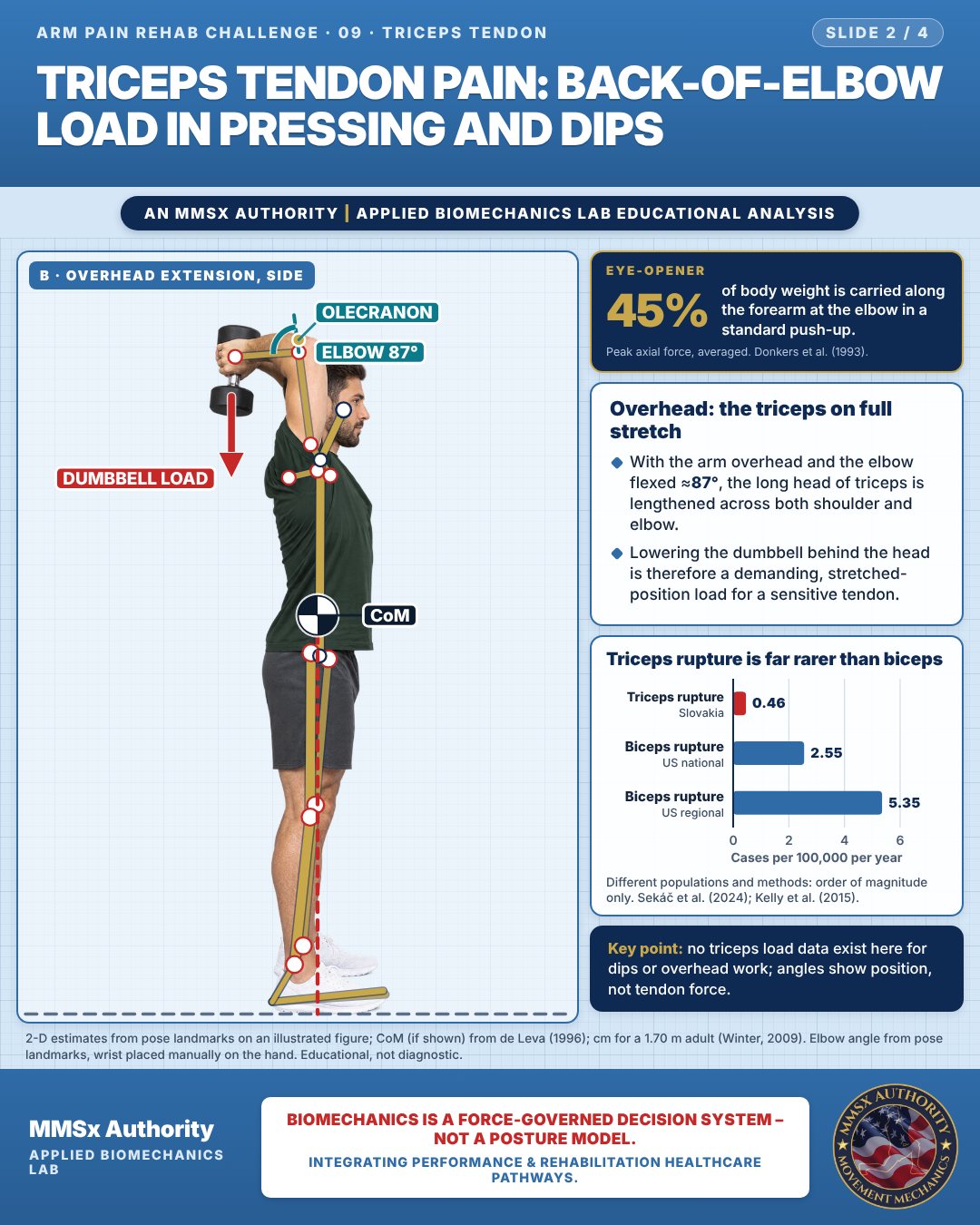
Overhead: the triceps on full stretch
With the arm overhead and the elbow flexed ≈87°, the long head of triceps is lengthened across both shoulder and elbow.
Lowering the dumbbell behind the head is therefore a demanding, stretched-position load for a sensitive tendon.
Triceps rupture is far rarer than biceps
Movement C: Push-up, bottom (side view)
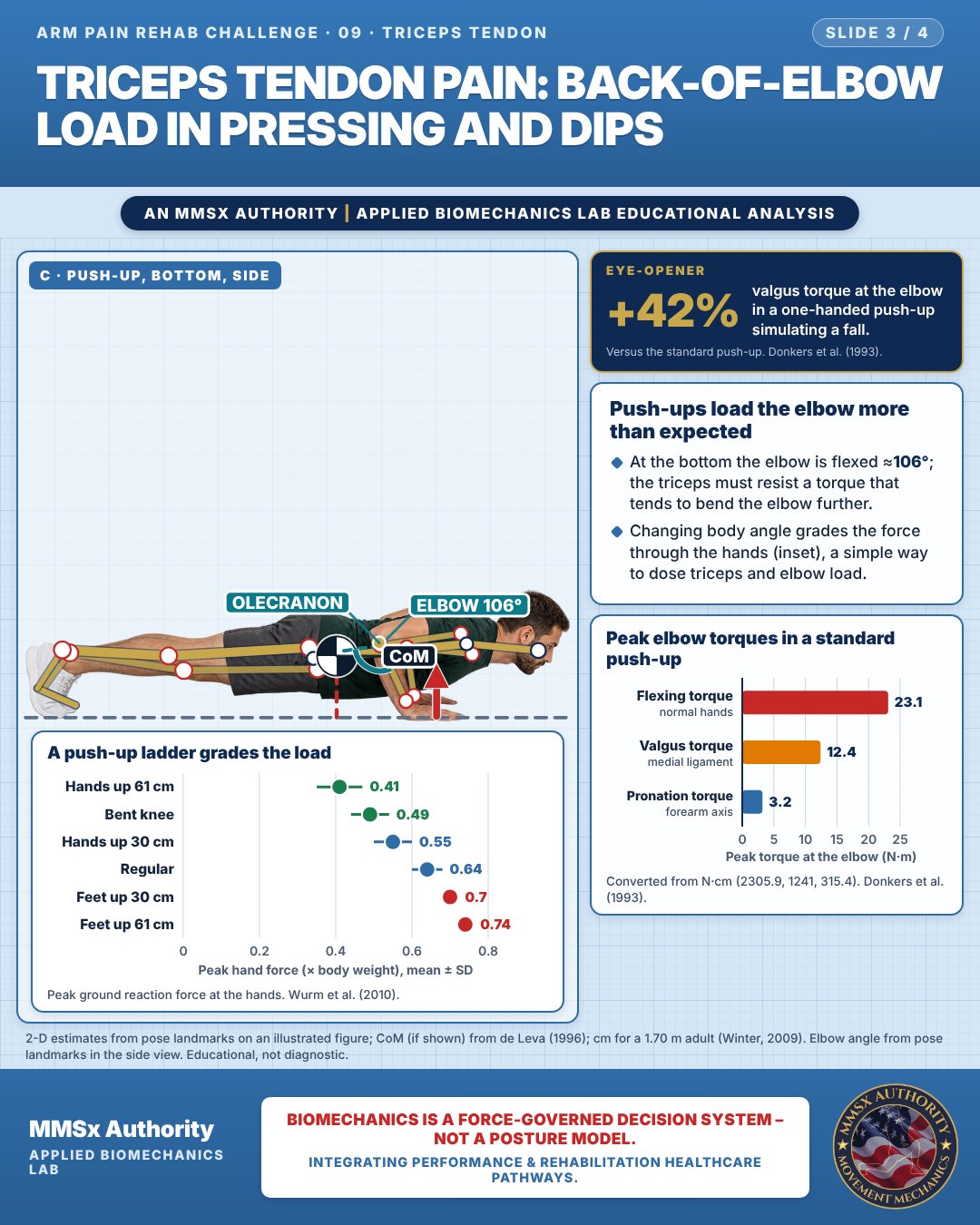
A push-up ladder grades the load
Push-ups load the elbow more than expected
At the bottom the elbow is flexed ≈106°; the triceps must resist a torque that tends to bend the elbow further.
Changing body angle grades the force through the hands (inset), a simple way to dose triceps and elbow load.
Peak elbow torques in a standard push-up
Decision pathway
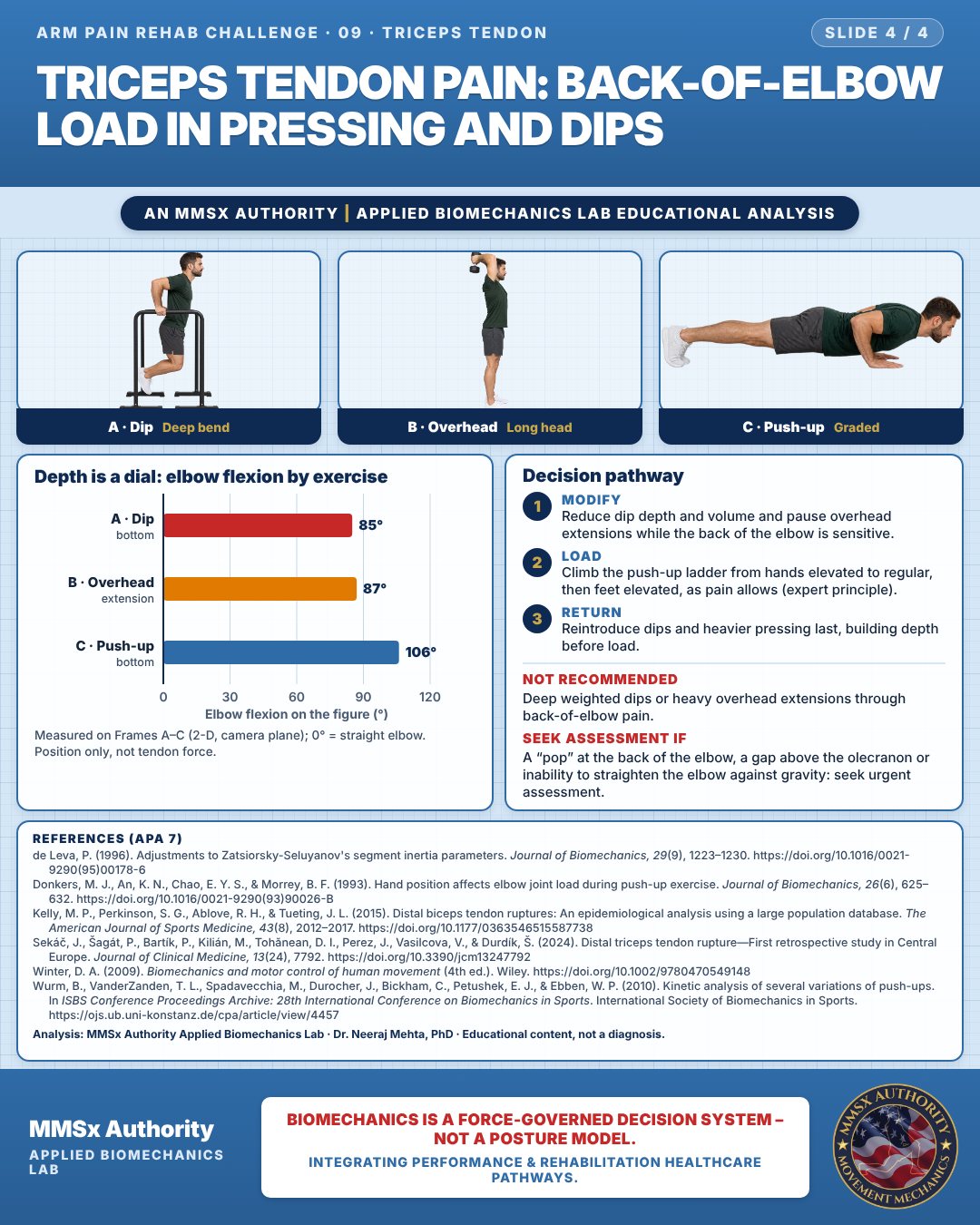
Depth is a dial: elbow flexion by exercise
Modify
Reduce dip depth and volume and pause overhead extensions while the back of the elbow is sensitive.
Load
Climb the push-up ladder from hands elevated to regular, then feet elevated, as pain allows (expert principle).
Return
Reintroduce dips and heavier pressing last, building depth before load.
Myth and evidence
Myth“Push-ups are body-weight, so the elbow load is small.”
EvidencePeak axial elbow force averages about 45% of body weight (Donkers et al., 1993), and hand loads range from 0.41 to 0.74 × body weight by variation (Wurm et al., 2010).
Cautions
Not recommended
Deep weighted dips or heavy overhead extensions through back-of-elbow pain.
Seek assessment if
A “pop” at the back of the elbow, a gap above the olecranon or inability to straighten the elbow against gravity: seek urgent assessment.
Methods note
2-D estimates from pose landmarks on an illustrated figure; CoM (if shown) from de Leva (1996); cm for a 1.70 m adult (Winter, 2009). Elbow angle from pose landmarks, wrist placed manually on the hand. Elbow angle from pose landmarks in the side view. These are educational estimates, not a diagnosis.
References
- de Leva, P. (1996). Adjustments to Zatsiorsky-Seluyanov's segment inertia parameters. Journal of Biomechanics, 29(9), 1223–1230. https://doi.org/10.1016/0021-9290(95)00178-6
- Donkers, M. J., An, K. N., Chao, E. Y. S., & Morrey, B. F. (1993). Hand position affects elbow joint load during push-up exercise. Journal of Biomechanics, 26(6), 625–632. https://doi.org/10.1016/0021-9290(93)90026-B
- Kelly, M. P., Perkinson, S. G., Ablove, R. H., & Tueting, J. L. (2015). Distal biceps tendon ruptures: An epidemiological analysis using a large population database. The American Journal of Sports Medicine, 43(8), 2012–2017. https://doi.org/10.1177/0363546515587738
- Sekáč, J., Šagát, P., Bartík, P., Kilián, M., Tohănean, D. I., Perez, J., Vasilcova, V., & Durdík, Š. (2024). Distal triceps tendon rupture—First retrospective study in Central Europe. Journal of Clinical Medicine, 13(24), 7792. https://doi.org/10.3390/jcm13247792
- Winter, D. A. (2009). Biomechanics and motor control of human movement (4th ed.). Wiley. https://doi.org/10.1002/9780470549148
- Wurm, B., VanderZanden, T. L., Spadavecchia, M., Durocher, J., Bickham, C., Petushek, E. J., & Ebben, W. P. (2010). Kinetic analysis of several variations of push-ups. In ISBS Conference Proceedings Archive: 28th International Conference on Biomechanics in Sports. International Society of Biomechanics in Sports. https://ojs.ub.uni-konstanz.de/cpa/article/view/4457
Cite this article
Mehta, N. (2026, October 28). Triceps tendon pain: back-of-elbow load in pressing and dips. MMSx Authority Applied Biomechanics Lab. https://mmsxauthority.org/edu/analysis/arm/09-triceps-tendon-pain-back-of-elbow-load-in-pressing-and-dips/
Part of the collection
Mehta, N. (2026). Elbow, Forearm, Wrist and Hand Rehabilitation: 50 Evidence-Based Biomechanics Analyses [Collection]. MMSx Authority Applied Biomechanics Lab. Zenodo. https://doi.org/10.5281/zenodo.23735910
All Arm Pain Rehab Challenge articles · Rehabilitation Library