Arm Pain Rehab Challenge · 08
Distal biceps rupture: the "pop", the Popeye sign and urgent assessment
Complete avulsion of the distal biceps tendon from the radial tuberosity, usually from a sudden eccentric load on a flexed, supinated elbow (Frame A:…
Key points
- Stop. After a “pop” with the elbow bent under load, stop lifting and protect the arm.
- Refer. Seek early specialist assessment so operative and non-operative options can be weighed together.
- Rehab. Follow a physiotherapy-led programme on either route, rebuilding flexion and supination strength gradually.
What it is
Complete avulsion of the distal biceps tendon from the radial tuberosity, usually from a sudden eccentric load on a flexed, supinated elbow (Frame A: catching a falling box). The muscle belly may retract (proximal bulge — "reverse Popeye"; Frame C compares both arms).
How we analysed the movement
Three movements relevant to this topic were analysed from illustrated reference figures. Joint centres were located with two-dimensional pose estimation where the whole arm was visible; elbow and wrist angles, and the directions of external load and tendon pull, were then drawn on the figure; on hand close-ups, where pose estimation does not apply, the landmarks were placed manually. The figures are educational estimates that show how position changes mechanical demand; they are not measurements of a patient. Every research value quoted below comes from the published source cited beside it.
Movement A: Catching a box (side view)
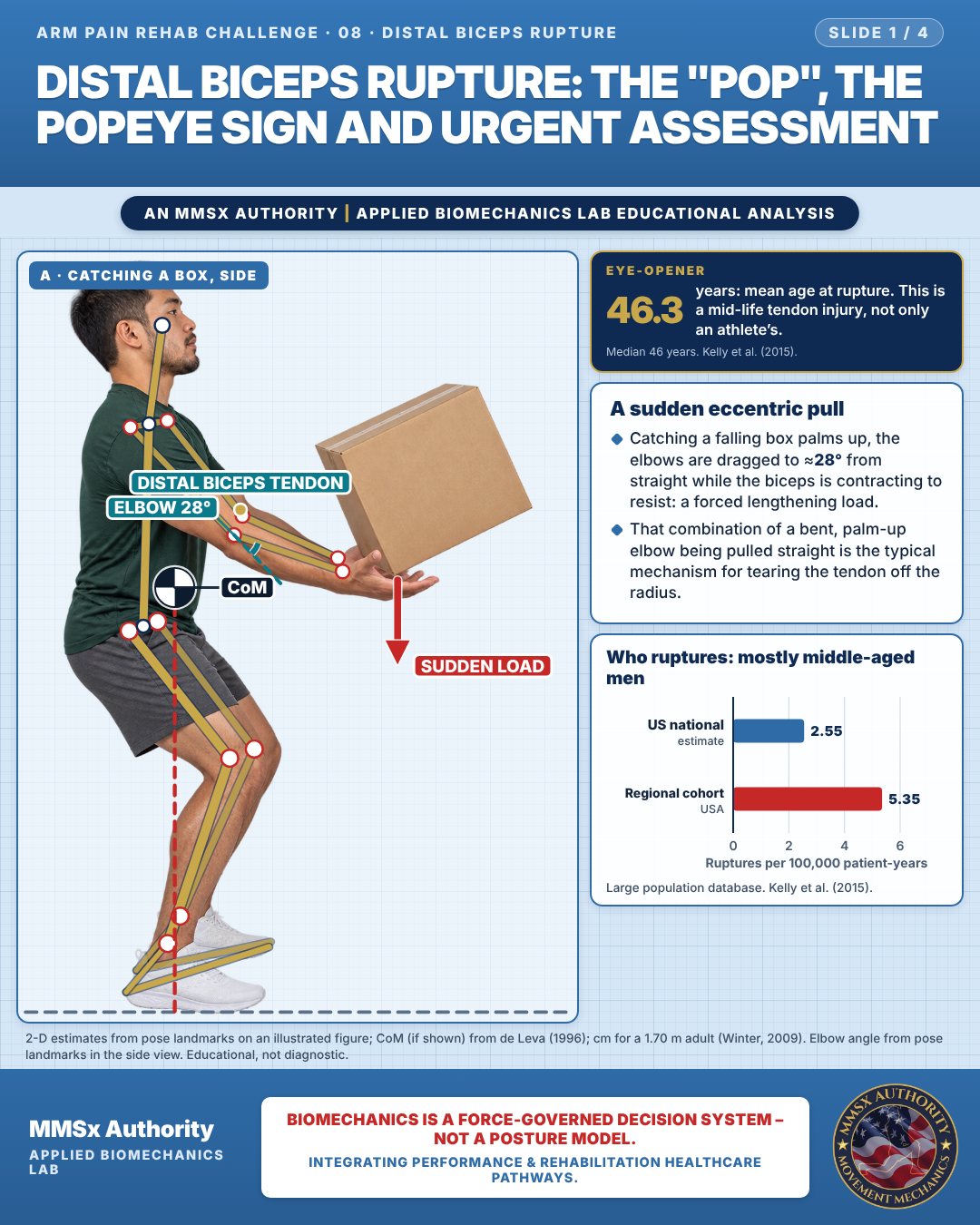
A sudden eccentric pull
Catching a falling box palms up, the elbows are dragged to ≈28° from straight while the biceps is contracting to resist: a forced lengthening load.
That combination of a bent, palm-up elbow being pulled straight is the typical mechanism for tearing the tendon off the radius.
Who ruptures: mostly middle-aged men
Movement B: Hold elbow crease (front view)
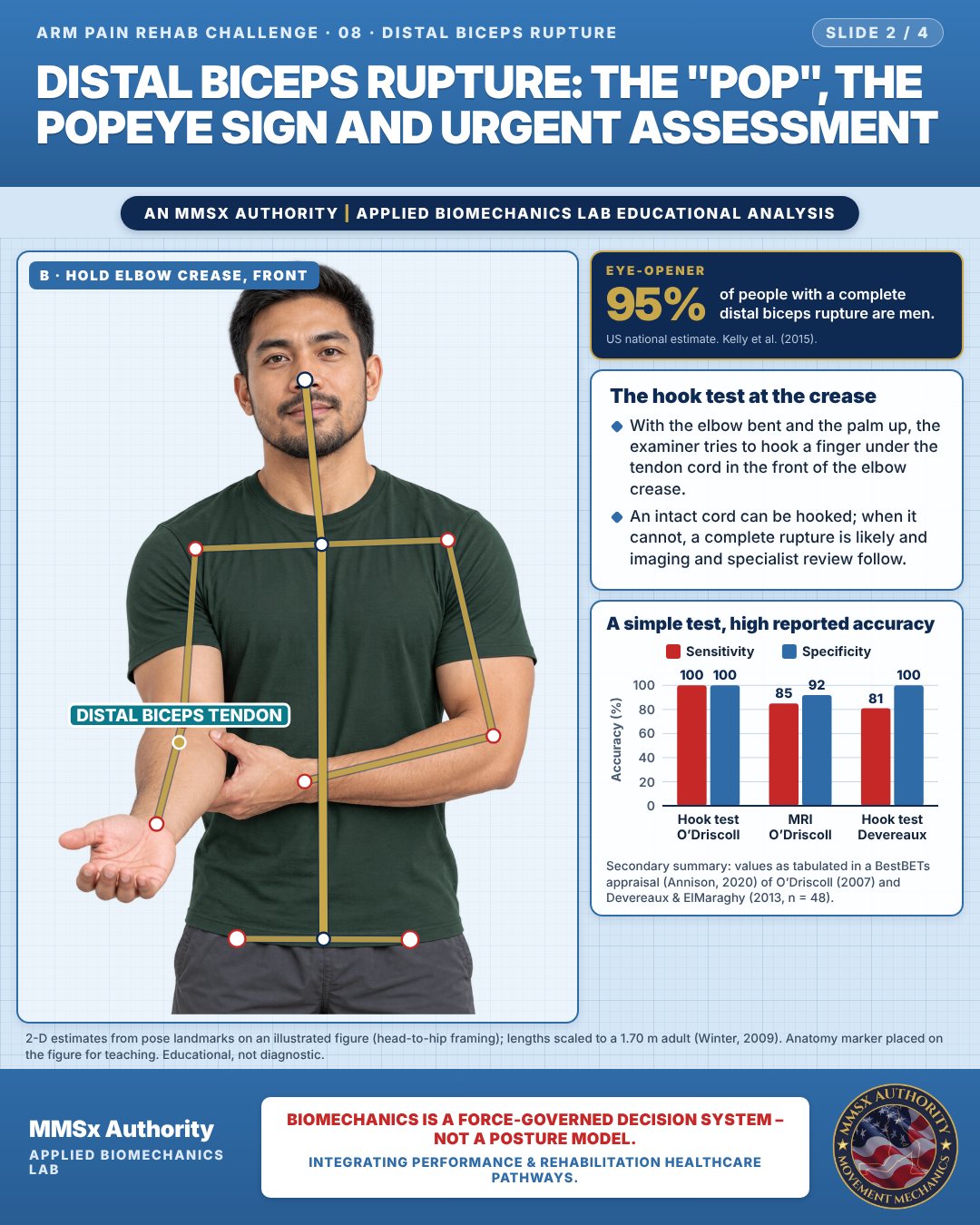
The hook test at the crease
With the elbow bent and the palm up, the examiner tries to hook a finger under the tendon cord in the front of the elbow crease.
An intact cord can be hooked; when it cannot, a complete rupture is likely and imaging and specialist review follow.
A simple test, high reported accuracy
Movement C: Compare both arms (front view)
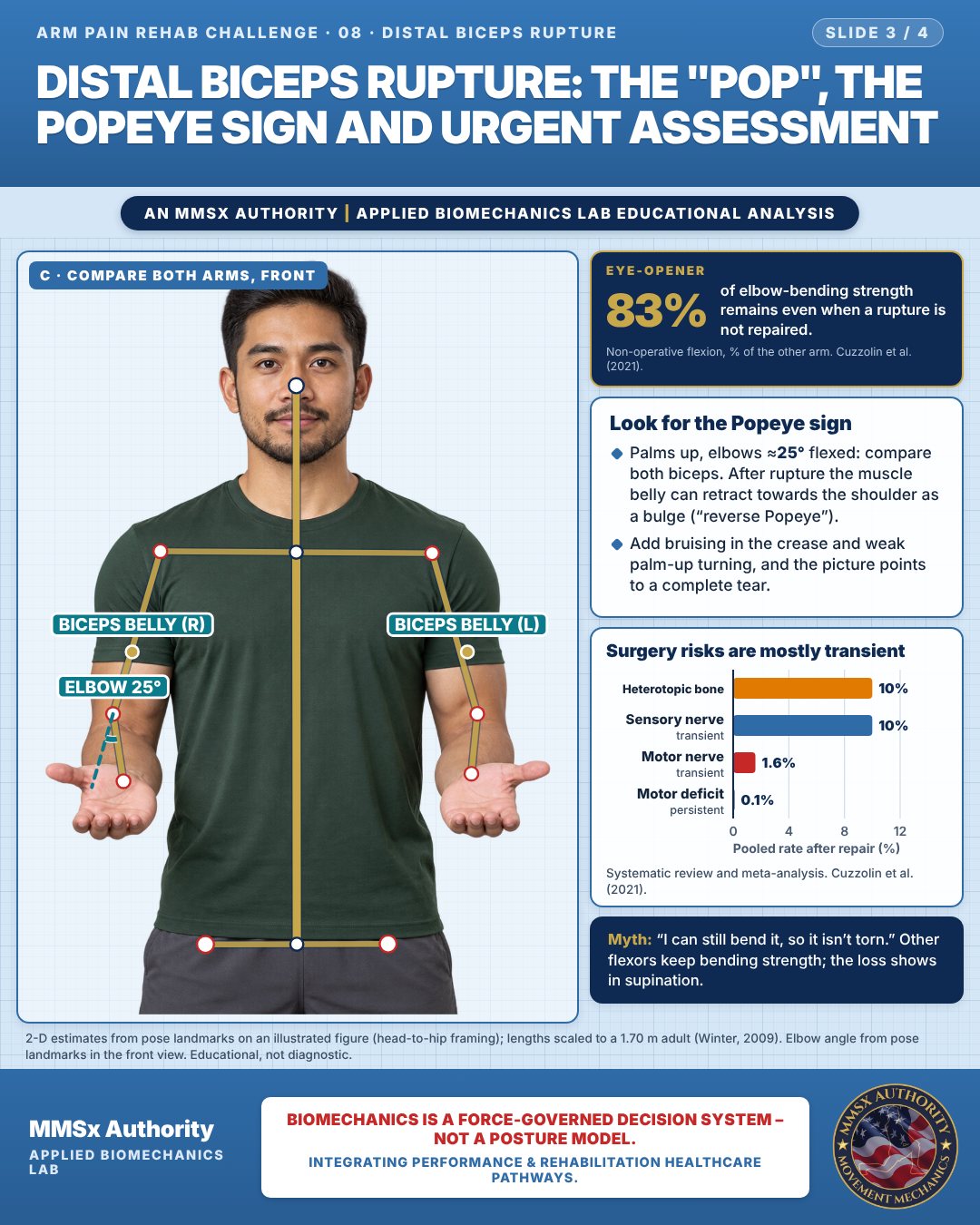
Look for the Popeye sign
Palms up, elbows ≈25° flexed: compare both biceps. After rupture the muscle belly can retract towards the shoulder as a bulge (“reverse Popeye”).
Add bruising in the crease and weak palm-up turning, and the picture points to a complete tear.
Surgery risks are mostly transient
Decision pathway
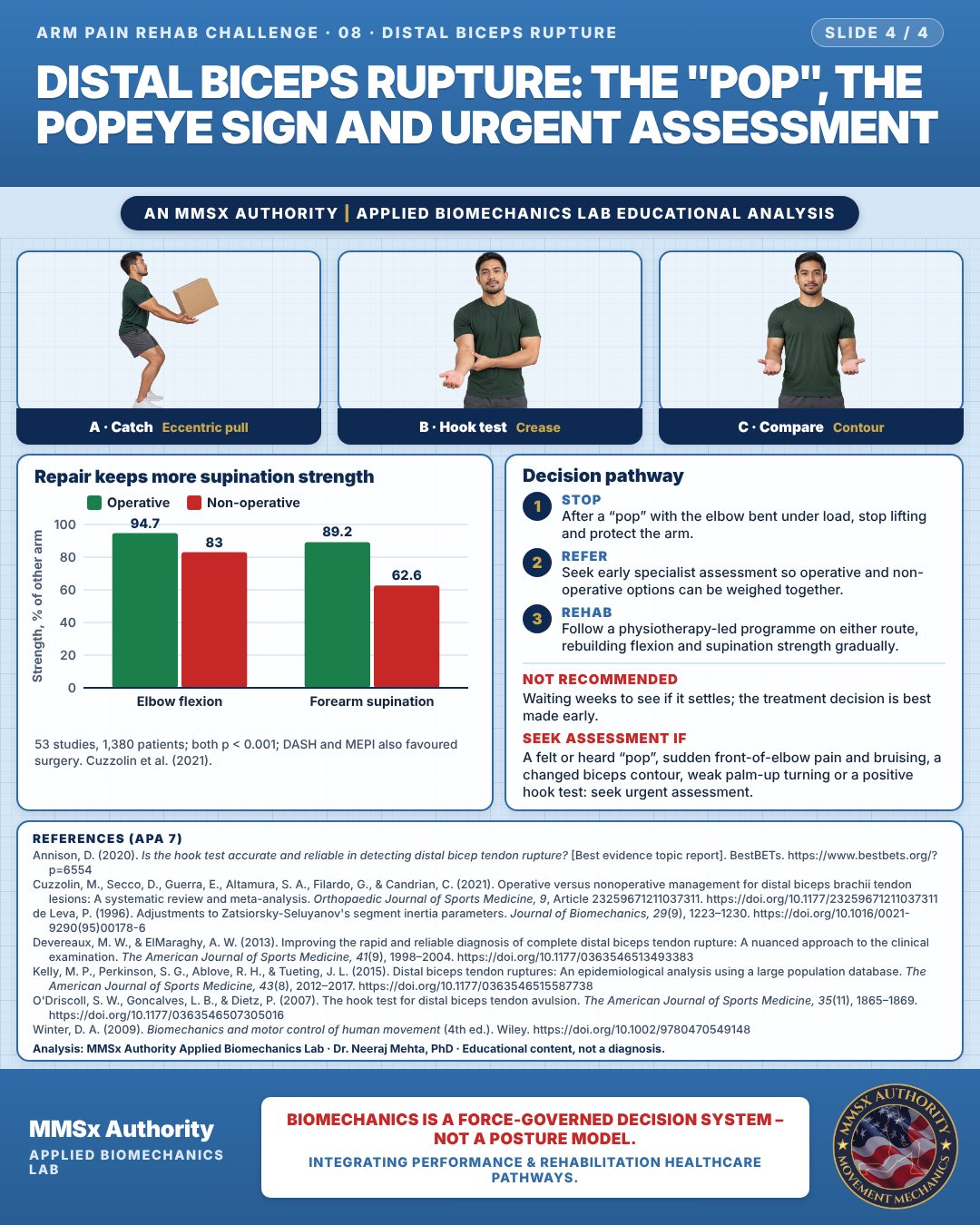
Repair keeps more supination strength
Stop
After a “pop” with the elbow bent under load, stop lifting and protect the arm.
Refer
Seek early specialist assessment so operative and non-operative options can be weighed together.
Rehab
Follow a physiotherapy-led programme on either route, rebuilding flexion and supination strength gradually.
What the evidence supports
- Early specialist referral after a suspected complete rupture so that operative vs non-operative choice can be made with the patient (meta-analysis favours surgery for strength and function; Cuzzolin et al., 2021). Physiotherapy-led rehabilitation follows either route.
Myth and evidence
Myth“If I can still bend the elbow, the tendon can't be ruptured.”
EvidenceFlexion is largely preserved by brachialis/brachioradialis (83% strength non-operatively); the deficit shows in supination (62.6%) (Cuzzolin et al., 2021).
Cautions
Not recommended
Waiting weeks to see if it settles; the treatment decision is best made early.
Seek assessment if
A felt or heard “pop”, sudden front-of-elbow pain and bruising, a changed biceps contour, weak palm-up turning or a positive hook test: seek urgent assessment.
Methods note
2-D estimates from pose landmarks on an illustrated figure; CoM (if shown) from de Leva (1996); cm for a 1.70 m adult (Winter, 2009). Elbow angle from pose landmarks in the side view. 2-D estimates from pose landmarks on an illustrated figure (head-to-hip framing); lengths scaled to a 1.70 m adult (Winter, 2009). Anatomy marker placed on the figure for teaching. Elbow angle from pose landmarks in the front view. These are educational estimates, not a diagnosis.
References
- Annison, D. (2020). Is the hook test accurate and reliable in detecting distal bicep tendon rupture? [Best evidence topic report]. BestBETs. https://www.bestbets.org/?p=6554
- Cuzzolin, M., Secco, D., Guerra, E., Altamura, S. A., Filardo, G., & Candrian, C. (2021). Operative versus nonoperative management for distal biceps brachii tendon lesions: A systematic review and meta-analysis. Orthopaedic Journal of Sports Medicine, 9, Article 23259671211037311. https://doi.org/10.1177/23259671211037311
- de Leva, P. (1996). Adjustments to Zatsiorsky-Seluyanov's segment inertia parameters. Journal of Biomechanics, 29(9), 1223–1230. https://doi.org/10.1016/0021-9290(95)00178-6
- Devereaux, M. W., & ElMaraghy, A. W. (2013). Improving the rapid and reliable diagnosis of complete distal biceps tendon rupture: A nuanced approach to the clinical examination. The American Journal of Sports Medicine, 41(9), 1998–2004. https://doi.org/10.1177/0363546513493383
- Kelly, M. P., Perkinson, S. G., Ablove, R. H., & Tueting, J. L. (2015). Distal biceps tendon ruptures: An epidemiological analysis using a large population database. The American Journal of Sports Medicine, 43(8), 2012–2017. https://doi.org/10.1177/0363546515587738
- O'Driscoll, S. W., Goncalves, L. B., & Dietz, P. (2007). The hook test for distal biceps tendon avulsion. The American Journal of Sports Medicine, 35(11), 1865–1869. https://doi.org/10.1177/0363546507305016
- Winter, D. A. (2009). Biomechanics and motor control of human movement (4th ed.). Wiley. https://doi.org/10.1002/9780470549148
Cite this article
Mehta, N. (2026, October 28). Distal biceps rupture: the "pop", the Popeye sign and urgent assessment. MMSx Authority Applied Biomechanics Lab. https://mmsxauthority.org/edu/analysis/arm/08-distal-biceps-rupture-the-pop-the-popeye-sign-and-urgent-assessment/
Part of the collection
Mehta, N. (2026). Elbow, Forearm, Wrist and Hand Rehabilitation: 50 Evidence-Based Biomechanics Analyses [Collection]. MMSx Authority Applied Biomechanics Lab. Zenodo. https://doi.org/10.5281/zenodo.23735910
All Arm Pain Rehab Challenge articles · Rehabilitation Library