Arm Pain Rehab Challenge · 05
Counterforce straps and braces for elbow pain: do they reduce tendon load?
A counterforce strap is a band worn on the proximal forearm just below the elbow, intended to dampen force transmission to the wrist-extensor origin.
Key points
- Optional. A strap may be worn during activity for short-term relief (Grade F); long-term value unproven (Grade D; Lucado et al., 2022).
- Load. Keep progressive wrist-extensor loading as the core treatment; a strap does not replace it.
- Check. Judge any strap by pain-free grip during your own tasks, and keep it comfortably loose.
What it is
A counterforce strap is a band worn on the proximal forearm just below the elbow, intended to dampen force transmission to the wrist-extensor origin; a dynamic extensor brace applies a small external wrist-extension force.
How we analysed the movement
Three movements relevant to this topic were analysed from illustrated reference figures. Joint centres were located with two-dimensional pose estimation where the whole arm was visible; elbow and wrist angles, and the directions of external load and tendon pull, were then drawn on the figure; on hand close-ups, where pose estimation does not apply, the landmarks were placed manually. The figures are educational estimates that show how position changes mechanical demand; they are not measurements of a patient. Every research value quoted below comes from the published source cited beside it.
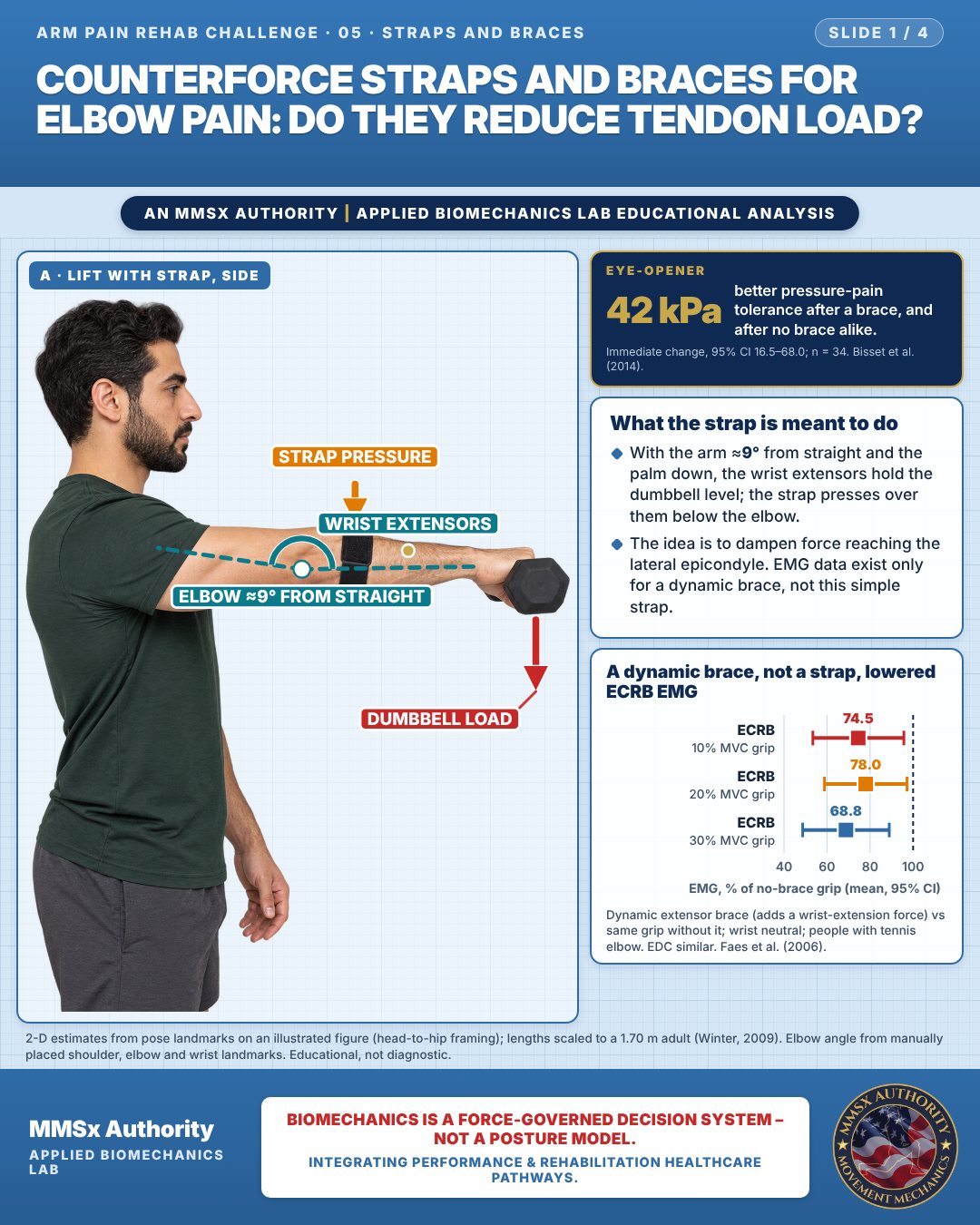
Movement A: Lift with strap (side view)
What the strap is meant to do
With the arm ≈9° from straight and the palm down, the wrist extensors hold the dumbbell level; the strap presses over them below the elbow.
The idea is to dampen force reaching the lateral epicondyle. EMG data exist only for a dynamic brace, not this simple strap.
A dynamic brace, not a strap, lowered ECRB EMG
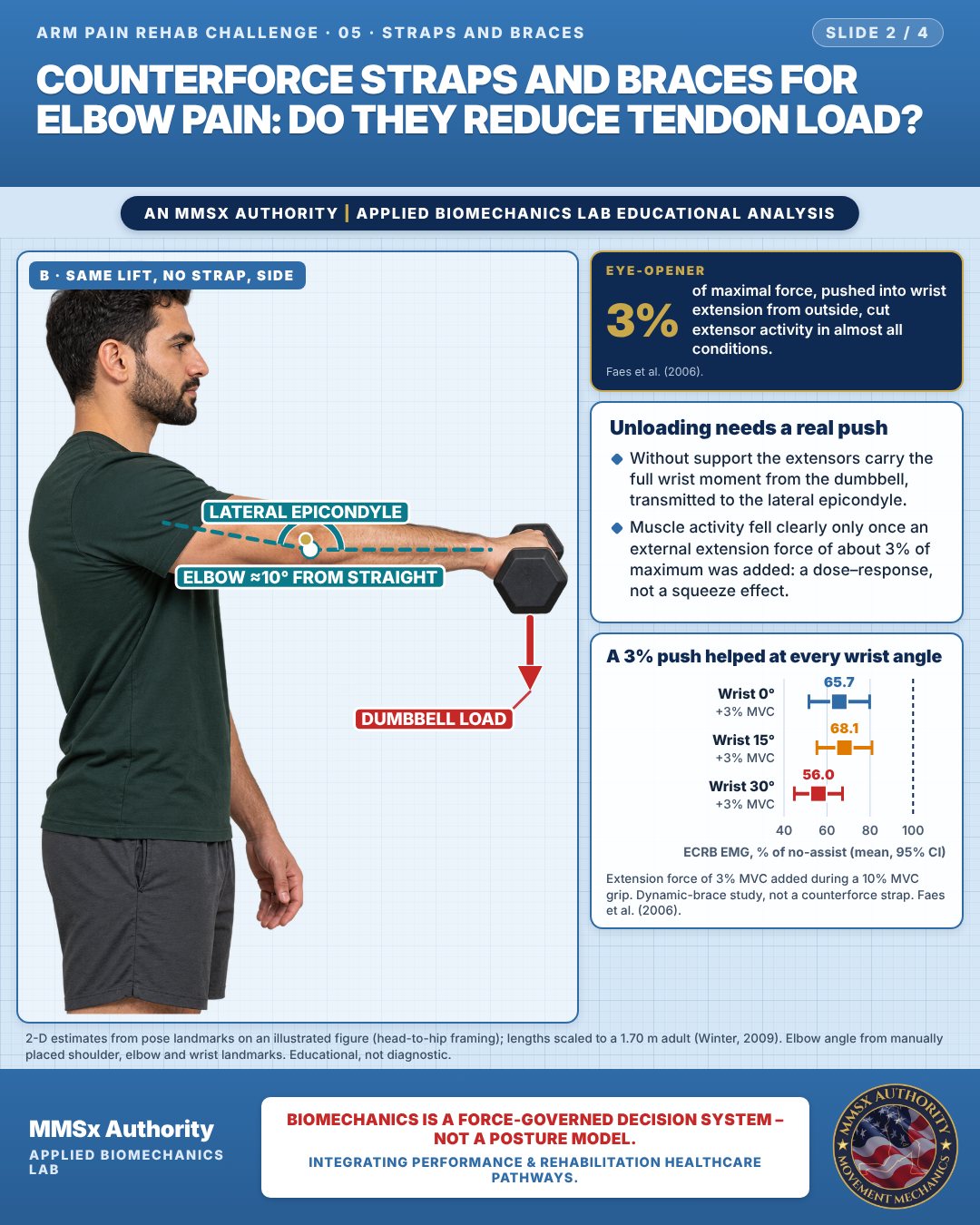
Movement B: Same lift, no strap (side view)
Unloading needs a real push
Without support the extensors carry the full wrist moment from the dumbbell, transmitted to the lateral epicondyle.
Muscle activity fell clearly only once an external extension force of about 3% of maximum was added: a dose–response, not a squeeze effect.
A 3% push helped at every wrist angle
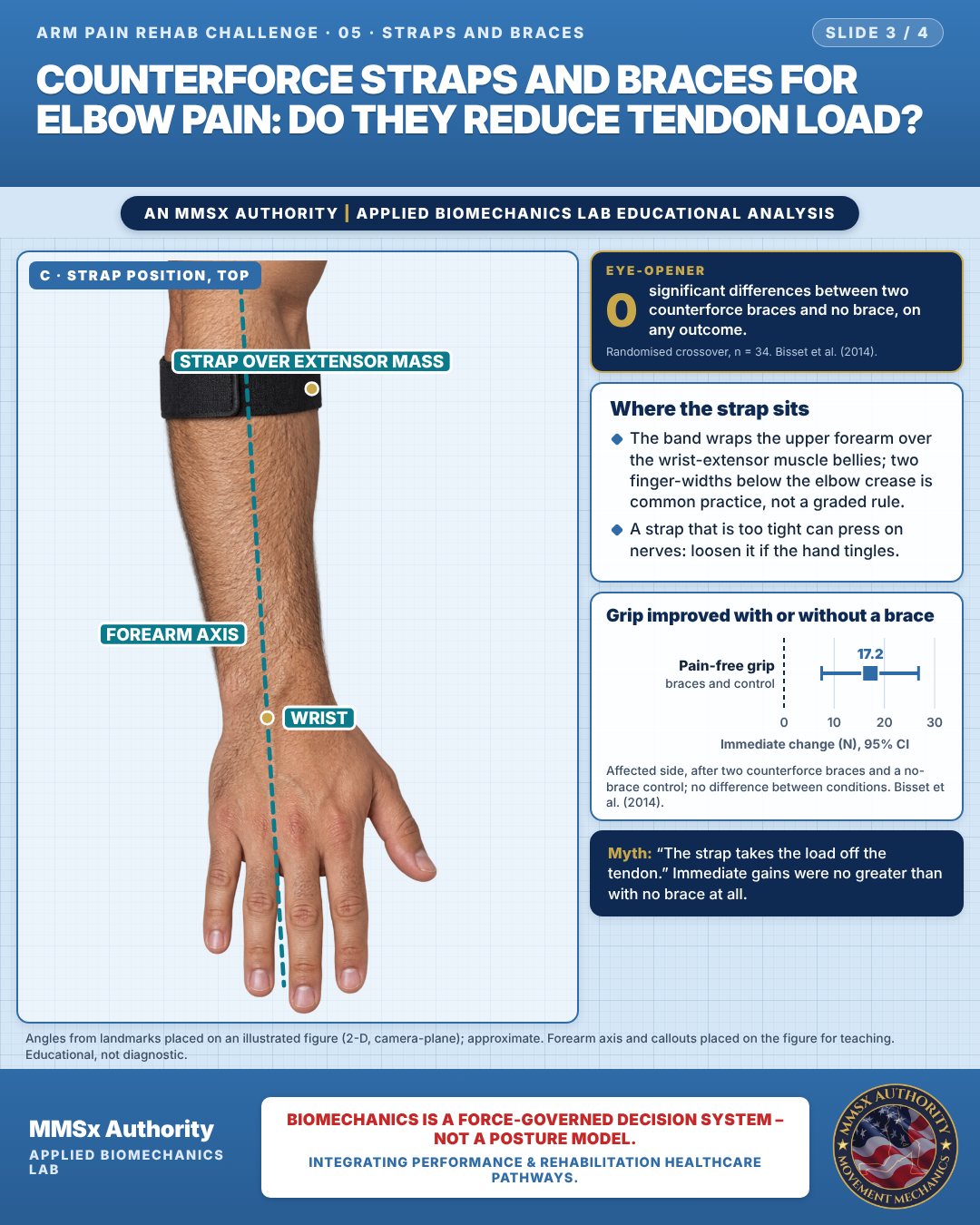
Movement C: Strap position, top
Where the strap sits
The band wraps the upper forearm over the wrist-extensor muscle bellies; two finger-widths below the elbow crease is common practice, not a graded rule.
A strap that is too tight can press on nerves: loosen it if the hand tingles.
Grip improved with or without a brace
Decision pathway
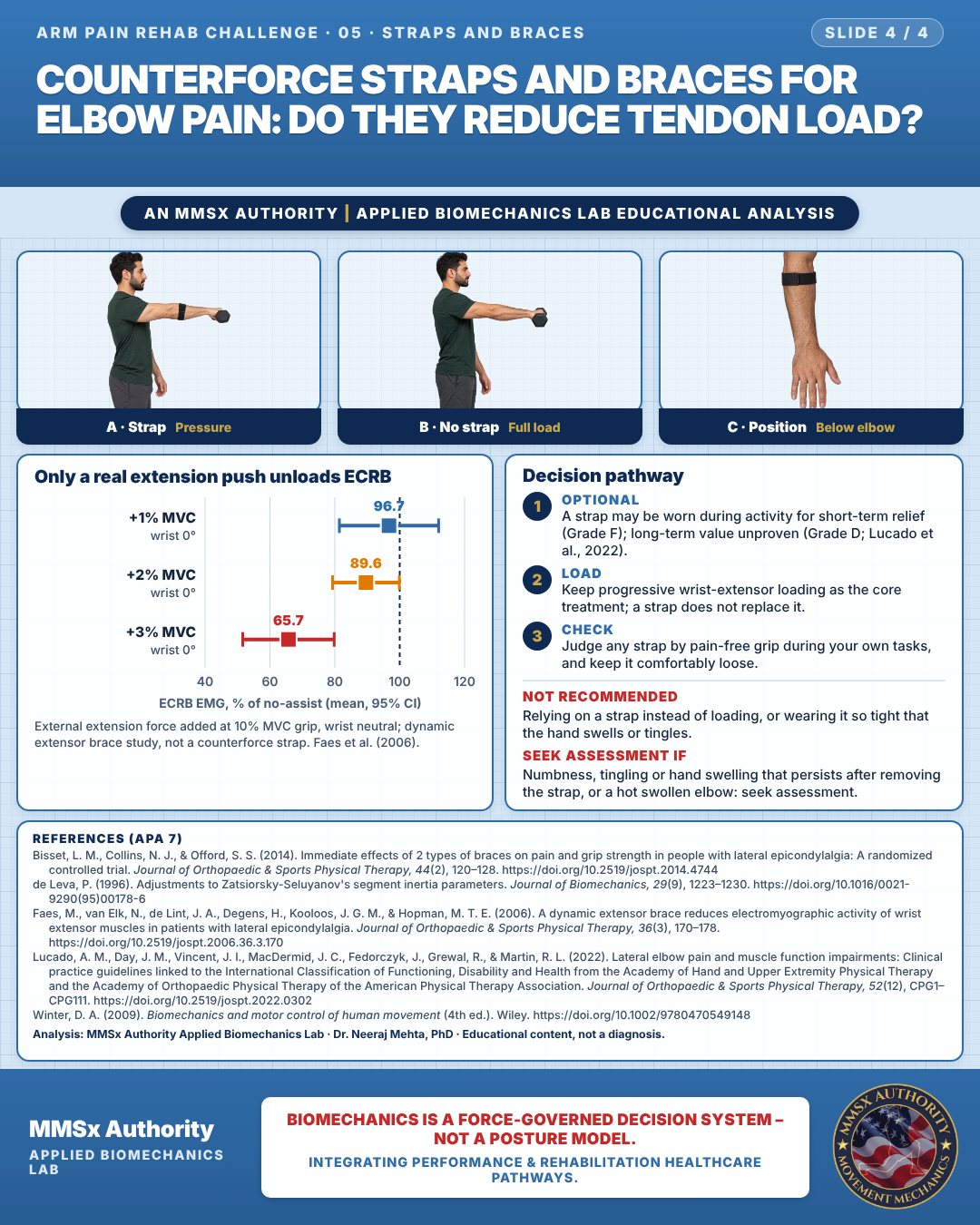
Only a real extension push unloads ECRB
Optional
A strap may be worn during activity for short-term relief (Grade F); long-term value unproven (Grade D; Lucado et al., 2022).
Load
Keep progressive wrist-extensor loading as the core treatment; a strap does not replace it.
Check
Judge any strap by pain-free grip during your own tasks, and keep it comfortably loose.
What the evidence supports
- Optional, short-term, activity-time use only (Grade F); not a substitute for loading (Lucado et al., 2022). Placement in Movement C (two finger-widths below the crease) reflects common practice, not a graded recommendation.
Myth and evidence
Myth“The strap takes the load off the tendon.”
EvidenceImmediate gains are no greater than without a brace (Bisset et al., 2014); measurable extensor unloading appears only when an external extension force is applied (Faes et al., 2006).
Cautions
Not recommended
Relying on a strap instead of loading, or wearing it so tight that the hand swells or tingles.
Seek assessment if
Numbness, tingling or hand swelling that persists after removing the strap, or a hot swollen elbow: seek assessment.
Methods note
2-D estimates from pose landmarks on an illustrated figure (head-to-hip framing); lengths scaled to a 1.70 m adult (Winter, 2009). Elbow angle from manually placed shoulder, elbow and wrist landmarks. Angles from landmarks placed on an illustrated figure (2-D, camera-plane); approximate. Forearm axis and callouts placed on the figure for teaching. These are educational estimates, not a diagnosis.
References
- Bisset, L. M., Collins, N. J., & Offord, S. S. (2014). Immediate effects of 2 types of braces on pain and grip strength in people with lateral epicondylalgia: A randomized controlled trial. Journal of Orthopaedic & Sports Physical Therapy, 44(2), 120–128. https://doi.org/10.2519/jospt.2014.4744
- de Leva, P. (1996). Adjustments to Zatsiorsky-Seluyanov's segment inertia parameters. Journal of Biomechanics, 29(9), 1223–1230. https://doi.org/10.1016/0021-9290(95)00178-6
- Faes, M., van Elk, N., de Lint, J. A., Degens, H., Kooloos, J. G. M., & Hopman, M. T. E. (2006). A dynamic extensor brace reduces electromyographic activity of wrist extensor muscles in patients with lateral epicondylalgia. Journal of Orthopaedic & Sports Physical Therapy, 36(3), 170–178. https://doi.org/10.2519/jospt.2006.36.3.170
- Lucado, A. M., Day, J. M., Vincent, J. I., MacDermid, J. C., Fedorczyk, J., Grewal, R., & Martin, R. L. (2022). Lateral elbow pain and muscle function impairments: Clinical practice guidelines linked to the International Classification of Functioning, Disability and Health from the Academy of Hand and Upper Extremity Physical Therapy and the Academy of Orthopaedic Physical Therapy of the American Physical Therapy Association. Journal of Orthopaedic & Sports Physical Therapy, 52(12), CPG1–CPG111. https://doi.org/10.2519/jospt.2022.0302
- Winter, D. A. (2009). Biomechanics and motor control of human movement (4th ed.). Wiley. https://doi.org/10.1002/9780470549148
Cite this article
Mehta, N. (2026, October 28). Counterforce straps and braces for elbow pain: do they reduce tendon load? MMSx Authority Applied Biomechanics Lab. https://mmsxauthority.org/edu/analysis/arm/05-counterforce-straps-and-braces-for-elbow-pain-do-they-reduce-tendon/
Part of the collection
Mehta, N. (2026). Elbow, Forearm, Wrist and Hand Rehabilitation: 50 Evidence-Based Biomechanics Analyses [Collection]. MMSx Authority Applied Biomechanics Lab. Zenodo. https://doi.org/10.5281/zenodo.23735910
All Arm Pain Rehab Challenge articles · Rehabilitation Library