Arm Pain Rehab Challenge · 06
Isometric and heavy slow loading for elbow tendinopathy: building the dose
Progressive tendon loading: graded isometric holds, then slow concentric–eccentric and functional loading (carries, rows), dosed by symptom response.
Key points
- Hold. Isometric wrist-extension holds kept below the pain threshold, about 10 × 15 s.
- Slow. Progress to slow lifting and lowering of the wrist (Grade B; Lucado et al., 2022); stress the lowering.
- Apply. Add carries, then rows, raising load only when next-day symptoms stay settled.
What it is
Progressive tendon loading: graded isometric holds, then slow concentric–eccentric and functional loading (carries, rows), dosed by symptom response.
How we analysed the movement
Three movements relevant to this topic were analysed from illustrated reference figures. Joint centres were located with two-dimensional pose estimation where the whole arm was visible; elbow and wrist angles, and the directions of external load and tendon pull, were then drawn on the figure; on hand close-ups, where pose estimation does not apply, the landmarks were placed manually. The figures are educational estimates that show how position changes mechanical demand; they are not measurements of a patient. Every research value quoted below comes from the published source cited beside it.
Movement A: Isometric wrist hold (side view)
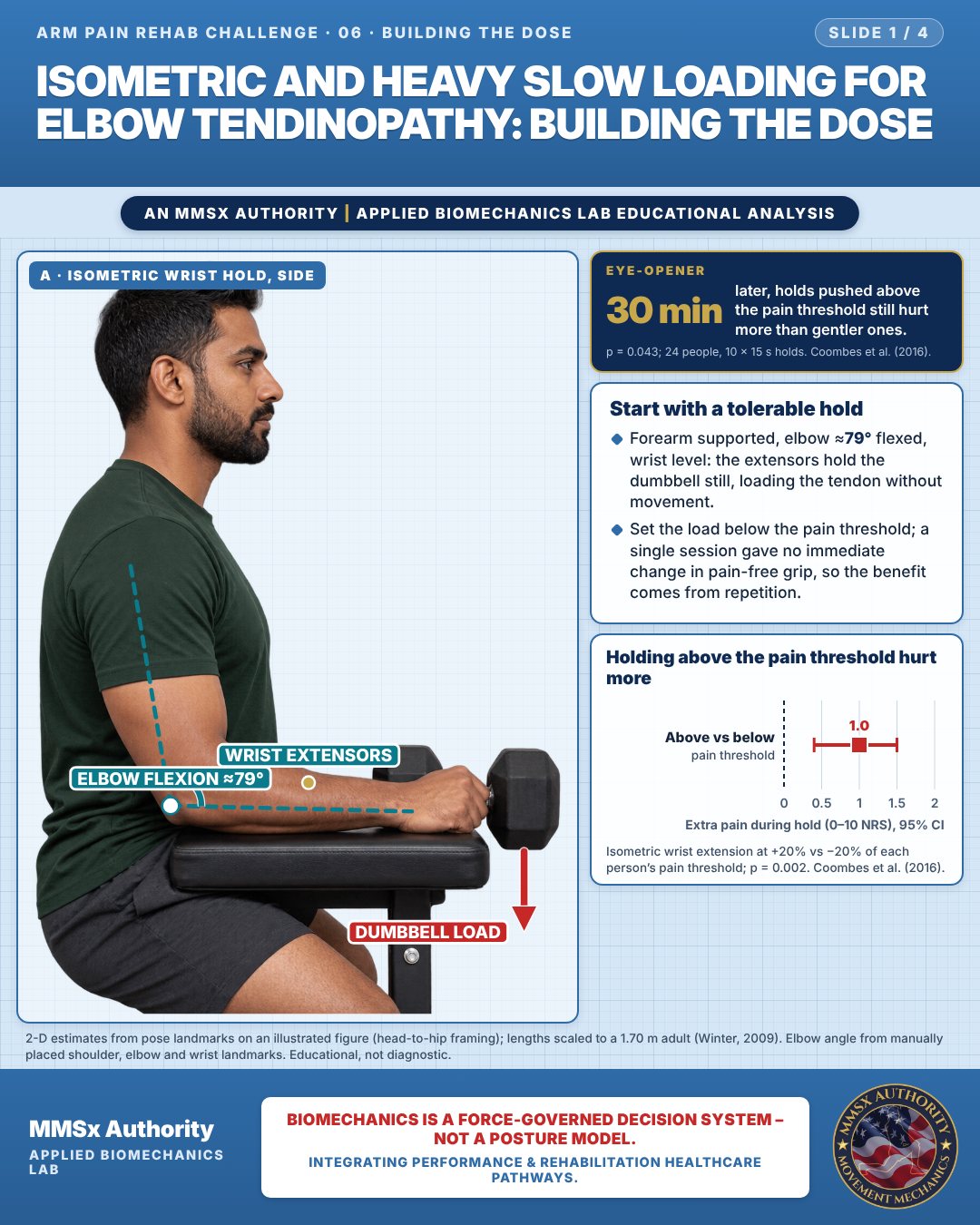
Start with a tolerable hold
Forearm supported, elbow ≈79° flexed, wrist level: the extensors hold the dumbbell still, loading the tendon without movement.
Set the load below the pain threshold; a single session gave no immediate change in pain-free grip, so the benefit comes from repetition.
Holding above the pain threshold hurt more
Movement B: One-hand carry (side view)
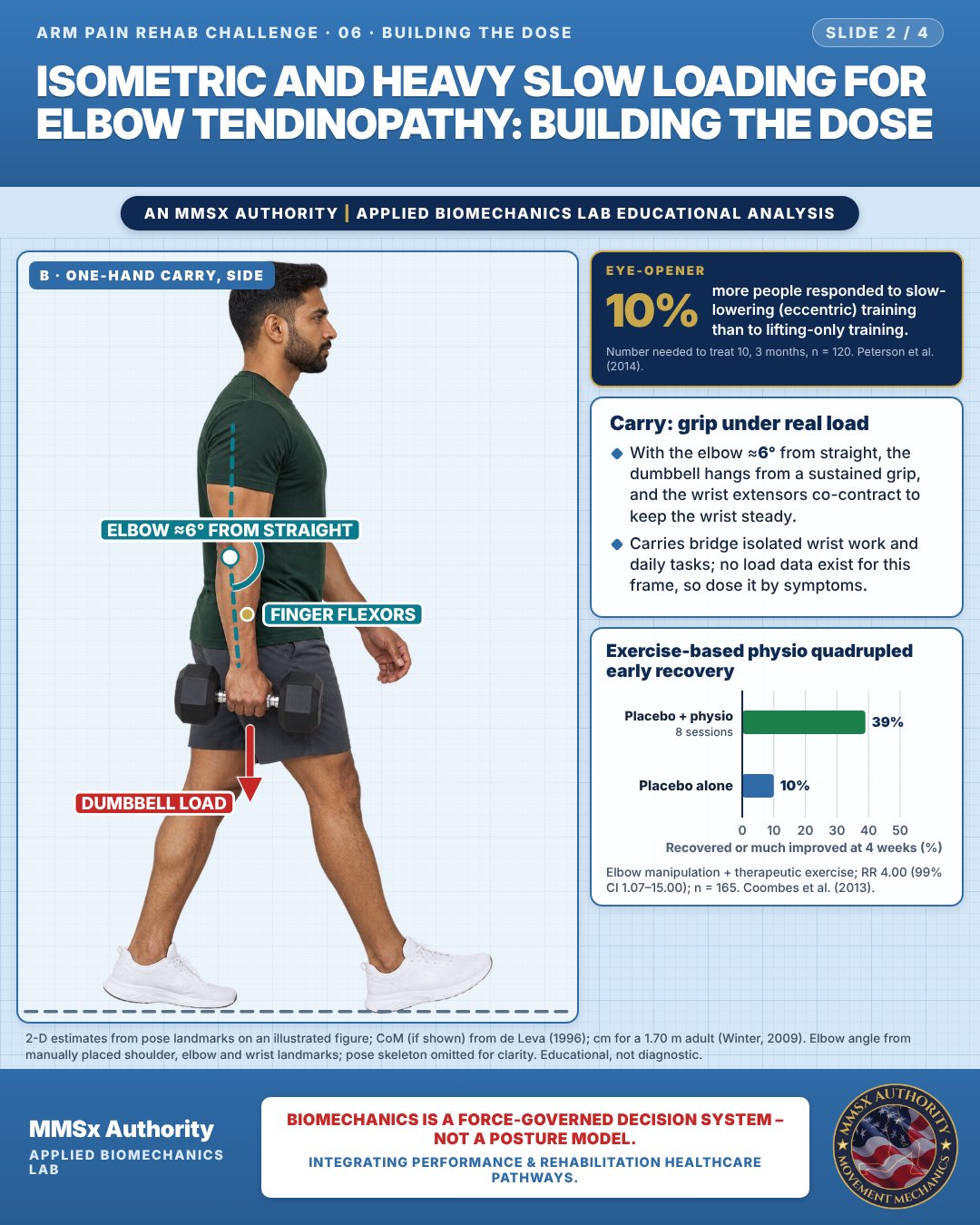
Carry: grip under real load
With the elbow ≈6° from straight, the dumbbell hangs from a sustained grip, and the wrist extensors co-contract to keep the wrist steady.
Carries bridge isolated wrist work and daily tasks; no load data exist for this frame, so dose it by symptoms.
Exercise-based physio quadrupled early recovery
Movement C: Bench row (side view)
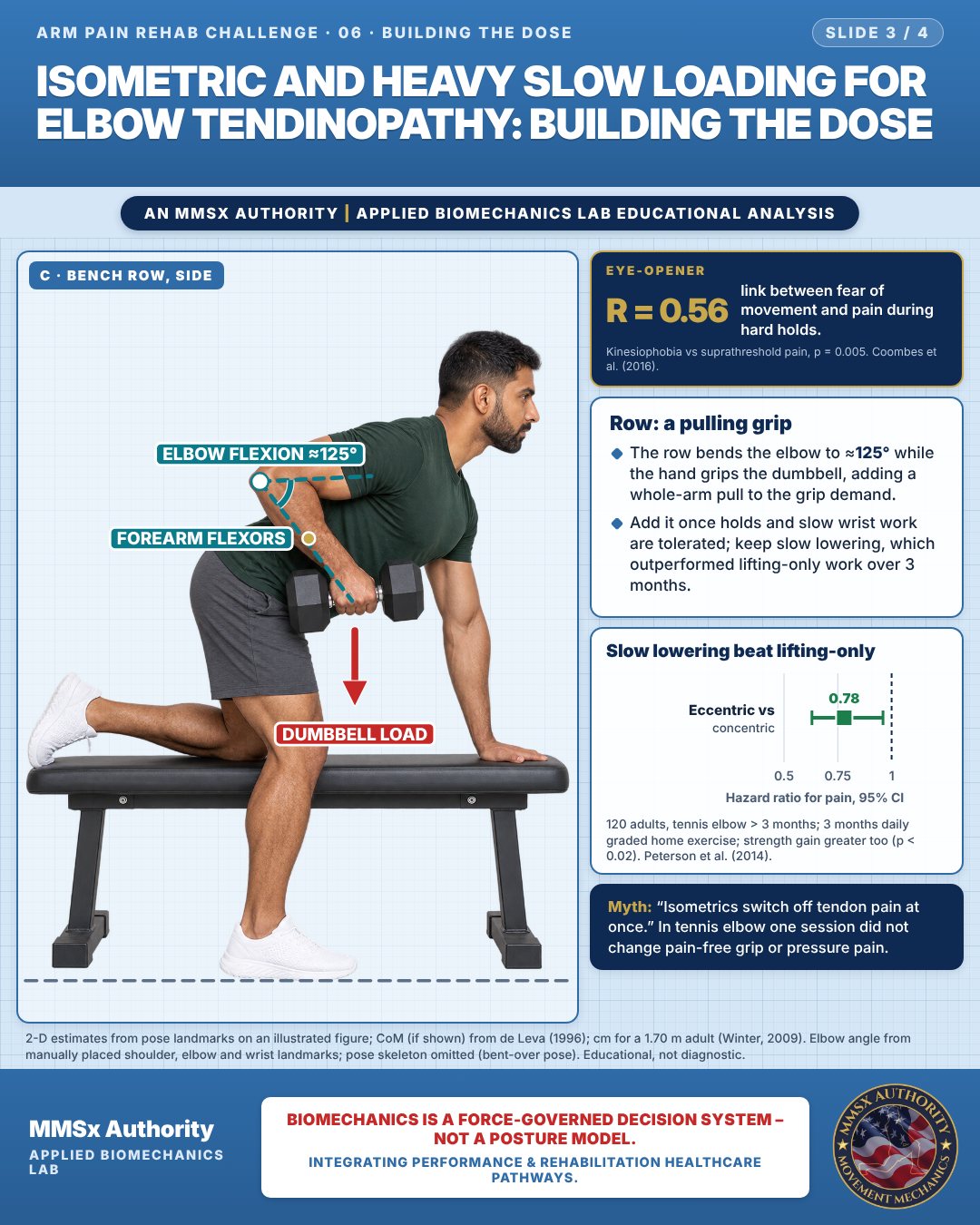
Row: a pulling grip
The row bends the elbow to ≈125° while the hand grips the dumbbell, adding a whole-arm pull to the grip demand.
Add it once holds and slow wrist work are tolerated; keep slow lowering, which outperformed lifting-only work over 3 months.
Slow lowering beat lifting-only
Decision pathway
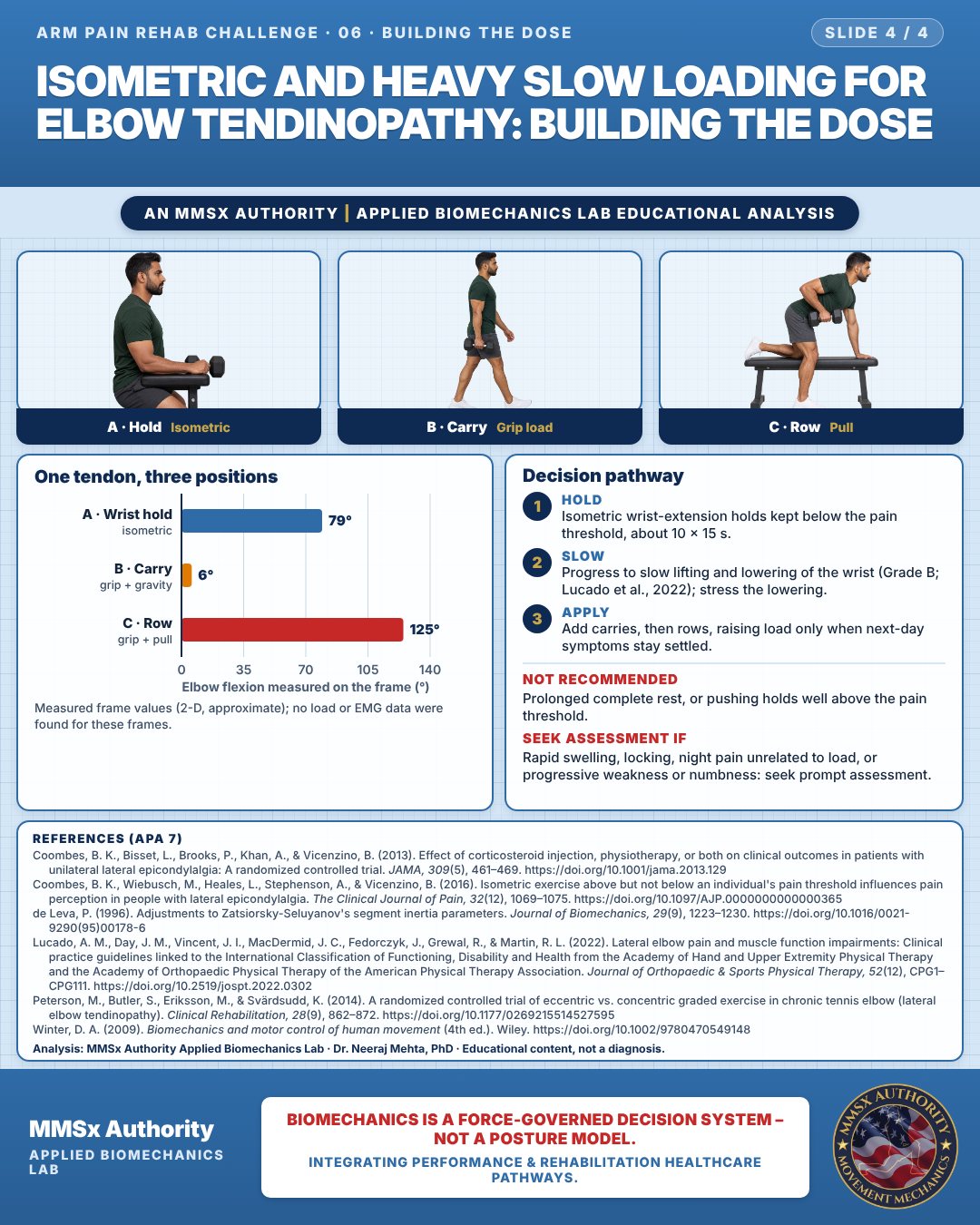
One tendon, three positions
Hold
Isometric wrist-extension holds kept below the pain threshold, about 10 × 15 s.
Slow
Progress to slow lifting and lowering of the wrist (Grade B; Lucado et al., 2022); stress the lowering.
Apply
Add carries, then rows, raising load only when next-day symptoms stay settled.
Myth and evidence
Myth“Isometrics switch off tendon pain immediately.”
EvidenceIn LE a single isometric session did not change pain-free grip or pressure pain threshold (Coombes et al., 2016).
Cautions
Not recommended
Prolonged complete rest, or pushing holds well above the pain threshold.
Seek assessment if
Rapid swelling, locking, night pain unrelated to load, or progressive weakness or numbness: seek prompt assessment.
Methods note
2-D estimates from pose landmarks on an illustrated figure (head-to-hip framing); lengths scaled to a 1.70 m adult (Winter, 2009). Elbow angle from manually placed shoulder, elbow and wrist landmarks. 2-D estimates from pose landmarks on an illustrated figure; CoM (if shown) from de Leva (1996); cm for a 1.70 m adult (Winter, 2009). Elbow angle from manually placed shoulder, elbow and wrist landmarks; pose skeleton omitted for clarity. Elbow angle from manually placed shoulder, elbow and wrist landmarks; pose skeleton omitted (bent-over pose). These are educational estimates, not a diagnosis.
References
- Coombes, B. K., Bisset, L., Brooks, P., Khan, A., & Vicenzino, B. (2013). Effect of corticosteroid injection, physiotherapy, or both on clinical outcomes in patients with unilateral lateral epicondylalgia: A randomized controlled trial. JAMA, 309(5), 461–469. https://doi.org/10.1001/jama.2013.129
- Coombes, B. K., Wiebusch, M., Heales, L., Stephenson, A., & Vicenzino, B. (2016). Isometric exercise above but not below an individual's pain threshold influences pain perception in people with lateral epicondylalgia. The Clinical Journal of Pain, 32(12), 1069–1075. https://doi.org/10.1097/AJP.0000000000000365
- de Leva, P. (1996). Adjustments to Zatsiorsky-Seluyanov's segment inertia parameters. Journal of Biomechanics, 29(9), 1223–1230. https://doi.org/10.1016/0021-9290(95)00178-6
- Lucado, A. M., Day, J. M., Vincent, J. I., MacDermid, J. C., Fedorczyk, J., Grewal, R., & Martin, R. L. (2022). Lateral elbow pain and muscle function impairments: Clinical practice guidelines linked to the International Classification of Functioning, Disability and Health from the Academy of Hand and Upper Extremity Physical Therapy and the Academy of Orthopaedic Physical Therapy of the American Physical Therapy Association. Journal of Orthopaedic & Sports Physical Therapy, 52(12), CPG1–CPG111. https://doi.org/10.2519/jospt.2022.0302
- Peterson, M., Butler, S., Eriksson, M., & Svärdsudd, K. (2014). A randomized controlled trial of eccentric vs. concentric graded exercise in chronic tennis elbow (lateral elbow tendinopathy). Clinical Rehabilitation, 28(9), 862–872. https://doi.org/10.1177/0269215514527595
- Winter, D. A. (2009). Biomechanics and motor control of human movement (4th ed.). Wiley. https://doi.org/10.1002/9780470549148
Cite this article
Mehta, N. (2026, October 28). Isometric and heavy slow loading for elbow tendinopathy: building the dose. MMSx Authority Applied Biomechanics Lab. https://mmsxauthority.org/edu/analysis/arm/06-isometric-and-heavy-slow-loading-for-elbow-tendinopathy-building-the/
Part of the collection
Mehta, N. (2026). Elbow, Forearm, Wrist and Hand Rehabilitation: 50 Evidence-Based Biomechanics Analyses [Collection]. MMSx Authority Applied Biomechanics Lab. Zenodo. https://doi.org/10.5281/zenodo.23735910
All Arm Pain Rehab Challenge articles · Rehabilitation Library