Arm Pain Rehab Challenge · 04
Tennis elbow injections versus exercise: what the long-term evidence shows
The band resists wrist extension, so the extensors that arise from the lateral epicondyle work against a graded, adjustable load. Exercise builds…
Key points
- Choose. Make exercise the core plan; the guideline grades loading B and makes no injection recommendation (Lucado et al., 2022).
- Load. Progress band wrist extension, hammer rotation and grip by next-day symptoms.
- Expect. Plan for weeks to months; most people recover by a year with or without injection.
What it is
As Title 01. This title compares corticosteroid (and other) injections with exercise-based physiotherapy and natural recovery.
How we analysed the movement
Three movements relevant to this topic were analysed from illustrated reference figures. Joint centres were located with two-dimensional pose estimation where the whole arm was visible; elbow and wrist angles, and the directions of external load and tendon pull, were then drawn on the figure; on hand close-ups, where pose estimation does not apply, the landmarks were placed manually. The figures are educational estimates that show how position changes mechanical demand; they are not measurements of a patient. Every research value quoted below comes from the published source cited beside it.
Movement A: Band wrist lift (side view)
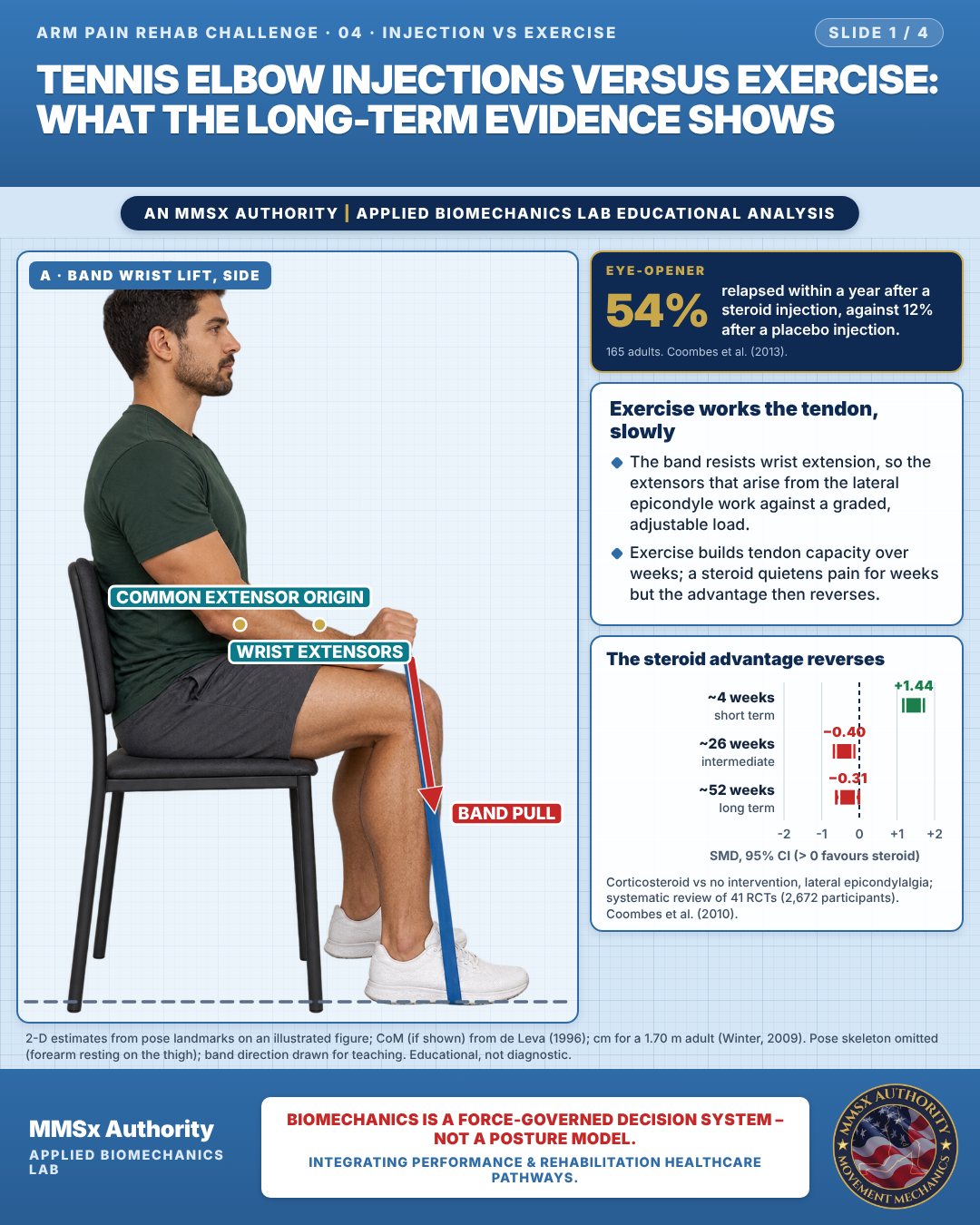
Exercise works the tendon, slowly
The band resists wrist extension, so the extensors that arise from the lateral epicondyle work against a graded, adjustable load.
Exercise builds tendon capacity over weeks; a steroid quietens pain for weeks but the advantage then reverses.
The steroid advantage reverses
Movement B: Hammer rotation (side view)
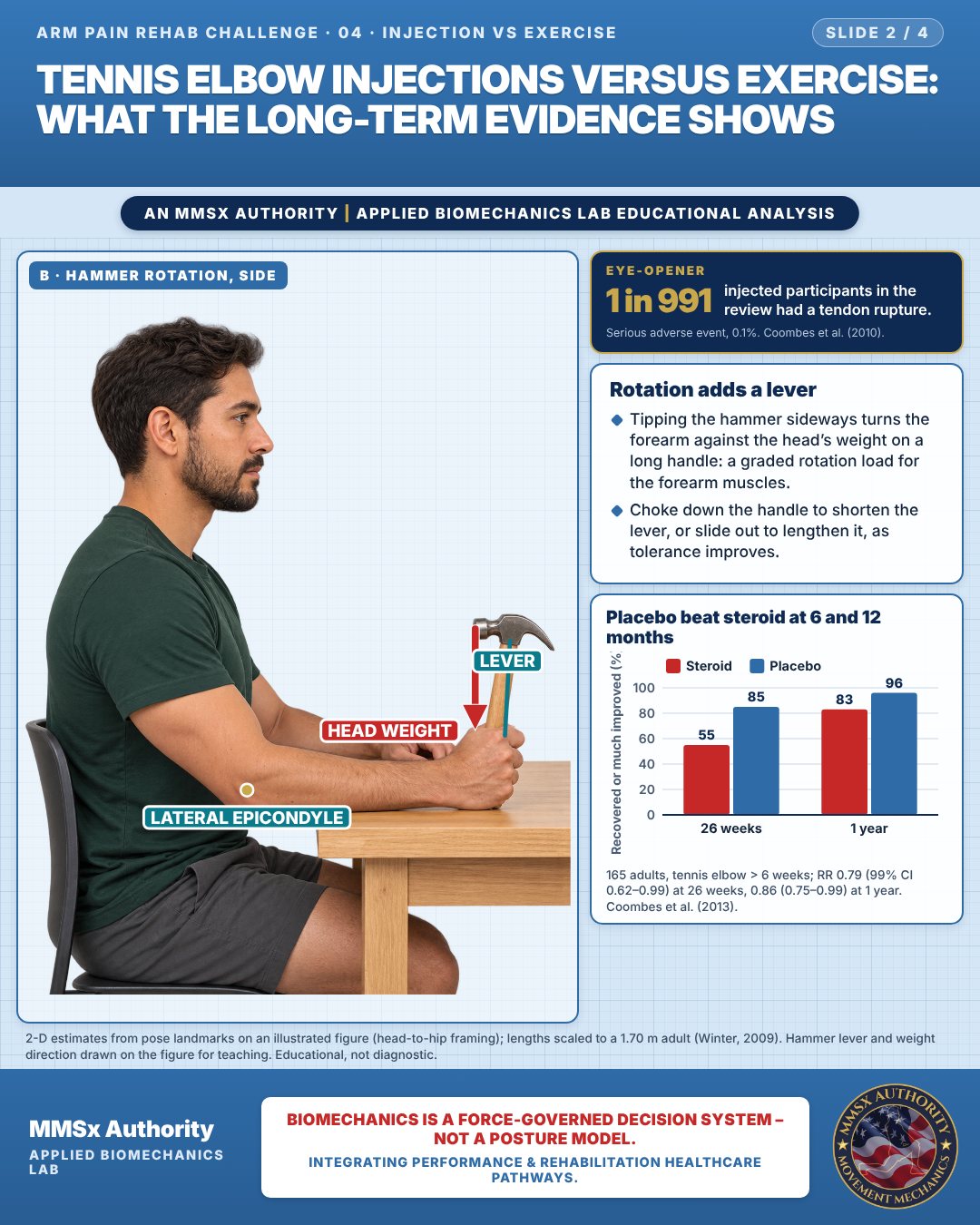
Rotation adds a lever
Tipping the hammer sideways turns the forearm against the head’s weight on a long handle: a graded rotation load for the forearm muscles.
Choke down the handle to shorten the lever, or slide out to lengthen it, as tolerance improves.
Placebo beat steroid at 6 and 12 months
Movement C: Soft-ball squeeze (front view)
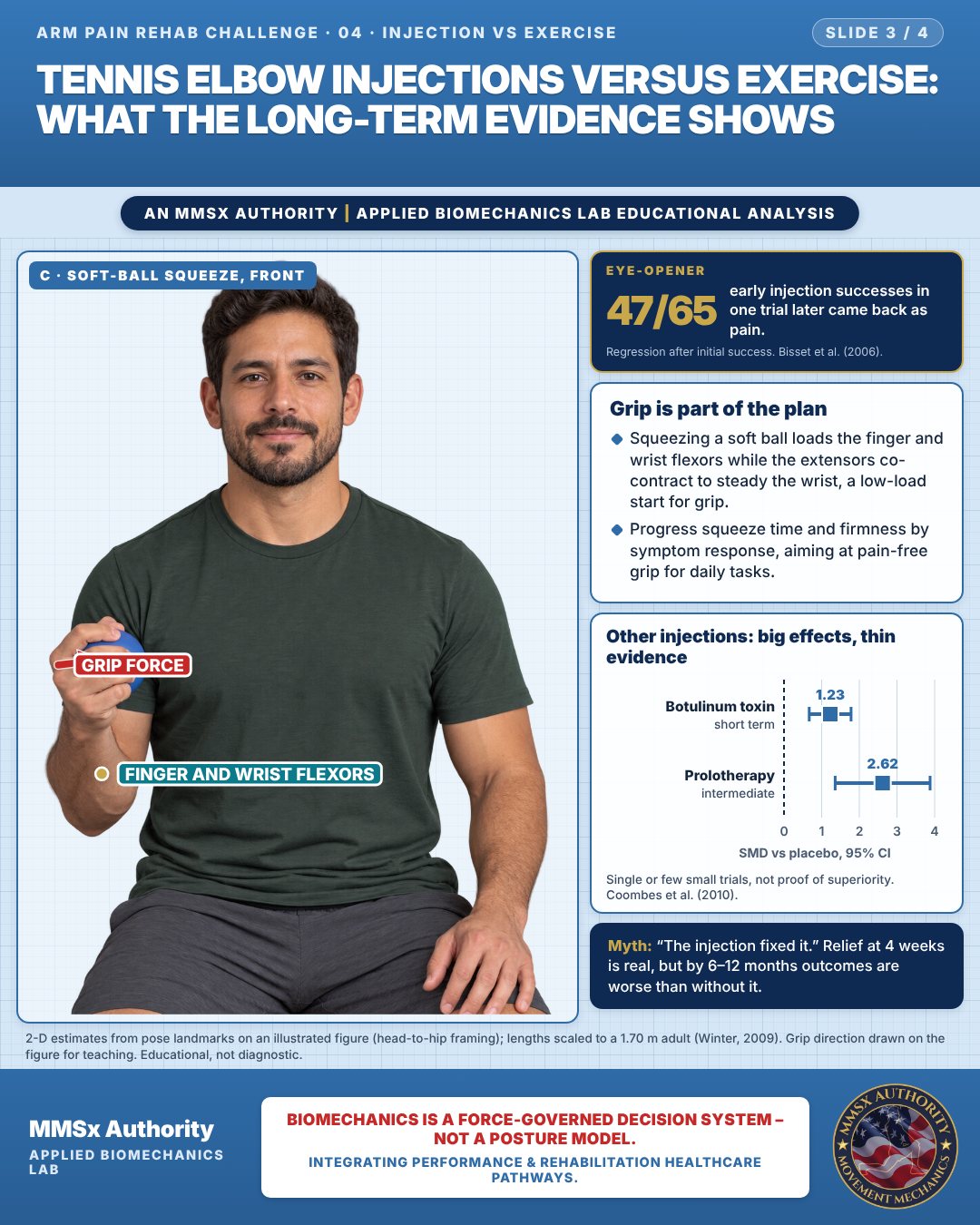
Grip is part of the plan
Squeezing a soft ball loads the finger and wrist flexors while the extensors co-contract to steady the wrist, a low-load start for grip.
Progress squeeze time and firmness by symptom response, aiming at pain-free grip for daily tasks.
Other injections: big effects, thin evidence
Decision pathway
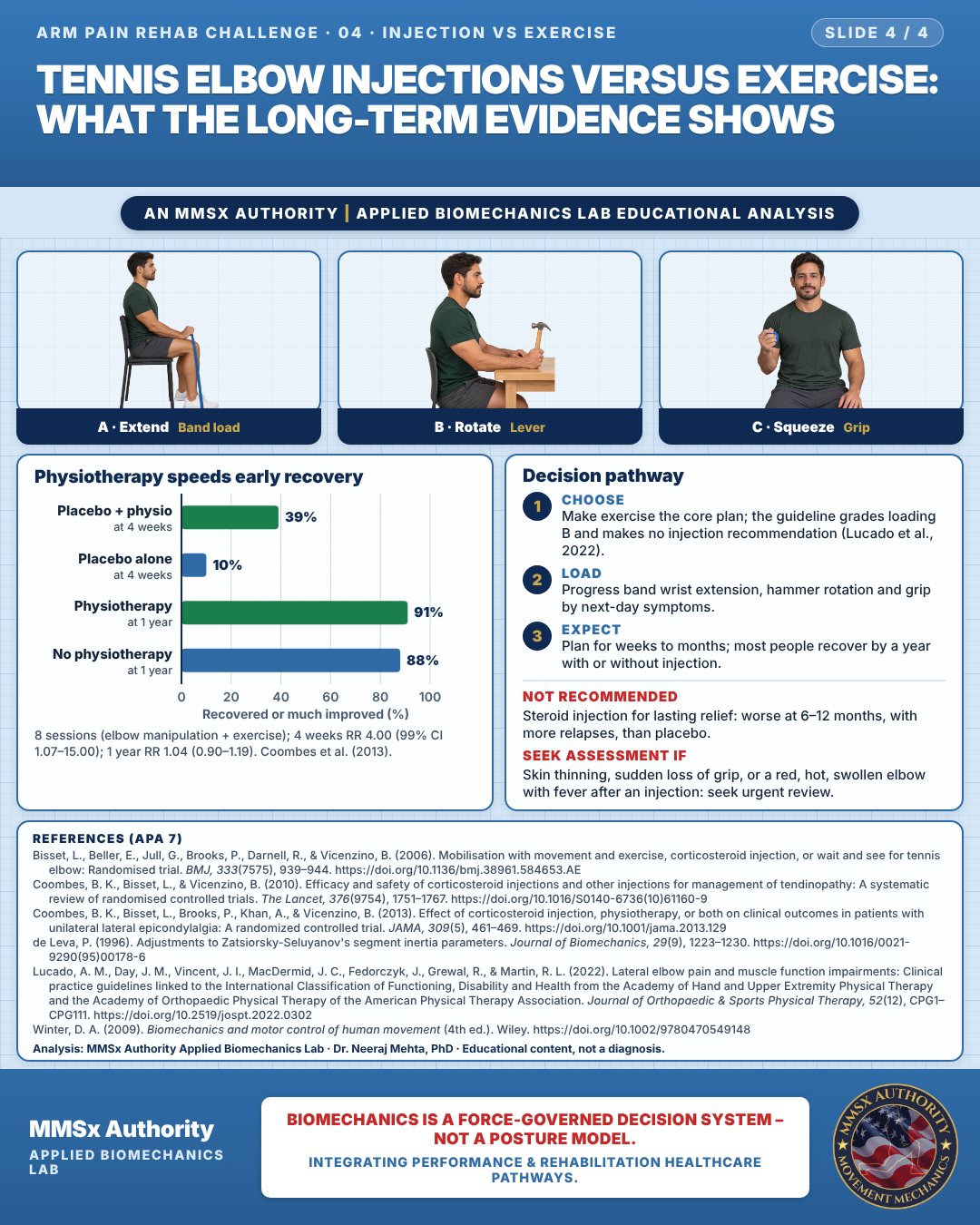
Physiotherapy speeds early recovery
Choose
Make exercise the core plan; the guideline grades loading B and makes no injection recommendation (Lucado et al., 2022).
Load
Progress band wrist extension, hammer rotation and grip by next-day symptoms.
Expect
Plan for weeks to months; most people recover by a year with or without injection.
What the evidence supports
- Exercise-based care recommended (clinical practice guideline Grade B; Lucado et al., 2022). The clinical practice guideline makes no recommendation on injection; trial evidence shows short-term benefit and long-term harm from corticosteroid (Coombes et al., 2010, 2013). Movement A–C (band wrist extension, hammer rotation, ball squeeze) represent the exercise arm.
Myth and evidence
Myth“The injection fixed it.”
EvidenceEarly relief is real (SMD 1.44 at 4 weeks) but by 6–12 months outcomes are worse than no injection, with higher recurrence (Coombes et al., 2010, 2013).
Cautions
Not recommended
Steroid injection for lasting relief: worse at 6–12 months, with more relapses, than placebo.
Seek assessment if
Skin thinning, sudden loss of grip, or a red, hot, swollen elbow with fever after an injection: seek urgent review.
Methods note
2-D estimates from pose landmarks on an illustrated figure; CoM (if shown) from de Leva (1996); cm for a 1.70 m adult (Winter, 2009). Pose skeleton omitted (forearm resting on the thigh); band direction drawn for teaching. 2-D estimates from pose landmarks on an illustrated figure (head-to-hip framing); lengths scaled to a 1.70 m adult (Winter, 2009). Hammer lever and weight direction drawn on the figure for teaching. Grip direction drawn on the figure for teaching. These are educational estimates, not a diagnosis.
References
- Bisset, L., Beller, E., Jull, G., Brooks, P., Darnell, R., & Vicenzino, B. (2006). Mobilisation with movement and exercise, corticosteroid injection, or wait and see for tennis elbow: Randomised trial. BMJ, 333(7575), 939–944. https://doi.org/10.1136/bmj.38961.584653.AE
- Coombes, B. K., Bisset, L., & Vicenzino, B. (2010). Efficacy and safety of corticosteroid injections and other injections for management of tendinopathy: A systematic review of randomised controlled trials. The Lancet, 376(9754), 1751–1767. https://doi.org/10.1016/S0140-6736(10)61160-9
- Coombes, B. K., Bisset, L., Brooks, P., Khan, A., & Vicenzino, B. (2013). Effect of corticosteroid injection, physiotherapy, or both on clinical outcomes in patients with unilateral lateral epicondylalgia: A randomized controlled trial. JAMA, 309(5), 461–469. https://doi.org/10.1001/jama.2013.129
- de Leva, P. (1996). Adjustments to Zatsiorsky-Seluyanov's segment inertia parameters. Journal of Biomechanics, 29(9), 1223–1230. https://doi.org/10.1016/0021-9290(95)00178-6
- Lucado, A. M., Day, J. M., Vincent, J. I., MacDermid, J. C., Fedorczyk, J., Grewal, R., & Martin, R. L. (2022). Lateral elbow pain and muscle function impairments: Clinical practice guidelines linked to the International Classification of Functioning, Disability and Health from the Academy of Hand and Upper Extremity Physical Therapy and the Academy of Orthopaedic Physical Therapy of the American Physical Therapy Association. Journal of Orthopaedic & Sports Physical Therapy, 52(12), CPG1–CPG111. https://doi.org/10.2519/jospt.2022.0302
- Winter, D. A. (2009). Biomechanics and motor control of human movement (4th ed.). Wiley. https://doi.org/10.1002/9780470549148
Cite this article
Mehta, N. (2026, October 28). Tennis elbow injections versus exercise: what the long-term evidence shows. MMSx Authority Applied Biomechanics Lab. https://mmsxauthority.org/edu/analysis/arm/04-tennis-elbow-injections-versus-exercise-what-the-long-term-evidence/
Part of the collection
Mehta, N. (2026). Elbow, Forearm, Wrist and Hand Rehabilitation: 50 Evidence-Based Biomechanics Analyses [Collection]. MMSx Authority Applied Biomechanics Lab. Zenodo. https://doi.org/10.5281/zenodo.23735910
All Arm Pain Rehab Challenge articles · Rehabilitation Library