Arm Pain Rehab Challenge · 03
Golfer's elbow: inner elbow pain from gripping, throwing and lifting
Medial elbow tendinopathy (golfer's elbow, medial epicondylalgia): pain at the medial epicondyle and common flexor–pronator origin, provoked by…
Key points
- Modify. Ease hard gripping, throwing and swing volume while pain settles; review the trail-arm action.
- Load. Graded wrist-flexion and pronation work, borrowed from tennis-elbow loading (untested for the inner elbow).
- Support. Plan recovery around exhausting work days; fatigue is associated with symptoms.
What it is
Medial elbow tendinopathy (golfer's elbow, medial epicondylalgia): pain at the medial epicondyle and common flexor–pronator origin, provoked by resisted wrist flexion, forearm pronation and gripping.
How we analysed the movement
Three movements relevant to this topic were analysed from illustrated reference figures. Joint centres were located with two-dimensional pose estimation where the whole arm was visible; elbow and wrist angles, and the directions of external load and tendon pull, were then drawn on the figure; on hand close-ups, where pose estimation does not apply, the landmarks were placed manually. The figures are educational estimates that show how position changes mechanical demand; they are not measurements of a patient. Every research value quoted below comes from the published source cited beside it.
Movement A: Golf impact (side view)
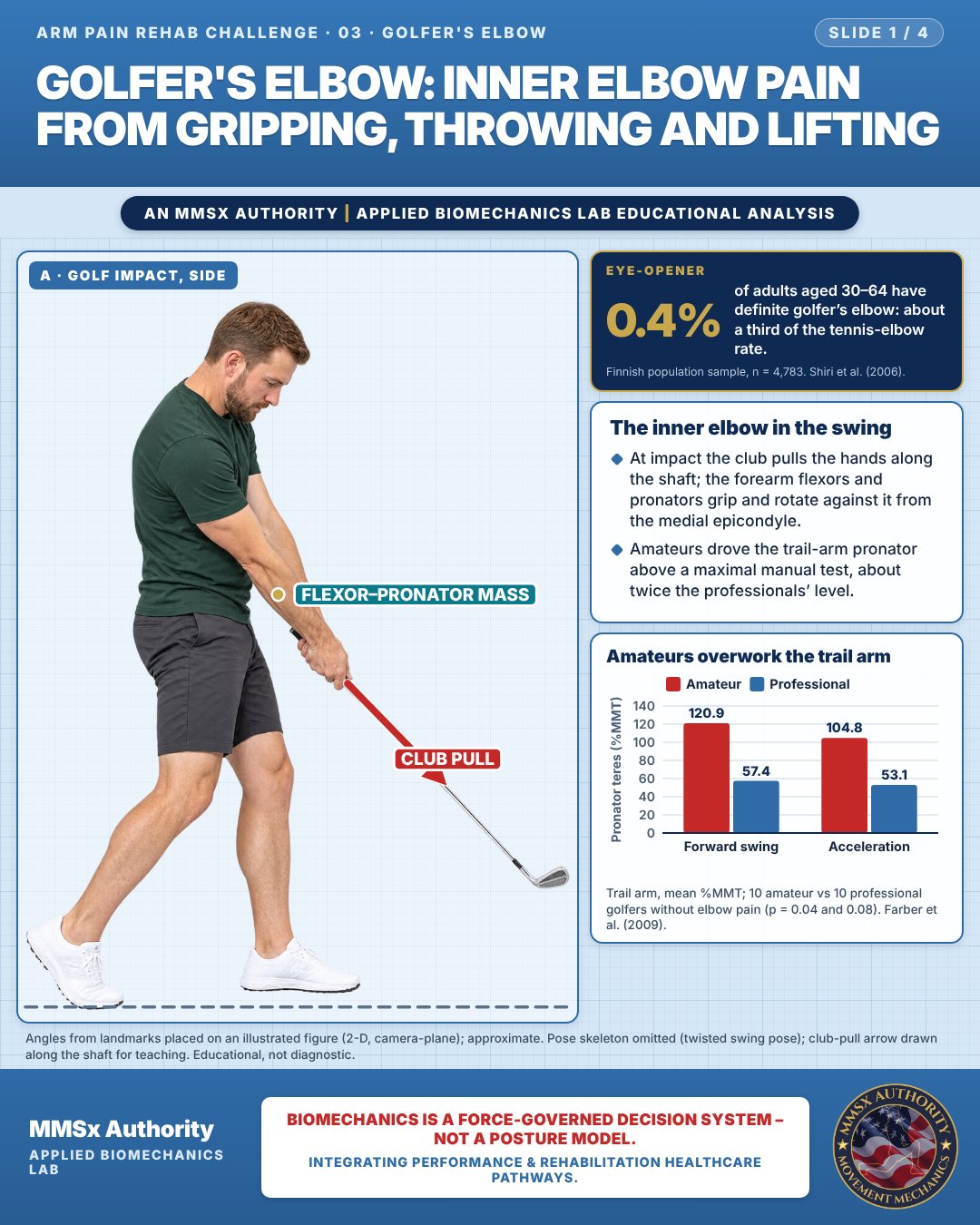
The inner elbow in the swing
At impact the club pulls the hands along the shaft; the forearm flexors and pronators grip and rotate against it from the medial epicondyle.
Amateurs drove the trail-arm pronator above a maximal manual test, about twice the professionals’ level.
Amateurs overwork the trail arm
Movement B: Wrist-flexion curl (side view)
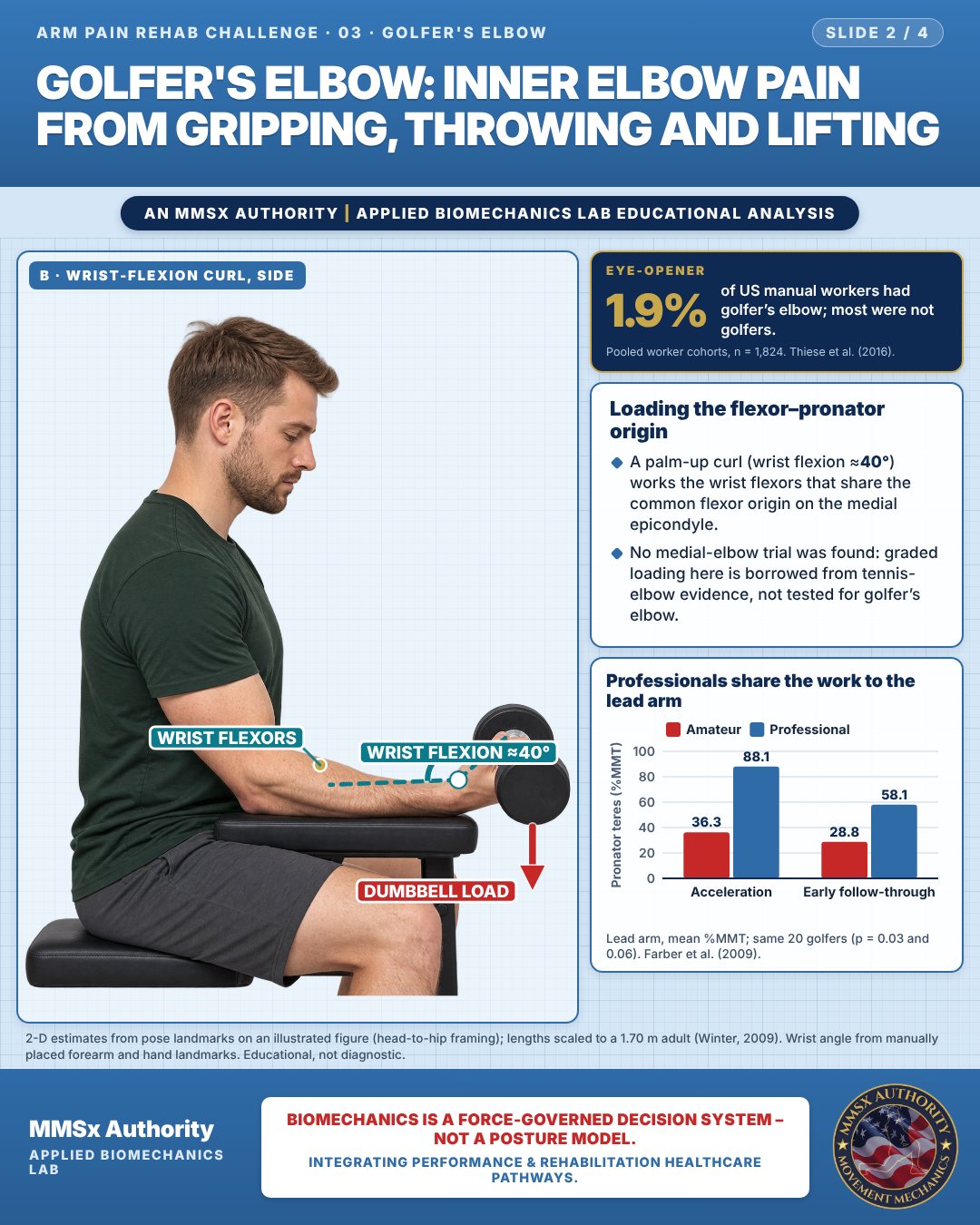
Loading the flexor–pronator origin
A palm-up curl (wrist flexion ≈40°) works the wrist flexors that share the common flexor origin on the medial epicondyle.
No medial-elbow trial was found: graded loading here is borrowed from tennis-elbow evidence, not tested for golfer’s elbow.
Professionals share the work to the lead arm
Movement C: Hand on inner elbow (front view)
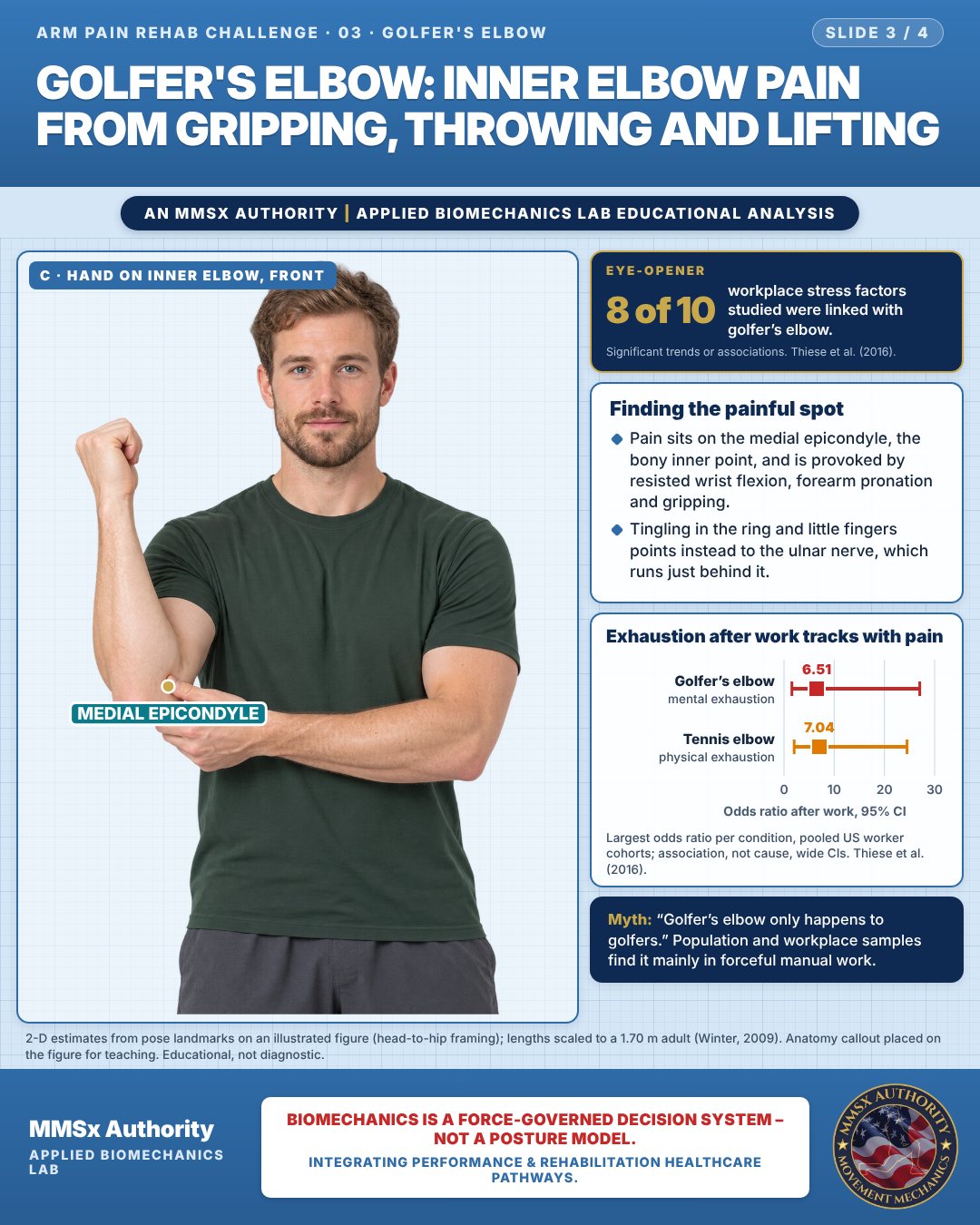
Finding the painful spot
Pain sits on the medial epicondyle, the bony inner point, and is provoked by resisted wrist flexion, forearm pronation and gripping.
Tingling in the ring and little fingers points instead to the ulnar nerve, which runs just behind it.
Exhaustion after work tracks with pain
Decision pathway
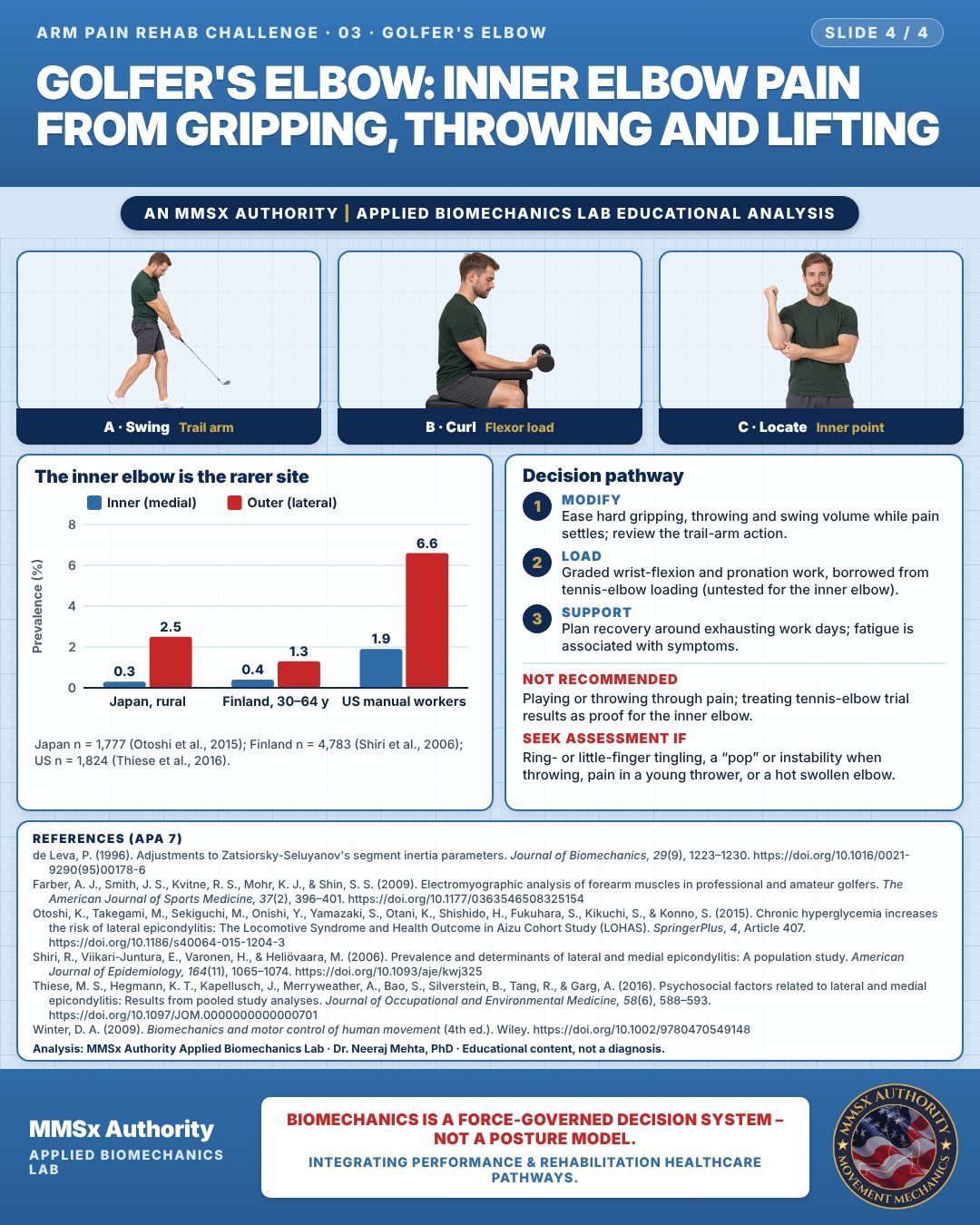
The inner elbow is the rarer site
Modify
Ease hard gripping, throwing and swing volume while pain settles; review the trail-arm action.
Load
Graded wrist-flexion and pronation work, borrowed from tennis-elbow loading (untested for the inner elbow).
Support
Plan recovery around exhausting work days; fatigue is associated with symptoms.
Myth and evidence
Myth“Golfer's elbow only happens to golfers.”
EvidenceIn population and workplace samples it occurs mainly in non-golfers in forceful manual work (Shiri et al., 2006; Thiese et al., 2016).
Cautions
Not recommended
Playing or throwing through pain; treating tennis-elbow trial results as proof for the inner elbow.
Seek assessment if
Ring- or little-finger tingling, a “pop” or instability when throwing, pain in a young thrower, or a hot swollen elbow.
Methods note
Angles from landmarks placed on an illustrated figure (2-D, camera-plane); approximate. Pose skeleton omitted (twisted swing pose); club-pull arrow drawn along the shaft for teaching. 2-D estimates from pose landmarks on an illustrated figure (head-to-hip framing); lengths scaled to a 1.70 m adult (Winter, 2009). Wrist angle from manually placed forearm and hand landmarks. Anatomy callout placed on the figure for teaching. These are educational estimates, not a diagnosis.
References
- de Leva, P. (1996). Adjustments to Zatsiorsky-Seluyanov's segment inertia parameters. Journal of Biomechanics, 29(9), 1223–1230. https://doi.org/10.1016/0021-9290(95)00178-6
- Farber, A. J., Smith, J. S., Kvitne, R. S., Mohr, K. J., & Shin, S. S. (2009). Electromyographic analysis of forearm muscles in professional and amateur golfers. The American Journal of Sports Medicine, 37(2), 396–401. https://doi.org/10.1177/0363546508325154
- Otoshi, K., Takegami, M., Sekiguchi, M., Onishi, Y., Yamazaki, S., Otani, K., Shishido, H., Fukuhara, S., Kikuchi, S., & Konno, S. (2015). Chronic hyperglycemia increases the risk of lateral epicondylitis: The Locomotive Syndrome and Health Outcome in Aizu Cohort Study (LOHAS). SpringerPlus, 4, Article 407. https://doi.org/10.1186/s40064-015-1204-3
- Shiri, R., Viikari-Juntura, E., Varonen, H., & Heliövaara, M. (2006). Prevalence and determinants of lateral and medial epicondylitis: A population study. American Journal of Epidemiology, 164(11), 1065–1074. https://doi.org/10.1093/aje/kwj325
- Thiese, M. S., Hegmann, K. T., Kapellusch, J., Merryweather, A., Bao, S., Silverstein, B., Tang, R., & Garg, A. (2016). Psychosocial factors related to lateral and medial epicondylitis: Results from pooled study analyses. Journal of Occupational and Environmental Medicine, 58(6), 588–593. https://doi.org/10.1097/JOM.0000000000000701
- Winter, D. A. (2009). Biomechanics and motor control of human movement (4th ed.). Wiley. https://doi.org/10.1002/9780470549148
Cite this article
Mehta, N. (2026, October 28). Golfer's elbow: inner elbow pain from gripping, throwing and lifting. MMSx Authority Applied Biomechanics Lab. https://mmsxauthority.org/edu/analysis/arm/03-golfers-elbow-inner-elbow-pain-from-gripping-throwing-and-lifting/
Part of the collection
Mehta, N. (2026). Elbow, Forearm, Wrist and Hand Rehabilitation: 50 Evidence-Based Biomechanics Analyses [Collection]. MMSx Authority Applied Biomechanics Lab. Zenodo. https://doi.org/10.5281/zenodo.23735910
All Arm Pain Rehab Challenge articles · Rehabilitation Library