Arm Pain Rehab Challenge · 02
Tennis elbow is not inflammation: what the tendon is really doing
Lateral elbow tendinopathy is a degenerative/failed-healing condition of the wrist-extensor origin.
Key points
- Understand. Treat it as a tendon that has lost load capacity, not an inflamed joint.
- Load. Start with level wrist holds, then slow lowering; the guideline grades progressive loading B.
- Grade. Build carrying and gripping in steps the tendon tolerates the next day.
What it is
Lateral elbow tendinopathy is a degenerative/failed-healing condition of the wrist-extensor origin; the older term "epicondylitis" implies inflammation that tissue studies do not show.
How we analysed the movement
Three movements relevant to this topic were analysed from illustrated reference figures. Joint centres were located with two-dimensional pose estimation where the whole arm was visible; elbow and wrist angles, and the directions of external load and tendon pull, were then drawn on the figure; on hand close-ups, where pose estimation does not apply, the landmarks were placed manually. The figures are educational estimates that show how position changes mechanical demand; they are not measurements of a patient. Every research value quoted below comes from the published source cited beside it.
Movement A: Wrist-level hold (side view)
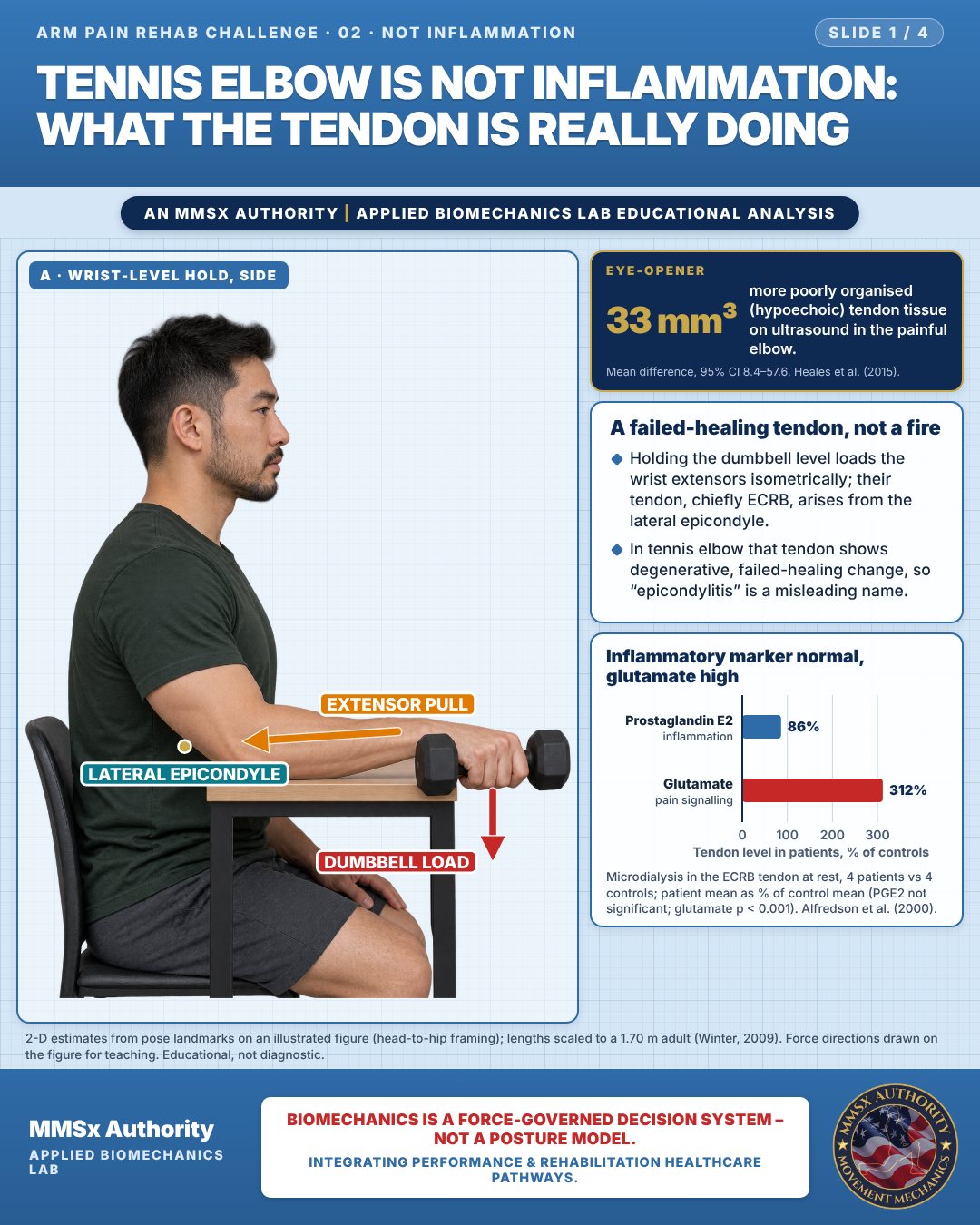
A failed-healing tendon, not a fire
Holding the dumbbell level loads the wrist extensors isometrically; their tendon, chiefly ECRB, arises from the lateral epicondyle.
In tennis elbow that tendon shows degenerative, failed-healing change, so “epicondylitis” is a misleading name.
Inflammatory marker normal, glutamate high
Movement B: Slow lowering (side view)
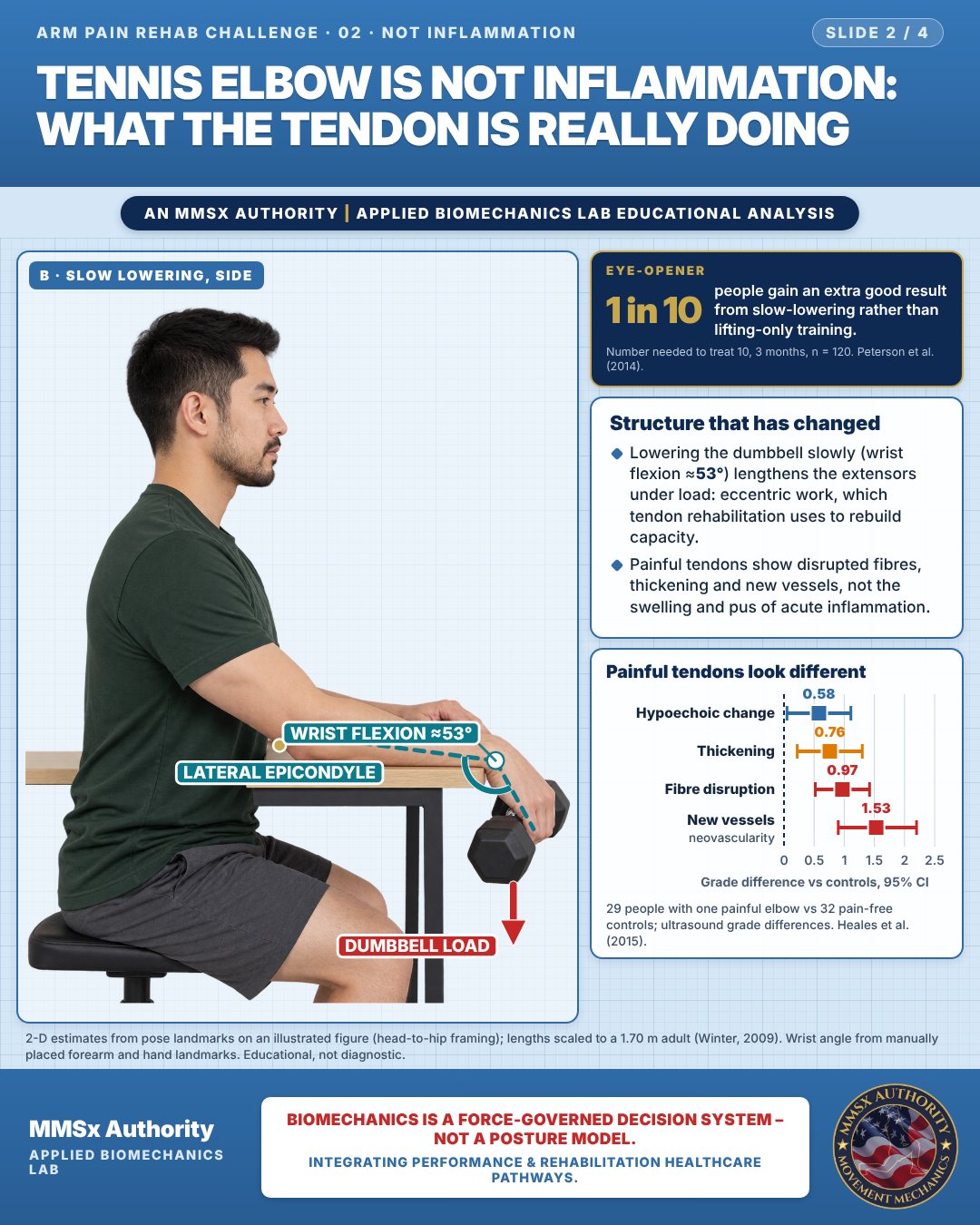
Structure that has changed
Lowering the dumbbell slowly (wrist flexion ≈53°) lengthens the extensors under load: eccentric work, which tendon rehabilitation uses to rebuild capacity.
Painful tendons show disrupted fibres, thickening and new vessels, not the swelling and pus of acute inflammation.
Painful tendons look different
Movement C: Bag carry (front view)
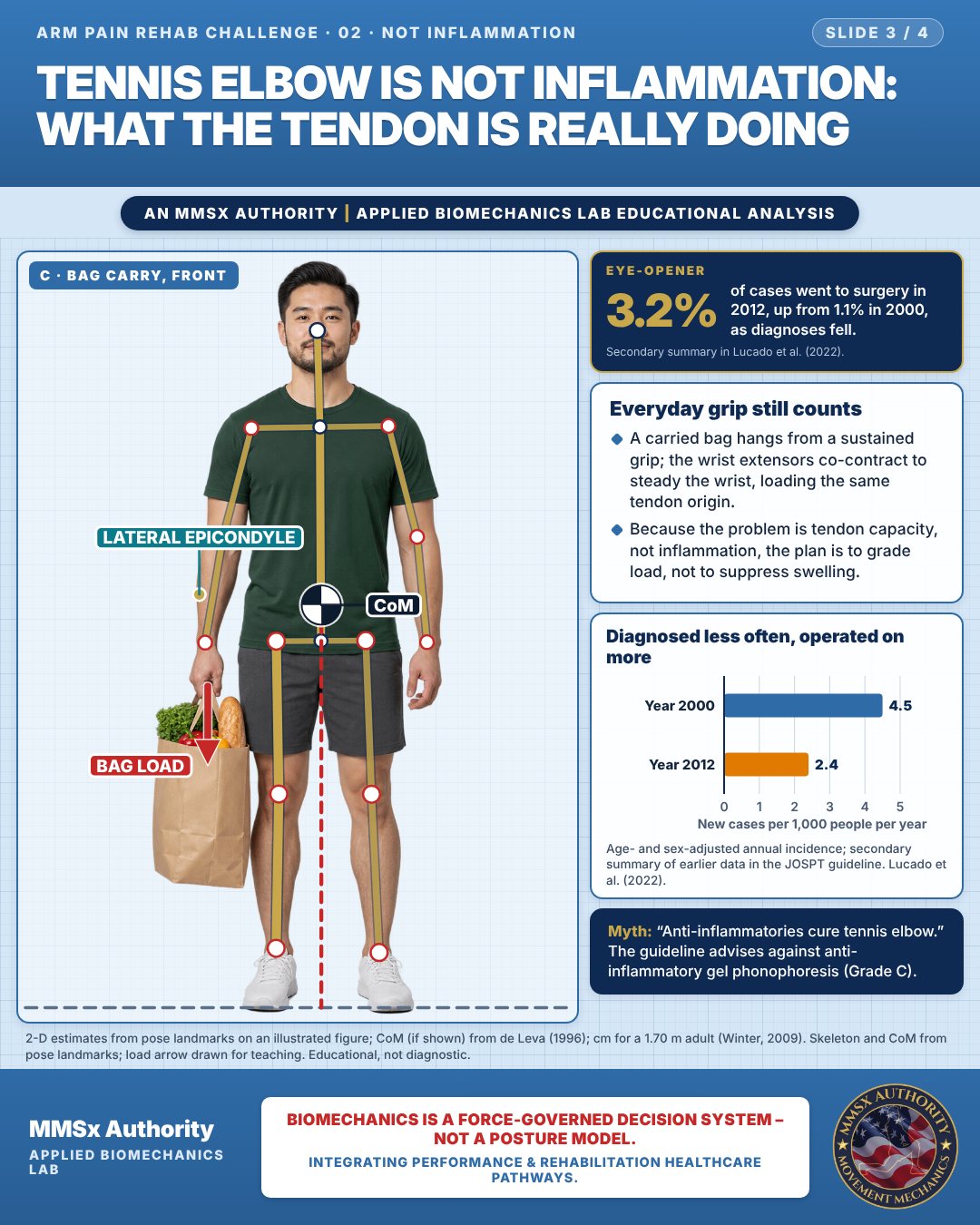
Everyday grip still counts
A carried bag hangs from a sustained grip; the wrist extensors co-contract to steady the wrist, loading the same tendon origin.
Because the problem is tendon capacity, not inflammation, the plan is to grade load, not to suppress swelling.
Diagnosed less often, operated on more
Decision pathway
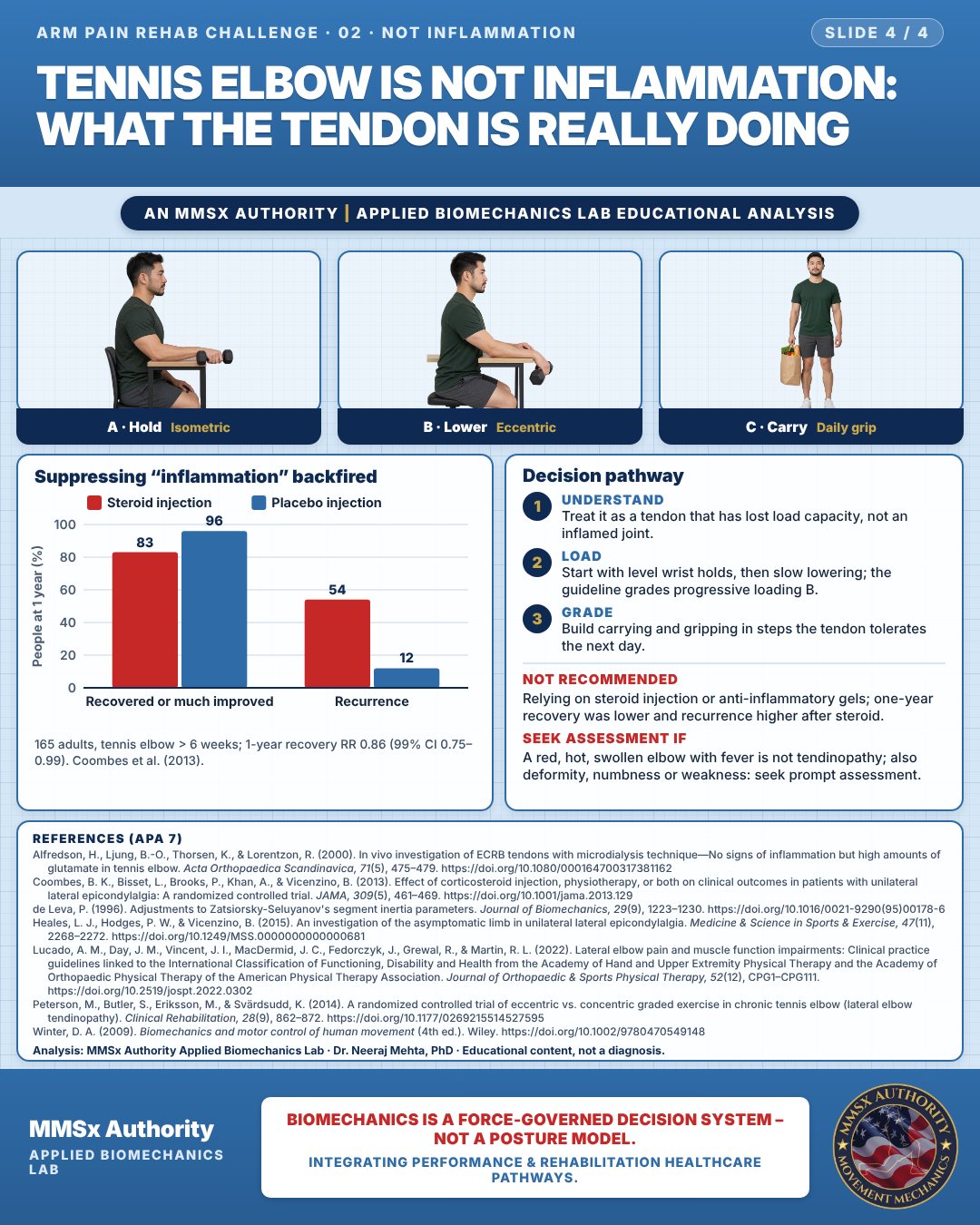
Suppressing “inflammation” backfired
Understand
Treat it as a tendon that has lost load capacity, not an inflamed joint.
Load
Start with level wrist holds, then slow lowering; the guideline grades progressive loading B.
Grade
Build carrying and gripping in steps the tendon tolerates the next day.
What the evidence supports
- Progressive tendon loading (isometric/concentric/eccentric, clinical practice guideline Grade B) is the core; phonophoresis with anti-inflammatory gels should not be used (Grade C); iontophoresis with an anti-inflammatory may be considered only early (2–4 weeks) in highly irritable cases (Grade C) (Lucado et al., 2022).
Myth and evidence
Myth“Tennis elbow is inflammation, so anti-inflammatories cure it.”
EvidenceTendon microdialysis found normal PGE2 (Alfredson et al., 2000) and steroid injection worsened 1-year recovery and recurrence (Coombes et al., 2013).
Cautions
Not recommended
Relying on steroid injection or anti-inflammatory gels; one-year recovery was lower and recurrence higher after steroid.
Seek assessment if
A red, hot, swollen elbow with fever is not tendinopathy; also deformity, numbness or weakness: seek prompt assessment.
Methods note
2-D estimates from pose landmarks on an illustrated figure (head-to-hip framing); lengths scaled to a 1.70 m adult (Winter, 2009). Force directions drawn on the figure for teaching. Wrist angle from manually placed forearm and hand landmarks. 2-D estimates from pose landmarks on an illustrated figure; CoM (if shown) from de Leva (1996); cm for a 1.70 m adult (Winter, 2009). Skeleton and CoM from pose landmarks; load arrow drawn for teaching. These are educational estimates, not a diagnosis.
References
- Alfredson, H., Ljung, B.-O., Thorsen, K., & Lorentzon, R. (2000). In vivo investigation of ECRB tendons with microdialysis technique—No signs of inflammation but high amounts of glutamate in tennis elbow. Acta Orthopaedica Scandinavica, 71(5), 475–479. https://doi.org/10.1080/000164700317381162
- Coombes, B. K., Bisset, L., Brooks, P., Khan, A., & Vicenzino, B. (2013). Effect of corticosteroid injection, physiotherapy, or both on clinical outcomes in patients with unilateral lateral epicondylalgia: A randomized controlled trial. JAMA, 309(5), 461–469. https://doi.org/10.1001/jama.2013.129
- de Leva, P. (1996). Adjustments to Zatsiorsky-Seluyanov's segment inertia parameters. Journal of Biomechanics, 29(9), 1223–1230. https://doi.org/10.1016/0021-9290(95)00178-6
- Heales, L. J., Hodges, P. W., & Vicenzino, B. (2015). An investigation of the asymptomatic limb in unilateral lateral epicondylalgia. Medicine & Science in Sports & Exercise, 47(11), 2268–2272. https://doi.org/10.1249/MSS.0000000000000681
- Lucado, A. M., Day, J. M., Vincent, J. I., MacDermid, J. C., Fedorczyk, J., Grewal, R., & Martin, R. L. (2022). Lateral elbow pain and muscle function impairments: Clinical practice guidelines linked to the International Classification of Functioning, Disability and Health from the Academy of Hand and Upper Extremity Physical Therapy and the Academy of Orthopaedic Physical Therapy of the American Physical Therapy Association. Journal of Orthopaedic & Sports Physical Therapy, 52(12), CPG1–CPG111. https://doi.org/10.2519/jospt.2022.0302
- Peterson, M., Butler, S., Eriksson, M., & Svärdsudd, K. (2014). A randomized controlled trial of eccentric vs. concentric graded exercise in chronic tennis elbow (lateral elbow tendinopathy). Clinical Rehabilitation, 28(9), 862–872. https://doi.org/10.1177/0269215514527595
- Winter, D. A. (2009). Biomechanics and motor control of human movement (4th ed.). Wiley. https://doi.org/10.1002/9780470549148
Cite this article
Mehta, N. (2026, October 28). Tennis elbow is not inflammation: what the tendon is really doing. MMSx Authority Applied Biomechanics Lab. https://mmsxauthority.org/edu/analysis/arm/02-tennis-elbow-is-not-inflammation-what-the-tendon-is-really-doing/
Part of the collection
Mehta, N. (2026). Elbow, Forearm, Wrist and Hand Rehabilitation: 50 Evidence-Based Biomechanics Analyses [Collection]. MMSx Authority Applied Biomechanics Lab. Zenodo. https://doi.org/10.5281/zenodo.23735910
All Arm Pain Rehab Challenge articles · Rehabilitation Library