Arm Pain Rehab Challenge · 01
Tennis elbow: why the outer elbow hurts when you grip and lift
Lateral elbow tendinopathy (tennis elbow, lateral epicondylalgia): pain at the lateral epicondyle and common wrist-extensor origin (chiefly extensor…
Key points
- Modify. Lift palm-up or closer to the body and spread hard gripping while pain settles.
- Load. Progress isometric, then slow concentric and eccentric wrist-extensor exercise (guideline Grade B).
- Track. Measure pain-free grip; build it gradually for work or sport demands.
What it is
Lateral elbow tendinopathy (tennis elbow, lateral epicondylalgia): pain at the lateral epicondyle and common wrist-extensor origin (chiefly extensor carpi radialis brevis), provoked by gripping and by resisted wrist or middle-finger extension.
How we analysed the movement
Three movements relevant to this topic were analysed from illustrated reference figures. Joint centres were located with two-dimensional pose estimation where the whole arm was visible; elbow and wrist angles, and the directions of external load and tendon pull, were then drawn on the figure; on hand close-ups, where pose estimation does not apply, the landmarks were placed manually. The figures are educational estimates that show how position changes mechanical demand; they are not measurements of a patient. Every research value quoted below comes from the published source cited beside it.
Movement A: Palm-down lift (side view)
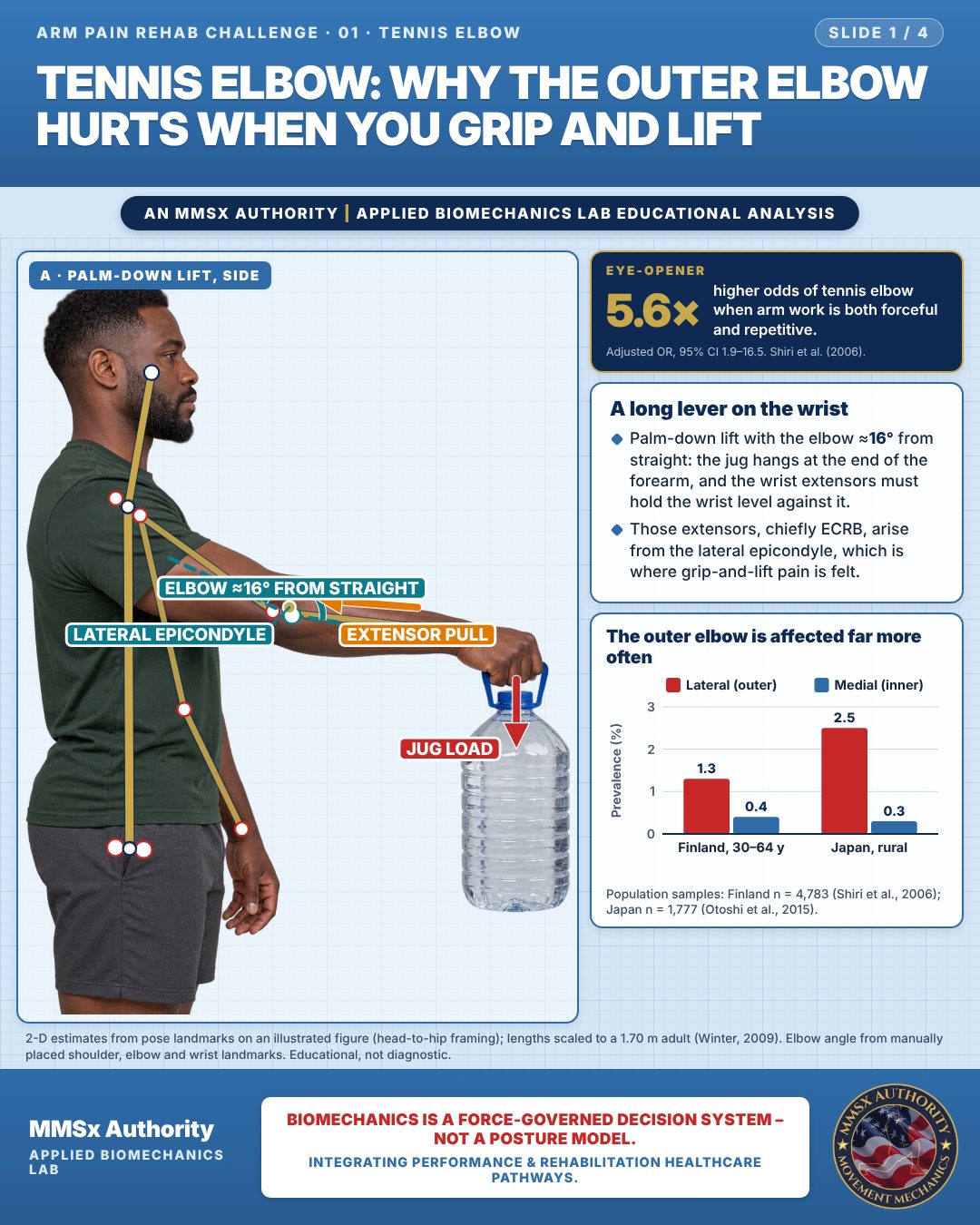
A long lever on the wrist
Palm-down lift with the elbow ≈16° from straight: the jug hangs at the end of the forearm, and the wrist extensors must hold the wrist level against it.
Those extensors, chiefly ECRB, arise from the lateral epicondyle, which is where grip-and-lift pain is felt.
The outer elbow is affected far more often
Movement B: Tight grip, top
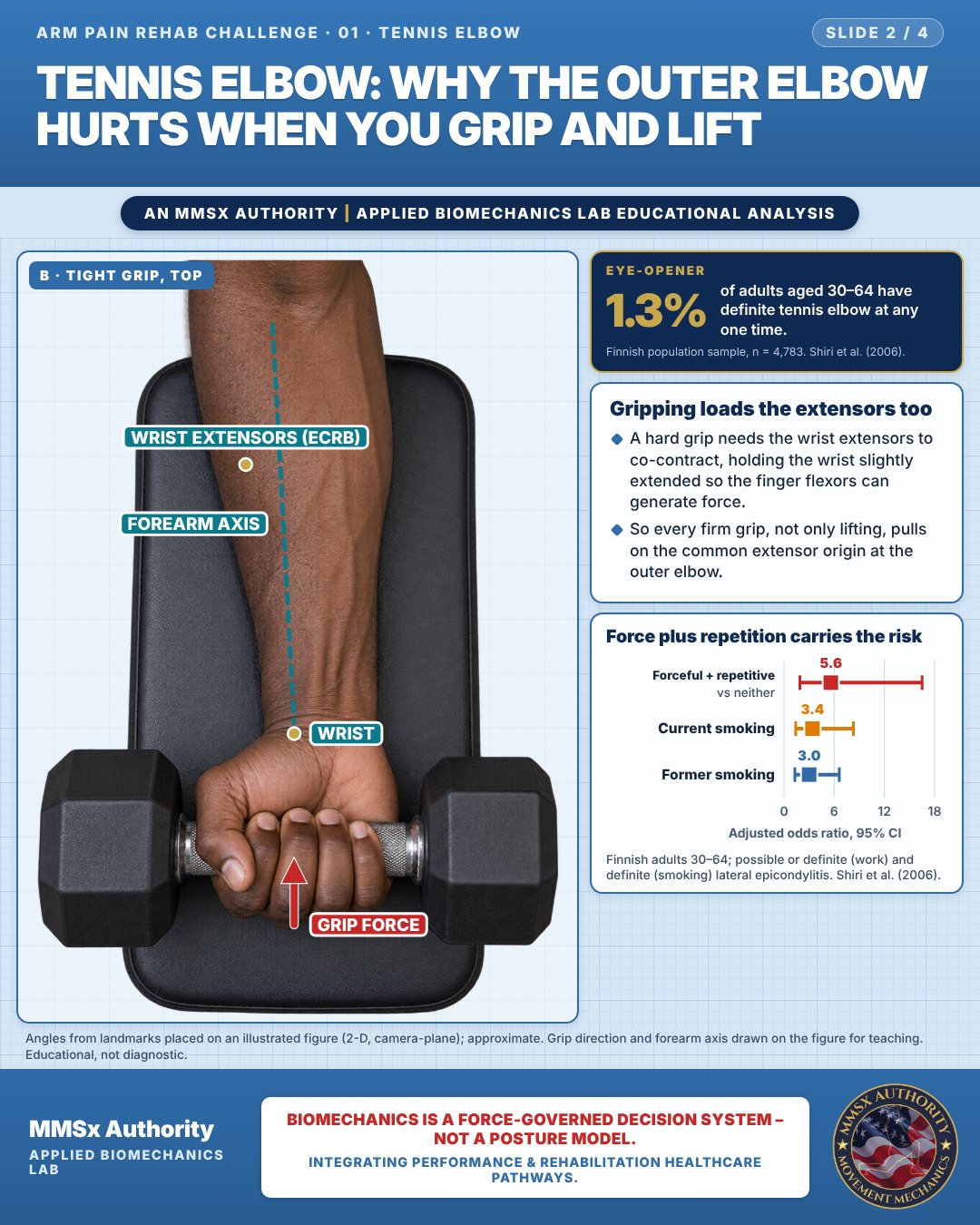
Gripping loads the extensors too
A hard grip needs the wrist extensors to co-contract, holding the wrist slightly extended so the finger flexors can generate force.
So every firm grip, not only lifting, pulls on the common extensor origin at the outer elbow.
Force plus repetition carries the risk
Movement C: Hand on outer elbow (front view)
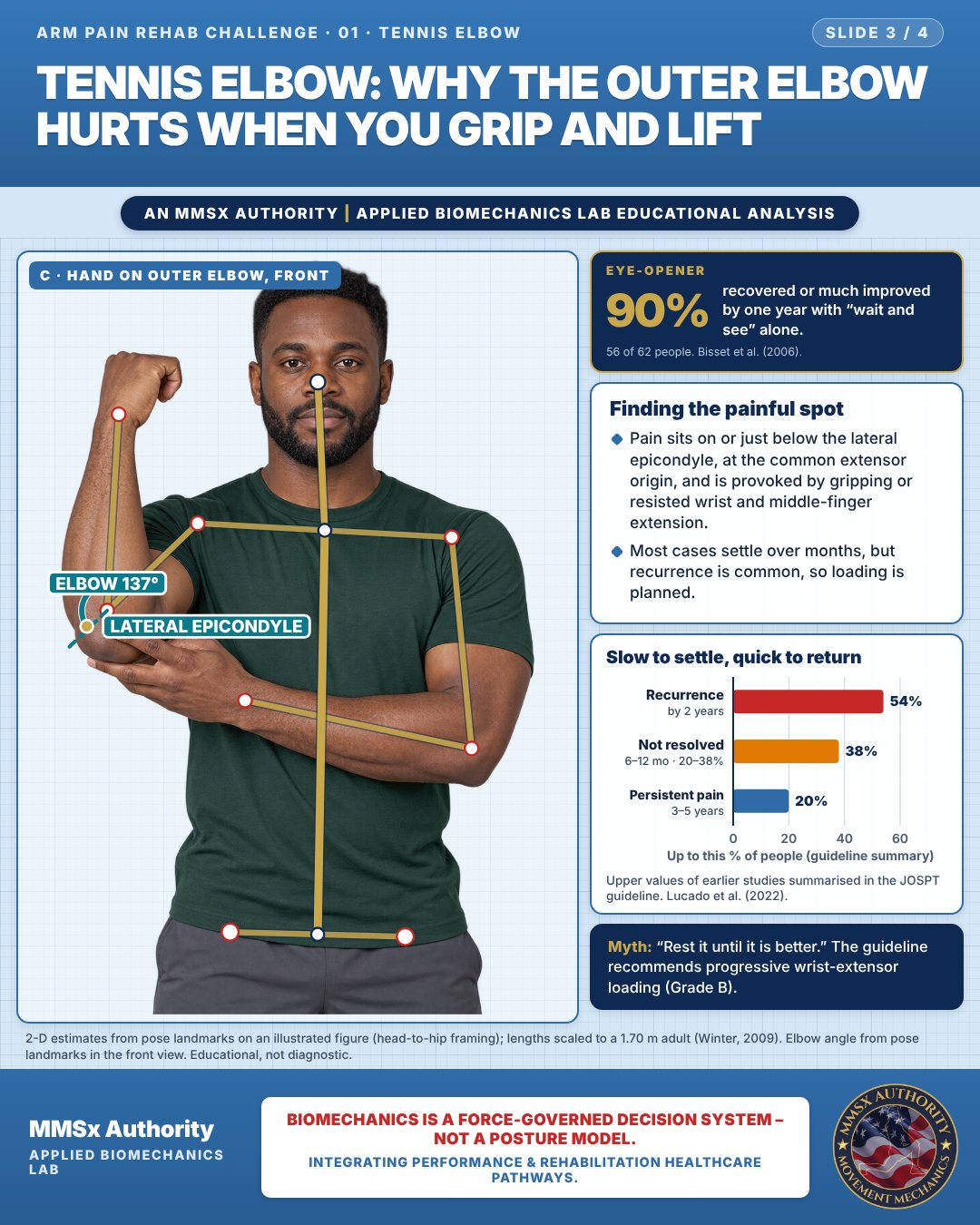
Finding the painful spot
Pain sits on or just below the lateral epicondyle, at the common extensor origin, and is provoked by gripping or resisted wrist and middle-finger extension.
Most cases settle over months, but recurrence is common, so loading is planned.
Slow to settle, quick to return
Decision pathway
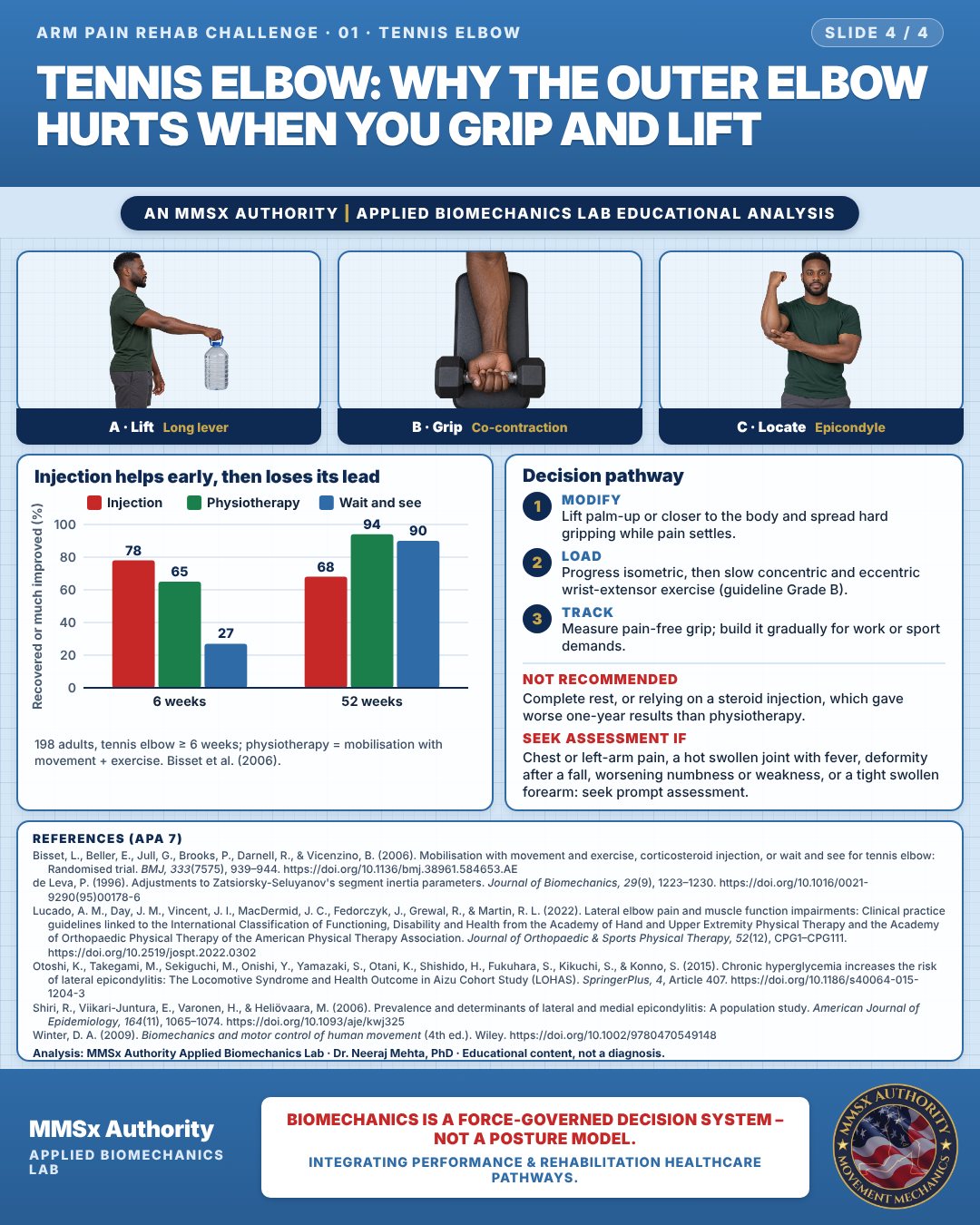
Injection helps early, then loses its lead
Modify
Lift palm-up or closer to the body and spread hard gripping while pain settles.
Load
Progress isometric, then slow concentric and eccentric wrist-extensor exercise (guideline Grade B).
Track
Measure pain-free grip; build it gradually for work or sport demands.
What the evidence supports
- Recommended: isometric, concentric and/or eccentric resisted wrist-extensor exercise for subacute/chronic LET (Grade B); combine strengthening with other interventions including manual therapy (B); local elbow mobilisation/manipulation for short-term pain and pain-free grip (B); rigid taping for short-term relief in irritable LET (B); measure pain-free grip and maximum grip strength (B); phased reloading for high-demand users (F) (clinical practice guideline, Lucado et al., 2022).
- Not recommended / no recommendation: counterforce or wrist orthosis for intermediate/long-term outcomes — no recommendation, evidence conflicts (D); therapeutic ultrasound alone (D); phonophoresis with hydrocortisone, prednisolone or diclofenac gels should not be used (C) (clinical practice guideline, Lucado et al., 2022).
Myth and evidence
Myth“Rest it until it is fully better.”
EvidenceThe guideline recommends progressive loading (Grade B), and most people improve over 52 weeks whatever the approach (Bisset et al., 2006).
Cautions
Not recommended
Complete rest, or relying on a steroid injection, which gave worse one-year results than physiotherapy.
Seek assessment if
Chest or left-arm pain, a hot swollen joint with fever, deformity after a fall, worsening numbness or weakness, or a tight swollen forearm: seek prompt assessment.
Methods note
2-D estimates from pose landmarks on an illustrated figure (head-to-hip framing); lengths scaled to a 1.70 m adult (Winter, 2009). Elbow angle from manually placed shoulder, elbow and wrist landmarks. Angles from landmarks placed on an illustrated figure (2-D, camera-plane); approximate. Grip direction and forearm axis drawn on the figure for teaching. Elbow angle from pose landmarks in the front view. These are educational estimates, not a diagnosis.
References
- Bisset, L., Beller, E., Jull, G., Brooks, P., Darnell, R., & Vicenzino, B. (2006). Mobilisation with movement and exercise, corticosteroid injection, or wait and see for tennis elbow: Randomised trial. BMJ, 333(7575), 939–944. https://doi.org/10.1136/bmj.38961.584653.AE
- de Leva, P. (1996). Adjustments to Zatsiorsky-Seluyanov's segment inertia parameters. Journal of Biomechanics, 29(9), 1223–1230. https://doi.org/10.1016/0021-9290(95)00178-6
- Lucado, A. M., Day, J. M., Vincent, J. I., MacDermid, J. C., Fedorczyk, J., Grewal, R., & Martin, R. L. (2022). Lateral elbow pain and muscle function impairments: Clinical practice guidelines linked to the International Classification of Functioning, Disability and Health from the Academy of Hand and Upper Extremity Physical Therapy and the Academy of Orthopaedic Physical Therapy of the American Physical Therapy Association. Journal of Orthopaedic & Sports Physical Therapy, 52(12), CPG1–CPG111. https://doi.org/10.2519/jospt.2022.0302
- Otoshi, K., Takegami, M., Sekiguchi, M., Onishi, Y., Yamazaki, S., Otani, K., Shishido, H., Fukuhara, S., Kikuchi, S., & Konno, S. (2015). Chronic hyperglycemia increases the risk of lateral epicondylitis: The Locomotive Syndrome and Health Outcome in Aizu Cohort Study (LOHAS). SpringerPlus, 4, Article 407. https://doi.org/10.1186/s40064-015-1204-3
- Shiri, R., Viikari-Juntura, E., Varonen, H., & Heliövaara, M. (2006). Prevalence and determinants of lateral and medial epicondylitis: A population study. American Journal of Epidemiology, 164(11), 1065–1074. https://doi.org/10.1093/aje/kwj325
- Winter, D. A. (2009). Biomechanics and motor control of human movement (4th ed.). Wiley. https://doi.org/10.1002/9780470549148
Cite this article
Mehta, N. (2026, October 28). Tennis elbow: why the outer elbow hurts when you grip and lift. MMSx Authority Applied Biomechanics Lab. https://mmsxauthority.org/edu/analysis/arm/01-tennis-elbow-why-the-outer-elbow-hurts-when-you-grip-and-lift/
Part of the collection
Mehta, N. (2026). Elbow, Forearm, Wrist and Hand Rehabilitation: 50 Evidence-Based Biomechanics Analyses [Collection]. MMSx Authority Applied Biomechanics Lab. Zenodo. https://doi.org/10.5281/zenodo.23735910
All Arm Pain Rehab Challenge articles · Rehabilitation Library