Shoulder Rehab Challenge · 01
Why does my shoulder hurt? Understanding common causes and movement sensitivity
Arm elevated 120° in front of the body: the arm’s weight acts about 18 cm from the joint, ≈ 6 N·m that the cuff and deltoid must hold. Most shoulder…
Key points
- Screen. Check the neck, fracture, infection and other serious causes; most shoulder pain is a clinical diagnosis.
- Load. Progressive exercise for the cuff and shoulder blade is the core treatment; adjust lever and dose to symptoms.
- Review. Most improve within three months; refer if there is no improvement by 12 weeks.
What it is
Shoulder pain is pain felt in the shoulder region. It most often comes from the rotator cuff and subacromial tissues, the glenohumeral joint (for example frozen shoulder or osteoarthritis) or the acromioclavicular joint, and it can also be referred from the neck. It is commonly provoked by raising, reaching and loading the arm. In primary care, subacromial pain is a clinical diagnosis (Pandey et al., 2025).
How we analysed the movement
Three movements relevant to this topic were analysed from illustrated reference figures. Joint centres were located with two-dimensional pose estimation; arm elevation and elbow angles, shoulder level, the whole-body centre of mass and, where relevant, the arm lever (the horizontal distance from the shoulder joint to the centre of mass of the arm, with any hand load) and the resulting shoulder moment were then calculated from standard segment parameters. The figures are educational estimates that show how position changes mechanical demand; they are not measurements of a patient. Every research value quoted below comes from the published source cited beside it.
Movement A: Arm raise (side view)
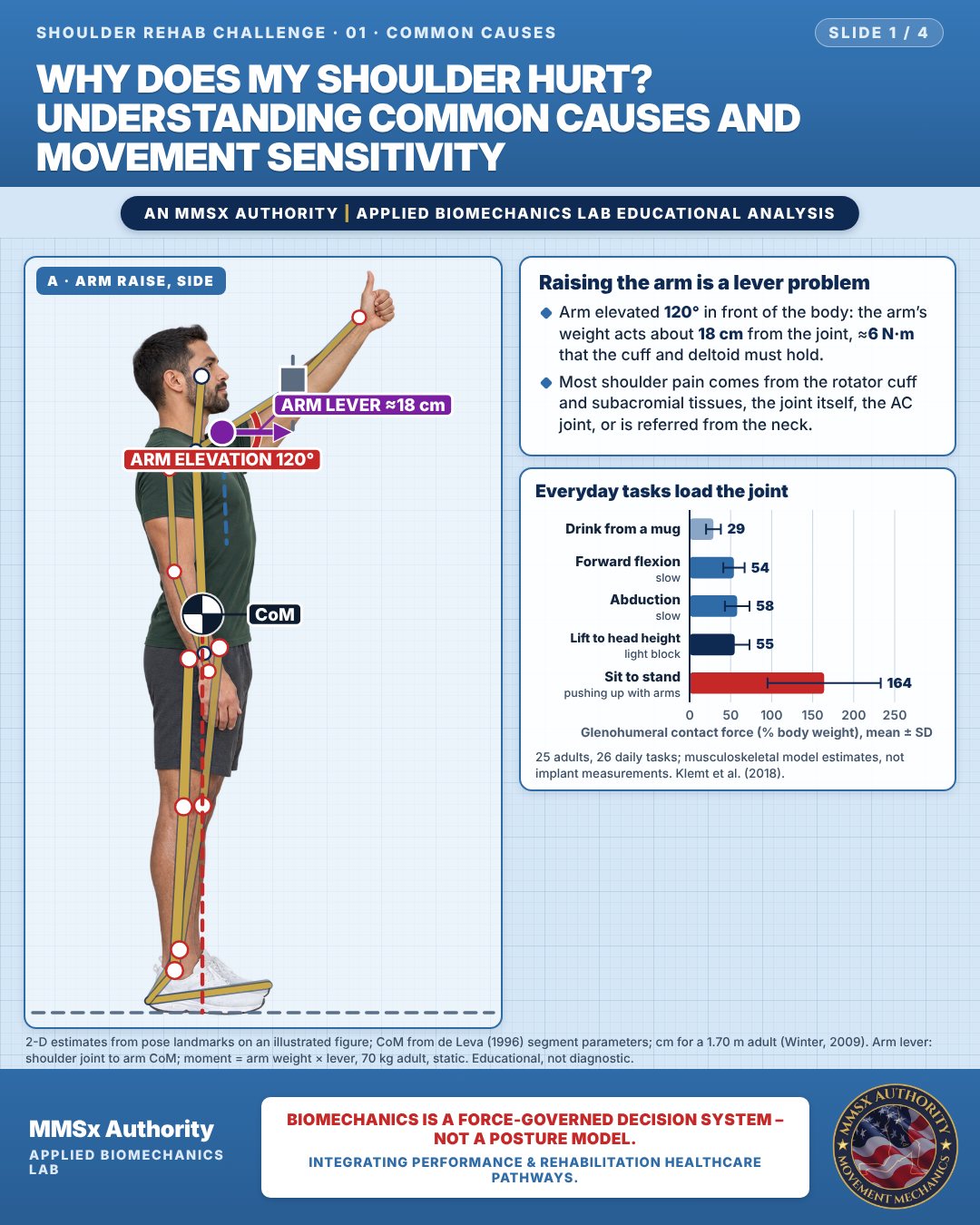
Raising the arm is a lever problem
Arm elevated 120° in front of the body: the arm’s weight acts about 18 cm from the joint, ≈6 N·m that the cuff and deltoid must hold.
Most shoulder pain comes from the rotator cuff and subacromial tissues, the joint itself, the AC joint, or is referred from the neck.
Everyday tasks load the joint
Movement B: High-shelf reach (side view)
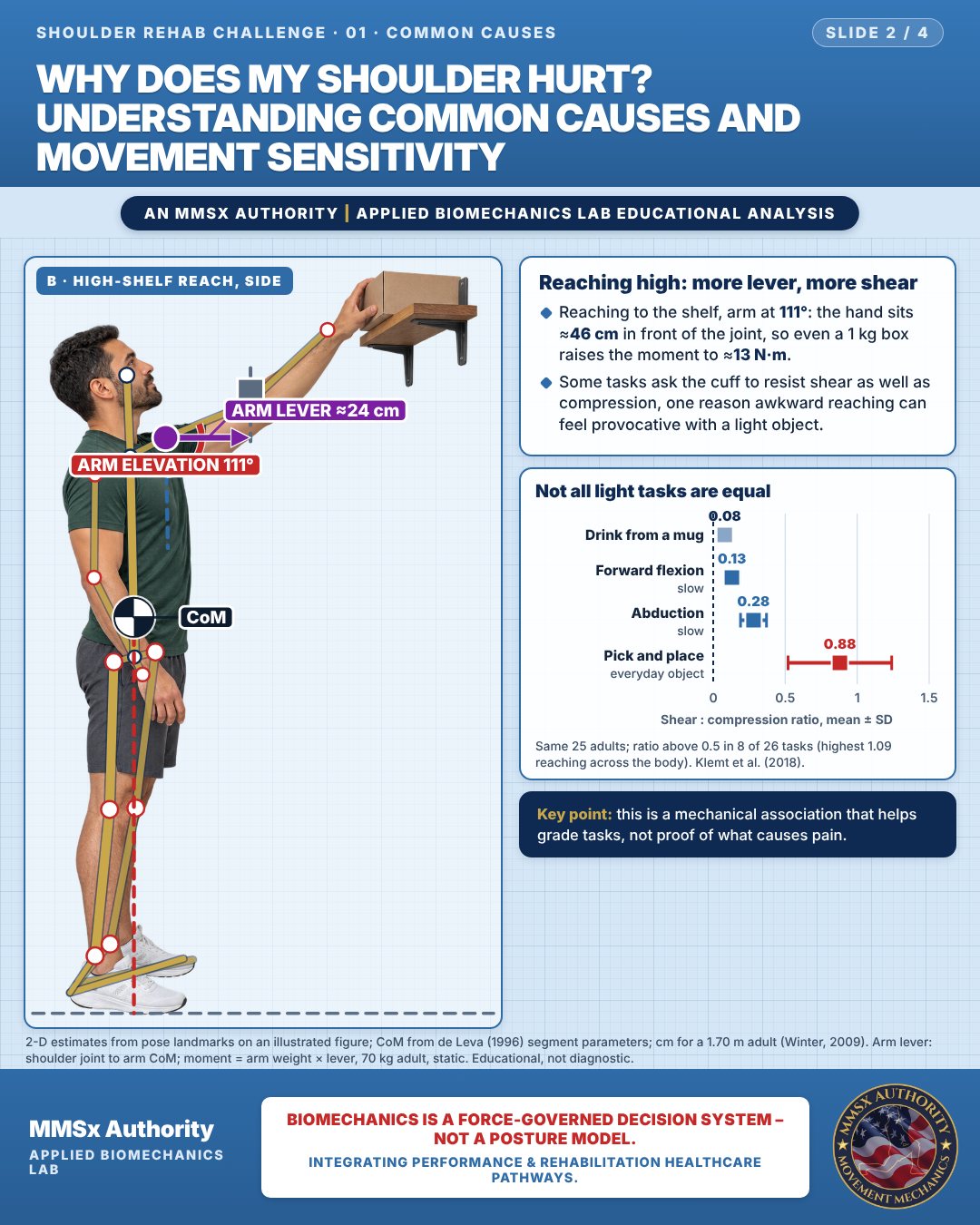
Reaching high: more lever, more shear
Reaching to the shelf, arm at 111°: the hand sits ≈46 cm in front of the joint, so even a 1 kg box raises the moment to ≈13 N·m.
Some tasks ask the cuff to resist shear as well as compression, one reason awkward reaching can feel provocative with a light object.
Not all light tasks are equal
Movement C: Carrying a bag (front view)
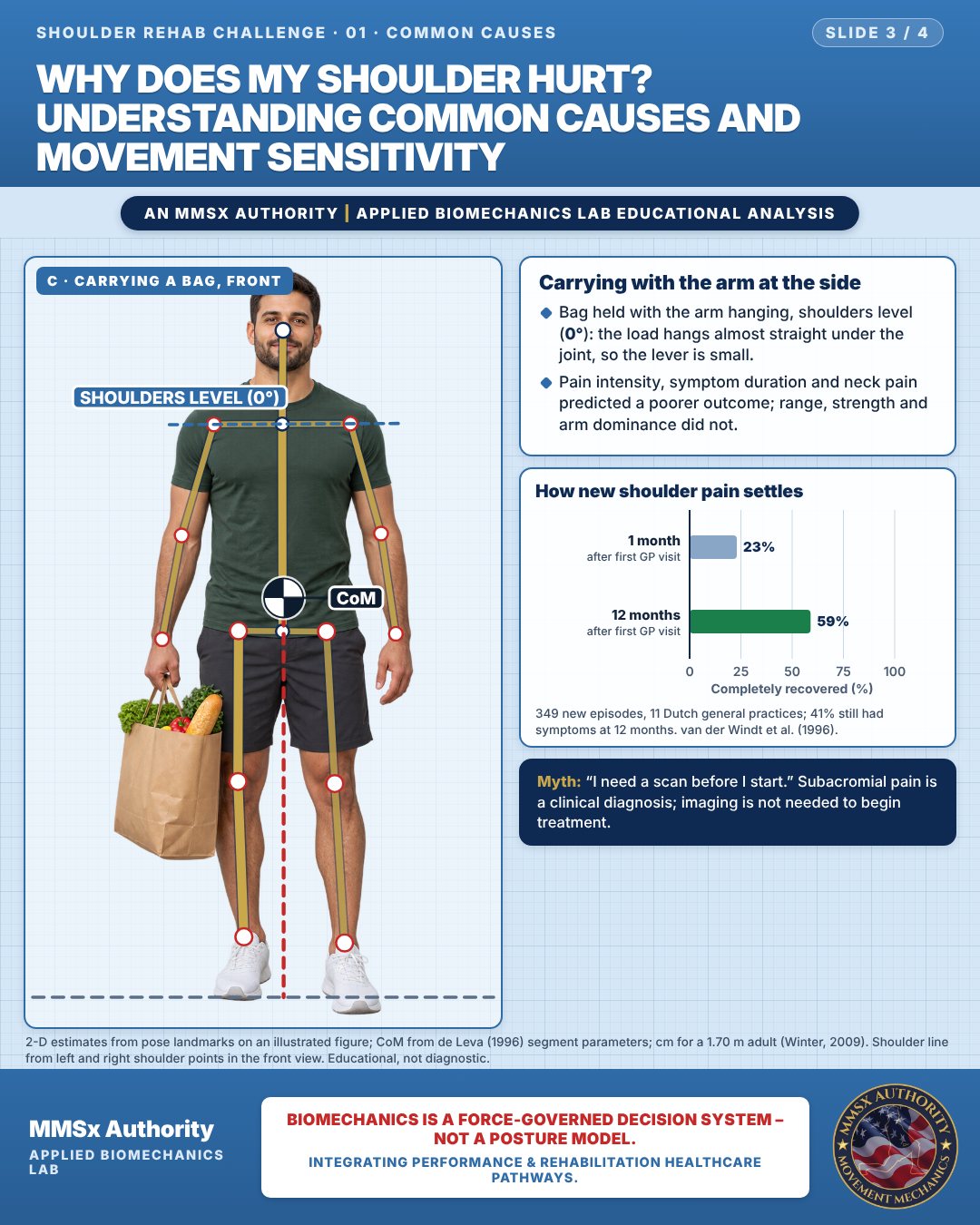
Carrying with the arm at the side
Bag held with the arm hanging, shoulders level (0°): the load hangs almost straight under the joint, so the lever is small.
Pain intensity, symptom duration and neck pain predicted a poorer outcome; range, strength and arm dominance did not.
How new shoulder pain settles
Decision pathway
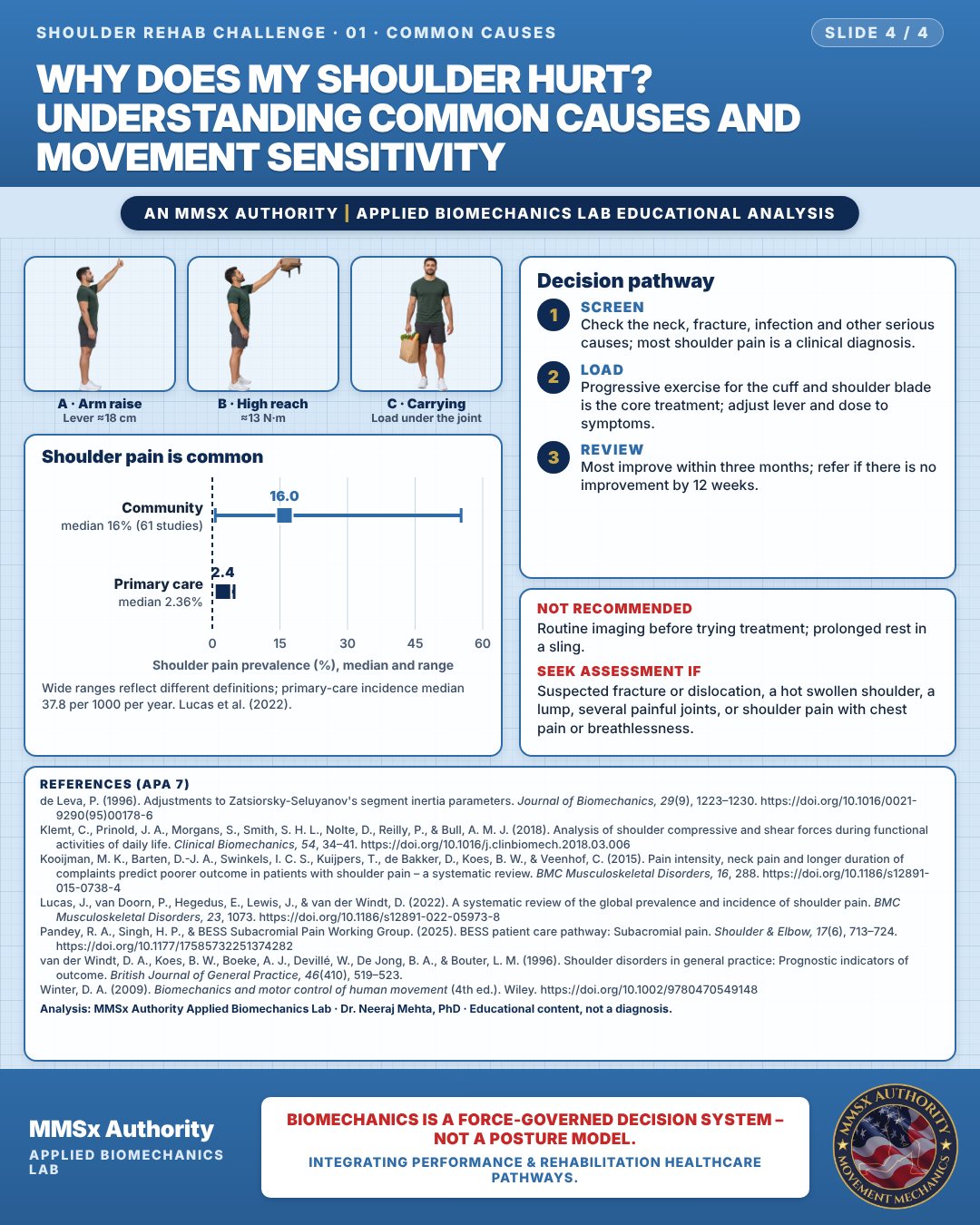
Shoulder pain is common
Screen
Check the neck, fracture, infection and other serious causes; most shoulder pain is a clinical diagnosis.
Load
Progressive exercise for the cuff and shoulder blade is the core treatment; adjust lever and dose to symptoms.
Review
Most improve within three months; refer if there is no improvement by 12 weeks.
What the evidence supports
- BESS (2025): subacromial pain is a clinical diagnosis and imaging is not essential to start treatment. Patients can be reassured that most symptoms respond "within three months". Referral to secondary care is advised if there is no improvement by 12 weeks of non-operative management (Pandey et al., 2025).
Cautions
Not recommended
Routine imaging before trying treatment; prolonged rest in a sling.
Seek assessment if
Suspected fracture or dislocation, a hot swollen shoulder, a lump, several painful joints, or shoulder pain with chest pain or breathlessness.
Methods note
2-D estimates from pose landmarks on an illustrated figure; CoM from de Leva (1996) segment parameters; cm for a 1.70 m adult (Winter, 2009). Arm lever: shoulder joint to arm CoM; moment = arm weight × lever, 70 kg adult, static. Shoulder line from left and right shoulder points in the front view. These are educational estimates, not a diagnosis.
References
- de Leva, P. (1996). Adjustments to Zatsiorsky-Seluyanov's segment inertia parameters. Journal of Biomechanics, 29(9), 1223–1230. https://doi.org/10.1016/0021-9290(95)00178-6
- Klemt, C., Prinold, J. A., Morgans, S., Smith, S. H. L., Nolte, D., Reilly, P., & Bull, A. M. J. (2018). Analysis of shoulder compressive and shear forces during functional activities of daily life. Clinical Biomechanics, 54, 34–41. https://doi.org/10.1016/j.clinbiomech.2018.03.006
- Kooijman, M. K., Barten, D.-J. A., Swinkels, I. C. S., Kuijpers, T., de Bakker, D., Koes, B. W., & Veenhof, C. (2015). Pain intensity, neck pain and longer duration of complaints predict poorer outcome in patients with shoulder pain – a systematic review. BMC Musculoskeletal Disorders, 16, 288. https://doi.org/10.1186/s12891-015-0738-4
- Lucas, J., van Doorn, P., Hegedus, E., Lewis, J., & van der Windt, D. (2022). A systematic review of the global prevalence and incidence of shoulder pain. BMC Musculoskeletal Disorders, 23, 1073. https://doi.org/10.1186/s12891-022-05973-8
- Pandey, R. A., Singh, H. P., & BESS Subacromial Pain Working Group. (2025). BESS patient care pathway: Subacromial pain. Shoulder & Elbow, 17(6), 713–724. https://doi.org/10.1177/17585732251374282
- van der Windt, D. A., Koes, B. W., Boeke, A. J., Devillé, W., De Jong, B. A., & Bouter, L. M. (1996). Shoulder disorders in general practice: Prognostic indicators of outcome. British Journal of General Practice, 46(410), 519–523.
- Winter, D. A. (2009). Biomechanics and motor control of human movement (4th ed.). Wiley. https://doi.org/10.1002/9780470549148
Cite this article
Mehta, N. (2026, October 24). Why does my shoulder hurt? Understanding common causes and movement sensitivity. MMSx Authority Applied Biomechanics Lab. https://mmsxauthority.org/edu/analysis/shoulder/01-why-does-my-shoulder-hurt-understanding-common-causes-and-movement/
Part of the collection
Mehta, N. (2026). Shoulder Rehabilitation: 50 Evidence-Based Biomechanics Analyses [Collection]. MMSx Authority Applied Biomechanics Lab. Zenodo. https://doi.org/10.5281/zenodo.23735725
All Shoulder Rehab Challenge articles · Rehabilitation Library