Part VIII · CORPORATE WELLNESS APPLICATION
Behaviour Change
Almost everyone already knows they should sit less and move more — yet most do not. This chapter confronts that puzzle, the knowing–doing gap, and draws on behaviour-change science to explain why knowledge alone changes little, and what actually does: building the capability, opportunity and motivation for movement, and turning it into habit.
27.1 The Knowing–Doing Gap
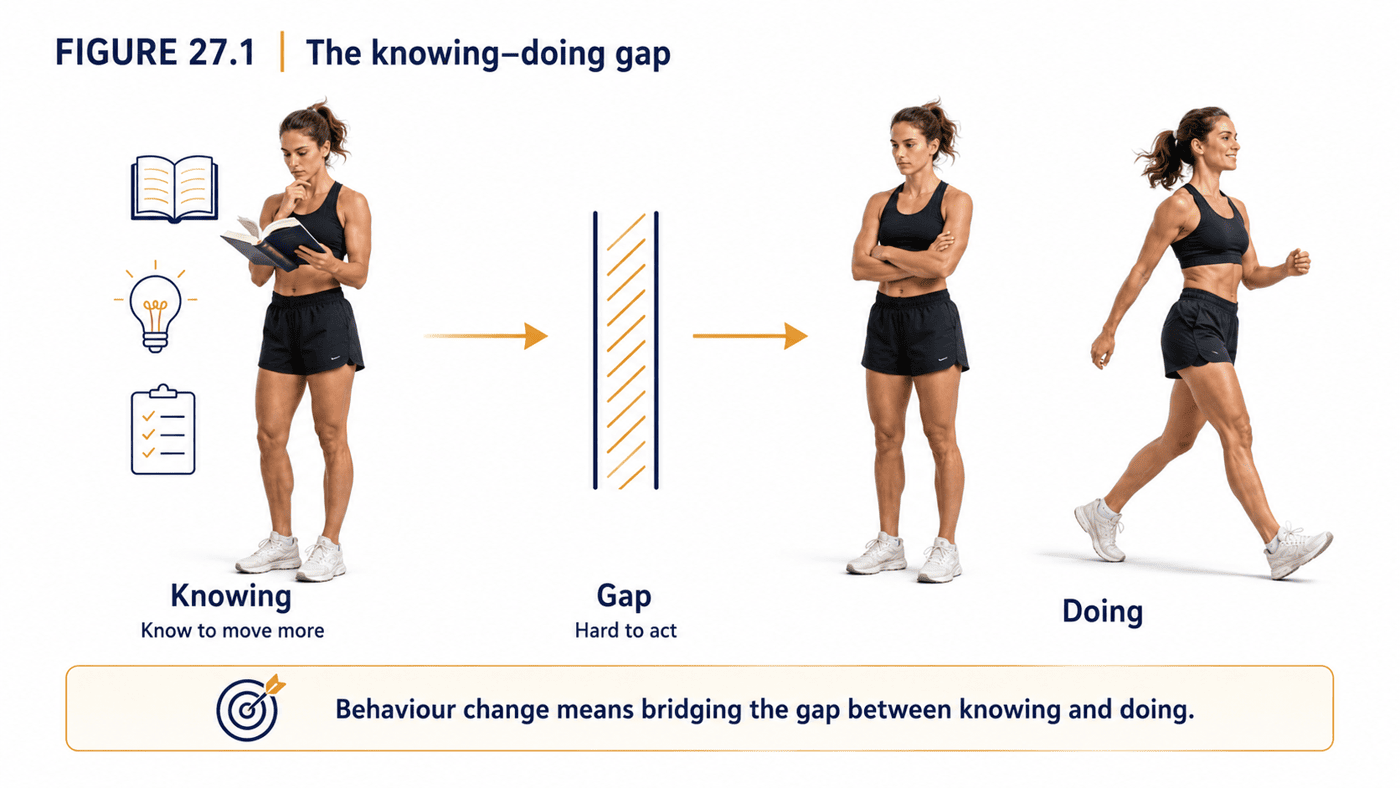
There is a puzzle at the heart of this entire book, and any programme to change how people move must confront it. The puzzle is this: almost everyone already knows that sitting too much is bad for them and that they ought to move more. The message is hardly a secret; it has been repeated for years in health campaigns, news articles and doctors’ surgeries. And yet most people, knowing all this perfectly well, continue to sit for most of their waking hours, a pattern now recognised as a health concern in its own right (Owen et al., 2010). There is a wide gap between knowing and doing, shown in Figure 27.1, and it is the central challenge of behaviour change.
Recognising this gap matters because so much effort to improve health behaviour founders on a false assumption — the assumption that if people only knew the facts, they would act on them. This chapter argues that knowledge, while necessary, is rarely sufficient, and that bridging the knowing-doing gap requires understanding why people who know what to do still do not do it, and addressing those real reasons rather than simply repeating the message more loudly. The chapter is, in a sense, the psychological counterpart to the mechanical science of the rest of the book: it asks not what the body needs, but how people can actually be helped to give it.
27.2 Why Knowledge Is Not Enough
The belief that information alone changes behaviour — sometimes called the information-deficit model — is intuitive, widespread and largely mistaken. If it were true, the well-informed would all be active, smokers who know the risks would all quit, and every desk worker who has read that sitting is harmful would already have changed. The stubborn reality is that human behaviour is driven by far more than knowledge: by habit, by environment, by emotion, by social norms, by competing demands, by the friction of the moment. Knowing the right thing to do is only one small input into whether it actually happens.
This is not a counsel of despair but a redirection of effort. If knowledge is not enough, then the work of behaviour change lies in understanding and addressing the other forces — the ones that actually determine what people do. The remainder of this chapter draws on behaviour-change science to set out a practical framework for this. It is worth saying clearly that this is a real science, with robust models and evidence, not a matter of motivational slogans; and its central lesson for the desk body is that helping people move is less about persuading them and more about making movement genuinely easier, more rewarding and more automatic. Education, the second pillar of Chapter 25, remains necessary — but it must be joined by the rest.
27.3 Capability, Opportunity, Motivation
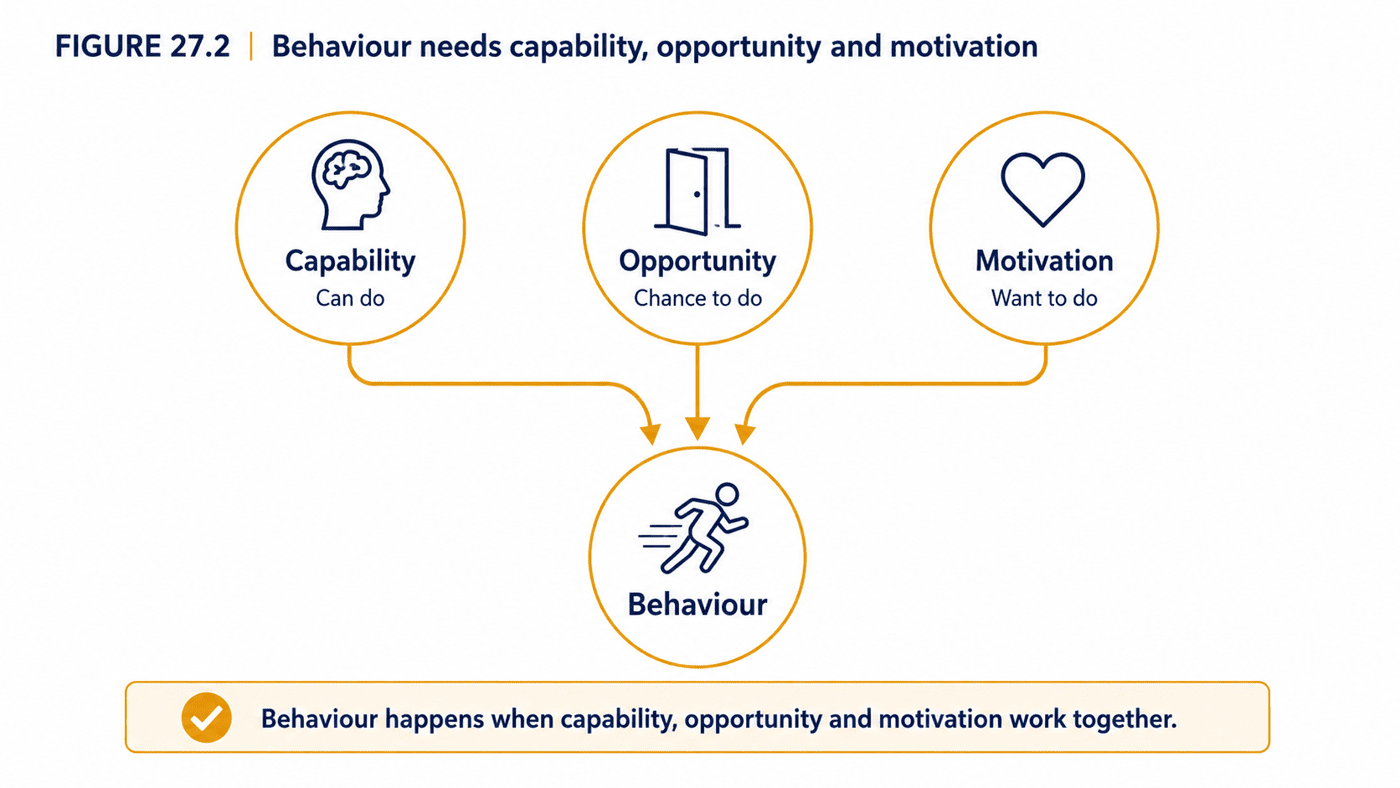
A clear and well-supported way to understand what behaviour actually requires is captured in a model widely used in behavioural science, which holds that any behaviour arises from the interaction of three necessary components: capability, opportunity and motivation (Michie et al., 2011). Figure 27.2 shows the idea. Capability is whether a person is physically and psychologically able to do the behaviour — the skill, knowledge and physical capacity. Opportunity is whether the environment and circumstances allow and prompt it — the time, the space, the cues, the social permission. Motivation is whether the person wants to, and intends to, do it — including both deliberate intention and automatic impulse.
The power of this simple framework is its insistence that all three components are necessary: if any one is missing, the behaviour does not happen, however strong the others. A person may be perfectly capable of moving and highly motivated, but if the environment offers no opportunity — no time, no permission, no prompt — they will not; another may have every opportunity and capability but no motivation. This explains why single-stranded efforts so often fail, and it provides a diagnostic tool for behaviour change: when a desired behaviour is not happening, ask which component — capability, opportunity or motivation — is the binding constraint, and address that. The next three sections take each in turn, as they apply to the desk body.
27.4 Capability
Capability — being able to do the behaviour — is, for movement, often the least of the problems, but it is not nothing. Physically, most people are capable of the movements this book recommends, which is precisely why they are chosen to be gentle, scalable and accessible; the reset, the walking, the basic routines ask little special ability. Psychologically, capability includes knowing how — and here the education of Chapter 25, and books such as this one, play their part, replacing the vague ‘move more’ with concrete, doable actions.
Where capability does matter, it is usually in two subtler senses. The first is confidence — a person’s belief that they can do the behaviour, which is itself a powerful determinant of whether they try; the gentle, achievable framing of the reset system is designed partly to build this confidence by making the first steps unintimidating. The second is the practical know-how to fit movement into a real day, which is more a matter of strategy than of physical ability. For the desk body, then, capability is rarely the main barrier — but ensuring people know how, and believe they can, remains a worthwhile foundation on which opportunity and motivation can build.
27.5 Opportunity
Opportunity — whether the environment and circumstances allow and prompt the behaviour — is, for the desk body, frequently the binding constraint, and this is where Chapter 25’s emphasis on environment finds its psychological justification. A person may be entirely able and willing to move, yet be thwarted by a working day with no time built in, a culture that frowns on leaving the desk, an environment with nowhere to walk and nothing to prompt a break, and the sheer momentum of sedentary defaults. When that is so, no amount of education or motivation will help; the constraint is opportunity, and opportunity must be created.
This is why so much of the most effective behaviour change works through the environment rather than the person — by altering the cues, defaults and frictions that shape what people do automatically (Marteau et al., 2012). Creating opportunity for movement means building in the time, designing the spaces, providing the prompts, and granting the cultural permission that the four pillars describe. The great advantage of this approach is that it does not depend on continually persuading people; it makes the desired behaviour the easy, prompted, default one, so that it happens more by design than by effort. For the desk body, creating opportunity is often the single most powerful lever of change.
27.6 Motivation
Motivation — wanting and intending to do the behaviour — is more complex than it first appears, because it has two distinct faces. There is reflective motivation: the conscious intentions, plans and evaluations through which a person decides movement is worthwhile. And there is automatic motivation: the habits, impulses and emotional responses that drive much behaviour below the level of deliberate choice. Effective behaviour change engages both, and a common error is to address only the reflective — to assume that if people decide to move, they will — while neglecting the automatic, which often wins.
Reflective motivation is strengthened by connecting movement to what a person genuinely values — their energy, their health, their ability to do the things they care about — rather than to abstract duty or fear. Lasting motivation, the evidence suggests, grows best when behaviour is experienced as autonomous (one’s own choice rather than an imposition), competent (something one can succeed at), and connected to others (Ryan & Deci, 2000) — which is why coercive or shaming approaches tend to backfire, and supportive, choiceful, sociable ones endure. Automatic motivation, meanwhile, is engaged largely by building habits, the subject of the next section. For the desk body, the most durable motivation comes not from frightening people about sitting but from helping them experience movement as their own choice, within their power, rewarding, and woven into a life they value.
27.7 The Power of Habit
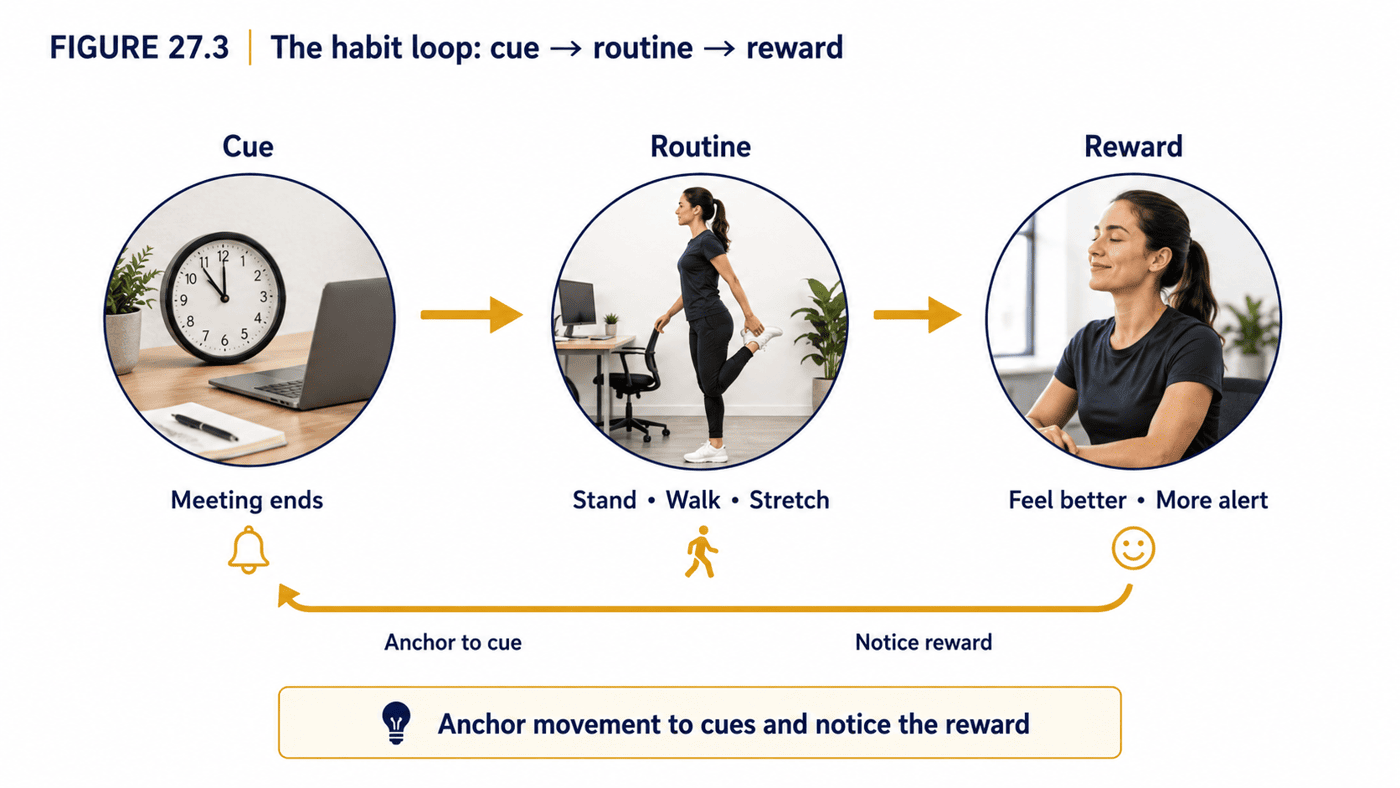
If any single mechanism turns good intentions into lasting behaviour, it is habit — and habit is the bridge by which movement becomes automatic rather than effortful. A habit is a behaviour that has become linked to a cue so that it happens more or less automatically, with little deliberate decision. Its structure is often described as a loop, shown in Figure 27.3: a cue triggers a routine, which delivers a reward, and the reward strengthens the link so that the cue more reliably triggers the routine next time. Behaviours that become habitual in this way no longer depend on motivation or willpower — they simply happen.
This is enormously useful for the desk body, because the goal is precisely to make movement automatic. The practical route, drawn on in Part VII, is to anchor new movement to existing, reliable cues — a reset at the end of every meeting, a walk at lunch, a stretch on rising — so that the established cue comes to trigger the new routine; and to notice the reward, the feeling of energy or ease that movement brings, which strengthens the loop. Habits take time to form — commonly weeks to a couple of months of repetition, varying by person and behaviour (Lally et al., 2010) — so patience and consistency matter, and an occasional lapse does not undo a forming habit. But once movement has become habitual, the knowing-doing gap closes almost by itself: the behaviour no longer has to be chosen each time, because it has become simply what one does.
27.8 Barriers and Strategies
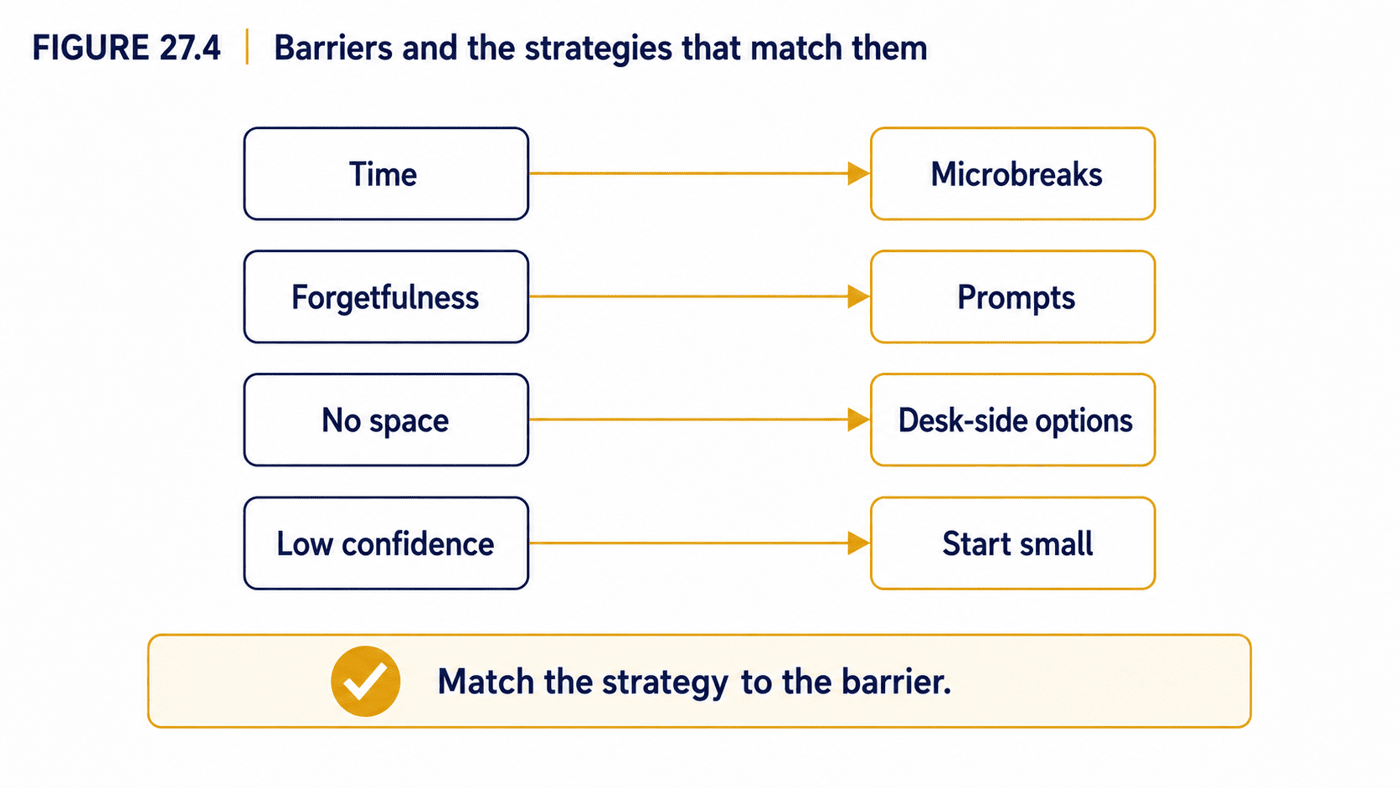
Pulling these ideas together, effective behaviour change for the desk body proceeds not by exhortation but by identifying the specific barrier in a given situation and matching a strategy to it, as Figure 27.4 sets out. The common barriers are familiar. ‘No time’ is met not by insisting people find an hour but by offering movement so small and woven-in — the three-minute reset, the movement snack — that it needs no separate time. Forgetting, amid absorbing work, is met by cues and prompts, and by anchoring movement to existing habits. Self-consciousness is met by discreet options and, above all, by a culture that makes moving normal. Low motivation is met by linking movement to what the person values and by building rewarding habits. And the pervasive pull of sedentary defaults is met by redesigning the environment so the default favours movement.
The unifying principle is that each barrier has a matched strategy, and that the right response is to diagnose which barrier is operating — which, in the language of this chapter, is usually a question of which of capability, opportunity and motivation is lacking — and to address that specifically. This is a far more effective stance than the blunt instrument of telling people to try harder, which addresses no actual barrier and tends only to add guilt. Behaviour change, done well, is a matter of thoughtful design and matched strategy, not willpower and exhortation — and it is within the reach of any programme, coach or individual willing to think in these terms.
If–then plans: making intentions concrete
One simple technique deserves particular mention, because it consistently helps bridge the gap between intending to move and actually moving: the making of concrete, specific plans that link an intention to a particular cue. Rather than a vague resolution to ‘move more’, the plan takes the form ‘when this happens, then I will do that’ — when a meeting ends, I will stand and do a reset; when I make my mid-morning coffee, I will take a short walk; when I finish a task, I will stretch. Specifying the cue and the action in advance turns an abstract intention into a concrete plan that the cue can trigger.
This works because it does much of the deciding ahead of time, so that in the moment there is no fresh choice to make and no willpower to summon — the cue simply prompts the pre-decided action. It is, in effect, the deliberate first step toward the habit loop of the previous section: a consciously planned cue-and-action pairing that, with repetition, becomes automatic. For the desk body, encouraging people to make such specific if-then plans — rather than leaving them with only a general good intention — is among the simplest and most effective ways to help intentions actually translate into movement.
Self-compassion over self-criticism
A final point concerns how people treat themselves when, inevitably, they fall short — because the response to lapses shapes whether a behaviour endures. The common instinct is self-criticism: to scold oneself for missing a walk or a week of movement, on the theory that being hard on oneself drives improvement. The evidence and experience of behaviour change suggest the opposite. Harsh self-criticism tends to breed discouragement, guilt and avoidance, and often ends a faltering habit altogether; a kinder, more matter-of-fact response — noting the lapse without drama and simply returning to the behaviour — sustains it far better.
This matters because lapses are not the exception but the norm: no one moves perfectly every day, and a forming habit is not destroyed by an occasional miss, only by giving up. Treating oneself with the same patience one would offer a friend — expecting imperfection, forgiving it, and returning to the practice — is therefore not mere softness but sound strategy. For the desk body, as for any behaviour, the people who sustain movement over the long term are rarely those who never lapse, but those who lapse, shrug, and begin again without self-reproach.
Social and environmental support
Two further levers, drawn from the framework of this chapter, deserve emphasis because they work with human nature rather than against it: the social and the environmental. Behaviour is powerfully shaped by what those around us do — by social norms — so making movement visibly normal and shared turns the influence of others from an obstacle into an aid. Walking with colleagues, movement that is done together, the simple sight of others stepping away to move: these recruit the social motivation that the self-determination view identifies as one root of lasting behaviour (Ryan & Deci, 2000), and they make moving feel ordinary rather than conspicuous.
The environmental lever, meanwhile, is the quiet workhorse of behaviour change, as section 27.5 argued: arranging surroundings, cues and defaults so that movement is prompted and easy means it happens without continual decision. The deepest lesson of behaviour-change science, for the desk body, is that the most reliable changes are those that do not depend on sustained willpower at all — that work through habit, social norms and environmental design to make the healthy behaviour the automatic, default, socially-supported one. Willpower is a poor and exhaustible engine; habit, environment and the example of others are tireless ones, and the wise approach leans on the latter.
Starting where the person is
A final practical principle is to meet people at their actual point of readiness rather than assuming everyone is poised to act. People differ in how ready they are to change a behaviour — some have not yet considered moving more, some are weighing it, some are ready to begin, and some are trying to maintain a change they have already made — and the influential stages-of-change model describes this progression well (Prochaska & DiClemente, 1983). The support that helps depends on the stage: someone not yet contemplating change is helped by information and gentle motivation, not by a detailed action plan they are not ready to use; someone ready to act is helped by precisely that concrete plan.
The practical lesson is to tailor support to readiness rather than offering the same thing to everyone. Pressing a detailed regimen on someone who has not yet decided to change tends to meet resistance; offering only vague encouragement to someone eager to begin wastes their readiness. Meeting people where they are — and helping them take the next step from there, whatever it is — respects their autonomy and is far more effective than a one-size-fits-all push. For the desk body, this means recognising that some readers of this book are ready to act today while others are still being persuaded, and that both are served by being met where they stand.
This is, in the end, a hopeful conclusion for anyone seeking to help themselves or others move more. It means that the stubborn knowing-doing gap is not evidence of weak character or failed willpower, but a predictable result of capability, opportunity or motivation being missing — and each of those can be addressed. Change the conditions, build the habits, and the behaviour follows; and the desk body, so often the casualty of good intentions defeated by daily life, can at last be helped not by trying harder but by designing better.
27.9 From Informing to Designing
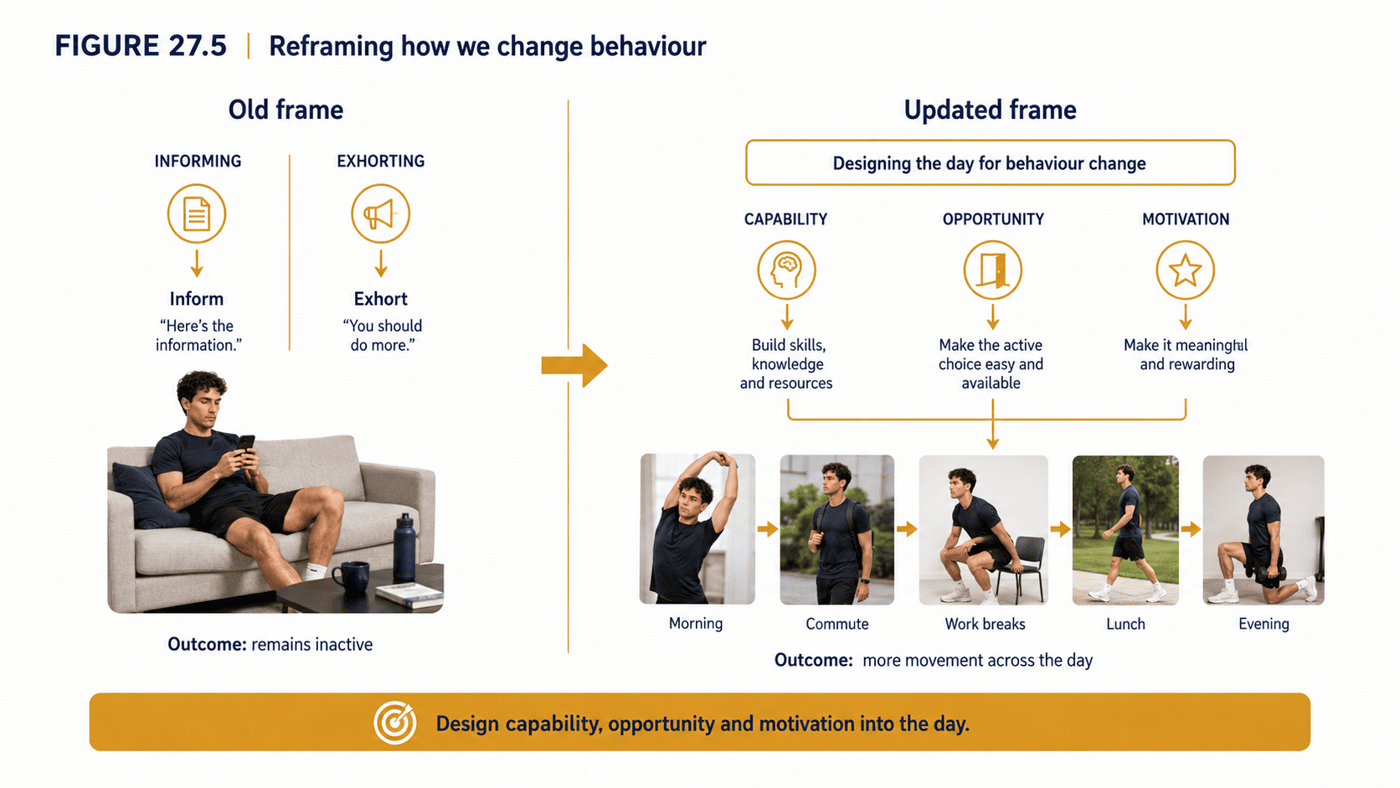
The shift this chapter asks for is captured in Figure 27.5: away from the instinct to inform and exhort — to give people the facts and urge them to try harder — and toward designing capability, opportunity and motivation into people’s lives. It is the same shift, at the level of psychology, that Chapter 25 described at the level of the workplace and Part VII at the level of the individual day: away from willpower and good intentions, and toward making the desired behaviour easy, prompted, rewarding and automatic.
This reframing is both realistic and hopeful. Realistic, because it takes human behaviour as it actually is — shaped far more by habit, environment and the friction of the moment than by knowledge or resolve. Hopeful, because it means that the failure to move is not a failure of character to be overcome by trying harder, but a design problem to be solved — and design problems can be solved. For the desk body, the implication is liberating: people do not need to be better people to move more; they need environments, habits and supports that make moving the natural thing to do. Build those, and the knowing-doing gap — the puzzle this chapter began with — begins to close.
| Barrier | Usually a lack of | Matched strategy |
|---|---|---|
| “No time” | Opportunity | Tiny, woven-in movement (reset, snacks) |
| Forgetting | Opportunity (cues) | Prompts; anchor to existing habits |
| Self-consciousness | Opportunity (norms) | Discreet options; a culture of moving |
| Low motivation | Motivation | Link to values; build rewarding habits |
| Sedentary defaults | Opportunity | Redesign the environment and defaults |
| “Don’t know how” | Capability | Concrete, achievable actions; build confidence |
Table 27.1. Common barriers to movement, the component usually lacking, and the strategy that matches — diagnose, then address.
In summary
- There is a wide knowing-doing gap: almost everyone knows they should move more, yet most do not — the central challenge of behaviour change.
- Information alone rarely changes behaviour; the information-deficit model is mistaken, because behaviour is driven by habit, environment, emotion and norms as much as knowledge.
- Behaviour requires capability, opportunity and motivation together; if any is missing it does not happen, which gives a diagnostic tool for change (Michie et al., 2011).
- Capability is rarely the main barrier for movement, though confidence and know-how matter; opportunity — time, space, prompts, permission — is often the binding constraint (Marteau et al., 2012).
- Motivation has reflective and automatic faces; durable motivation grows when movement is autonomous, achievable and sociable, not coerced or shamed (Ryan & Deci, 2000).
- Habit is the bridge to automatic behaviour: anchor movement to existing cues, notice the reward, and repeat over weeks until it needs no decision (Lally et al., 2010).
- Effective change matches a strategy to each specific barrier — thoughtful design, not exhortation — reframing the failure to move as a solvable design problem, not a flaw of character.
References
Lally, P., van Jaarsveld, C. H. M., Potts, H. W. W., & Wardle, J. (2010). How are habits formed: Modelling habit formation in the real world. European Journal of Social Psychology, 40(6), 998–1009.
Marteau, T. M., Hollands, G. J., & Fletcher, P. C. (2012). Changing human behavior to prevent disease: The importance of targeting automatic processes. Science, 337(6101), 1492–1495.
Michie, S., van Stralen, M. M., & West, R. (2011). The behaviour change wheel: A new method for characterising and designing behaviour change interventions. Implementation Science, 6, 42.
Owen, N., Healy, G. N., Matthews, C. E., & Dunstan, D. W. (2010). Too much sitting: The population health science of sedentary behavior. Exercise and Sport Sciences Reviews, 38(3), 105–113.
Prochaska, J. O., & DiClemente, C. C. (1983). Stages and processes of self-change of smoking: Toward an integrative model of change. Journal of Consulting and Clinical Psychology, 51(3), 390–395.
Ryan, R. M., & Deci, E. L. (2000). Self-determination theory and the facilitation of intrinsic motivation, social development, and well-being. American Psychologist, 55(1), 68–78.