Part VIII · CORPORATE WELLNESS APPLICATION
Desk Body Screening for Coaches and Wellness Teams
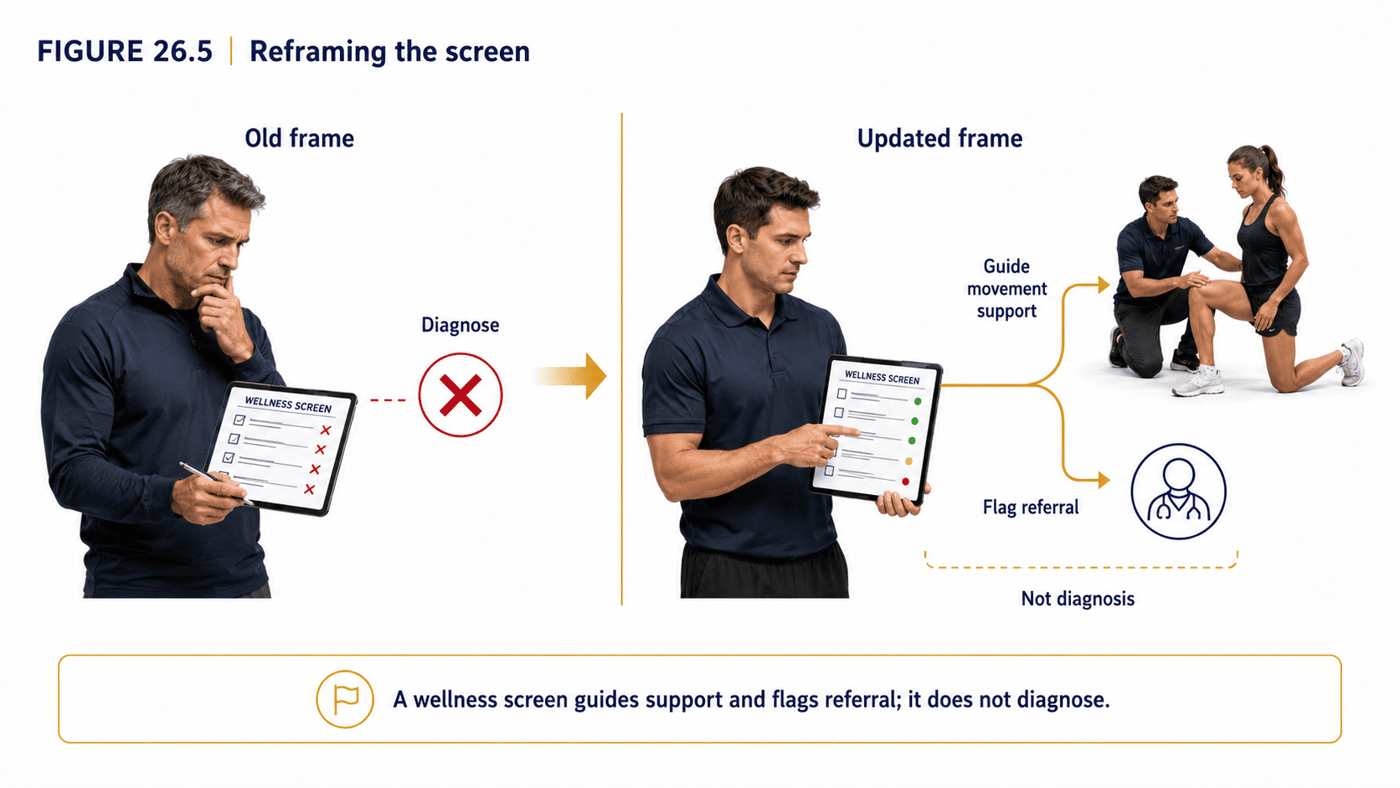
Coaches and wellness teams are often the first to notice the desk body’s troubles, and a simple, responsible screen can help them guide movement support and recognise when to refer. This chapter sets out such a screen — and insists, throughout, on the bright line that defines it: these are wellness screens to guide and refer, never diagnostic instruments.
26.1 Screening, Not Diagnosing
This chapter must open with the point that governs everything in it, because to mistake it would be to do harm. The screening described here is for coaches, personal trainers, wellness leads and similar non-clinical professionals, and it is wellness screening, not clinical diagnosis. Its purpose is to help such professionals guide people toward appropriate movement support and — just as importantly — to recognise when someone should be referred to a qualified healthcare professional. It is emphatically not a means of diagnosing conditions, naming pathologies, or treating injury or disease, none of which lie within the competence or remit of a non-clinician.
This bright line is not a legal formality but a matter of genuine safety and respect. A coach who strays into diagnosing risks giving false reassurance, causing alarm, delaying proper care, or doing harm through advice beyond their competence. The skilled and responsible non-clinician is defined precisely by knowing where their role ends — by guiding movement confidently within their competence, and referring promptly and without hesitation whenever something falls outside it. Everything that follows in this chapter — the domains, the items, the triage — must be read in this light: as tools to guide and to refer, never to diagnose. A reader who keeps this single principle firmly in view will use the rest of the chapter well.
26.2 The Purpose of a Wellness Screen
Within that boundary, a wellness screen serves two clear and legitimate purposes. The first is to guide appropriate movement support: to build a practical picture of a person’s movement habits, mobility, strength and comfort so that the general movement guidance of this book — the reset system, the routines, the emphasis on walking — can be offered in a way that fits them. The second, and the more important for safety, is to recognise when to refer: to spot the warning signs that mean a person should be seen by a qualified healthcare professional rather than guided by a coach.
Both purposes are about direction, not diagnosis. The screen does not tell a coach what is wrong with someone; it helps them decide what to do next — offer general movement support, work with the person on an individualised but still non-clinical plan, or refer onward. This is a genuinely valuable function: coaches and wellness teams are often the first to encounter the desk body’s troubles, and a person who is well guided toward helpful movement, or well directed toward proper care when they need it, has been served well; coaches and wellness teams are, in this sense, an important first line of support for the desk body in the workplace (Buckley et al., 2015). The screen is a compass for the non-clinician, pointing the way — not a diagnostic verdict.
26.3 The Four Domains
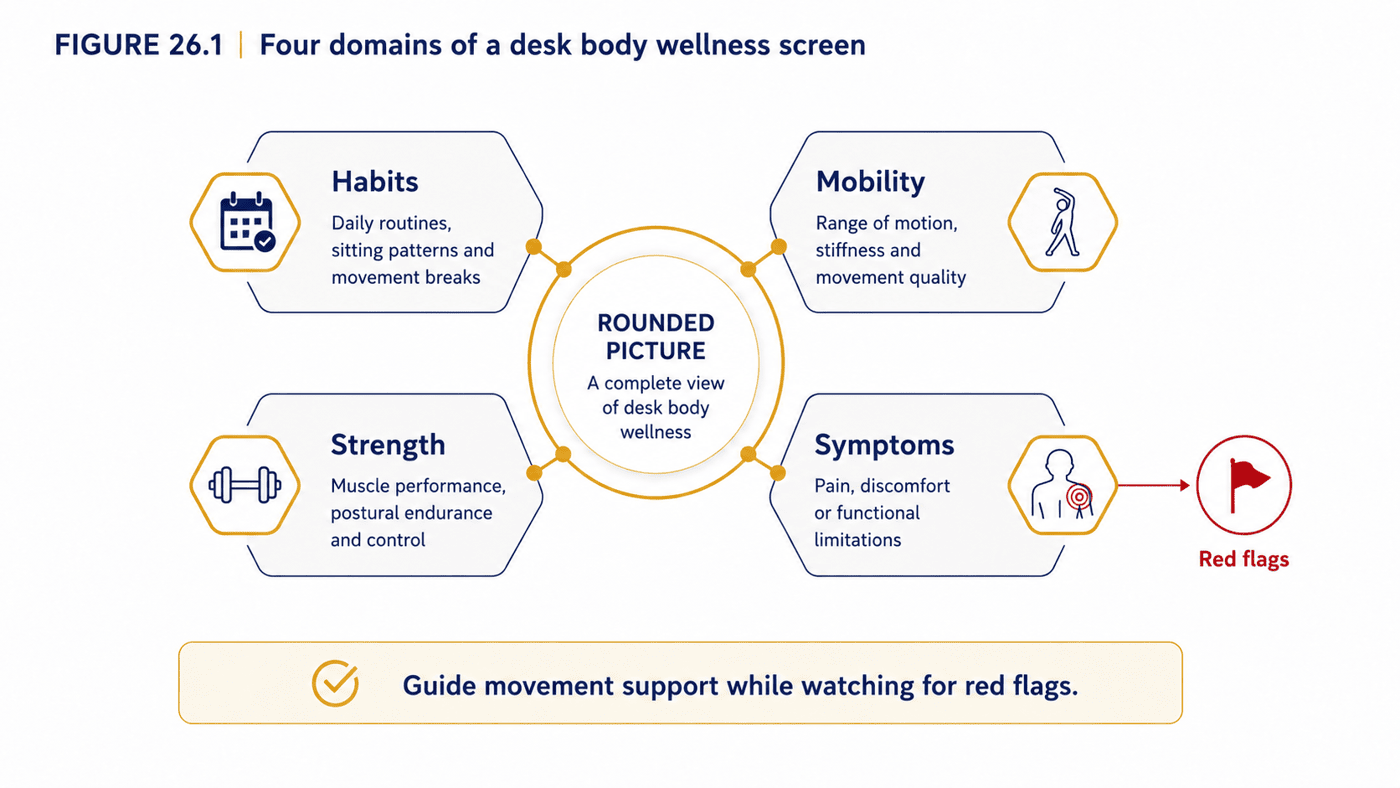
A practical desk body wellness screen looks across four simple domains, shown in Figure 26.1. The first is habits and exposure: how much a person sits, how often they break it up, and how active they are overall — the behavioural picture that this whole book identifies as the root issue. The second is mobility: whether the person can move the key regions — hips, thoracic spine, neck, ankles — through a reasonable range, the ranges Chapter 22 addresses. The third is strength and capacity: a rough sense of whether the person has the basic strength for daily tasks, the capacity Chapter 23 builds. The fourth is symptoms and flags: any discomfort the person reports — and, above all, any of the red-flag warning signs that require referral.
These four domains map directly onto the book’s account of the desk body, and together they give the non-clinician a rounded, practical picture: how the person moves through their day, how freely their body moves, how much capacity it has, and whether anything is amiss. Crucially, the fourth domain carries a special status: while the first three guide movement support, the symptoms-and-flags domain exists above all to catch the warning signs that must trigger referral, and it therefore takes priority over everything else, as the next sections make clear.
26.4 Example Screen Items
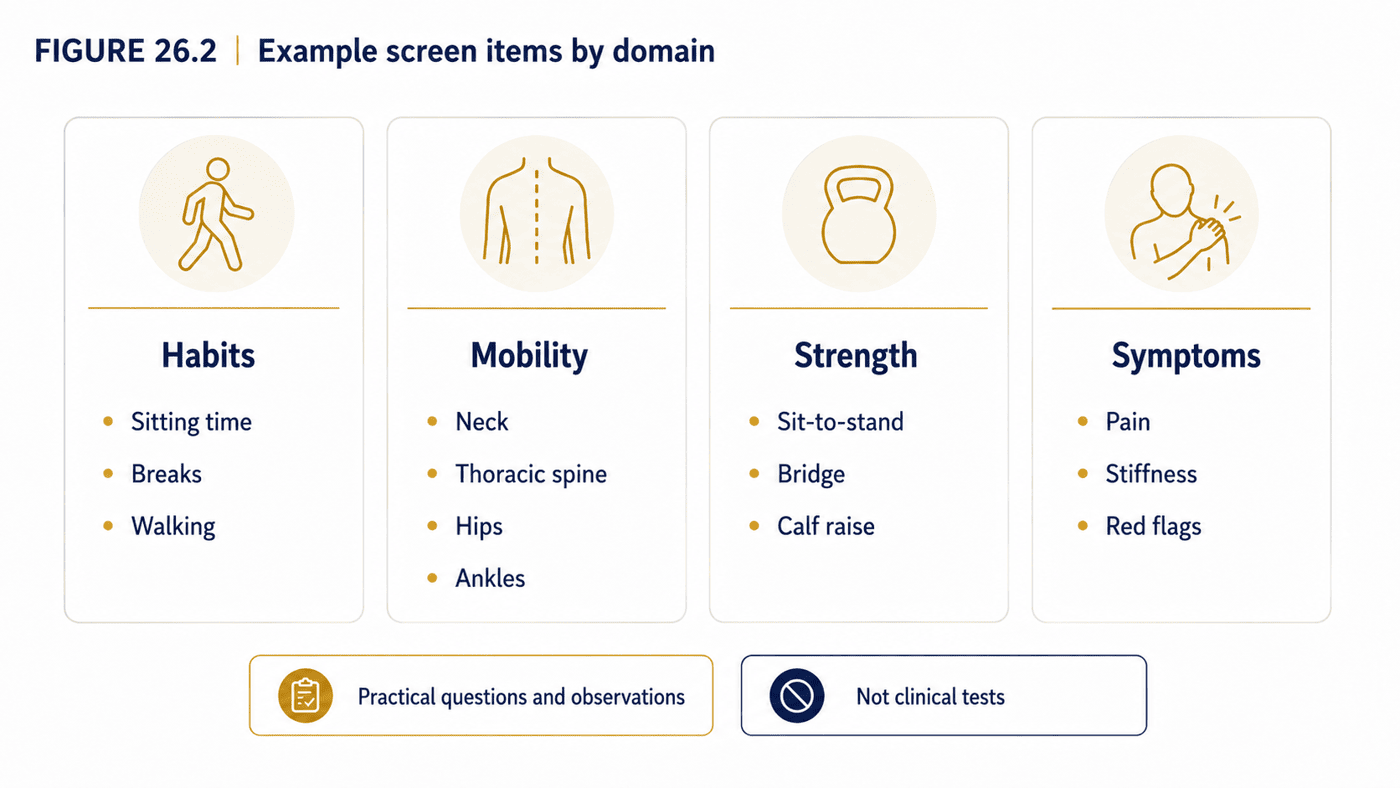
What does screening across these domains actually look like in practice? It is built from simple, practical questions and observations — not clinical tests — as Figure 26.2 illustrates. For habits, a few questions suffice: roughly how many hours a day do you sit; how often do you get up and move; how much walking or activity do you do in a typical week? For mobility, simple movement observations — can the person comfortably take the hips, upper back, neck and ankles through a reasonable range — give a practical sense of stiffness, of the kind any movement professional routinely makes.
For strength and capacity, everyday functional observations serve: how easily the person rises from a chair without using the hands, or how long they can hold a reasonable posture before tiring, give a rough, practical picture without any specialised testing. For symptoms and flags, the questions are about where any discomfort is, when it occurs and how much it affects the person — and, woven through, the specific screening for red flags described in the next section. None of this is clinical assessment; it is the practical, common-sense gathering of information that a competent coach can do, interpreted always as a guide to support and referral rather than as a diagnosis.
26.5 Red Flags First
Of the four domains, the screening for red flags is the one that matters most and must come first in the screener’s mind, because it is the safety net that protects people from harm. Most back and neck pain is non-specific and not a sign of serious disease (Hartvigsen et al., 2018; Maher et al., 2017; Foster et al., 2018; Hogg-Johnson et al., 2008); red-flag screening exists precisely to identify the small minority of presentations that do require medical attention. Before guiding anyone toward movement, the non-clinician must satisfy themselves that none of the warning signs described in Part VI is present — and if any is, the response is not movement guidance but prompt referral to a qualified healthcare professional. The consolidated red-flag guidance in Appendix C is the reference for this, and it should be thoroughly familiar to anyone screening.
In brief, and without attempting to be exhaustive, the categories of warning sign that should prompt referral — and, for the most serious, urgent or emergency care — include: neurological symptoms such as spreading numbness, pins and needles or weakness; any disturbance of bladder or bowel control, or numbness around the saddle area, or weakness in both legs (which require emergency care); symptoms following significant trauma; systemic features such as fever, unexplained weight loss or a history of cancer; pain that is severe, unrelenting, progressive or markedly worse at night; and, for headaches, the sudden ‘thunderclap’ onset, or headache with fever and a stiff neck or with neurological signs, or chest pain or breathlessness suggesting the heart rather than the musculoskeletal system. The non-clinician’s task is not to interpret or diagnose these — it is simply to recognise that they fall outside the scope of movement support and to refer promptly. When in any doubt, the safe and correct course is always to refer.
26.6 Screen, Flag, Triage, Refer
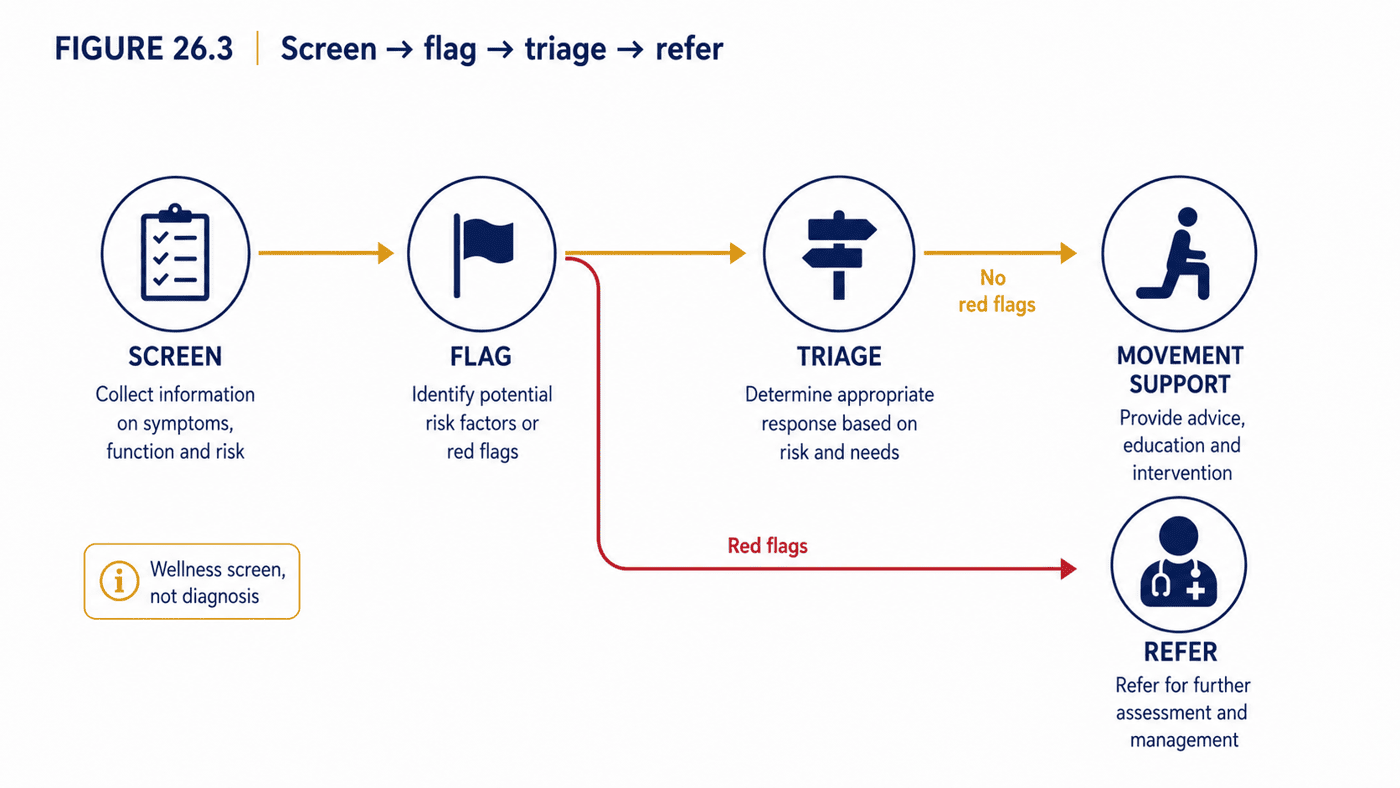
These elements combine into a simple, safe sequence, shown in Figure 26.3, that any wellness professional can follow: screen, flag, triage, refer. First, screen across the four domains. Then, flag: ask whether any red flag is present — and if so, the path ends immediately in referral to a qualified professional, before any movement guidance is given. Only if no red flag is present does the sequence proceed to triage: sorting the person by their movement need. And where the person’s needs exceed what the coach can appropriately support, the path again leads to referral or onward signposting.
The shape of this flow embodies the chapter’s safety logic. The red-flag check is a gate that everyone must pass through before any movement support is offered, so that the warning signs are never missed in the enthusiasm to help. Referral is built in not as a failure but as a normal, frequent and proper outcome — a sign of good practice, not poor. And the movement support that follows, for those who pass the gate, is the general, educational guidance of this book, offered within the non-clinician’s competence. Followed faithfully, this simple sequence lets coaches and wellness teams help confidently while keeping people safe.
26.7 Triage: Green, Amber, Red
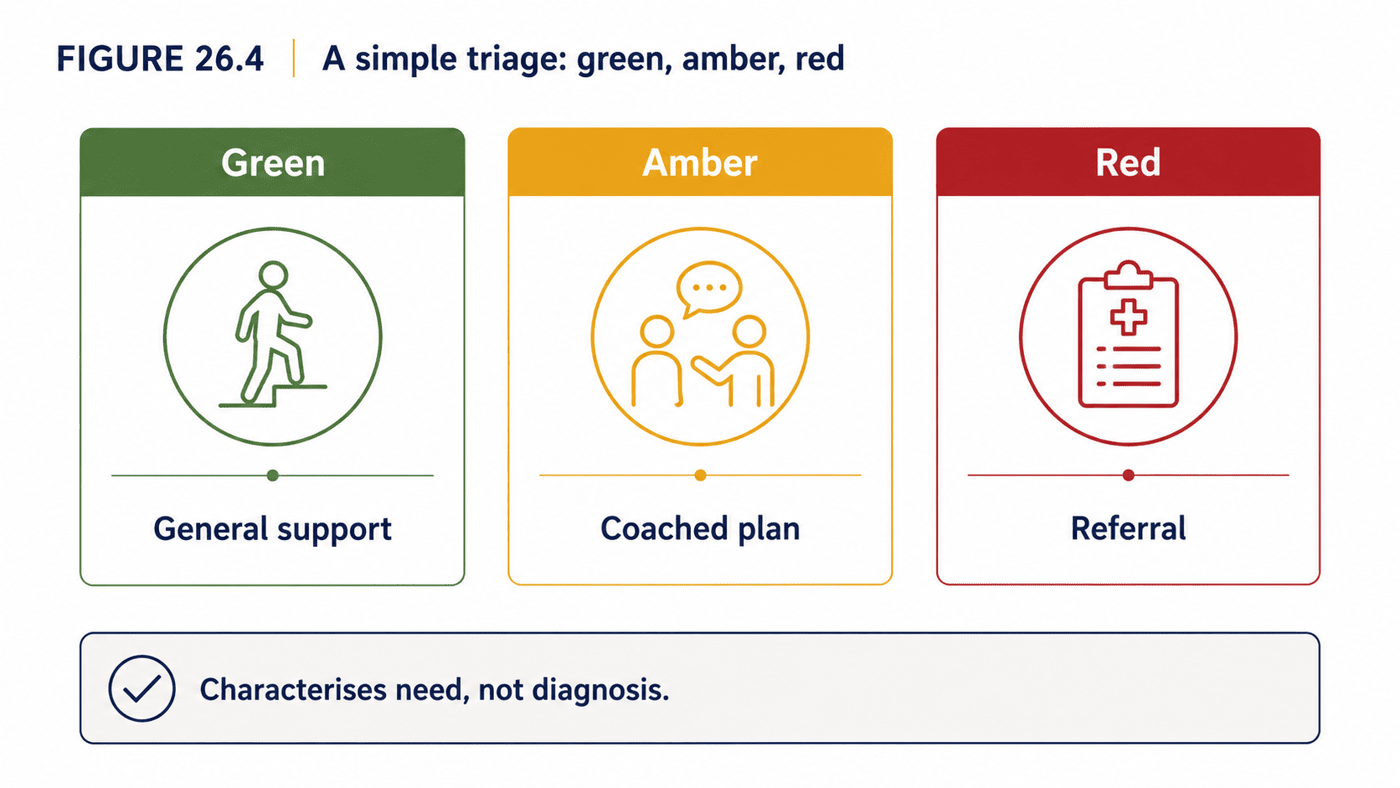
For those who pass the red-flag gate, a simple triage helps match the response to the person’s need, shown in Figure 26.4. A green picture — no flags, and only minor stiffness or simply low activity — calls for general movement support: the reset system, the routines and the walking emphasis of Part VII, offered as education and encouragement. An amber picture — more notable stiffness, weakness or recurring discomfort, but still without any red flag — calls for a more individualised, coach-guided approach, working with the person on an appropriate and progressive plan within the coach’s competence, and reviewing how they get on. A red picture — any red-flag symptom — calls, as always, for prompt referral to a qualified healthcare professional.
This green-amber-red sorting is a familiar and intuitive tool, and it keeps the non-clinician’s response proportionate. But it must be understood for what it is: a way of characterising need and deciding what to do, not a diagnostic classification of what is wrong. ‘Amber’ is not a diagnosis; it is simply a signal that a person needs more individualised movement support and closer attention than a green picture, while still falling within the coach’s scope. And the boundary that matters most — the line into red, into referral — is drawn by the red flags, not by the coach’s judgement of severity. Triage guides the response; it does not diagnose the person.
26.8 Staying Within Scope
Because the temptation to overstep is real — a caring coach naturally wants to help, and people often ask for more than a coach should give — a few principles help keep practice safely within scope. Refer rather than reassure when anything is uncertain: it is far safer to refer someone who turns out to be fine than to reassure someone who is not. Describe, do not diagnose: a coach can note what they observe — stiffness, low activity, reported discomfort — without attaching a diagnostic label or speculating about pathology. Communicate carefully, in a way that informs and, where referral is needed, encourages it without causing undue alarm — the same calm, non-frightening tone the pain chapters of Part VI model (O’Sullivan et al., 2018).
It is also worth attending to the ordinary professional basics: keeping appropriate records of what was discussed and advised, being clear with people about the nature and limits of the screen, and working within the standards and insurance of one’s profession. Organisations setting up screening should ensure their staff are appropriately trained for this limited role and clear about its boundaries, and should take their own professional, occupational-health and legal advice. None of this is onerous, and all of it protects both the people being screened and the professionals doing the screening. The screen is a powerful aid to helping people well — provided it is always used as what it is: a guide to support and referral, within scope, and never a substitute for clinical care.
What a wellness screen is not
It is worth stating plainly what the screen is not, since clarity about its limits is what makes it safe. It is not a clinical assessment: it does not diagnose, and it cannot substitute for the judgement of a qualified healthcare professional. It is not a gatekeeping hurdle designed to keep people away from care — on the contrary, its safety function is to direct people toward care when they need it. It is not infallible: a screen can miss things, which is precisely why the bias must always be toward referral when anything is uncertain. And it is not a one-off verdict that, once passed, need never be revisited.
Understanding these limits is not a weakness of the screen but the source of its value. A tool used in clear awareness of what it cannot do is used safely; a tool mistaken for more than it is becomes dangerous. The competent non-clinician holds these limits firmly in mind, and is therefore neither falsely reassured by a ‘green’ screen nor tempted to act beyond their role — they screen, guide and refer, and leave diagnosis and treatment to those qualified for them.
Re-screening and ongoing attention
Screening is not a single event but part of an ongoing, attentive relationship. People change: habits shift, new discomforts arise, and a person who showed no red flag at one point may develop one later. A responsible approach therefore treats screening as something to revisit — periodically, and especially whenever a person reports a change — rather than as a box ticked once and forgotten. The coach who stays alert to new symptoms over the course of working with someone is practising the safety function of screening continuously, not just at the outset.
This ongoing attention is particularly important for the red flags. A new neurological symptom, a change in pain, an unexplained development that emerges months into a movement programme demands the same prompt referral as one found at the first screen — perhaps more so, since a change in an established pattern can itself be significant. The watchfulness that screening embodies, in short, is not a hurdle at the entrance but a habit of attention maintained throughout, always ready to redirect someone toward proper care should the need arise.
Communicating a referral
How a referral is communicated matters greatly, because the aim is to direct someone toward care without frightening them. The same calm, measured, non-alarming tone the pain chapters of Part VI model applies here: a coach can explain, simply and honestly, that they have noticed something that falls outside what they can advise on, and that it would be sensible for the person to see an appropriate professional to be sure — framing the referral as a normal, prudent step rather than a cause for alarm. Most referrals, after all, are precautionary, and saying so truthfully reassures.
Equally, a coach should neither speculate about what might be wrong nor offer a diagnosis dressed up as a guess, both of which can frighten or mislead. The message is simply that the matter is outside the coach’s scope and warrants professional attention — delivered with enough seriousness that the person acts on it, but without dramatising. Handled this way, a referral protects the person without distressing them, and preserves their trust in the coach as someone who knows their limits and has the person’s wellbeing at heart.
Screening in practice
Two brief examples show the screen at work. In the first, a coach screening a new client notes, among otherwise unremarkable answers, that the person has recently developed numbness spreading down one leg and some difficulty they had not had before. Recognising a red flag, the coach does not attempt to interpret it or to begin any movement programme, but calmly explains that this should be checked by a healthcare professional first, and signposts accordingly. Whatever the eventual outcome, the coach has done exactly the right thing: recognised that the matter lay outside their scope, and referred.
In the second, a coach screens an office worker who reports long sitting, general stiffness and mild end-of-day discomfort, with no red flags of any kind — a ‘green’ to ‘amber’ picture. Here the coach proceeds confidently within scope: offering the general movement support of this book, working with the person on an appropriate, gradual plan, and staying alert to any change over time. Between them, the two examples capture the whole of responsible screening — guiding confidently where it is appropriate, referring promptly where it is not, and always knowing which is which.
Working with the wider team
Responsible screening does not happen in isolation; it works best as part of a wider network of support, with clear pathways to the professionals a coach may need to refer to. A wellness team or coach who knows, in advance, where and how to direct someone — which local services, which professionals, which routes for urgent concerns — can refer smoothly and promptly when the need arises, rather than scrambling in the moment. Establishing these referral pathways before they are needed is part of setting up screening responsibly, and is something organisations should attend to when they introduce it.
This wider-team perspective also clarifies the coach’s place in the picture. The non-clinician is one part of a larger system of health and movement support, with a valuable but bounded role: guiding general movement, recognising limits, and connecting people to the right further help. Good relationships and clear communication with clinical colleagues — understanding what each can and cannot do, and referring with useful, factual information rather than speculation — make the whole system work better for the people it serves. Screening, at its best, is not a solo act but a coordinated one, with the coach knowing both their role and the people to whom they can turn.
The value of responsible screening
It is worth ending by affirming the real value of screening done well, lest the chapter’s many cautions give the impression that it is more trouble than it is worth. A responsible wellness screen does three valuable things at once. It directs people toward appropriate movement support, so that the general guidance of this book reaches them in a way that fits their needs. It catches warning signs early, so that those who need professional care are directed to it promptly rather than struggling on or being given inappropriate advice. And it builds trust, because a coach who screens carefully, stays within scope and refers when appropriate earns the confidence of the people they work with.
These benefits are precisely why the cautions matter: it is the discipline of screening responsibly — guiding within scope, referring red flags, never diagnosing — that makes the screen genuinely helpful rather than potentially harmful. Far from being a bureaucratic encumbrance, a good screen is the tool that lets coaches and wellness teams do the most good they safely can: helping the many who simply need to move better, and ensuring the few who need more are sent to the right place. Used in the spirit this chapter describes, screening is one of the most valuable things a wellness professional can offer the desk body.
For the coach or wellness professional, then, the message of this chapter is encouraging as well as cautionary. The caution — stay within scope, refer red flags, never diagnose — is what keeps people safe and must never be relaxed. But the encouragement is real: within those bounds, the responsible screener does genuine good, helping the many who simply need to move better and ensuring the few who need more are directed to it. Used in the spirit set out here — as a guide to support and referral, never a diagnosis — a wellness screen lets coaches and wellness teams be exactly what the desk body so often needs: a knowledgeable, trustworthy first point of help.
| Step | What the non-clinician does |
|---|---|
| Screen | Build a practical picture across four domains — not a clinical assessment |
| Flag | Check for red flags first; any red flag → refer before guiding (Appendix C) |
| Triage | If no flag: green → general support; amber → coach-guided plan |
| Refer | Red flags, uncertainty, or needs beyond scope → qualified professional |
| Stay in scope | Describe not diagnose; communicate calmly; keep records; refer when in doubt |
Table 26.1. The screen-flag-triage-refer sequence — a guide for non-clinicians, not a diagnostic protocol.
In summary
- The screening in this chapter is for non-clinicians and is a wellness screen, not a diagnosis — the bright line that governs everything in it.
- Its two purposes are to guide appropriate movement support and to recognise when to refer — direction, not diagnosis.
- It screens across four domains — habits and exposure, mobility, strength and capacity, and symptoms and flags — using simple practical questions and observations, not clinical tests.
- Red flags come first: before any movement guidance, screen for the Part VI warning signs, and refer any of them promptly — urgently for the most serious (Appendix C).
- The safe sequence is screen → flag → triage → refer, with the red-flag check a gate everyone passes before support is offered, and referral a normal, proper outcome.
- Triage — green, amber, red — matches the response to need (general support, coach-guided plan, or referral); it characterises need, it does not diagnose.
- Staying within scope — describe not diagnose, refer when in doubt, communicate calmly, keep records, work within training — protects both the person and the professional.
References
Buckley, J. P., Hedge, A., Yates, T., Copeland, R. J., Loosemore, M., Hamer, M., … Dunstan, D. W. (2015). The sedentary office: An expert statement on the growing case for change towards better health and productivity. British Journal of Sports Medicine, 49(21), 1357–1362.
Foster, N. E., Anema, J. R., Cherkin, D., Chou, R., Cohen, S. P., Gross, D. P., … Buchbinder, R. (2018). Prevention and treatment of low back pain: Evidence, challenges, and promising directions. The Lancet, 391(10137), 2368–2383.
Hartvigsen, J., Hancock, M. J., Kongsted, A., Louw, Q., Ferreira, M. L., Genevay, S., … Woolf, A. (2018). What low back pain is and why we need to pay attention. The Lancet, 391(10137), 2356–2367.
Hogg-Johnson, S., van der Velde, G., Carroll, L. J., Holm, L. W., Cassidy, J. D., Guzman, J., … Peloso, P. (2008). The burden and determinants of neck pain in the general population. Spine, 33(4S), S39–S51.
Maher, C., Underwood, M., & Buchbinder, R. (2017). Non-specific low back pain. The Lancet, 389(10070), 736–747.
O’Sullivan, P. B., Caneiro, J. P., O’Keeffe, M., Smith, A., Dankaerts, W., Fersum, K., & O’Sullivan, K. (2018). Cognitive functional therapy: An integrated behavioral approach for the targeted management of disabling low back pain. Physical Therapy, 98(5), 408–423.