Part VIII · CORPORATE WELLNESS APPLICATION
The Future of Desk Work and Movement Health
Desk work is changing, and with it the prospects for movement health. This closing chapter looks ahead — to hybrid working, technology, active workstations and policy — and argues that the sedentary future is not fixed. Between a future sedentary by default and one where movement is designed in lies a choice; and that choice is the note on which this book ends.
28.1 Looking Ahead
This final chapter turns from the present to the future, because the world of desk work is not static, and the prospects for the desk body depend on where that world is heading. The ways people work, the technologies they use, the spaces they work in and the policies that govern them are all in flux — and each of these changes carries implications, for better or worse, for how much people sit and move. The purpose of this chapter is to survey those changes and to argue a hopeful but conditional case: that the sedentary future is not inevitable, and that, with deliberate choices, desk work and movement health can be reconciled rather than opposed.
There is a reason to close a book of mechanical science with a look at the future and at choices. Everything in the preceding chapters has shown that the desk body’s troubles arise not from any flaw in the body but from a mismatch between a body built to move and a way of working that asks it to be still. That mismatch is a product of how work has been designed — and what has been designed can be redesigned. The future of the desk body, in other words, is not a matter of fate but of decisions, made by organisations, technologists, policymakers and individuals. This chapter is about those decisions, and the future they might make.
28.2 Forces Shaping the Future
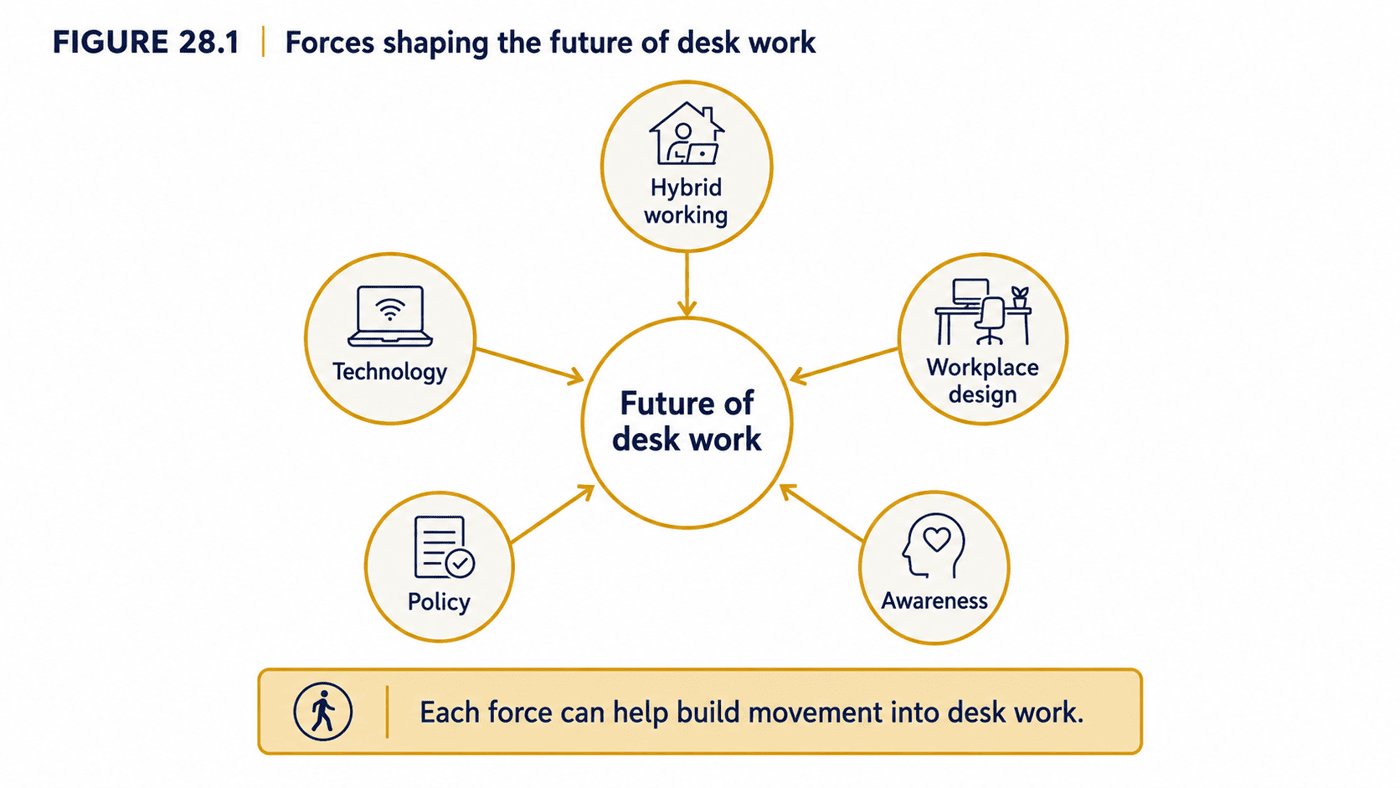
Several large forces are reshaping desk work, each shown in Figure 28.1, and each cuts both ways. The rise of hybrid and remote working has scattered desk work into homes as well as offices, which can mean less commuting movement and longer unbroken home sitting — but also more autonomy to structure one’s own movement. Technology, considered more fully below, can deepen sedentary habits or actively counter them. A growing attention to workplace design is bringing movement-friendly principles into how offices and jobs are built. Policy and guidance increasingly recognise sedentary behaviour as a health issue in its own right, as reflected in physical-activity guidelines that now address sitting directly (Bull et al., 2020). And, underlying all of these, a rising public and professional awareness of movement health — to which, modestly, this book hopes to contribute — is changing expectations of what work should ask of the body.
What unites these forces is that none has a predetermined direction: each is an opportunity that may be taken or missed. Hybrid work could entrench isolation and sitting, or could liberate people to move more; technology could chain people more tightly to screens, or could prompt and support movement; workplace design and policy could continue to treat sitting as the unremarkable default, or could deliberately build in movement. The future of the desk body will be decided by how these opportunities are taken — which is precisely why the choices of the coming years matter so much, and why a clear understanding of what the body needs, of the kind this book has tried to provide, is so timely.
28.3 A Spectrum of Active Workstations
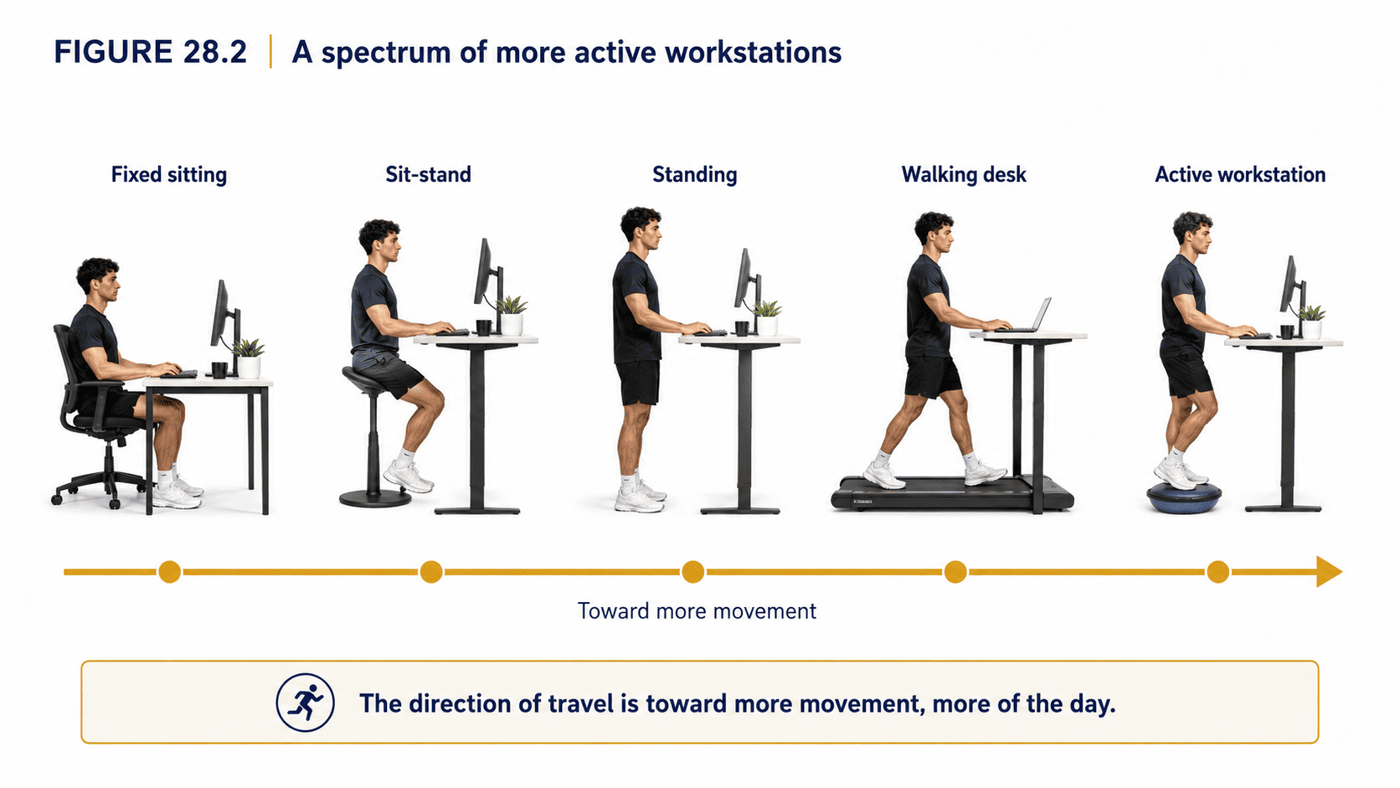
One of the most visible changes is the broadening range of ways to work, which now spans a spectrum from wholly sedentary to genuinely active, shown in Figure 28.2. At one end sits the traditional fixed sitting workstation, the status quo of the last century. Beyond it lie the sit-stand desk, allowing the alternation of posture discussed in Chapter 14; active-sitting options such as dynamic stools that keep the body subtly moving; walking meetings, which convert sedentary discussion into movement; and, at the far end, treadmill and cycle desks that let people move continuously while they work.
Two cautions keep this spectrum in perspective. First, more active is not always better in a simple sense — the principle of Chapter 14 holds, that the best posture is a varied one, and the aim is to move along and around the spectrum through the day rather than to fix oneself at any single point, however active. Treadmill desks are no more meant to be used unbroken all day than chairs are. Second, technology and equipment are enablers, not the essence: the spectrum of workstations matters because it expands the opportunity to move, but the simplest and most powerful movement remains the free and universal one, walking, that needs no equipment at all. Still, the very existence and spread of this spectrum reflects a hopeful shift — a growing recognition that work need not mean stillness, and a widening of the practical options for building movement into the working day.
28.4 Technology: Risk and Promise
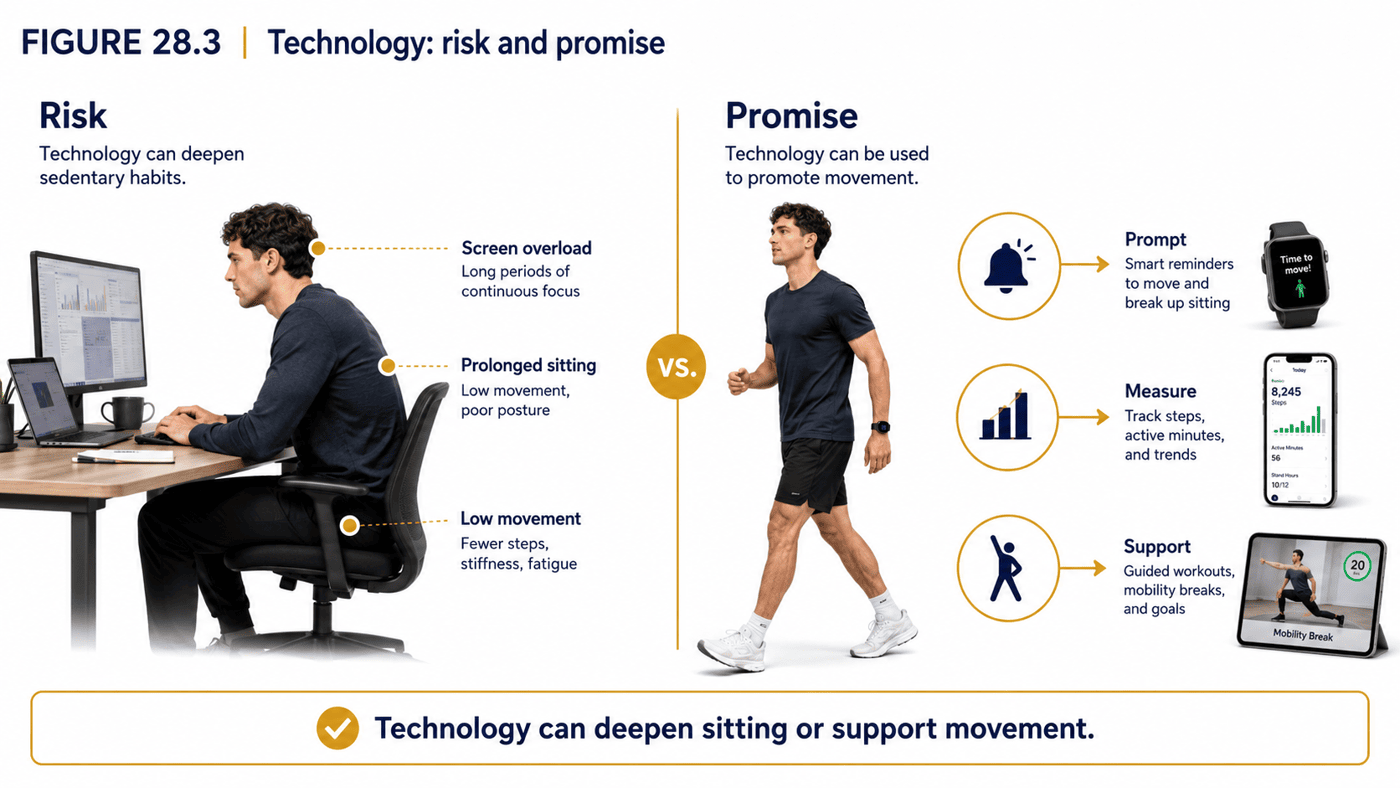
No force will shape the future of the desk body more than technology, and its influence is genuinely double-edged, as Figure 28.3 sets out. On the side of risk, technology has been the great engine of sedentary life: it has moved ever more of work onto screens, made it possible to do almost everything without rising, and, through always-on connectivity, extended sedentary work into evenings and weekends. The frictionless convenience that technology offers is, very often, the convenience of not having to move. Left to this trajectory, technology threatens to make the desk body’s plight worse.
Yet the same technology holds real promise, if turned to the purpose. The wearable devices and applications that now track movement can prompt people to break up sitting, make the invisible behaviour of sedentariness visible, and provide the feedback that, used lightly, supports change. Software can build in movement reminders; design tools can help create more active workplaces; and emerging technologies may find new ways to weave movement into work. The decisive point is that technology has no inherent direction: the very capabilities that can chain people to screens can also be turned to prompting, measuring and supporting movement. Whether technology becomes the desk body’s enemy or its ally is not a question about technology at all, but about the human choices that direct it — and those choices remain open.
The home-working desk body
The spread of home and hybrid working deserves particular attention, because it changes the desk body’s circumstances in ways both helpful and harmful. On the harmful side, home working can remove what little movement the office day contained — the commute, the walk to a meeting room, the trip to a distant printer — and can blur the boundary between work and rest, extending sedentary screen time into what were once non-working hours. The home setup may also be less considered than the office one, with people working from sofas and kitchen tables in postures sustained for hours.
On the helpful side, home working offers something the office often denies: autonomy. The person working from home has far more freedom to structure their own day — to take a reset unobserved, to walk at lunch, to alternate posture, to step outside between tasks — without the cultural constraints that can make moving feel awkward in an open-plan office. The practical message for home workers is to use that autonomy deliberately: to build in the movement the commute and the office circulation once provided, to protect the boundary between work and rest, and to apply the reset system all the more consciously precisely because the environment no longer prompts movement on its own.
Movement health as a shared responsibility
A recurring temptation, in discussions of sitting and health, is to frame the whole matter as a question of individual willpower — as though the sedentary worker simply needs to try harder. This book has argued throughout that this framing is both unfair and ineffective. The sedentary character of modern work is a product of how work, technology and environments have been designed, and responsibility for changing it is correspondingly shared: individuals can choose to move more, but employers shape the environments and cultures that make movement easy or hard, designers and technologists shape the tools and spaces, and policymakers shape the guidance and expectations.
Recognising movement health as a shared responsibility is both fairer and more hopeful. Fairer, because it stops placing the entire burden on individuals struggling against environments stacked against them. More hopeful, because it opens many more points of leverage than individual resolve alone: a great deal can be achieved when employers, designers, technologists and policymakers each take up their part, creating conditions in which moving more becomes the natural thing to do. The future of the desk body will be shaped not by individuals alone, but by all of these actors together — which is precisely why a clear, shared understanding of what the body needs matters so much.
What individuals can do now
None of this, however, means individuals must wait for systemic change before acting, and it would be a misreading of this book to take from it any sense of helplessness. While employers, designers and policymakers have their parts to play, the individual reader retains real and immediate agency. The whole of Part VII is precisely a set of things any person can do now, whatever their workplace: take the three-minute reset, weave in mobility and strength, and above all walk more. The science of this book empowers the individual to understand their own body and to act on that understanding today.
The most constructive stance, then, is to act on both fronts at once: to do what one can as an individual, here and now, while also — where one has influence — pushing for the environmental and cultural changes that make movement easier for everyone. The two are complementary, not competing: individual action improves one’s own desk body immediately, while collective change improves the conditions for all. A reader who takes up the reset system today, and who also advocates for a more active workplace, is contributing to both the personal and the shared future this chapter envisions.
A note on equity
Any honest look at the future of movement health must note that its benefits and burdens are not evenly distributed. Sedentary work, and the freedom to do something about it, vary greatly across jobs and circumstances: some workers have the autonomy, the supportive employer and the means to adopt sit-stand desks, walking meetings and flexible movement, while others are tied to fixed workstations, rigid schedules and workplaces with neither the culture nor the resources for change. There is a real risk that movement-friendly working becomes a privilege of the already-advantaged rather than a benefit shared by all.
Keeping equity in view matters, then, both as a caution and as an aspiration. The caution is that programmes and technologies should not be designed only for the office worker with autonomy and resources, quietly leaving others behind. The aspiration is that the understanding this book offers — much of which costs nothing — should be made as widely available as possible, and that the push for more active work should reach the workplaces that need it most, not only those best placed to act. A more active future of work is worth pursuing for everyone who sits to work, not merely for the fortunate few.
The long view
It is worth, finally, setting the desk body in its largest frame. As Part I argued, the troubles of the desk body are one instance of a broader theme: the mismatch between bodies shaped by millions of years of an active past and the very recent, very different environments that modern life has built. Sitting is not the only such mismatch, but it is among the most pervasive, and learning to live well with it is part of a larger task — that of consciously designing modern environments to fit the bodies that must live in them, rather than passively allowing those environments to work against us.
Seen in this long view, the project of this book is modest in scope but part of something significant: the deliberate reconciliation of human biology with human invention. The desk is one of civilisation’s great tools, and so are the screens and technologies that surround it; the task is not to renounce them but to use them in ways that respect the moving body they serve. That reconciliation — keeping what modern work offers while restoring the movement the body needs — is the quiet ambition behind every page of this book, and it is a task not for one moment but for the long future of how we work.
A growing evidence base
Reason for optimism also comes from the state of the science itself. The study of sedentary behaviour as a health issue in its own right — distinct from the question of whether people exercise — is relatively young, having gathered pace only in recent decades, yet it has already produced the substantial body of evidence drawn on throughout this book (Owen et al., 2010; Buckley et al., 2015; Ekelund et al., 2016). The trajectory is one of rapidly deepening understanding, and the coming years are likely to sharpen considerably our knowledge of how sitting affects the body, how much movement is enough, and which interventions work best.
This matters because better evidence enables better action. As research clarifies the mechanisms, refines the guidance and identifies the most effective ways to build movement into work, organisations and individuals will be able to act with greater confidence and precision than this book, written at one moment in a developing field, can offer. The science will continue to advance, and the practical guidance will advance with it; readers should expect the understanding set out here to be refined, extended and improved over time. A growing evidence base is not a sign that current knowledge is unreliable, but that the field is alive and moving in the right direction — toward an ever-clearer picture of how to keep the desk body well.
Environments have changed before
Finally, history offers grounds for hope. The idea of deliberately redesigning environments to protect human health is not new; societies have done it repeatedly, and often with great success. The sanitation reforms that conquered waterborne disease, the workplace-safety movements that made dangerous industries far less deadly, the ergonomic redesign that reduced repetitive strain — each began with the recognition that an environment was harming people, and proceeded to change that environment rather than merely exhorting individuals to cope. The sedentary character of modern work is a problem of the same kind, and amenable to the same response.
Seen against this precedent, the project of building movement back into work is neither utopian nor unprecedented; it is the latest instance of a familiar and achievable task. Just as earlier generations came to see that environments could be designed for health rather than left to harm, so this generation can come to see sustained sitting as a designed-in hazard that can be designed out. The mismatch between the moving body and the sedentary day is real — but it is the kind of problem that human societies have shown, again and again, that they can solve. That is perhaps the most hopeful note on which to consider the future of the desk body.
It is worth dwelling, for a moment, on how genuinely open this choice is. Nothing about the sedentary character of modern work is fixed or necessary; it is, rather, the unplanned by-product of a century of changes — in technology, in the nature of work, in the design of workplaces — none of which set out to make people sit, but which together have done so. What was never deliberately chosen can be deliberately changed, and the tools to change it — the understanding, the practices, the design principles — are now in hand, as this book has tried to show.
The encouraging truth is that the changes required are neither radical nor costly. They do not demand that anyone abandon desk work, give up the technologies that make modern work possible, or upend how they live. They ask only that movement be woven back into a way of working that has squeezed it out — through small individual habits, thoughtful workplace design, and a clearer collective understanding of what the body needs. Modest as these changes are, their cumulative effect, across millions of working lives, would be profound — which is why the choice between the two futures, though it may seem abstract, matters as much as almost any decision about how we live and work.
There is, too, a quiet optimism in how much is already shifting. Awareness of sedentary harm has moved from the margins to the mainstream of health thinking; sit-stand desks and walking meetings, once eccentric, are now unremarkable; guidelines, employers and individuals increasingly take the matter seriously. The direction of travel, imperfect and uneven as it is, points the right way — and every workplace that builds in movement, and every person who reclaims it, makes the better of the two futures a little more real. The choice is not made once, by someone else, somewhere distant; it is made daily, by all of us, in how we choose to work.
It bears emphasising, as this survey of the future draws to its close, that the case made throughout this book leans on no speculative or fashionable claim, but on the settled and growing weight of evidence that prolonged sitting harms health and that regular movement protects it (Saint-Maurice et al., 2020). The future of desk work will be shaped by forces no single person controls — by technology, by economics, by the slow evolution of how organisations think — and it would be naive to imagine that good intentions alone will steer it. Yet within those large currents, the accumulated choices of individuals, employers, designers and policymakers genuinely do shape the outcome, and they are not bound to repeat the sedentary pattern of the past. The understanding this book has set out is offered precisely so that those choices, wherever they are made, can be made well — in the knowledge of what the body is for, and of what it costs to forget it.
28.5 Two Futures
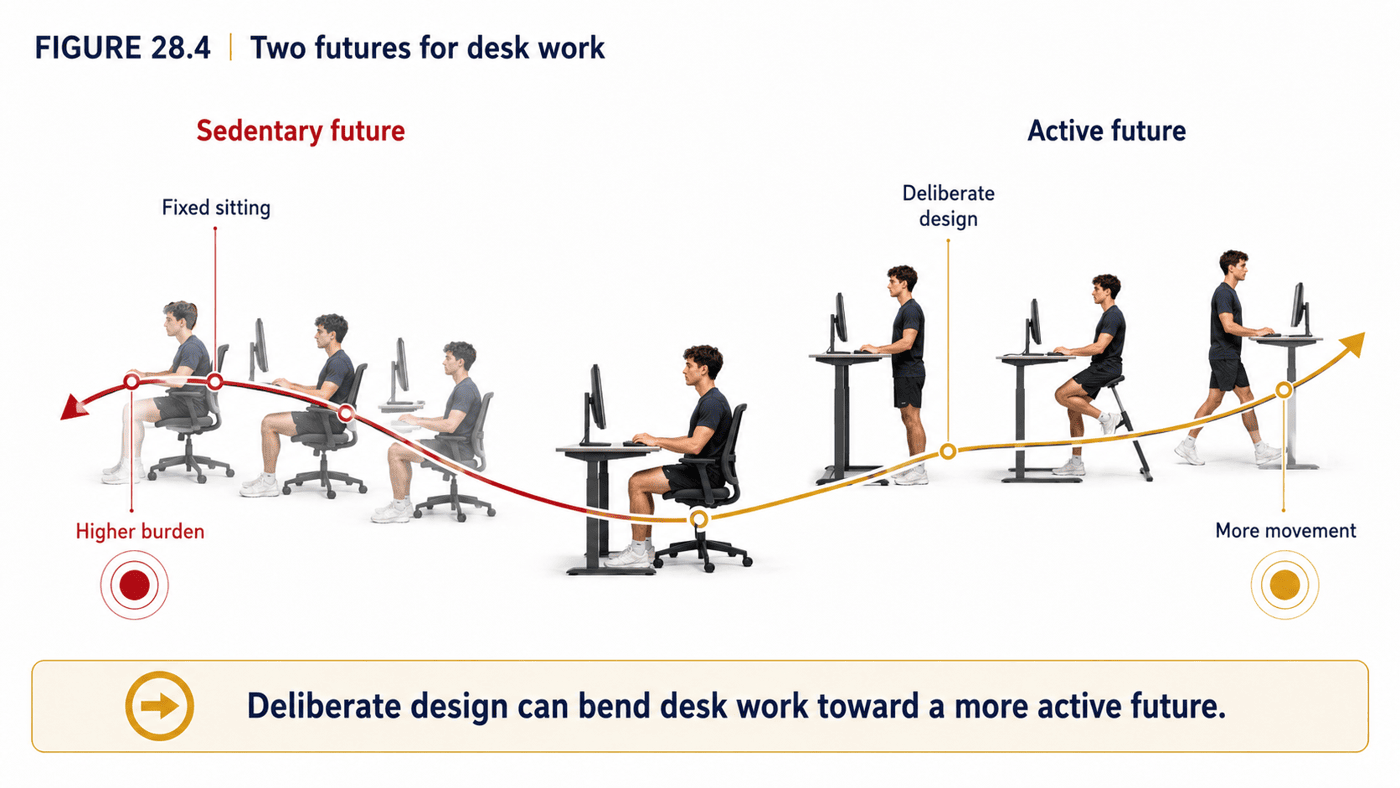
All of this resolves into a choice between two broad futures, shown in Figure 28.4. In the first, nothing changes deliberately: sitting remains the unexamined default of work, technology deepens its hold, and the sedentary burden of working life persists or grows, with all the costs to comfort, capacity and health that this book has described. In the second, the opportunities of the coming years are deliberately taken: movement is designed into work, technology is turned to support it, and the sedentary burden of work is steadily reduced. The trajectories diverge — and the difference between them is not technological inevitability but deliberate choice.
It would be naive to predict which future will prevail, and the honest expectation is a mixture: some workplaces and individuals will seize the opportunity, others will not, and the picture will vary widely. But the central message of this chapter, and indeed of this part, is that the outcome is genuinely open and genuinely chooseable. The sedentary character of modern work is not a law of nature; it is the accumulated result of countless decisions about how work is designed, and different decisions would yield a different result. The body has not changed; what has changed, and can change again, is what we ask of it. The better future is available to any organisation, and any person, willing to choose it.
What decides between these futures is not any single grand measure but the accumulation of countless ordinary ones: each workplace that builds movement into its day, each leader who normalises stepping away from the desk, each technology turned to prompting rather than prolonging sitting, each person who takes up the reset and the walk. The sedentary future arrives by default, through the absence of such choices; the active future arrives by design, through their presence. Neither is guaranteed, and the realistic expectation is a patchwork of both — but the direction is genuinely ours to influence, and every choice in favour of movement tilts the balance, however slightly, toward the future worth having.
28.6 The Future We Can Design
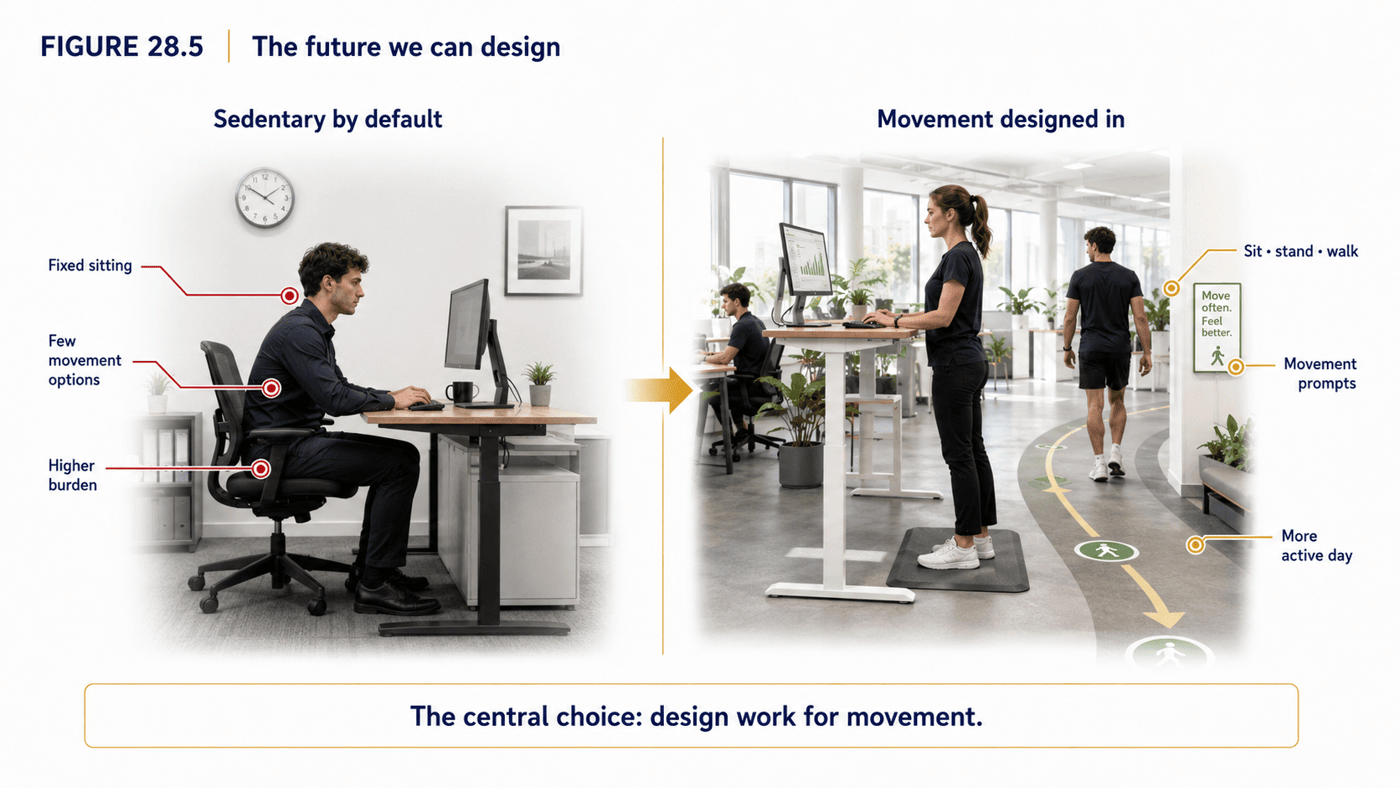
The choice this book leaves with its readers is captured, finally, in Figure 28.5: between a future that is sedentary by default — sitting designed in, movement an effort, the body asked to adapt to stillness — and one of movement by design, in which movement is built into how work is done, sitting becomes a choice rather than a sentence, and work is shaped to fit the body rather than the body forced to endure the work. This is the same reframing that has run through the whole book, now projected onto the future: the recognition that the mismatch between the moving body and the sedentary day is not fixed, and that it can be designed away.
And so this book ends where it began, with its central thesis, now carried forward into the future. The desk body, it has argued throughout, is not a weak body or a broken one; it is an under-varied, under-loaded, over-still body — a body built over millions of years to move, asked by modern work to be still. Understanding this is the first step; the reset, mobility, strength and walking of Part VII are the practical remedy; building movement into workplaces and lives, through the science of behaviour and design, is how the remedy is made to last. None of it requires the body to be other than it is. It requires only that we ask of the body what it was made for — movement — and that we design our work, our technology and our days to allow it. The desk body was never the problem. The way we have asked it to work is — and that, as this book has tried to show, is something we can change.
| Force | The risk | The opportunity |
|---|---|---|
| Hybrid & remote work | Less commuting movement; longer home sitting | Autonomy to structure one’s own movement |
| Technology | More screen time; always-on work | Prompts, feedback and active-design tools |
| Workplace design | Sitting as the unexamined default | Movement designed into spaces and jobs |
| Policy & guidance | Sedentariness ignored | Sedentary behaviour addressed directly |
Table 28.1. The forces shaping desk work, each cutting both ways — the future depends on how the opportunities are taken.
In summary
- Desk work is changing, and with it the prospects for movement health; the sedentary future is not inevitable but a matter of choice.
- Several forces — hybrid working, technology, workplace design, policy and rising awareness — are reshaping desk work, each an opportunity that may be taken or missed (Bull et al., 2020).
- Workstations now span a spectrum from fixed sitting to active options; the aim is to move along and around it through the day, while remembering that walking needs no equipment.
- Technology is double-edged: the same capabilities that deepen sedentary habits can be turned to prompting, measuring and supporting movement — the choice is in how it is used.
- Two futures diverge — sedentary by default, or movement by design — and the difference is deliberate choice, not technological fate.
- The book ends where it began: the desk body is not weak or broken but under-varied, under-loaded and over-still — a moving body asked to be still.
- Understanding, the reset system, and building movement into workplaces and lives together make the remedy last; the body was never the problem, and the sedentary design of work is something we can change.
References
Buckley, J. P., Hedge, A., Yates, T., Copeland, R. J., Loosemore, M., Hamer, M., … Dunstan, D. W. (2015). The sedentary office: An expert statement on the growing case for change towards better health and productivity. British Journal of Sports Medicine, 49(21), 1357–1362.
Bull, F. C., Al-Ansari, S. S., Biddle, S., Borodulin, K., Buman, M. P., Cardon, G., … Willumsen, J. F. (2020). World Health Organization 2020 guidelines on physical activity and sedentary behaviour. British Journal of Sports Medicine, 54(24), 1451–1462.
Ekelund, U., Steene-Johannessen, J., Brown, W. J., Fagerland, M. W., Owen, N., Powell, K. E., … Lee, I.-M. (2016). Does physical activity attenuate, or even eliminate, the detrimental association of sitting time with mortality? The Lancet, 388(10051), 1302–1310.
Owen, N., Healy, G. N., Matthews, C. E., & Dunstan, D. W. (2010). Too much sitting: The population health science of sedentary behavior. Exercise and Sport Sciences Reviews, 38(3), 105–113.
Saint-Maurice, P. F., Troiano, R. P., Bassett, D. R., Graubard, B. I., Carlson, S. A., Shiroma, E. J., … Matthews, C. E. (2020). Association of daily step count and step intensity with mortality among US adults. JAMA, 323(12), 1151–1160.