Part VIII · CORPORATE WELLNESS APPLICATION
Building a Desk Body Wellness Programme
The desk body is not only an individual concern but a workplace one. This chapter turns the book outward to the organisation, setting out how to build movement into the working environment through four pillars — environment, education, the movement system and culture — on a foundation of measurement, and how to implement it sensibly and evaluate whether it works.
25.1 From the Individual to the Organisation
Every part of this book until now has addressed the desk body of the individual — the person at the screen, and what they can understand and do. But desk work is overwhelmingly a collective activity, organised by employers in workplaces whose design, norms and expectations shape how people sit and move as powerfully as any private choice. A person may know everything in this book and still be defeated by an environment that demands unbroken sitting, a culture that frowns on moving, and a working day with no room built in for movement. This final part, accordingly, turns the lens outward, to the organisations where desk work happens.
The case for organisations to act is twofold. The human case is the one this whole book has made: sustained sitting quietly erodes the comfort, capacity and wellbeing of the people who do desk work, and that erosion is neither inevitable nor acceptable. The organisational case follows from it: people who are comfortable, energetic and well tend to work better, and the discomfort, fatigue and ill health that sedentary work fosters carry real costs in wellbeing, engagement and lost time. The growing consensus among occupational-health experts is that workplaces should act deliberately to reduce sedentary behaviour and build in movement (Buckley et al., 2015; Owen et al., 2010), a view reflected in global guidelines that now address sedentary behaviour directly (Bull et al., 2020). The physiological basis is well established: prolonged uninterrupted sitting carries metabolic costs that regularly breaking it up helps to offset (Healy et al., 2008; Dunstan et al., 2012). This chapter sets out how to do so in a structured, evidence-informed way — not as a token gesture, but as a genuine programme.
25.2 The Four Pillars
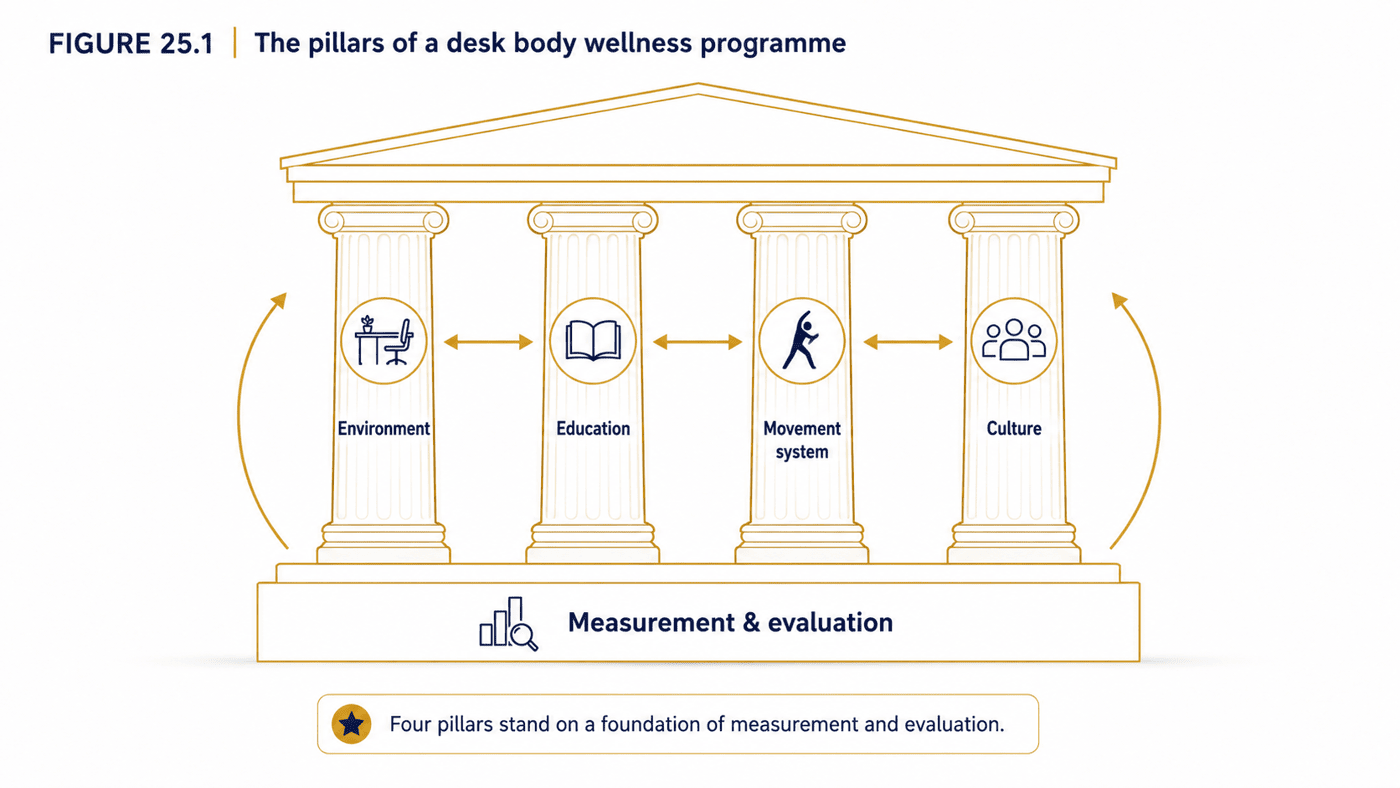
A desk body wellness programme that actually changes behaviour rests, this chapter argues, on four pillars standing on a common foundation, as Figure 25.1 shows. The four pillars are environment (designing surroundings that prompt movement), education (helping people understand the why and the how), the movement system (the practical routines of Part VII, made doable at work), and culture (the leadership and norms that make moving acceptable). Beneath them all lies the foundation of measurement and evaluation, without which a programme cannot know whether it is working or how to improve.
The pillars matter because programmes that rely on any one alone tend to fail. Education without an enabling environment leaves people knowing what to do but unable to do it; an environment of sit-stand desks without education or culture leaves expensive equipment unused; exhortation without leadership rings hollow. The four pillars are mutually reinforcing, and the most effective programmes attend to all of them together — a theme that echoes the multifactorial logic running through this whole book. The sections that follow take each pillar, and the foundation, in turn.
25.3 Pillar One: Environment
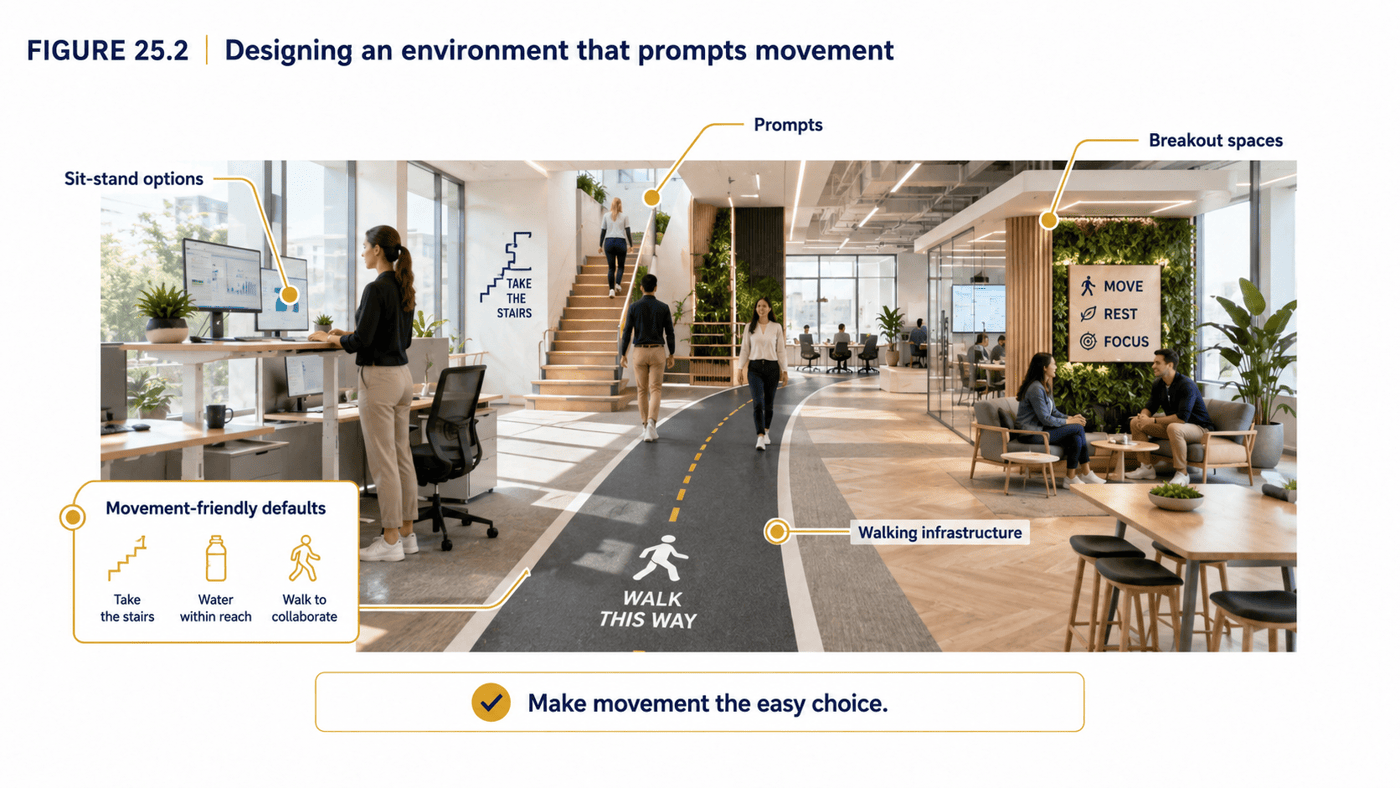
The first and arguably most powerful pillar is the environment, because the surroundings of work quietly shape behaviour all day long, whether or not anyone thinks about it. The insight that underlies this pillar, drawn from behavioural science, is that people tend to follow the path of least resistance — to do whatever the environment makes easiest — so the most reliable way to change behaviour is to change the environment so that the desired behaviour becomes the easy, default option (Marteau et al., 2012). Applied to the desk body, this means designing workplaces in which moving is easy and frequent rather than effortful and rare, as Figure 25.2 illustrates.
Several levers serve this end. Sit-stand options — adjustable desks, as discussed in Chapter 14 — let people alternate posture rather than being fixed in a chair. Movement prompts, from software nudges to simple cultural cues, remind people to break up sitting. Walking routes and infrastructure — attractive stairs, walking paths, centralised printers and bins, hubs that require a short walk — weave movement into the day’s necessities. Breakout and standing spaces make it natural to stand and move for conversations and informal meetings. And, underlying all of these, the deliberate setting of defaults so that the movement-friendly option is the one that happens automatically. None of these forces anyone to move; they simply make movement the easy choice, and that, repeated across a workforce and a year, is profoundly powerful.
25.4 Pillar Two: Education
The second pillar is education, and it is the one this book itself most directly serves. People are far more likely to adopt and sustain movement when they understand why it matters and how to do it — when the abstract injunction to ‘sit less and move more’ is replaced by a genuine understanding of what sustained sitting does to the body and what the simple remedies achieve. The science developed in this book — the desk body as under-varied, under-loaded and over-still, and the reset system as its antidote — is precisely the kind of accurate, motivating understanding that education should convey.
Effective education, however, is not lecturing. It works best when it is practical, relevant and respectful — connecting to the discomforts people actually feel, offering concrete and achievable actions, and trusting people to make their own informed choices rather than hectoring them. It should also be careful and non-alarming: the aim is to motivate and reassure, not to frighten, and the biopsychosocial, hurt-does-not-equal-harm framing of Part VI applies here too. Delivered well — through brief sessions, accessible materials, and the language to make sense of what people feel — education turns a programme from a set of imposed instructions into something people understand and choose to take part in.
25.5 Pillar Three: The Movement System
The third pillar is the practical heart of the programme: the movement system of Part VII, made doable within the working day. A programme should actively enable and encourage the four tools developed there — the three-minute reset taken through the day, the ten-minute mobility routine, the twenty-minute strength plan, and, above all, walking woven into work. The organisation’s role is to make these not merely permitted but easy and normal: building in the time, the prompts, the spaces and the cultural permission that turn good intentions into daily practice.
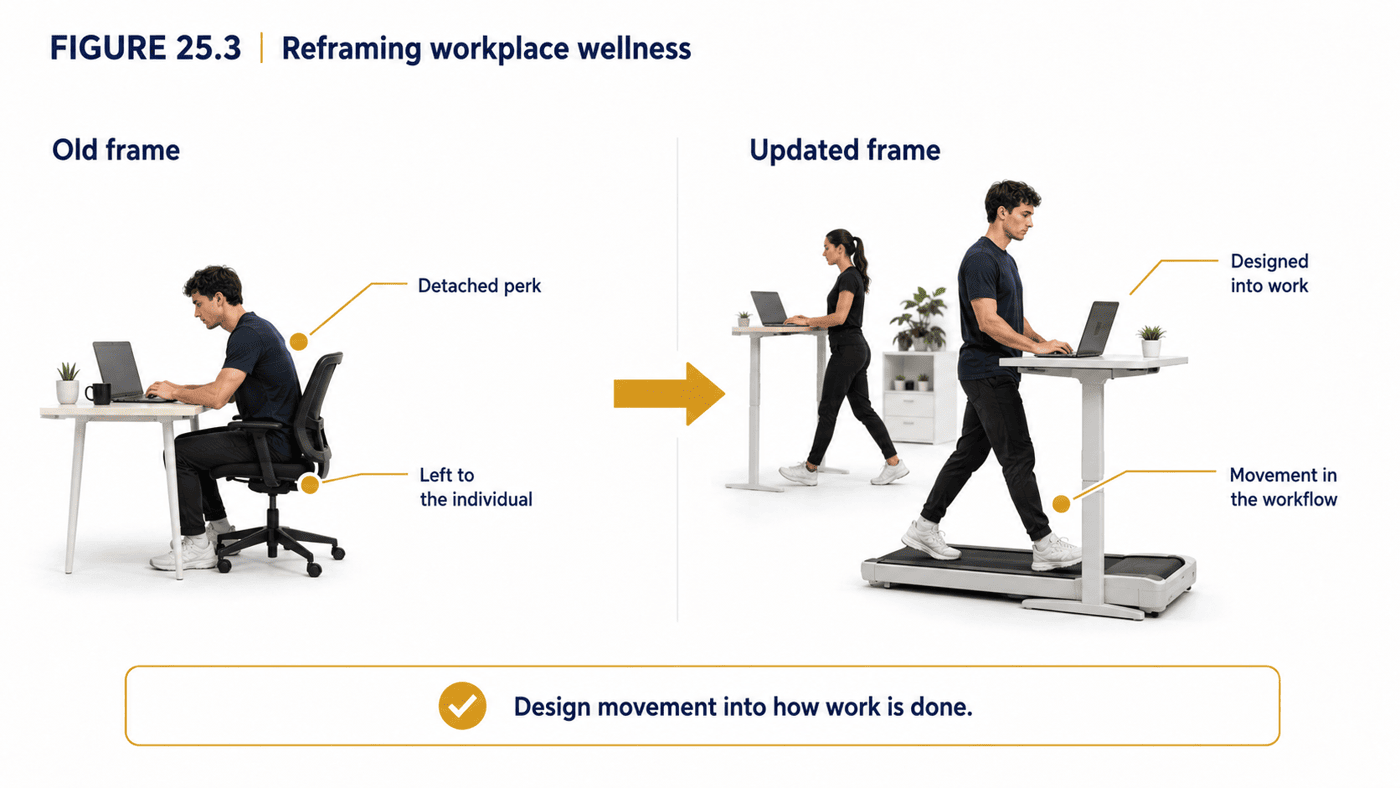
Concretely, this might mean normalising brief movement breaks in and around meetings, encouraging and enabling walking meetings, providing space and perhaps brief guided sessions for mobility or simple strengthening, and championing walking through the working day. The crucial principle, consistent with Part VII, is that this is about frequent, modest, woven-in movement rather than a separate fitness regime bolted onto an unchanged sedentary day. A programme that simply offers a gym membership while leaving the working day as sedentary as ever has missed the point; one that builds the reset system into the rhythm of work has grasped it.
25.6 Pillar Four: Culture and Leadership
The fourth pillar is the most intangible and often the most decisive: culture. The best-designed environment and the clearest education will founder if the unspoken norms of a workplace make moving feel unprofessional, disruptive or career-limiting — if standing in a meeting draws raised eyebrows, if leaving the desk looks like slacking, if the busy ideal is one of unbroken, head-down sitting. Culture grants or withholds the permission to move, and without that permission, no programme succeeds.
Culture is shaped above all by leadership and by visible norms. When leaders and managers themselves take movement breaks, hold walking meetings, and speak of movement as normal and valued rather than as a distraction, they grant everyone else permission to do the same; when they model unbroken sitting and reward only desk-bound presence, they undermine any formal programme. Building a supportive culture therefore means engaging leadership genuinely, making movement visibly normal at every level, and taking care that the programme never stigmatises — that it includes those with different bodies, abilities and circumstances, and frames movement as a shared good rather than an individual obligation or judgement. Culture is slow to change, but it is the soil in which the other pillars either flourish or fail.
25.7 The Foundation: Measurement and Evaluation
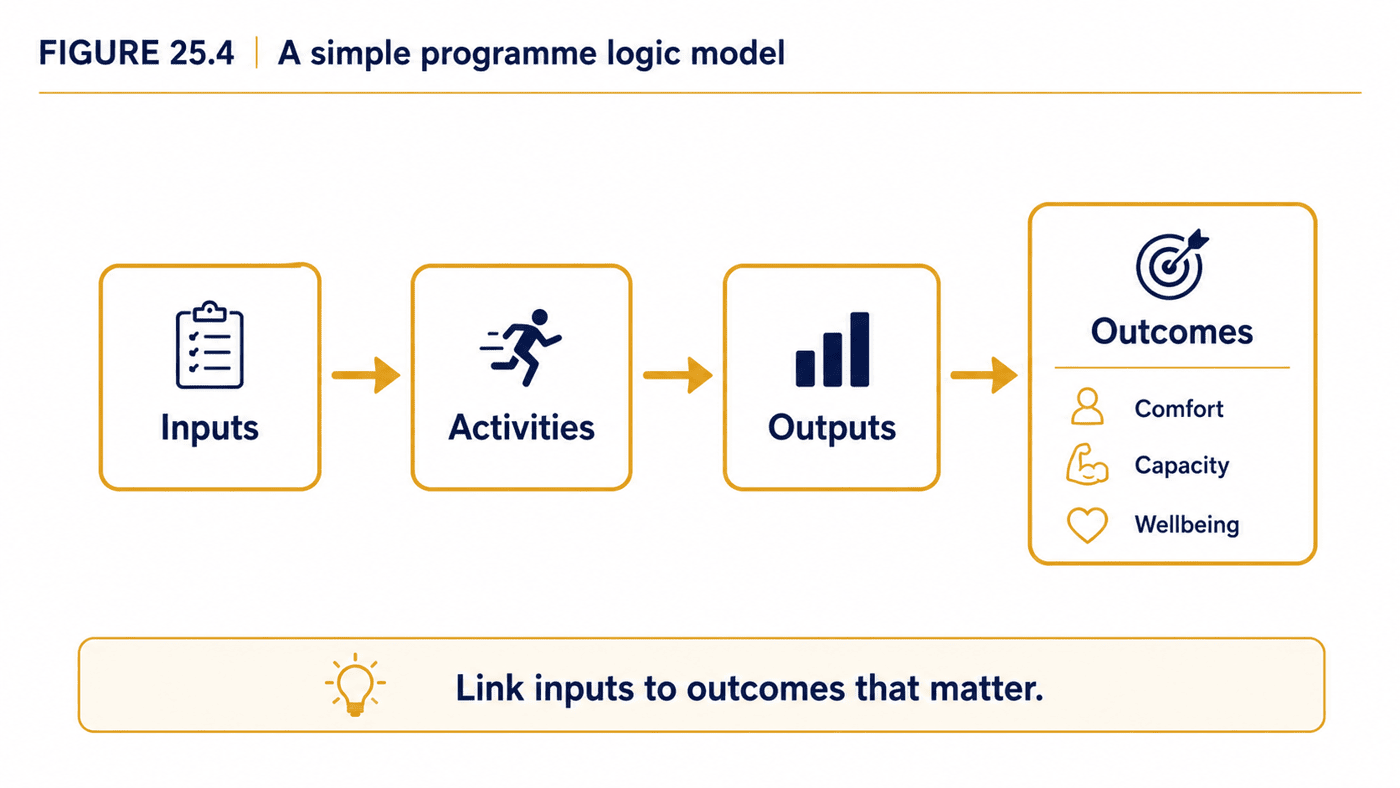
Beneath the four pillars lies the foundation of measurement and evaluation, for a programme that is not evaluated cannot know whether it is helping, whom it is reaching, or how to improve. A simple programme logic model, shown in Figure 25.4, frames this clearly: it links the inputs invested (time, space, leadership support), through the activities undertaken (education, environmental change, the movement system) and the outputs they produce (movement breaks taken, walking done, routines used), to the outcomes that ultimately matter (greater comfort, capacity and wellbeing). Designing a programme around this chain keeps it focused on outcomes rather than activity for its own sake.
In practice, evaluation can draw on simple, proportionate measures: participation and engagement; self-reported changes in movement behaviour, comfort and energy; and, over time, broader indicators of wellbeing the organisation already tracks. A word of caution is warranted, however. Measurement should be proportionate and respectful — enough to learn and improve, not so much that it becomes intrusive, burdensome, or a source of pressure and surveillance, which would undermine the very wellbeing the programme exists to support. The aim is a light, honest feedback loop that lets the programme learn what is working and adapt, not an exercise in monitoring people. Evaluated sensibly, a programme improves continually; evaluated not at all, it drifts and fades.
25.8 Implementation: A Roadmap
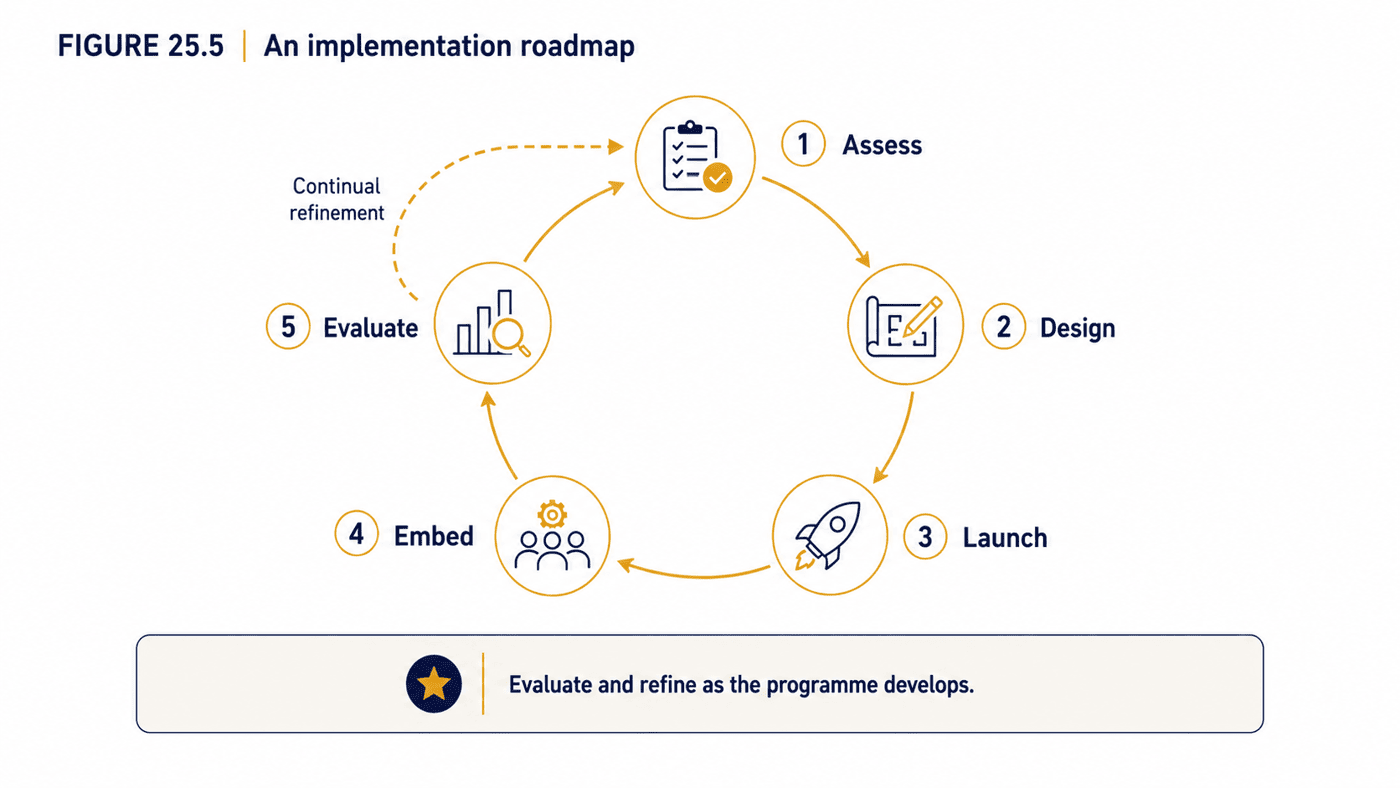
With the pillars and foundation in view, the question becomes how to put a programme in place, and here a phased roadmap, shown in Figure 25.5, serves better than a wholesale overnight launch. A sensible sequence runs: assess the current situation — needs, baseline behaviour, the existing environment and culture; design a programme tailored to that situation across the four pillars; launch it with clear, motivating communication; embed it by building habits and shifting culture over time; and evaluate it, feeding what is learnt back into refinement. The arrow from evaluation returns to the start, because a good programme is not a one-off project but a continual cycle of improvement.
Two practical principles make implementation more likely to succeed. The first is to start small and build: piloting with a willing team, learning what works in the particular organisation, and scaling gradually is far more effective than an ambitious launch that overreaches and collapses. The second is to tailor rather than impose: every organisation’s work, spaces, people and culture differ, and a programme must be shaped to fit them rather than copied wholesale from a template. The evidence on workplace interventions to reduce sitting, while still developing, suggests that multi-component approaches embedded in the organisation tend to do better than single, isolated measures (Shrestha et al., 2018) — which is precisely the four-pillar, tailored, phased approach this chapter describes.
Common pitfalls
A handful of predictable pitfalls account for most programme failures, and naming them helps avoid them. The first is the single-pillar programme — a row of sit-stand desks, or a one-off talk, or a poster campaign — which neglects the other pillars and so achieves little; movement behaviour rarely changes from any one intervention alone. The second is top-down imposition without consultation, which breeds resentment rather than participation; people support what they help shape. The third is the absent leadership that undermines a formal programme with contrary example, as section 25.6 described.
Two further pitfalls are quieter but just as corrosive. The one-off launch treats the programme as a project with an end date rather than a continual practice, so that initial enthusiasm fades and nothing endures; sustained change requires sustained attention. And the unevaluated programme cannot learn, so it neither knows whether it is working nor improves. Each of these pitfalls is the mirror image of one of the principles in this chapter — work all the pillars, involve people, lead by example, treat it as ongoing, and evaluate — and avoiding them is, in large part, simply following those principles.
Small organisations and tight budgets
A programme need not be expensive, and the belief that workplace wellness requires a large budget deters many smaller organisations needlessly. The most powerful pillars — culture and the movement system — cost little or nothing: granting permission to move, modelling it from the top, normalising walking meetings and movement breaks, and encouraging the reset system require leadership and intent far more than money. Education can be delivered through brief sessions and shared materials. Even the environment offers low-cost levers — prompts, rearranged defaults, signposted stairs and walking routes — alongside the costlier ones such as sit-stand desks.
This matters because it democratises the whole endeavour: a small business, a single team, even one manager can build much of what this chapter describes without significant expenditure. The expensive equipment is optional; the essential ingredients — understanding, permission, leadership and the weaving-in of frequent movement — are available to any organisation that chooses them. A modest programme, thoughtfully built around the cultural and movement pillars, will often achieve more than a lavishly equipped one that neglects them.
A programme in practice
A brief example shows the pillars working together. A mid-sized professional firm, concerned by staff reports of stiffness, fatigue and discomfort, began not with equipment but with a small pilot in one willing department. Leadership openly backed it and began taking walking meetings themselves; brief sessions explained, in the terms of this book, why sustained sitting mattered and what simple movement achieved; the three-minute reset and a culture of stepping away from the desk were actively encouraged; a few low-cost environmental nudges were introduced; and simple feedback — a short survey of comfort and energy — was gathered before and after.
The pilot was imperfect and modest, but it worked well enough to learn from and build on: participants reported feeling less stiff and more energetic, movement breaks became normal in that team, and the lessons — what resonated, what fell flat — shaped a wider, gradual roll-out. The firm did not transform overnight, and did not try to; it started small, attended to all four pillars, evaluated honestly, and improved. That unspectacular, patient, multi-pillar approach — rather than any single dramatic intervention — is what tends, in practice, to build a programme that lasts.
Reaching the hybrid workforce
A modern programme must reckon with the fact that much desk work no longer happens in the office at all. Where staff work partly or wholly from home, a programme confined to the office building reaches only part of the working week, and risks leaving home workers — who may sit longer and in less considered setups — unsupported. Extending the four pillars to the hybrid workforce means thinking beyond the premises: offering guidance and education that home workers can use, encouraging supportive home setups, and weaving movement prompts and norms into remote working culture as much as office culture.
The environmental pillar is harder to apply at a distance — an organisation cannot redesign an employee’s spare room — but the others translate well. Education, the movement system and culture all reach home workers through communication, leadership example and shared norms; remote meetings can begin with or build in movement just as in-person ones can; and home workers, as the next chapters discuss, often have more autonomy to move than office workers do, if encouraged to use it. A programme that consciously includes its hybrid and remote staff — rather than quietly designing only for the office — serves the whole workforce, not just the part that happens to be on site.
Taken together, these elements describe not a fixed scheme to be installed once, but an ongoing, adaptable practice of making movement easy, understood, supported and normal across an organisation. A desk body wellness programme, built and sustained in this spirit, is among the most worthwhile investments an organisation can make in its people — improving the comfort, capacity and wellbeing on which good work and good lives alike depend, and turning the science of this book from individual knowledge into collective practice.
For an organisation persuaded by all this, the first step need be no grand undertaking. It might be as simple as a leader resolving to take walking meetings and say openly why; a short session explaining to a team what sustained sitting does and how the three-minute reset helps; a few prompts and rearranged defaults that make moving easier. From such modest beginnings, attended to honestly and built upon, a genuine programme grows. The four pillars are a framework to adapt to a particular organisation, not a rigid prescription to install — and the work of building a desk body that thrives at work can begin, in earnest, tomorrow.
| Pillar | What it does | Examples |
|---|---|---|
| Environment | Makes moving the easy default | Sit-stand desks; prompts; walking routes; breakout spaces |
| Education | Builds the why and the how | This book’s science; brief sessions; practical materials |
| Movement system | The daily practice | Part VII: reset, mobility, strength, walking at work |
| Culture | Grants permission to move | Leadership modelling; visible norms; inclusion |
| Measurement | Learns and improves | Participation; self-reported comfort, energy, behaviour |
Table 25.1. The four pillars and the measurement foundation of a desk body wellness programme.
In summary
- Desk work is collective and organised, so workplaces shape movement as powerfully as individual choice — and organisations should act deliberately (Buckley et al., 2015; Owen et al., 2010).
- An effective programme rests on four mutually reinforcing pillars — environment, education, the movement system and culture — on a foundation of measurement.
- Environment is the most powerful lever: design surroundings so that moving is the easy, default choice rather than an effort (Marteau et al., 2012).
- Education builds the why and how (the role this book serves), working best when practical, respectful and reassuring rather than lecturing or alarming.
- The movement system is Part VII made doable at work — frequent, woven-in movement — and culture, shaped by leadership, grants the permission to move.
- Measurement should be proportionate and respectful: a simple logic model keeps the programme outcome-focused, a light feedback loop lets it improve.
- Implement in tailored, evaluated, phased steps — assess, design, launch, embed, evaluate — starting small; multi-component, embedded approaches do best (Shrestha et al., 2018).
References
Buckley, J. P., Hedge, A., Yates, T., Copeland, R. J., Loosemore, M., Hamer, M., … Dunstan, D. W. (2015). The sedentary office: An expert statement on the growing case for change towards better health and productivity. British Journal of Sports Medicine, 49(21), 1357–1362.
Bull, F. C., Al-Ansari, S. S., Biddle, S., Borodulin, K., Buman, M. P., Cardon, G., … Willumsen, J. F. (2020). World Health Organization 2020 guidelines on physical activity and sedentary behaviour. British Journal of Sports Medicine, 54(24), 1451–1462.
Dunstan, D. W., Kingwell, B. A., Larsen, R., Healy, G. N., Cerin, E., Hamilton, M. T., … Owen, N. (2012). Breaking up prolonged sitting reduces postprandial glucose and insulin responses. Diabetes Care, 35(5), 976–983.
Healy, G. N., Dunstan, D. W., Salmon, J., Cerin, E., Shaw, J. E., Zimmet, P. Z., & Owen, N. (2008). Breaks in sedentary time: Beneficial associations with metabolic risk. Diabetes Care, 31(4), 661–666.
Marteau, T. M., Hollands, G. J., & Fletcher, P. C. (2012). Changing human behavior to prevent disease: The importance of targeting automatic processes. Science, 337(6101), 1492–1495.
Owen, N., Healy, G. N., Matthews, C. E., & Dunstan, D. W. (2010). Too much sitting: The population health science of sedentary behavior. Exercise and Sport Sciences Reviews, 38(3), 105–113.
Shrestha, N., Kukkonen-Harjula, K. T., Verbeek, J. H., Ijaz, S., Hermans, V., & Pedisic, Z. (2018). Workplace interventions for reducing sitting at work. Cochrane Database of Systematic Reviews, 2018(6), CD010912.