Part VII · THE DESK BODY RESET SYSTEM
Walking as Workday Medicine
The reset system ends where human movement begins: with walking. The most natural, accessible and powerful movement of all, walking underpins everything else in this part — the antidote to sitting that the body was built to perform. This chapter makes the case for walking as workday medicine, and shows how to weave it through the working day.
24.1 The Simplest Medicine
The reset system closes with the simplest and, in many ways, the most powerful tool of all — one that needs no instruction, no equipment and no special skill, because every reader has done it since infancy. It is walking. After the reset that interrupts the day, the mobility that restores range and the strength that rebuilds capacity, walking is the foundation beneath them all: the most natural movement of the human body, the most direct antidote to sitting, and a remarkably complete medicine for the desk body and far beyond it.
If the preceding chapters have been about specific routines, this one is about a habit so fundamental that it scarcely feels like exercise at all. And that is precisely its power. Walking asks nothing of a person except to do more of what they are already built to do; it can be woven into the most ordinary moments of a working day; and its benefits, as this chapter sets out, are out of all proportion to its simplicity. If the three-minute reset is the single most practical habit in this book, walking is the single most important form of movement — and the two together carry most of the book’s practical message.
24.2 Built to Walk
Walking is not merely one option among many; it is, in a deep sense, what the human body is for. As Chapter 1 set out, the human body is the product of millions of years of evolution as a walking — and, when needed, running — animal (Bramble & Lieberman, 2004; Lieberman, 2013). A whole catalogue of human features, from the springy arch of the foot to the upright spine, the long legs, the efficient stride and the very way the body balances and breathes, reflects an organism shaped for covering distance on two legs. Walking is the movement around which the human body was designed.
This evolutionary heritage explains why walking suits the body so completely and feels so natural, and why its absence is so quietly harmful. The desk body is, in the most literal sense, a walking animal that has stopped walking — a creature built for daily miles confined instead to a chair. Seen this way, walking is not a worthy imposition on a reluctant body but a return to its natural state: the restoration of the movement it was made for and, in modern sedentary life, so conspicuously lacks. To walk more is simply to let the body do what it has always been built to do.
24.3 Walking as Whole-Body Medicine
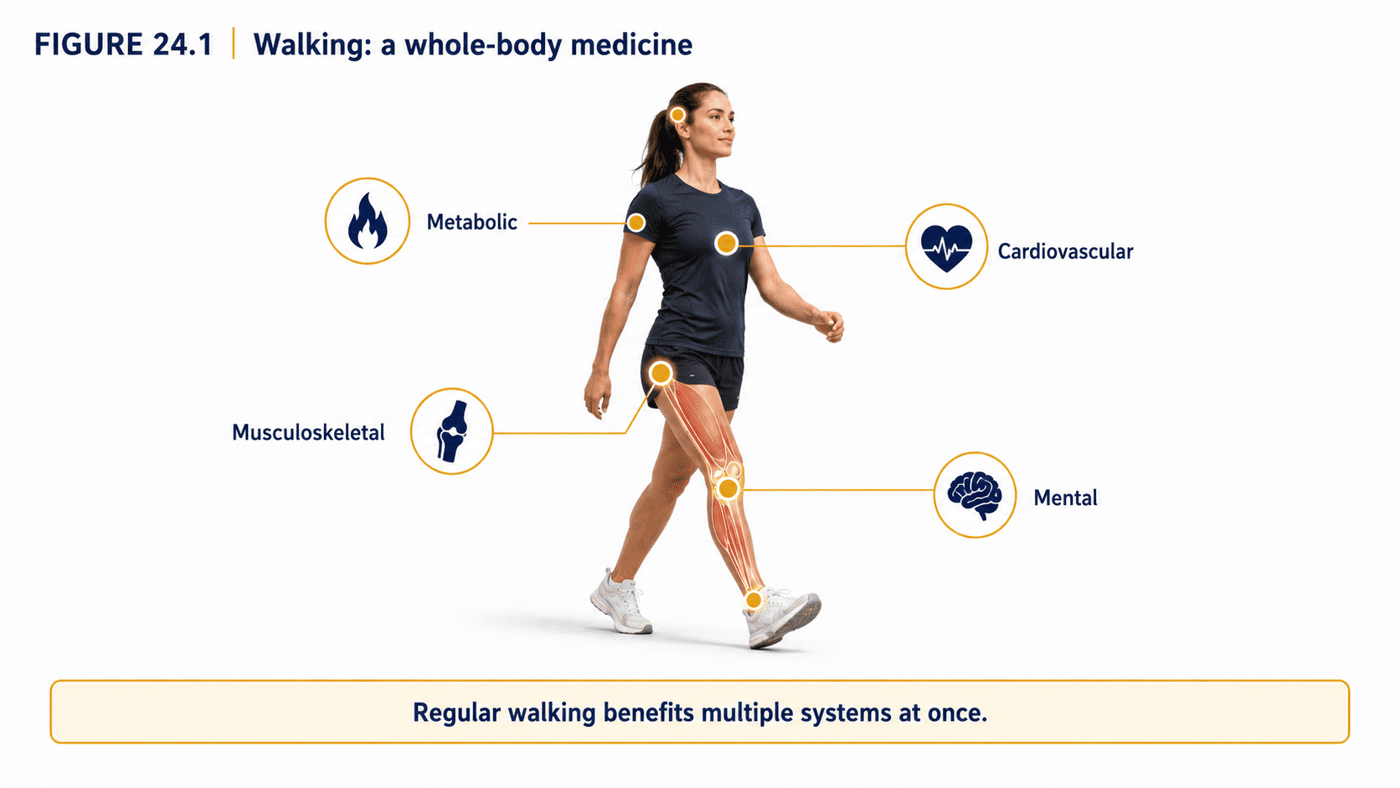
The benefits of regular walking are strikingly broad, touching nearly every system of the body, as Figure 24.1 illustrates. Metabolically, walking helps regulate blood glucose and fats and supports healthy weight, and — as Chapter 15 showed — walking breaks are especially effective at blunting the metabolic cost of sitting. For the cardiovascular system, regular walking benefits the heart and blood vessels and is associated with lower cardiovascular risk. Musculoskeletally, walking gently loads and nourishes the joints, moves the hips and legs through their range, works the muscles of the lower body, and loads bone in the way that maintains its strength. Mentally, walking improves mood, reduces stress and sharpens thinking, as Chapter 15 noted — a fact long known to writers and thinkers who walk to clear the mind.
Most strikingly of all, these benefits converge on longevity. A growing body of research links higher daily step counts with substantially lower risk of death from all causes — a relationship found consistently across large studies and populations (Saint-Maurice et al., 2020; Paluch et al., 2022; Lee et al., 2019). Indeed, sufficient daily activity appears to offset much of the mortality risk associated with prolonged sitting (Ekelund et al., 2016). Walking is, in short, about as close to a universal medicine as movement offers: free, safe for most people, requiring nothing but the will to do it, and benefiting body and mind alike. Few interventions in all of health can claim as much.
24.4 Walking and the Desk Body
For the desk body specifically, walking is almost perfectly designed as an antidote, because it directly reverses each of sitting’s core problems. It breaks up sustained sitting, interrupting the very stillness that this book has identified as the root harm. It gently loads a chronically under-loaded body, restoring the light, rhythmic loading that joints, muscles and bone depend upon. It moves the hips and legs through their range, countering the stiffness of sustained flexion, and it activates the glutes and posterior chain that sitting silences. And it clears and settles the mind, easing the stress and mental fatigue of concentrated desk work.
In this sense, walking ties the whole reset system together. A walk is simultaneously a movement break, a dose of gentle mobility, a little loading of the legs and a mental reset — several of the book’s threads delivered in one simple act. This is why walking deserves its place as the foundation of the system: not as a separate item to be added on, but as the natural movement that underlies and complements all the rest. The desk body that walks regularly has already addressed much of what the other routines target.
24.5 How Much: The Dose Response
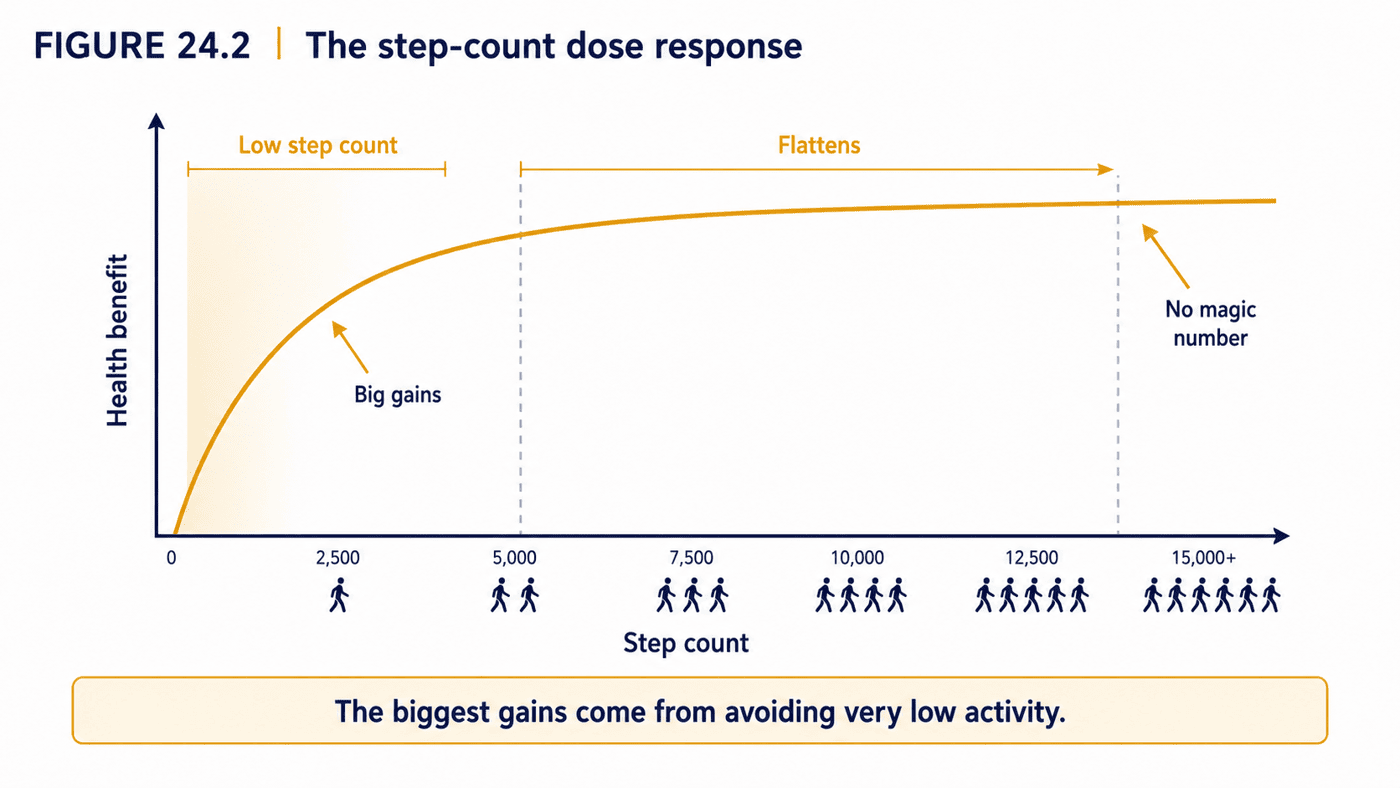
How much walking is enough? The honest and encouraging answer is that the relationship between steps and health is a dose response with its steepest gains at the bottom, as Figure 24.2 shows. The health benefit rises most sharply as a person moves from very low activity toward moderate activity, and then flattens: the difference between very little walking and a moderate amount is large and important, while the difference between a moderate amount and a great deal is smaller (Saint-Maurice et al., 2020; Paluch et al., 2022). The most valuable step, in other words, is the one taken by the person who currently takes very few.
This shape of the evidence has an important and liberating implication: the famous target of ten thousand steps a day is not a magic threshold, and was never founded on firm science — it originated, in fact, as a marketing slogan. Substantial health benefits appear well below ten thousand steps, and meaningful gains accrue from increases that any desk worker can manage (Lee et al., 2019; Tudor-Locke et al., 2011). The practical message is therefore not to hit a particular number but simply to walk more than you do now, whatever your starting point — and to remember, from Chapter 15, that the short walks of ‘movement snacks’ count fully toward the total. There is no threshold to clear, only a direction to move in. Physical-activity guidelines likewise stress regular activity over precise targets (Bull et al., 2020).
24.6 Building Walking Into the Workday
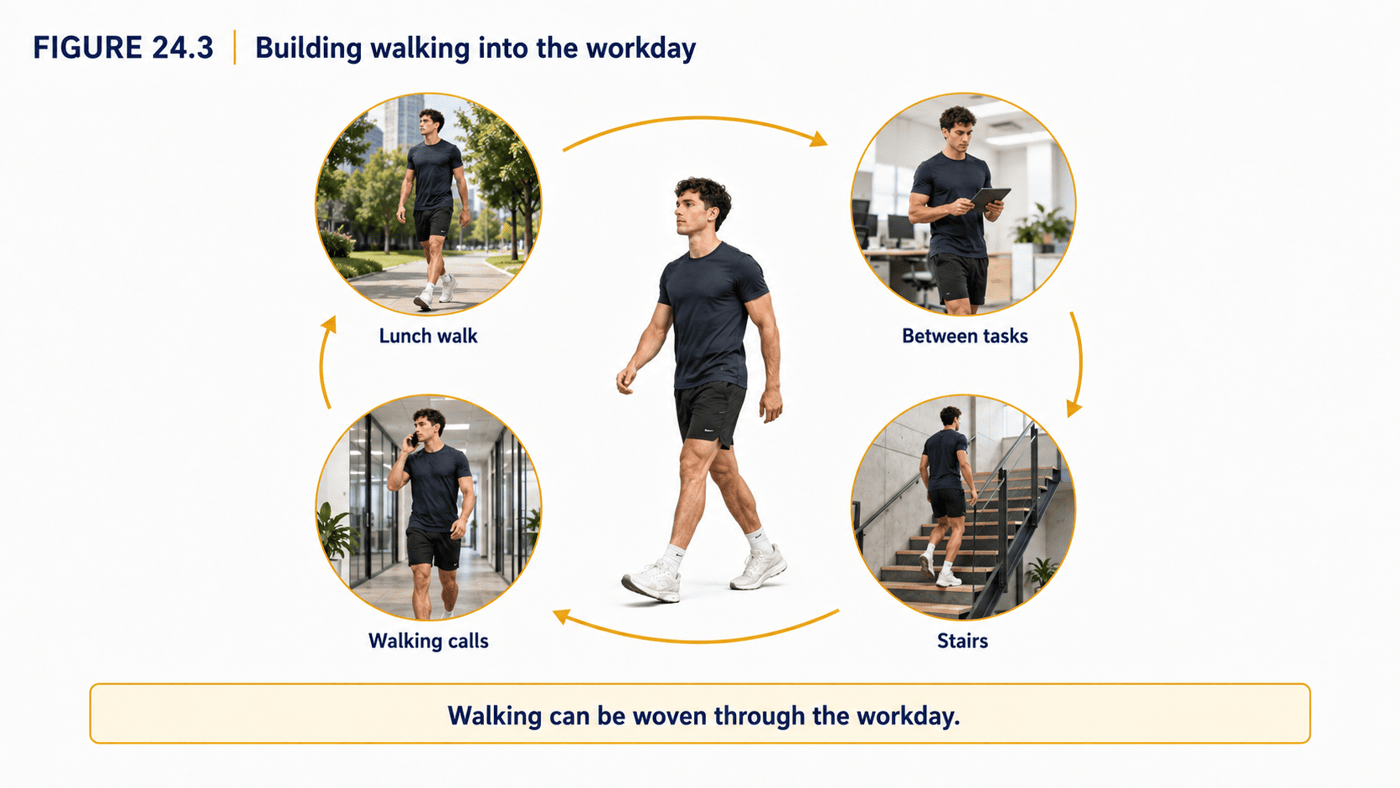
The challenge of walking is rarely the walking itself but finding room for it in a sedentary working day, and the solution, as with the movement breaks of Chapter 15, is to weave it into the day’s existing structure rather than to rely on finding separate time. Figure 24.3 sets out the opportunities. The commute can become an opportunity: walking part of the way, alighting a stop early, or parking further off turns dead travel time into movement. Walking meetings — taking a one-to-one discussion or a phone call on the move — convert sedentary hours into active ones. A lunchtime walk adds a substantial daily dose and clears the mind for the afternoon. Walking between tasks, and choosing the stairs over the lift, sprinkle small walks through the day.
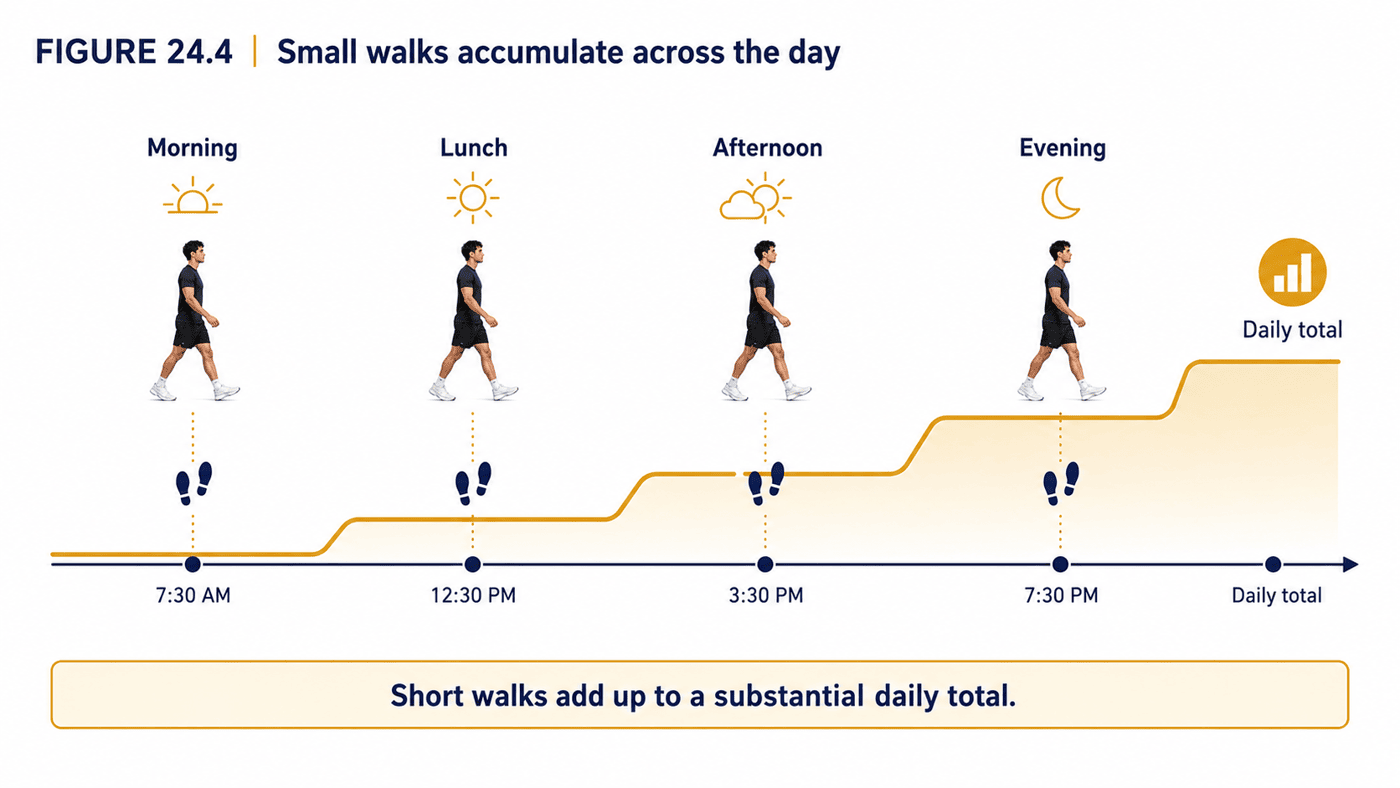
The power of this approach lies in accumulation, shown in Figure 24.4. None of these walks is long, but together, across a day, they add up to a substantial total that the sedentary day never gathers — and they do so without requiring a single block of dedicated exercise time. The desk worker who walks part of the commute, takes a lunchtime stroll, holds a walking call or two and moves between tasks may accumulate thousands of steps and a great deal of health benefit, all woven invisibly into an ordinary working day. As Chapter 15 argued of movement generally, the small and frequent compound into the large.
24.7 Walking Well
Because walking is so natural, it needs remarkably little technical instruction — the body knows how to do it, and overthinking it tends to help no one. A few light points are nonetheless worth a mention. Supportive, comfortable footwear that allows the foot to move naturally serves walking well, as Chapter 12 discussed. An easy, upright posture — tall but relaxed, eyes up, arms swinging naturally — lets the body move efficiently, though it should feel natural rather than rigidly held. And a pace brisk enough to feel one is actually exercising, while still able to hold a conversation, captures more benefit than a dawdle, without strain.
Beyond this, the best advice is not to complicate it. Walking is the one form of movement that requires no expertise, and the temptation to over-engineer it — with rules about form, gadgets and targets — risks turning a simple pleasure into a chore and a barrier. The body walks well by nature; the task is simply to give it more opportunity to do so. For almost everyone, more walking, done comfortably and regularly, is the whole of the prescription.
Walking and the mind
Among walking’s many benefits, its effect on the mind deserves particular emphasis, because it speaks directly to the experience of desk work. The desk worker spends the day not only sedentary but mentally absorbed, often under pressure, and walking offers a uniquely effective antidote: it reliably lifts mood, reduces stress and clears mental fog, and it has a long and well-attested association with creative and clear thinking. The common experience of a problem untangling itself on a walk, or a low mood lifting, is no illusion; the rhythmic, undemanding movement and the change of scene together seem to free the mind in a way that sitting at the desk does not.
This matters practically as well as personally. A walk taken in the middle of a demanding day is not time lost from thinking but, very often, time that improves it — returning the walker calmer, clearer and more focused than the unbroken desk session would have left them. The long tradition of thinkers, writers and leaders who walk to think reflects a genuine truth: for the mentally fatigued, mentally absorbed desk body, walking is as much a tonic for the mind as for the body, and the two benefits arrive together in the same simple act.
Walking with others
Walking need not be solitary, and making it social adds benefits of its own. A walking meeting turns a sedentary discussion into an active one while often loosening conversation and thought; a lunchtime walk with a colleague combines movement, connection and a break from the screen; and beyond work, walking with family, friends or a dog weaves activity into relationships and daily life. The company makes the walking more enjoyable, and enjoyment is what sustains a habit over the long term.
This social dimension also helps with the commonest reason habits fail — they fade away. A walk one looks forward to, in good company, is far more likely to endure than a solitary obligation, and a shared commitment to walk — a regular walking meeting, a standing date for a lunchtime stroll — builds in the gentle accountability that keeps a habit alive. For many people, the most reliable way to walk more is simply to walk with others.
From steps to a moving life
Walking has a way of becoming a gateway. It is so accessible, and its benefits so tangible, that it often serves as the first step — quite literally — toward a generally more active life. The person who begins by walking more frequently finds, in time, that movement feels good and that they crave more of it; the walking tends to pull the other habits of this part along behind it, making the reset, the mobility routine and the strength plan feel like natural extensions rather than impositions. Walking is, in the language of habit, a keystone habit — one good practice that quietly reorganises others around it.
This is why walking is the fitting foundation of the whole reset system. It asks the least and gives among the most; it is the easiest habit to begin and the hardest to regret; and it tends to open the door to the rest. A desk worker who does nothing more than walk substantially more than before has already transformed their physical life — and will very often find that, having started moving, they do not wish to stop.
Walking in a working life
A final example brings the chapter, and the part, to life. A software developer who was convinced he had no time to exercise — long days at the keyboard, an hour’s commute, evenings too tired to face the gym — decided simply to walk more, without adding any dedicated exercise time. He began alighting from the train two stops early, took his one-to-one meetings as walking meetings, stepped out for a fifteen-minute walk at lunch, and made a habit of pacing during phone calls.
None of it felt like exercise, and none of it required a single block of set-aside time — yet within weeks he was accumulating several thousand more steps a day than before, woven invisibly into a working life he had thought too full to change. He slept better, his mid-afternoon energy improved, his nagging stiffness eased, and he found himself clearer and calmer at his desk. He had taken no exercise class and bought no equipment; he had simply let a walking animal walk a little more — and in doing so had quietly remade his health, one ordinary step at a time.
Walking, weather and the real world
A practical objection arises quickly: what about bad weather, dark evenings, or a working environment with nowhere pleasant to walk? These are real, but rarely insurmountable. Suitable clothing turns most weather from an obstacle into a non-issue — there is, as the saying goes, no bad weather, only unsuitable clothing — and a brisk walk in cool or wet conditions is perfectly pleasant once begun. When the outdoors genuinely will not serve, indoor options abound: pacing during phone calls, walking the corridors or stairs of a building, a few laps of a shopping centre, or a treadmill at home all keep the habit alive.
The principle is to make walking robust to circumstance rather than dependent on ideal conditions, so that the habit survives the dark months and the awkward days. A walking practice that only happens in fine weather will lapse for much of the year; one that has indoor fallbacks and suitable clothing simply continues. As with every habit in this book, the aim is a default that holds up against the friction of real life, not a fair-weather intention.
Tracking, lightly
Many people find a step counter — on a phone or a wrist — a genuine help, because it makes an invisible behaviour visible and turns walking more into a small, satisfying game. Seeing the daily total climb can be quietly motivating, and a gentle awareness of how much, or how little, one moves is often enough to prompt the extra lunchtime walk or the choice of the stairs. Used this way, tracking is a useful source of feedback.
A word of caution, though, in keeping with the spirit of this chapter: the number is a servant, not a master. As section 24.5 made clear, there is no magic threshold, and a step counter should never become a source of pressure, anxiety or guilt, nor should a ‘bad’ day on the device undo the pleasure of moving. The aim is simply to walk more than before and to enjoy doing so; if the tracking supports that, it is welcome, and if it ever begins to sour the habit, it is better set aside. Walk for the walking, and let any number remain a light, encouraging guide.
Every bit of upright, moving time counts
Walking sits at the active end of a spectrum, and it is worth remembering that the whole spectrum matters, not only the dedicated walks. Between sitting still and a brisk walk lie all the small movements of an active day — standing rather than sitting, shifting and pacing, fidgeting, taking the stairs, doing things on foot rather than at a screen. As earlier chapters set out, all of this incidental movement adds up and contributes real benefit, and the desk worker who simply spends more of the day upright and in motion, in whatever small ways, is already moving in the right direction.
This broadens the message of the chapter from ‘walk more’ to ‘sit less and move more, all day’, of which walking is the simplest and most powerful expression. The dedicated walk is the centrepiece; but the standing, shifting and incidental movement around it all count toward the same end. Taken together, the habit is not really about hitting a step count at all — it is about returning a naturally active animal to a more active way of living, in which movement, in all its ordinary forms, is woven back into the day.
24.8 The Keystone Habit
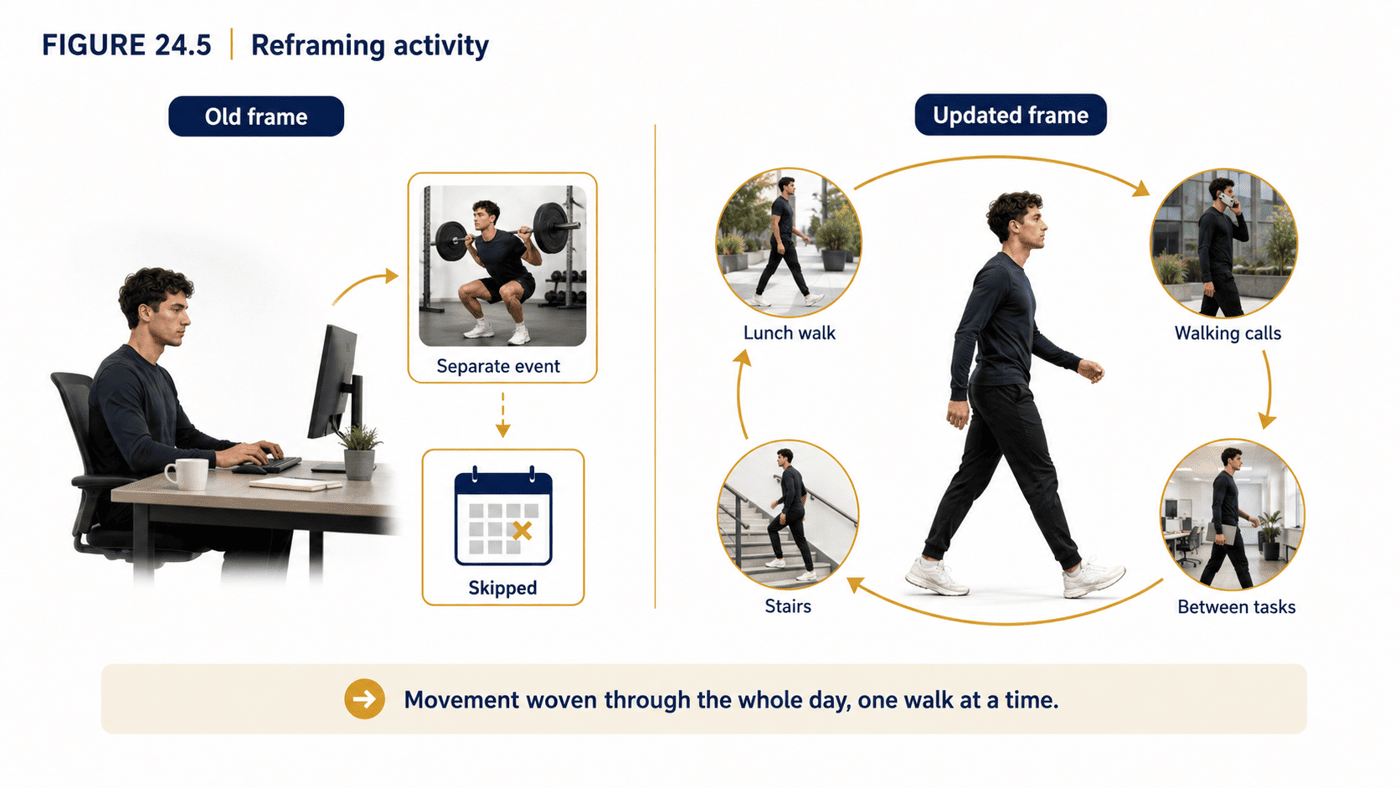
Walking is, in the end, the keystone of the desk body reset system and a fitting note on which to close this part. Figure 24.5 captures the shift in thinking it asks for: from exercise conceived as a separate, scheduled, easily-skipped event, to movement woven through the whole of the day, one walk at a time. This is the same shift the entire reset system embodies — away from the idea that one offsets a sedentary life with the occasional bout of exercise, and toward a life that is simply more active throughout, in small and frequent ways.
This reframing returns the book to its central thesis. The desk body is not a weak body but an under-varied, under-loaded, over-still one, and the remedy is not heroic compensation but the restoration of ordinary, frequent, natural movement. Walking is the purest expression of that remedy: the most natural movement of all, woven back into a life that has squeezed it out. The reset interrupts, the mobility routine restores, the strength plan rebuilds — and walking, underlying them all, simply returns the body to motion. Together they turn the understanding of the earlier parts into a way of living, and a desk body that resets, mobilises, strengthens and, above all, walks is a desk body well on its way to thriving.
And so the reset system ends where it is most fitting that it should: not with a complex regimen or a feat of discipline, but with the oldest and simplest of human movements, returned to a life that had let it slip away. Walk part of the commute; take the stairs; step out at lunch; pace during a call — and let the rest of the system build around that foundation. The desk body was never broken; it was only still. To set it moving again, a little and often, is the whole of the answer this book has to give.
And with that, the reset system is complete. Four tools, each building on the last — the three-minute reset that interrupts the day, the ten-minute routine that restores lost range, the twenty-minute plan that rebuilds strength, and the walking that underlies them all — together turn the understanding of this book into a way of living. None demands a gym, a transformation of one’s schedule or a feat of willpower; each asks only for small, regular movement woven back into an ordinary working life. The desk body, this book has argued throughout, is not weak but under-varied, under-loaded and over-still — and the reset system is, in the end, simply the deliberate, daily restoration of variety, load and movement to a body that was built to move and has been asked to sit. Reset it, mobilise it, strengthen it and, above all, walk — and the desk body thrives.
| Way to walk more | How it fits the workday |
|---|---|
| Walk part of the commute | Alight a stop early; park further away |
| Walking meetings | Take one-to-ones and calls on the move |
| A lunchtime walk | A substantial daily dose; clears the mind |
| Walk between tasks | Small walks sprinkled through the day |
| Take the stairs | Turns a routine choice into movement |
| Movement-snack walks | Short walks that count fully (Chapter 15) |
Table 24.1. Ways to weave walking into a working day — small, ordinary walks that accumulate into a substantial total.
In summary
- Walking is the final and most fundamental tool in the reset system — the most natural human movement and the foundation beneath the reset, mobility and strength routines.
- The human body is built to walk, the product of evolution as a walking animal; the desk body is a walking animal that has stopped walking (Bramble & Lieberman, 2004).
- Walking is a whole-body medicine — metabolic, cardiovascular, musculoskeletal and mental — and higher step counts are linked with substantially lower mortality (Saint-Maurice et al., 2020; Paluch et al., 2022).
- For the desk body it is a near-perfect antidote, reversing each of sitting’s core harms at once — breaking up stillness, loading the body, moving the hips and legs, and clearing the mind.
- Its dose response is steepest at low step counts; ten thousand steps is a marketing myth, not a threshold, so the message is simply to walk more than you do now (Lee et al., 2019).
- Walking is best woven through the workday — commute, walking meetings, lunch walks, walks between tasks, stairs — in small walks that accumulate into a substantial total.
- Walking is the keystone habit that ties the system and the book together: the restoration of ordinary, natural movement to a body built for it.
References
Bramble, D. M., & Lieberman, D. E. (2004). Endurance running and the evolution of Homo. Nature, 432(7015), 345–352.
Bull, F. C., Al-Ansari, S. S., Biddle, S., Borodulin, K., Buman, M. P., Cardon, G., … Willumsen, J. F. (2020). World Health Organization 2020 guidelines on physical activity and sedentary behaviour. British Journal of Sports Medicine, 54(24), 1451–1462.
Ekelund, U., Steene-Johannessen, J., Brown, W. J., Fagerland, M. W., Owen, N., Powell, K. E., … Lee, I.-M. (2016). Does physical activity attenuate, or even eliminate, the detrimental association of sitting time with mortality? The Lancet, 388(10051), 1302–1310.
Lee, I.-M., Shiroma, E. J., Kamada, M., Bassett, D. R., Matthews, C. E., & Buring, J. E. (2019). Association of step volume and intensity with all-cause mortality in older women. JAMA Internal Medicine, 179(8), 1105–1112.
Lieberman, D. E. (2013). The story of the human body: Evolution, health, and disease. Pantheon Books.
Paluch, A. E., Bajpai, S., Bassett, D. R., Carnethon, M. R., Ekelund, U., Evenson, K. R., … Fulton, J. E. (2022). Daily steps and all-cause mortality: A meta-analysis of 15 international cohorts. The Lancet Public Health, 7(3), e219–e228.
Saint-Maurice, P. F., Troiano, R. P., Bassett, D. R., Graubard, B. I., Carlson, S. A., Shiroma, E. J., … Matthews, C. E. (2020). Association of daily step count and step intensity with mortality among US adults. JAMA, 323(12), 1151–1160.
Tudor-Locke, C., Craig, C. L., Brown, W. J., Clemes, S. A., De Cocker, K., Giles-Corti, B., … Blair, S. N. (2011). How many steps/day are enough? For adults. International Journal of Behavioral Nutrition and Physical Activity, 8, 79.