Part VII · THE DESK BODY RESET SYSTEM
The 20-Minute Desk Body Strength Plan
The reset interrupts the day and mobility restores range; strength rebuilds capacity — the deeper reserve that sustained sitting allows to fade. This chapter sets out a simple, scalable plan of fundamental movements, done in about twenty minutes a couple of times a week, to make the desk body not merely mobile but robust. Begin gently, and seek advice where needed.
23.1 Why Strength Matters
The third tool in the reset system addresses the deepest of the desk body’s problems. The reset interrupts sustained sitting; the mobility routine restores lost range; but neither rebuilds the quality this book has returned to again and again as the heart of resilience: capacity — the strength and robustness of the tissues themselves. Sustained sitting is, at bottom, a state of chronic under-loading, and a body that is rarely challenged adapts by becoming weaker, exactly as a body that is regularly loaded adapts by becoming stronger. The strength plan is the deliberate re-loading of an under-loaded body.
The case for strength runs through the whole book. Physical inactivity and under-loading are powerful drivers of ill health and of the loss of physical robustness (Booth et al., 2012), and resistance training — challenging the muscles against a load — is among the most effective ways to counter this, with wide-ranging benefits for muscle, bone, metabolism and function across the lifespan (Westcott, 2012). Major physical-activity guidelines now recommend muscle-strengthening activity at least twice a week for adults, alongside regular movement, precisely because of these benefits (Bull et al., 2020). For the desk body specifically, strength is what turns a fragile-feeling, easily-fatigued system into one that meets the demands of the day with reserve to spare. Exercise, including strengthening, is among the few measures shown to help prevent low-back pain (Steffens et al., 2016).
23.2 The Load–Capacity Idea
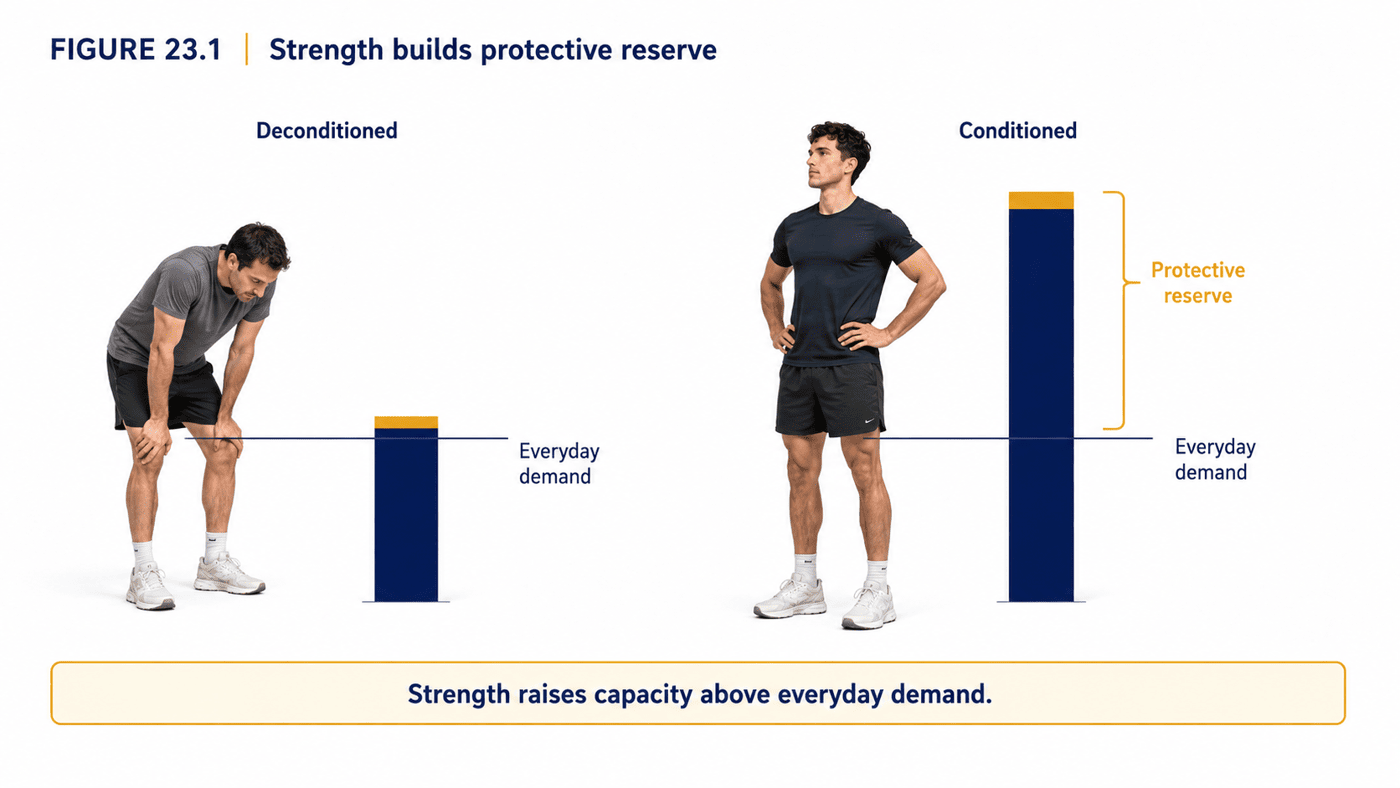
Strength is best understood through the load-versus-capacity framing that underlies this book’s whole approach to robustness. Every tissue has a capacity — a level of load it can comfortably tolerate — and experiences demand from the tasks of daily life. When capacity comfortably exceeds demand, there is reserve, and the tissue copes easily; when demand approaches or exceeds capacity, the tissue struggles, fatigues and is more easily irritated. Tissues adapt their capacity to the loads habitually placed upon them, growing stronger under appropriate load and weaker under chronic under-loading — the principle Mueller and Maluf (2002) termed the physical stress theory.
Figure 23.1 shows the consequence. The deconditioned desk body has let its capacity fall, so that ordinary demands consume most or all of its reserve; the strength-trained body has lifted its capacity well above everyday demand, creating a protective margin. This is the whole point of strength for the desk body: not to lift impressive weights or to build an impressive physique, but to raise the body’s capacity comfortably above the demands of life, so that those demands — a long day, an awkward lift, a sudden exertion — fall well within its reserve. Strength is, in this sense, protective robustness, and it is the surest antidote to the fragility that chronic under-loading breeds.
23.3 What the Plan Strengthens
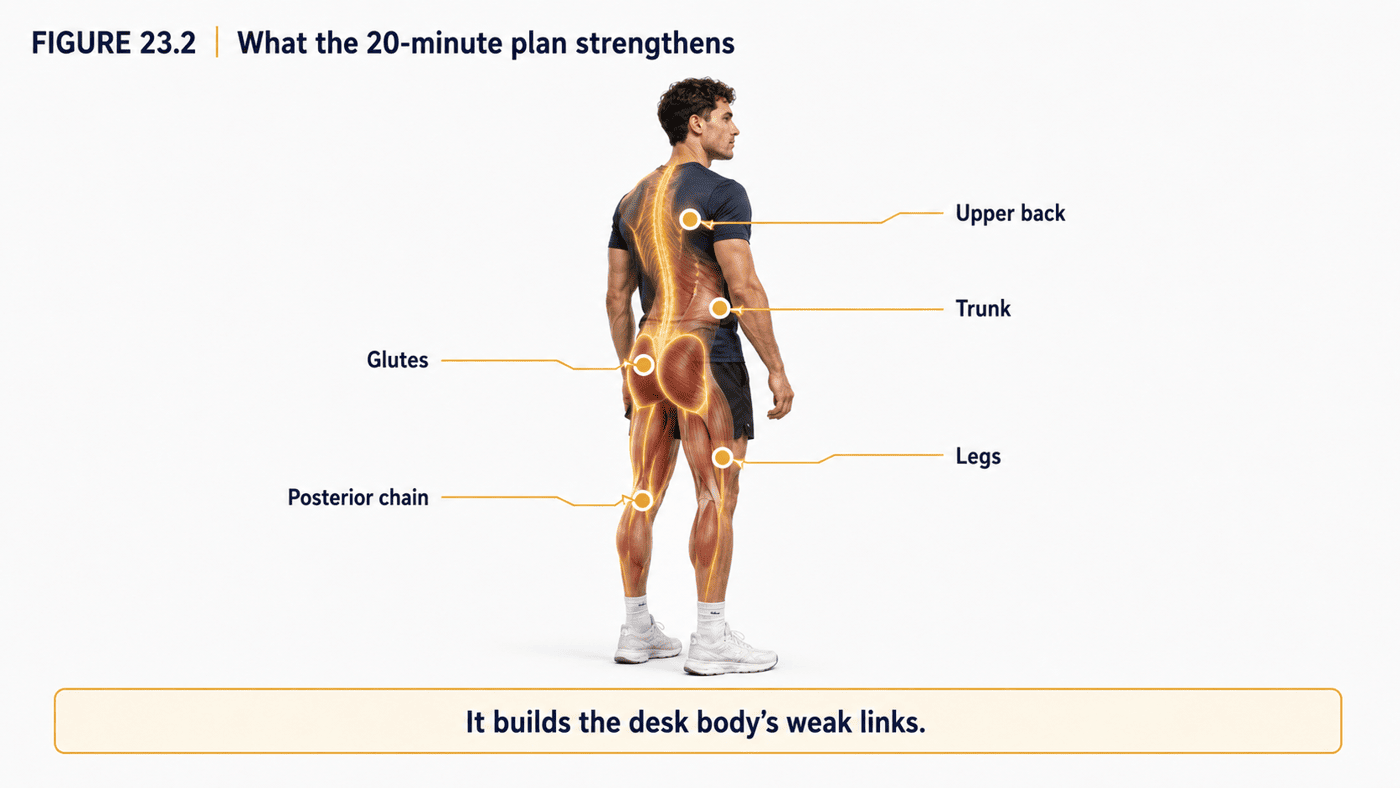
The plan concentrates on the desk body’s weak links, shown in Figure 23.2 — the regions that sustained sitting most allows to fade. Foremost are the glutes, the body’s powerhouse, switched off by hours of sitting (Chapter 11), and the posterior chain — the muscles of the back of the body that a forward-folded posture neglects. It strengthens the upper back, countering the rounded, under-used muscles of Chapter 5; the trunk, building the control and bracing that support the spine; and the legs, restoring the lower-body strength that a seated life erodes.
These are precisely the regions this book has identified as weakened by desk work, and strengthening them rebuilds the capacity of the whole posterior, supporting and locomotor systems that sitting leaves under-loaded. The plan deliberately ignores the muscles that desk work does not particularly weaken, in favour of these key links, so that twenty minutes is spent where it matters most for the desk body.
23.4 The Six Foundational Patterns
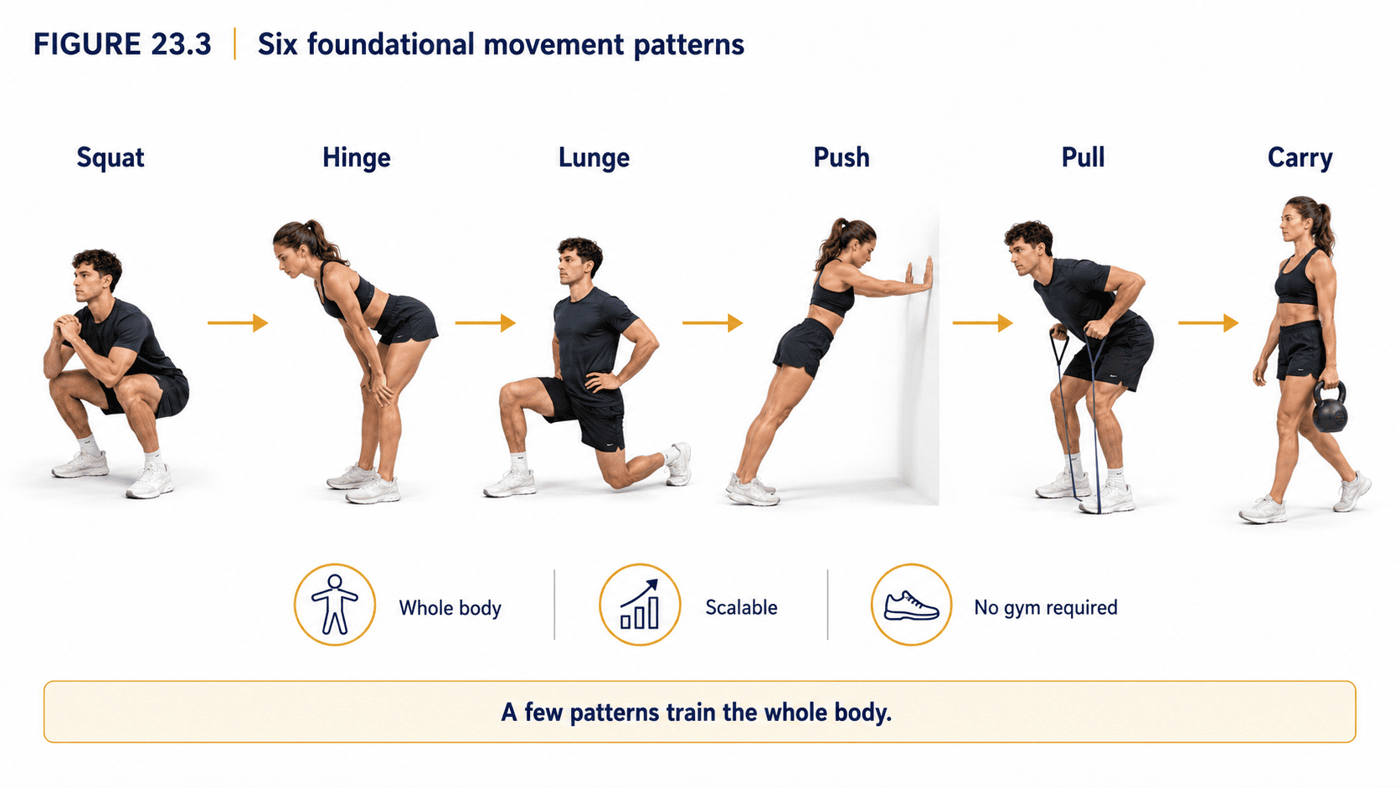
Rather than a long list of isolated exercises, the plan rests on a handful of fundamental movement patterns that together train the whole body, shown in Figure 23.3. Each is scalable — it can be made easier or harder to suit any starting point — and none requires a gym; most can be done with body weight alone or with simple, inexpensive equipment. What follows describes each pattern and what it builds. The emphasis throughout is on good, controlled movement at a manageable effort, not on maximal load.
1. Squat / sit-to-stand
Lowering and rising by bending at the hips and knees — in its simplest form, standing up from and sitting down to a chair under control. This trains the legs and glutes through the most fundamental of all human movements, and rebuilds the strength to rise, lower and carry the body. It scales from a supported sit-to-stand up to deeper or loaded squats as strength grows.
2. Hip hinge / glute bridge
Bending forward from the hips with a neutral spine — or, lying on the back, driving the hips upward into a bridge. This trains the glutes and the posterior chain, the desk body’s most neglected powerhouse, and teaches the crucial skill of moving from the hips rather than the lower back. The glute bridge is an easy, back-friendly starting point; the standing hinge progresses it.
3. Push
Pressing the body or a load away — from a wall push-up, to a push-up from the knees, to a full push-up as strength allows. This trains the chest, shoulders and arms, balancing the pulling work below and building upper-body pushing strength. The wall or incline version makes it accessible to almost anyone.
4. Pull / row
Pulling a load toward the body — a row with a resistance band, or pulling against any sturdy anchor. This is perhaps the most important pattern for the desk body, because it strengthens the upper-back muscles that rounded, arms-forward desk posture leaves weak and lengthened (Chapters 5 and 17), directly countering the upper-quarter pattern and supporting better posture.
5. Carry
Simply walking while carrying a load — a heavy bag or weight in one or both hands for a short distance, the everyday ‘suitcase carry’. This deceptively simple pattern trains the trunk, the grip and the whole body to stabilise and move under load, and translates directly into the carrying tasks of real life. It is among the most functional and accessible of all strengthening movements.
6. Core brace
Holding the trunk stable against movement — a dead-bug, in which the limbs move while the trunk stays still, or a plank held for a comfortable time. This trains the trunk to brace and control rather than to crunch, building the stability that supports the spine in everything else. The dead-bug is a gentle, back-friendly starting point.
23.5 The 20-Minute Structure
These six patterns combine into a balanced session of about twenty minutes, done two or three times a week on non-consecutive days, which the strengthening guidelines support as a sensible frequency (Bull et al., 2020). A simple structure is to perform each pattern for a set of around eight to twelve controlled repetitions (or, for the carry and the brace, a short distance or hold), resting briefly between, and to work through the patterns once to begin with, building toward two or three rounds as fitness allows. These numbers are illustrative starting points, not rigid prescriptions; the right amount is what is challenging yet comfortably manageable with good form, and that will differ from person to person.
The order can be arranged to alternate between patterns that work different regions — a lower-body pattern, then an upper-body one, and so on — so that one area recovers while another works, keeping the session efficient. What matters far more than the precise arrangement, however, is that the session is balanced across the six patterns, performed with control, and repeated consistently. Twenty minutes, a couple of times a week, performed regularly over months, rebuilds substantial capacity; an occasional heroic session does little.
23.6 Progression: A Little More Over Time
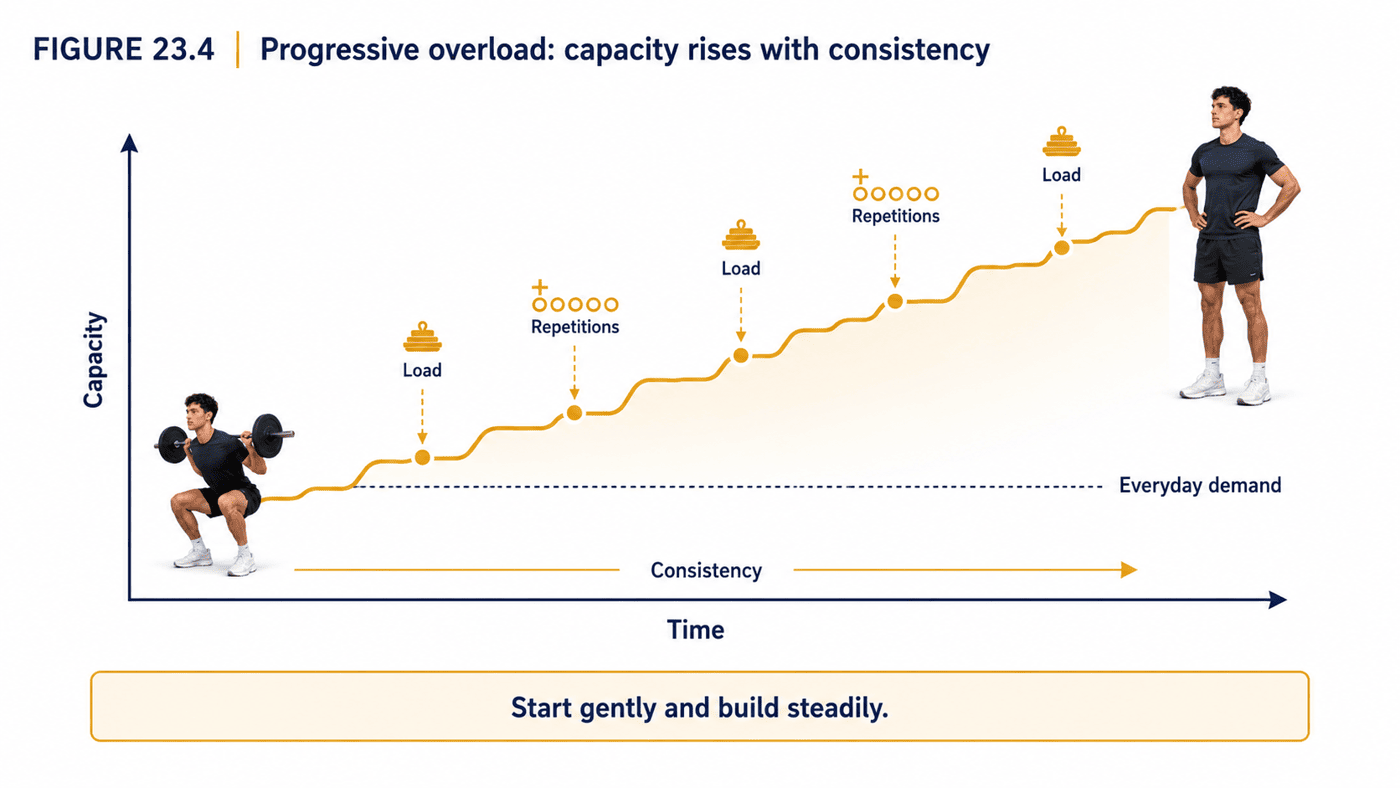
Strength is built by the principle of progressive overload: as the body adapts to a given challenge, the challenge is gradually increased, so that capacity keeps climbing. Figure 23.4 shows the idea — capacity rising steadily above everyday demand as training continues, provided the load is nudged upward over time. In practice this means starting at a comfortable level and then, as a movement becomes easy, making it a little harder: adding a repetition or two, a set, a little more range, a heavier band or weight, or progressing to a harder version of the pattern.
The watchword is gradual. Progression should be slow and patient — a little more over weeks, not a lot more at once — because tissues adapt to increased load steadily, and rushing invites the very irritation that appropriate loading otherwise prevents (Cook & Purdam, 2009). The body rewards consistent, incremental challenge and objects to sudden leaps. Started gently and progressed patiently, the plan builds capacity safely and continuously; attempted too hard too soon, it courts setback. For the desk body, slow and steady genuinely wins.
23.7 Doing It Safely and Well
Because this chapter introduces loaded exercise, a clear word on safety is essential, and it should be read as carefully as the rest. The plan describes gentle, scalable, widely-recommended movements suitable for many people, but it is general education, not a personalised programme, and bodies and circumstances differ greatly. The guiding principles are simple: start light, at a level that feels easily manageable, and let the body adapt before progressing; prioritise good form over load or repetitions, since controlled movement is what builds strength safely; and progress gradually, as the previous section described.
Equally important is the distinction between the normal sensations of effort and the warning signs of harm. The muscular effort and fatigue of working a muscle, and some general muscle soreness in the day or two after a new session, are normal and expected. Sharp, sudden or joint pain during a movement, or pain that worsens or lingers, is not, and is a signal to stop and reassess. This is emphatically not a ‘no pain, no gain’ endeavour; it is a patient rebuilding of capacity within comfortable limits. Anyone who is new to exercise, who has significant pain, a current injury or any of the red flags described in Part VI, who is pregnant, or who has a medical condition or any doubt should consult a suitably qualified professional before beginning, and seek individual guidance on technique and progression (Appendix C). Within these sensible bounds, the plan is a safe and powerful way to rebuild the robustness that sitting erodes.
You do not need a gym
A common barrier to strength training is the belief that it requires a gym, expensive equipment or specialist knowledge — and for the desk body, none of this is true. Every one of the six foundational patterns can be performed at home with little or nothing: body weight alone provides ample resistance for the squat, the push, the hinge and the core brace, especially at the start; a single inexpensive resistance band covers the pulling movements; and a couple of modest weights, or even a loaded bag, suffice for carries and for progressing the rest. A chair, a small space and a few minutes are very nearly the whole equipment list.
This matters because the best strength programme is, above all, the one a person will actually do, and the convenience of training at home removes the commonest practical excuses — the journey, the cost, the self-consciousness, the time. Home-based, bodyweight and minimal-equipment strength training is genuinely effective for building the capacity the desk body needs (Westcott, 2012); the gym is an option, not a requirement. For most desk workers, the living-room floor and a band will rebuild as much usable strength as they will ever need.
Bone, balance and the long game
The value of strength, like that of mobility, extends far beyond the working day and into the whole span of a life — and here its dividends are particularly quiet and particularly precious. Resistance training does not only build muscle; it helps maintain bone density and challenges balance and coordination, and these benefits accumulate into something that matters enormously in later life: protection against the frailty, bone loss and falls that so often steal independence in old age (Westcott, 2012). The strength built in midlife is a deposit against the vulnerabilities of age.
This is the long game of strength, and it reframes the twenty-minute plan as something more than a remedy for desk deconditioning. From perhaps the fourth decade onward, the body tends to lose muscle and bone gradually unless given reason to keep them — and regular strengthening provides exactly that reason, slowing or reversing the decline and preserving the capacity to live independently and resiliently for longer. Few investments of twenty minutes, two or three times a week, pay back so richly over a lifetime. The desk worker who builds strength now is not only easing today’s fragility but safeguarding decades of future capability.
Easing in, and finishing up
A brief, practical word on how to begin and end a session. There is no need for an elaborate warm-up, but it is sensible to ease into the strength work rather than starting cold: a few minutes of easy movement first — a short walk, or indeed the mobility routine of the previous chapter — raises the body’s readiness and prepares the joints and muscles for loading. This is one of the ways the three routines complement one another: the mobility routine makes a natural warm-up for the strength plan, so that the two can be paired in a single session.
Finishing requires even less ceremony. The notion that an elaborate ‘cool-down’ is essential is overstated; simply easing off, perhaps with a little gentle movement or a short walk and a few easy breaths, is enough to wind down comfortably. What matters far more than any warm-up or cool-down ritual is the quality of the movements in between — controlled, within comfortable limits, and progressed patiently. A few easy minutes either side is sensible; anything more elaborate is optional, and should never become a barrier to simply doing the session.
Recovery: where strength is actually built
A point often misunderstood is that muscles do not grow stronger during a training session, but in the recovery that follows it. The session provides the stimulus — a challenge that signals the body to adapt — and the actual strengthening happens in the hours and days afterward, as the tissues respond and rebuild. This is why the plan calls for two or three sessions a week on non-consecutive days rather than daily training: the rest days are not idleness but an essential part of the process, the time in which the body banks the gains the session asked for.
This has a practical and a reassuring implication. Practically, it means resisting the temptation to train the same movements hard every day, which gives the body no chance to adapt and invites fatigue and irritation rather than progress; the rest between sessions is doing real work. Reassuringly, it means that strength does not demand daily effort — a modest investment a few times a week, with recovery in between, is precisely what builds it. On the rest days, the lighter habits of this part — the reset, mobility and walking — keep the body moving without interfering with recovery, which is why the four tools fit so naturally together across a week.
23.8 Strength for Life, Not the Mirror
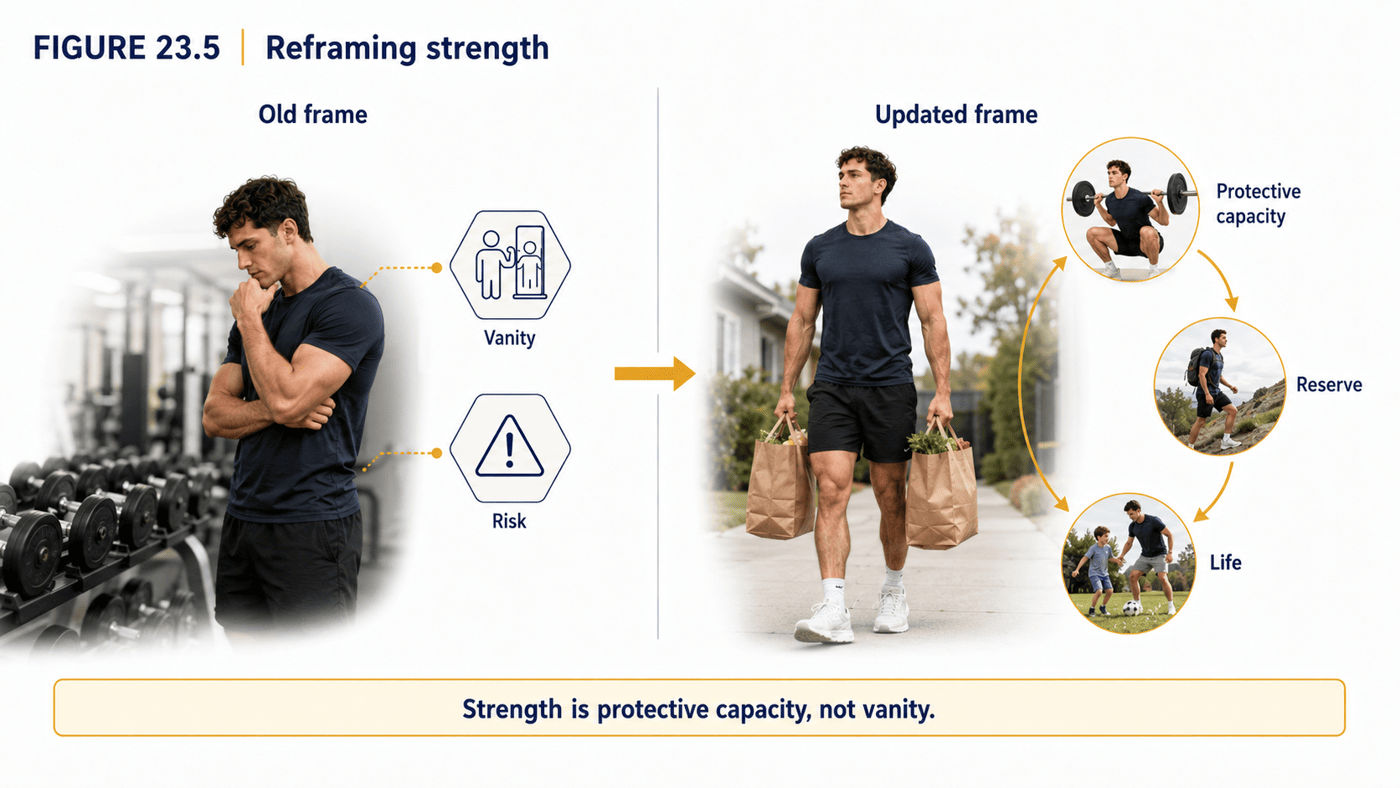
It is worth closing on what this strength plan is for, because strength training carries cultural baggage that can obscure its real value for the desk body. Figure 23.5 reframes it: not as gym vanity, the pursuit of an impressive physique or intimidating weights, and not as a risky activity to be feared, but as the building of protective capacity — strength for life. The aim is a body robust enough to meet the demands of work and living with reserve, to resist the fragility that under-loading breeds, and to carry that robustness into later life, when strength becomes ever more precious for independence and resilience.
Understood this way, strength is for everyone, not only the young or the athletic, and it is profoundly democratic: it can be started at any age and any level, scaled to any body, and pursued gently and patiently with great effect. The twenty-minute plan asks for no special talent, equipment or ambition — only the willingness to challenge the body a little, regularly, and to build over time. That modest investment buys something the desk body badly needs and chronic sitting steadily removes: the strength to meet life with reserve to spare.
| Pattern | Trains | An accessible starting point |
|---|---|---|
| Squat / sit-to-stand | Legs, glutes | Sit-to-stand from a chair |
| Hip hinge / bridge | Glutes, posterior chain | Glute bridge on the floor |
| Push | Chest, shoulders, arms | Push-up against a wall |
| Pull / row | Upper back, posture | Band row to the body |
| Carry | Trunk, grip, whole body | Short walk carrying a bag |
| Core brace | Trunk control | Dead-bug, lying on the back |
Table 23.1. The six foundational patterns, what each trains, and an accessible way to begin. All scale upward as strength grows.
In summary
- The 20-minute strength plan is the third tool in the reset system, rebuilding the capacity — the deeper robustness — that chronic under-loading erodes.
- Sitting is chronic under-loading; strength training re-loads the body, with wide-ranging benefits, and guidelines urge strengthening at least twice weekly (Westcott, 2012; Bull et al., 2020).
- Strength raises tissue capacity above everyday demand, creating protective reserve — the load-versus-capacity idea at the book’s core (Mueller & Maluf, 2002).
- It targets the desk body’s weak links — glutes, posterior chain, upper back, trunk and legs — through six scalable foundational patterns.
- About twenty minutes, two or three times a week, performed consistently and progressed gradually, rebuilds substantial capacity; heroics do not.
- Progress by adding a little over time; rushing invites irritation, while patient, incremental loading builds capacity safely (Cook & Purdam, 2009).
- It is strength for life, not the mirror — protective robustness for everyone — begun gently, built slowly, and pursued with professional guidance where pain, conditions or red flags are present.
References
Booth, F. W., Roberts, C. K., & Laye, M. J. (2012). Lack of exercise is a major cause of chronic diseases. Comprehensive Physiology, 2(2), 1143–1211.
Bull, F. C., Al-Ansari, S. S., Biddle, S., Borodulin, K., Buman, M. P., Cardon, G., … Willumsen, J. F. (2020). World Health Organization 2020 guidelines on physical activity and sedentary behaviour. British Journal of Sports Medicine, 54(24), 1451–1462.
Cook, J. L., & Purdam, C. R. (2009). Is tendon pathology a continuum? A pathology model to explain the clinical presentation of load-induced tendinopathy. British Journal of Sports Medicine, 43(6), 409–416.
Garber, C. E., Blissmer, B., Deschenes, M. R., Franklin, B. A., Lamonte, M. J., Lee, I.-M., … Swain, D. P. (2011). Quantity and quality of exercise for developing and maintaining cardiorespiratory, musculoskeletal, and neuromotor fitness in apparently healthy adults. Medicine & Science in Sports & Exercise, 43(7), 1334–1359.
Mueller, M. J., & Maluf, K. S. (2002). Tissue adaptation to physical stress: A proposed “physical stress theory” to guide physical therapist practice, education, and research. Physical Therapy, 82(4), 383–403.
Steffens, D., Maher, C. G., Pereira, L. S. M., Stevens, M. L., Oliveira, V. C., Chapple, M., … Hancock, M. J. (2016). Prevention of low back pain: A systematic review and meta-analysis. JAMA Internal Medicine, 176(2), 199–208.
Westcott, W. L. (2012). Resistance training is medicine: Effects of strength training on health. Current Sports Medicine Reports, 11(4), 209–216.