Part VII · THE DESK BODY RESET SYSTEM
The 10-Minute Workday Mobility Routine
Where the 3-minute reset interrupts the day, the 10-minute mobility routine restores what the day takes away: the ranges of movement that sustained sitting quietly erodes. Done once or twice daily, it keeps the hips, spine, shoulders and ankles moving freely — a daily maintenance habit for a body built to move in ways the desk does not allow.
22.1 Why Mobility Matters
The second tool in the reset system is a slightly longer routine with a different purpose. Where the three-minute reset interrupts sustained sitting through the day, the ten-minute mobility routine sets out to restore something that sitting steadily takes away: the freedom of movement — the working range of the joints — that a body confined to the desk posture gradually loses. It is a daily maintenance habit, done once or twice rather than many times, aimed at keeping the desk body moving through the ranges it was built for. Major guidelines now emphasise reducing prolonged sedentary time and moving regularly (Bull et al., 2020).
The need for it follows directly from Chapter 1’s framing of the desk body as under-varied. The body adapts to the range of movement it habitually uses, and tissues kept short and still adapt by becoming shorter and stiffer — a principle demonstrated long ago in the way muscles held in a shortened position lose sarcomeres and range (Williams & Goldspink, 1978); more broadly, tissues adapt to the physical stresses habitually placed upon them (Mueller & Maluf, 2002). The desk body, holding the hips folded, the spine rounded and the shoulders forward for hours, day after day, is a body being slowly trained into a narrower range. The mobility routine is the deliberate counter-training: a daily reminder to the tissues of the full range that is available, so that the range is not quietly lost.
22.2 Mobility, Flexibility and Why It Matters
A brief clarification sharpens what this routine is for. Flexibility usually refers to how far a joint or muscle can be moved passively — how far someone else, or gravity, can push it. Mobility refers to the range a person can move through actively, under their own control. The distinction matters because it is active, controllable range that is useful in life: the ability not merely to be stretched into a position, but to move into and out of it with strength and control. A body can be passively flexible yet lack usable mobility, and it is mobility that the desk body most needs to preserve.
This is why the routine emphasises active movement through range — moving the joints deliberately through their available motion — rather than only passive, held stretching. Passive stretching has its place and can contribute to range over time (Behm & Chaouachi, 2011; Page, 2012), and several movements here do involve gentle holds; but the routine’s emphasis is on taking the joints actively through their range, which both maintains the range and trains the control to use it. Interestingly, much of what limits range in the short term is not the physical length of the tissue but the nervous system’s tolerance to stretch — a tolerance that regular, gentle movement steadily expands (Weppler & Magnusson, 2010; Magnusson, 1996).
22.3 What the Routine Mobilises
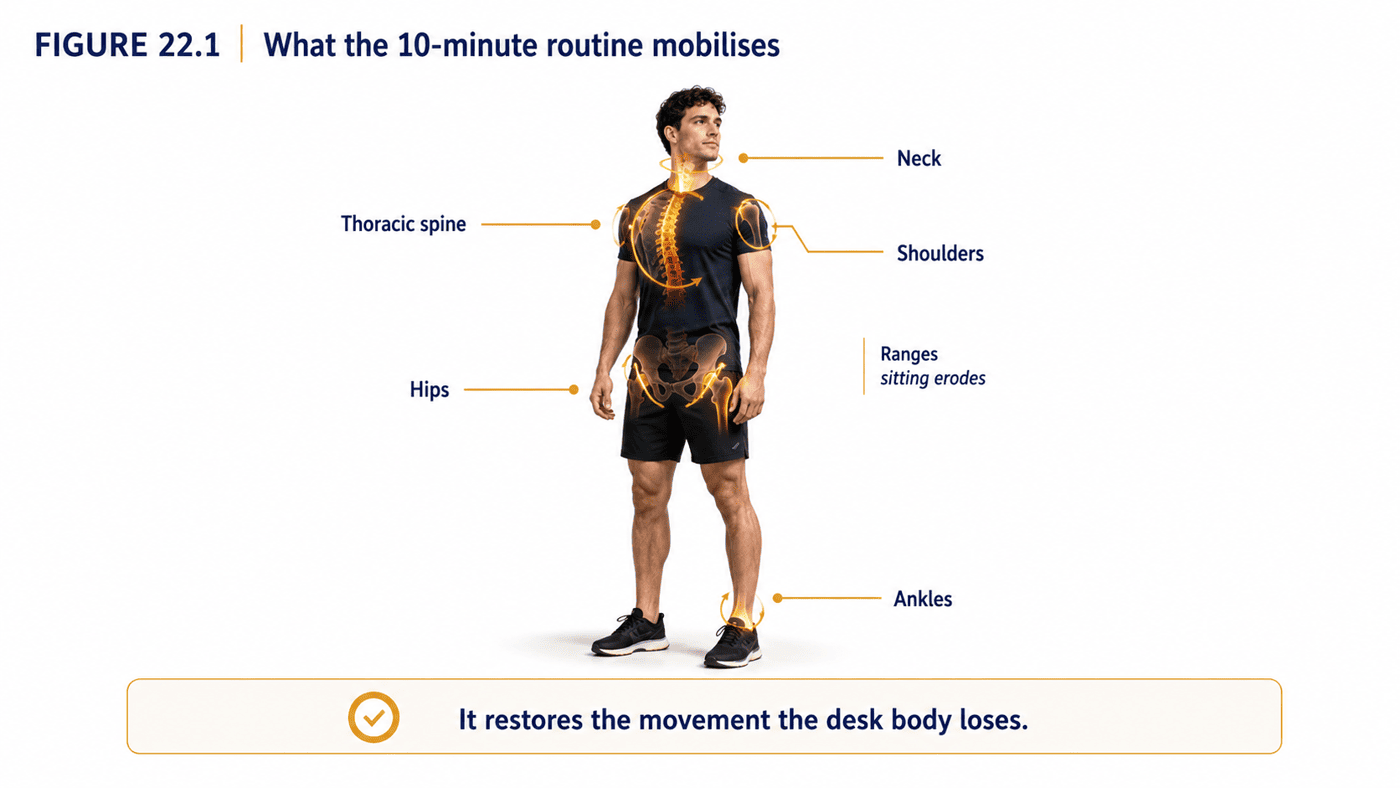
The routine concentrates on the regions sitting most affects, shown in Figure 22.1. Pride of place goes to the two stiffest casualties of the desk: the hips, held in sustained flexion and losing extension and rotation (Chapter 10), and the thoracic spine, held rounded and losing extension and rotation (Chapter 9). Around these, it mobilises the neck, restoring the rotation that forward-head posture restricts; the shoulders, taking them through the full range that arms-forward desk work neglects; and the ankles, restoring the dorsiflexion that a seated, unloaded lower leg loses.
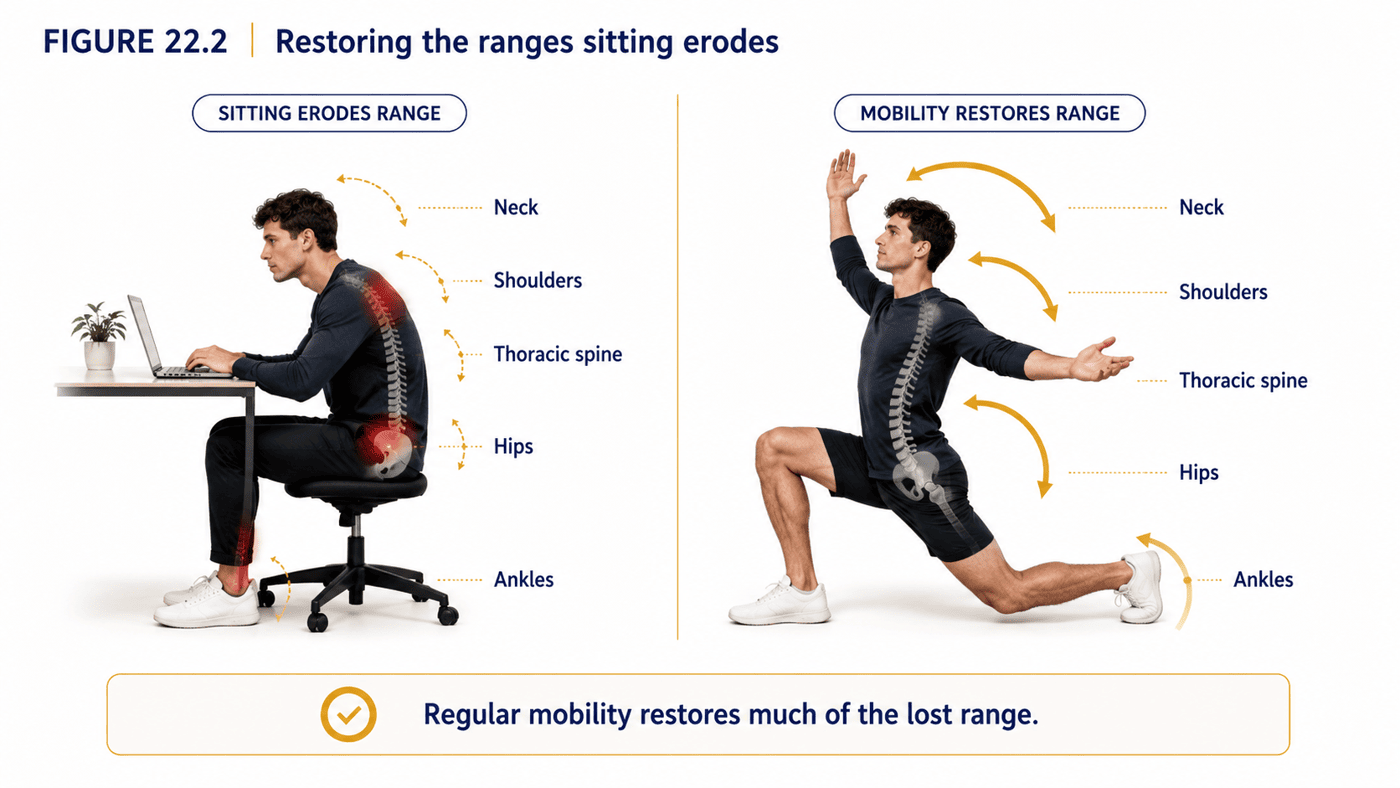
These targets are not arbitrary: they are the specific ranges this book has shown sitting to erode, and Figure 22.2 illustrates the effect the routine aims for — the narrowed working range of the desk-stiffened joint, restored toward its full extent by regular mobility work. The routine, in other words, is precisely targeted at undoing the particular stiffness that desk work creates, region by region.
22.4 The Routine, Movement by Movement
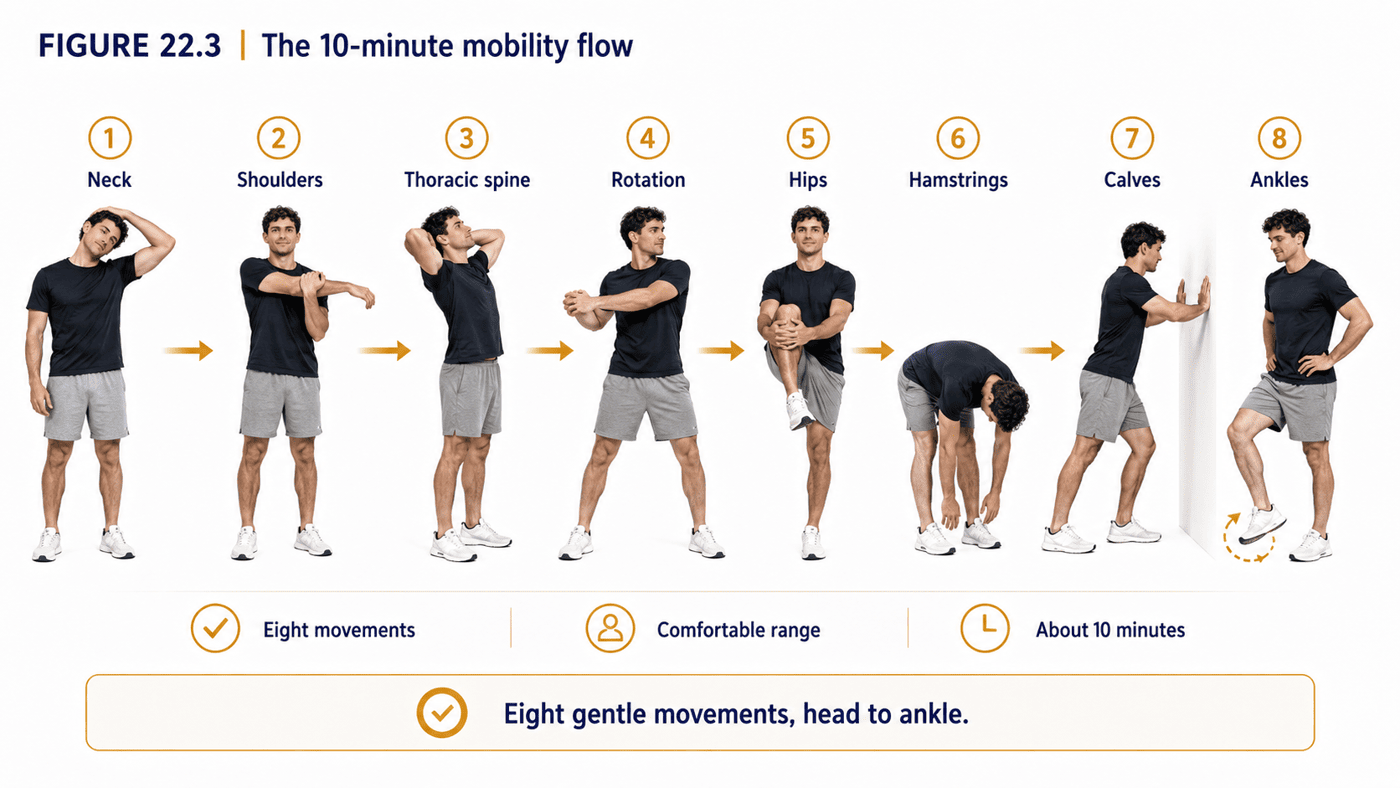
The routine is a sequence of eight gentle movements, worked from the neck downward, each taken slowly and smoothly through a comfortable range. As with the reset, this is not about forcing or straining; the aim is to explore and maintain range, not to wrench at the limits of it. A few slow repetitions or a brief, easy hold of each is enough.
1. Neck rotations and tilts
Slowly turn the head to look over each shoulder, and tilt the ear toward each shoulder, moving smoothly through a comfortable range several times. This maintains the cervical rotation and side-bending that forward-head desk posture quietly restricts (Chapters 4 and 16).
2. Shoulder circles
Take the shoulders, and then the whole arms, through large slow circles, forward and backward, exploring the full range of the shoulder. This moves the shoulder through the motion that arms-forward, static desk work neglects, and helps maintain its freedom (Chapters 5 and 17).
3. Cat–camel spinal movement
On hands and knees (or seated, if preferred), slowly alternate between rounding the whole spine upward and gently arching it downward, moving fluidly between the two. This mobilises the entire spine through flexion and extension, restoring movement to a back held in one sustained position all day, and gently working the segments between.
4. Thoracic rotations
Lying on one side with knees bent, or seated, open the top arm across the body and around, allowing the upper back to rotate and the chest to open, then return; repeat to each side. This directly targets the thoracic rotation and extension that the rounded desk posture most erodes (Chapter 9) — one of the highest-value movements in the routine.
5. Standing hip openers
Holding a support for balance, swing one leg gently forward and back, and then across and out, taking the hip through its range; repeat on each side. Hip circles serve the same end. This restores the hip flexion, extension and rotation that sustained sitting narrows (Chapter 10).
6. Hip-flexor lunge
Step one foot well forward into a lunge, lowering the back knee toward the floor and allowing the front of the rear hip to lengthen; hold briefly, then change sides. This addresses the shortened hip flexors of the desk body more deeply than the standing opener, restoring the hip extension that hours of folding take away.
7. Deep-squat hold
Lower into a comfortable deep squat — feet flat, sinking the hips toward the heels — holding a support if needed, and rest there briefly, letting the hips, knees and ankles settle into the position. The deep ‘resting squat’, a natural human rest posture, simultaneously mobilises the hips and ankles and gently loads the legs. Take it only as deep as is comfortable.
8. Ankle rocks and circles
Standing or kneeling, rock the weight forward over the toes to drive the knee over the foot, working ankle dorsiflexion, and circle the ankles in each direction. This restores the ankle mobility that a seated, unloaded lower leg loses (Chapter 12) and that healthy walking and squatting depend upon.
22.5 The 10-Minute Structure
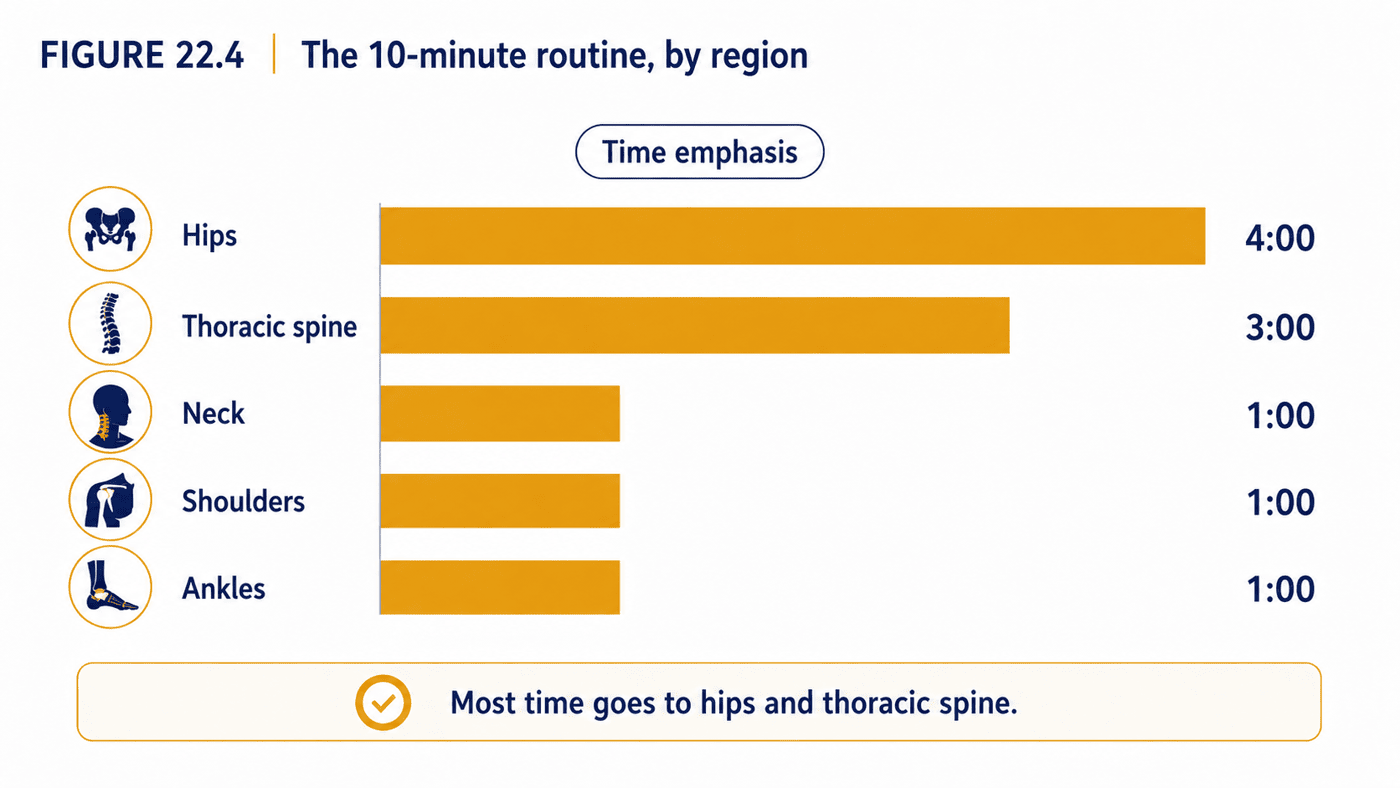
Strung together, the eight movements form a flowing routine of about ten minutes, shown in Figures 22.3 and 22.4. The greatest share of time is given to the hips and the thoracic spine — the desk body’s stiffest regions and the highest-value targets — with the neck, shoulders and ankles completing it. As with the reset, the timings are flexible; what matters is moving through the whole sequence and giving the stiffest regions their due. The routine can be shortened on busy days or extended when time allows.
22.6 How to Use It
Unlike the reset, which is taken many times a day, the mobility routine is a once-or-twice-daily practice, and consistency matters far more than intensity. A single run-through each day — perhaps in the morning to undo the stiffness of the night and prepare for the day, or in the middle of the working day as a longer movement break, or in the evening to release the accumulated stillness of desk hours — is enough to maintain range when done regularly. Two short sessions, morning and evening, suit some people better. The best time is simply the one that fits reliably into the day, since the routine’s benefit comes from repetition over weeks and months, not from any single heroic session.
A word on expectation: mobility is regained gradually, and the early sessions may reveal more stiffness than freedom. This is normal and not discouraging; the working range expands steadily with regular practice, as much through the nervous system’s growing tolerance as through any change in the tissue (Weppler & Magnusson, 2010). The routine rewards patience and consistency, and punishes neither the occasional missed day nor the inability to reach any particular range — it asks only to be returned to, regularly, over time.
Listen to the body, not the clock
A guiding rule for the mobility routine is to follow the body’s feedback rather than any prescribed depth or duration. Each movement should be taken to the point of a gentle, comfortable stretch or a mild sense of working range — never to sharp pain, never to a forced limit, and never with the bouncing or wrenching that can irritate tissues. The difference between a comfortable stretch sensation and pain is the body’s clearest guide: the first is the feeling of range being explored safely, the second a signal to ease off. Mobility is gained by gentle, repeated visits to the edge of comfortable range, not by storming past it.
This patience is not merely cautious; it reflects how range is actually regained. Much of the early gain comes from the nervous system learning to tolerate a position as safe, and that learning is undermined, not hastened, by force, which signals threat and provokes protective tightening (Weppler & Magnusson, 2010). Gentle, regular, comfortable movement teaches the body that the range is safe and steadily expands it; aggressive stretching teaches the opposite. For mobility, the soft approach is not only safer but more effective.
Mobility, ageing and future independence
Mobility carries a significance that reaches far beyond the working day, into the whole arc of a life. Range of movement tends to decline with age — but much of that decline reflects accumulated inactivity and the narrowing of habitual movement, not ageing alone, and a great deal of it is preserved, or regained, by keeping the joints moving regularly through their range. The mobility maintained in midlife is, in a real sense, an investment in the independence and ease of later life.
This matters because so many of the difficulties of older age — struggling to rise from a low chair, to reach overhead, to turn and look behind, to get up from the floor — are difficulties of lost mobility as much as lost strength. The person who keeps their hips, spine, shoulders and ankles moving freely through the decades preserves the physical freedom on which independent living depends. A daily ten minutes spent maintaining range is thus not only a remedy for today’s desk stiffness but a quiet safeguard of tomorrow’s capability.
Why mornings feel stiff — and moving early helps
Many desk workers notice that stiffness is worst first thing in the morning, and there is a simple, reassuring explanation. Through a night of stillness the tissues are unmoved for hours, fluid shifts and settles, and the body wakes having held more or less one position all night — the same sustained-stillness problem that the desk creates by day, compressed into the small hours. Morning stiffness is the natural consequence, and it typically eases within minutes of moving.
This is precisely why a mobility routine taken early in the day is so valuable: it deliberately moves the tissues that the night has left still, easing the stiffness and restoring range before the day’s sitting begins. Far from being a sign that something is wrong, morning stiffness that loosens with movement is simply a body reporting a night of stillness — and the morning routine is the answer the body is asking for. For those whose stiffness is worst on waking, this is the single best time to run through the routine.
Mobility in a working life
A common example illustrates the routine’s effect. A project manager in her fifties had begun to feel stiff and, as she put it, ‘old’ — her hips tight after long meetings, her back stiff on rising from her chair, turning to reverse the car increasingly awkward. None of it was pain, exactly; it was a creeping loss of easy movement that she had assumed was simply age. She began the ten-minute routine each morning, giving most of the time, as advised, to her hips and upper back.
The early sessions revealed just how much range she had quietly lost, which was sobering but also clarifying. Over several weeks of consistent practice, the stiffness eased: her hips opened, her back moved more freely, the deep squat that had felt impossible at first became comfortable, and turning to look behind regained its ease. What she had taken for irreversible ageing turned out to be largely reversible disuse — a narrowed range, restored by the simple act of moving through it daily. The routine had given her back not just movement but the confidence that her body was not, after all, simply winding down.
Individual variation: not everyone needs more range
A point of balance is worth making, because the message to mobilise can be over-applied. People differ considerably in their natural range of movement: some are constitutionally stiff and benefit greatly from regular mobility work, while others are naturally very mobile, even hypermobile, and need less stretching and rather more control and strength through the range they already possess. More range is not universally better; usable, controllable, well-supported range is the goal, and for the naturally supple person that means strengthening more than stretching.
This is why the mobility routine should be read as a means to an end — restoring and maintaining the range that sitting has taken away — rather than as a pursuit of ever-greater flexibility for its own sake. Most desk workers, having lost range to sustained sitting, do need to restore it; but the aim is to return to a healthy, functional range and to be strong within it, not to chase extremes. As throughout this book, the target is a balanced, capable body, and for mobility as for everything else, more is not always better.
Make it a pleasure, not a chore
Because the mobility routine depends entirely on consistency, anything that makes it more pleasant makes it more effective, by making it more likely to be done. Many people find the routine becomes something to look forward to when paired with something enjoyable — a favourite piece of music, a podcast, a few minutes by a window with a view — so that it serves as a genuine restorative pause in the day rather than another task to be endured. The gentle, flowing quality of the movements lends itself naturally to this.
Framing matters too. Approached as a brief, calming interlude — a few minutes to move, breathe and reset, away from the screen — the routine offers a mental as well as a physical benefit, and is far more likely to endure than a grim obligation. The most effective mobility routine is not the most ambitious one but the one that becomes a small, welcome habit; and making it pleasant is the surest way to make it last.
Building the routine up over time
Like strength, mobility responds to gentle progression, though of a different kind. As the body grows accustomed to the routine and the working range expands, the same movements can be explored a little more fully — sinking a little deeper into the squat, reaching a little further into a rotation, holding a position a few moments longer — always within comfort, and always guided by the body rather than by ambition. The routine that felt like a stretch at the limit in the first weeks becomes, in time, an easy passage through a range that has quietly grown.
Equally important is knowing how to shorten the routine without abandoning it on the days when ten minutes simply cannot be found. A brief version — a few of the highest-value movements, particularly for the hips and thoracic spine — keeps the habit alive and preserves much of the benefit, and is vastly better than skipping the routine entirely. The principle, as with the reset, is that consistency matters more than completeness: a short routine done daily beats a full one done rarely, and a flexible approach that bends to a busy day is the one most likely to endure.
22.7 Mobility in the Whole System
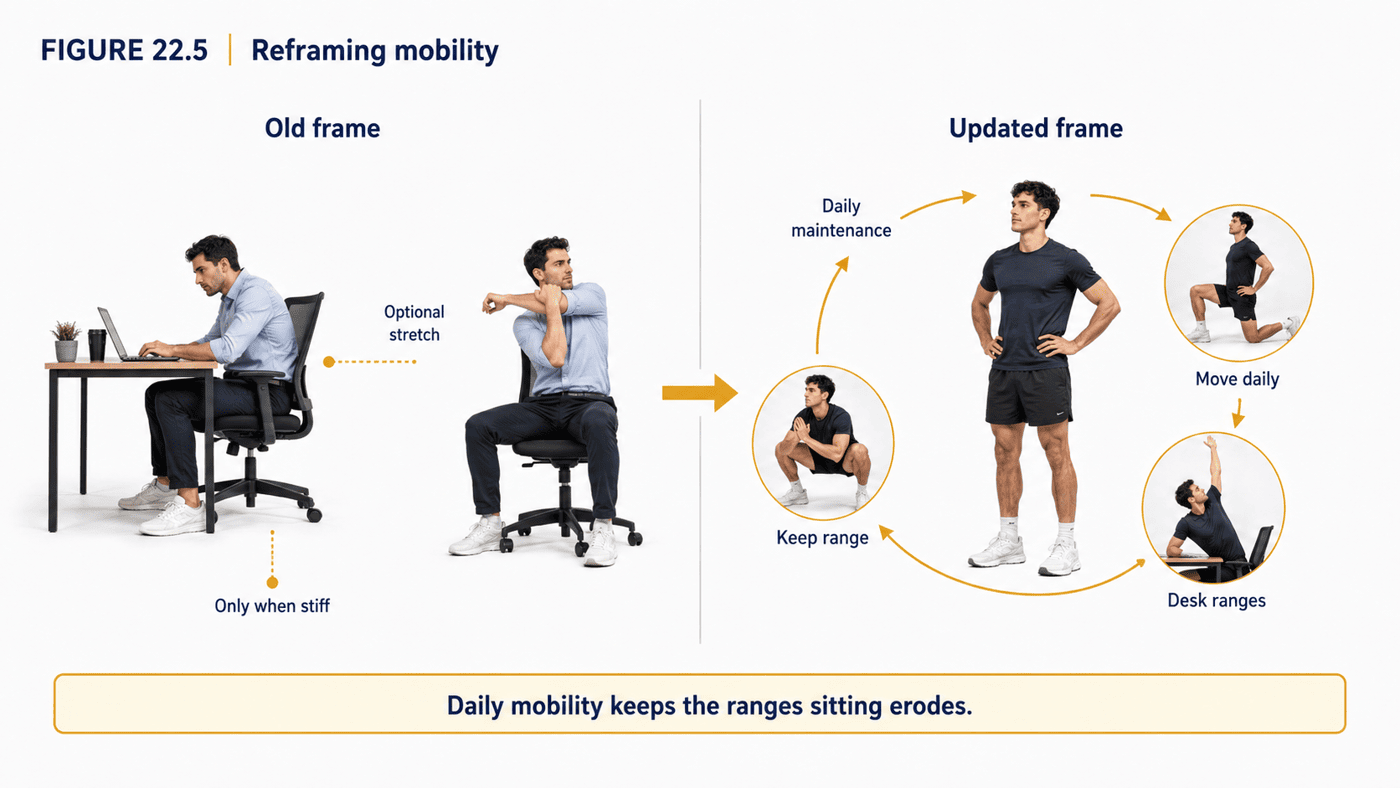
The mobility routine sits between the reset and the strength plan, and it is worth seeing how the three relate, because mobility is often misunderstood as the whole answer when it is one part of it. Mobility restores the range the desk body loses; but range without strength is incomplete, for a joint needs not only to move freely but to be strong and controlled through that movement. Figure 22.5 reframes mobility accordingly: not as optional stretching done only when stiff, but as daily maintenance — and as the partner of the strength built in the next chapter.
The most robust desk body, then, is one that is both mobile and strong: free to move through full range, and strong enough to control and use that range. Mobility work opens the range; strength work makes it usable and resilient; and the reset, taken through the day, keeps both from being lost to sustained stillness. The three routines are designed to work together, and the mobility routine is most valuable not in isolation but as one strand of the whole system.
Approached in that spirit, the ten-minute routine becomes more than a remedy for stiffness; it becomes a daily act of maintenance for a body built to move, and a small but meaningful reclaiming of the range that modern life quietly erodes. Ten minutes is a modest price for keeping the hips, spine, shoulders and ankles free through the years — and, paired with the reset that interrupts the day and the strength that follows, it helps return the desk body to the easy, full movement that is its natural birthright.
| Movement | Mainly mobilises | What it restores |
|---|---|---|
| Neck rotations & tilts | Neck | Cervical rotation and side-bending |
| Shoulder circles | Shoulders | Full shoulder range |
| Cat–camel | Whole spine | Spinal flexion and extension |
| Thoracic rotations | Upper back | Thoracic rotation and extension |
| Standing hip openers | Hips | Hip flexion, extension, rotation |
| Hip-flexor lunge | Hips | Hip extension; flexor length |
| Deep-squat hold | Hips & ankles | Combined hip and ankle range |
| Ankle rocks & circles | Ankles | Ankle dorsiflexion |
Table 22.1. The 10-minute mobility routine at a glance — each movement restores a range sitting erodes.
In summary
- The 10-minute mobility routine restores the working range that sustained sitting erodes — the second tool in the reset system, done once or twice daily.
- It rests on the principle that the body adapts to the range it uses: tissues kept short and still become stiffer (Williams & Goldspink, 1978).
- It emphasises active mobility — controllable range — over passive flexibility, because usable range is what life requires, and much short-term limitation reflects stretch tolerance (Weppler & Magnusson, 2010).
- It targets the regions sitting most affects — above all the hips and thoracic spine, with the neck, shoulders and ankles — through eight gentle movements.
- Most time goes to the stiffest regions; timings are flexible, and the routine can be shortened or extended to fit the day.
- Range returns gradually with consistent practice; early stiffness is normal, and forcing is counter-productive — consistency beats intensity.
- Mobility is one strand of the whole system: it opens the range, strength makes it usable, and the reset keeps both from being lost — done gently, with advice sought for pain or red flags.
References
Behm, D. G., & Chaouachi, A. (2011). A review of the acute effects of static and dynamic stretching on performance. European Journal of Applied Physiology, 111(11), 2633–2651.
Bull, F. C., Al-Ansari, S. S., Biddle, S., Borodulin, K., Buman, M. P., Cardon, G., … Willumsen, J. F. (2020). World Health Organization 2020 guidelines on physical activity and sedentary behaviour. British Journal of Sports Medicine, 54(24), 1451–1462.
Magnusson, S. P. (1996). Passive properties of human skeletal muscle during stretch maneuvers: A review. Scandinavian Journal of Medicine & Science in Sports, 8(2), 65–77.
Mueller, M. J., & Maluf, K. S. (2002). Tissue adaptation to physical stress: A proposed “physical stress theory” to guide physical therapist practice, education, and research. Physical Therapy, 82(4), 383–403.
Page, P. (2012). Current concepts in muscle stretching for exercise and rehabilitation. International Journal of Sports Physical Therapy, 7(1), 109–119.
Weppler, C. H., & Magnusson, S. P. (2010). Increasing muscle extensibility: A matter of increasing length or modifying sensation? Physical Therapy, 90(3), 438–449.
Williams, P. E., & Goldspink, G. (1978). Changes in sarcomere length and physiological properties in immobilized muscle. Journal of Anatomy, 127(3), 459–468.