Part VII · THE DESK BODY RESET SYSTEM
The 3-Minute Desk Reset
The reset system begins with its smallest and most frequent tool: a three-minute sequence, taken many times a day, that undoes the desk posture in miniature. It needs no equipment and barely interrupts work, yet it is the single most practical habit in this book — the microbreak of Chapter 15 made concrete, movement by movement.
21.1 The Most Powerful Habit
The reset system of this part is arranged like a set of nested tools, from the smallest and most frequent to the broadest, and it begins with the smallest of all: the three-minute desk reset. Chapter 15 made the case that the movement break is the most powerful single tool for the desk body, because it attacks the root problem of sustained stillness directly (Buckley et al., 2015). This chapter turns that principle into a concrete, repeatable routine — a short sequence of simple movements, taken several times through the working day, that resets the loading clock and undoes the desk posture in miniature.
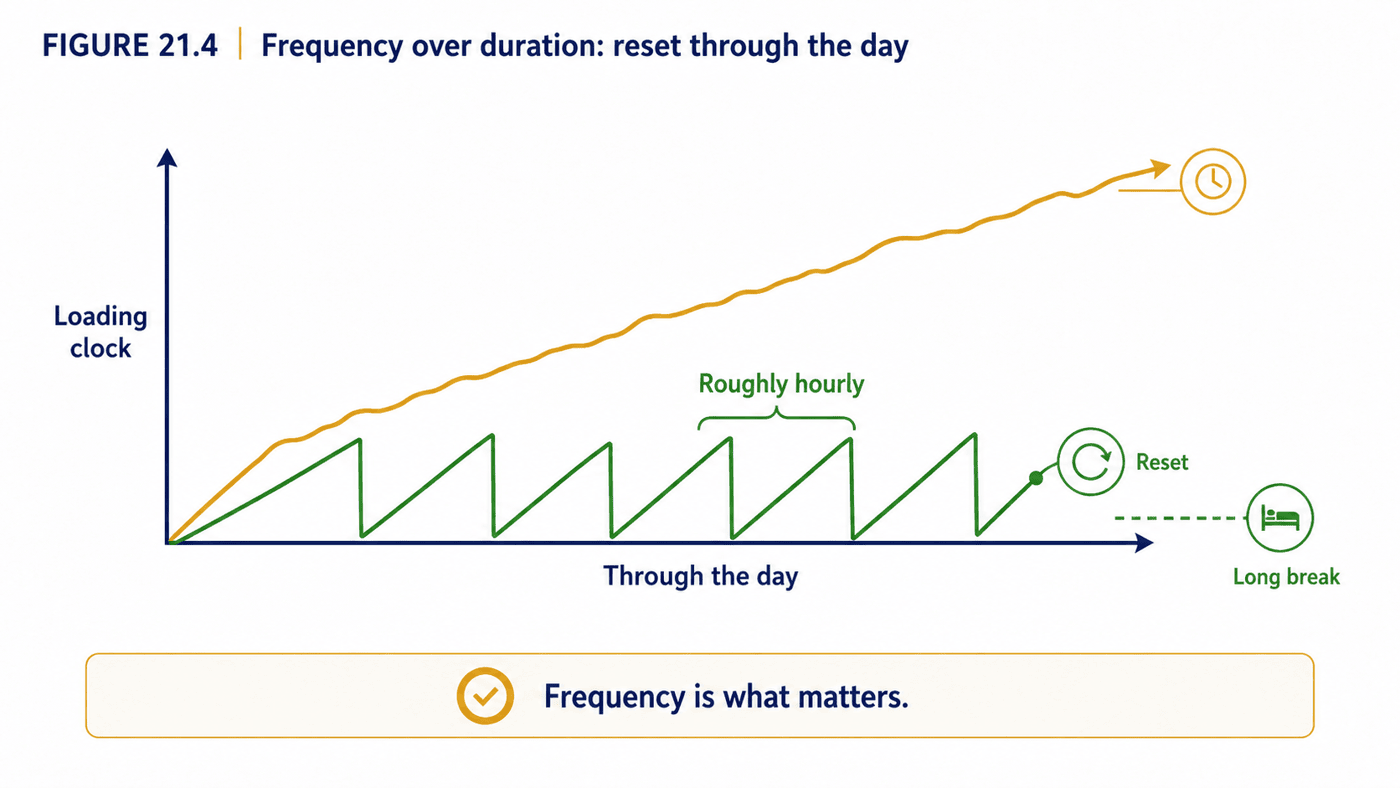
Its power lies precisely in its smallness. Because it takes only about three minutes and needs no equipment, no change of clothes and no special space, it can be slipped into the gaps of a working day without real disruption — and because it is brief and easy, it is the kind of thing a busy person will actually do, repeatedly, which is what makes it work. As Chapter 15 established, frequency matters far more than duration; a brief reset taken many times beats a long one taken rarely. The three-minute reset is built around that truth, and if a reader adopts only one practice from this entire book, this is the one to choose.
21.2 The Principle Behind the Reset
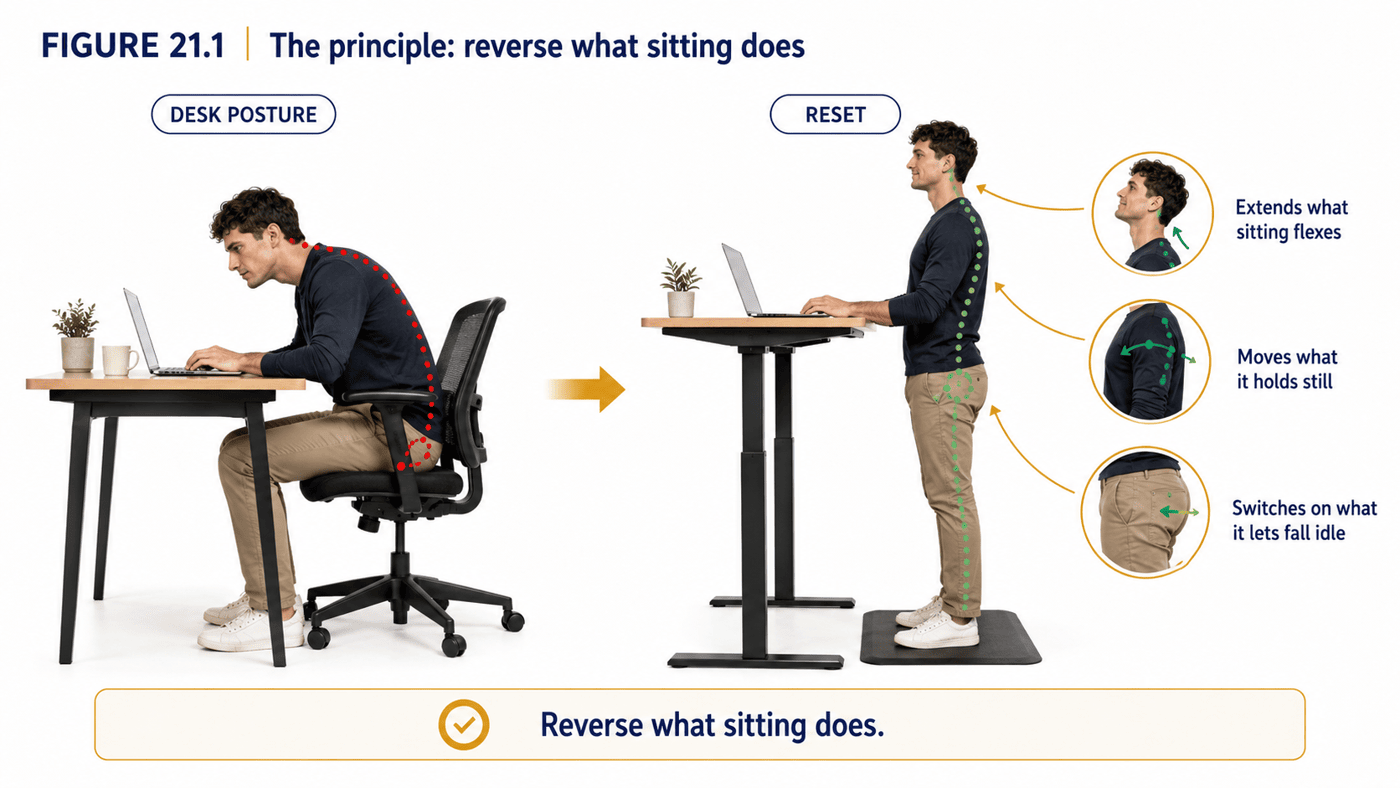
The design of the reset follows a single, simple principle: reverse what sitting does. Throughout this book, the desk posture has been characterised in three ways. It flexes the body — the spine rounds, the hips fold. It holds the body still — every structure fixed in one position for too long. And it lets key muscles fall idle — the glutes switch off, the postural muscles quieten. The reset is nothing more than the deliberate undoing of each of these, as Figure 21.1 shows: it extends what sitting flexes, it moves what sitting holds still, and it switches back on what sitting lets fall idle.
This principle is what gives the reset its shape and ensures it is comprehensive rather than arbitrary. Each movement in the sequence is chosen because it reverses a specific consequence of sitting: an extension to counter the flexion, a movement to counter the stillness, an activation to counter the idleness. Understanding the principle also means a reader is never bound to the exact sequence given here; once the logic is grasped — extend, move, activate — the reset can be adapted to any circumstance, because its essence is a principle, not a fixed drill.
21.3 What the Reset Targets
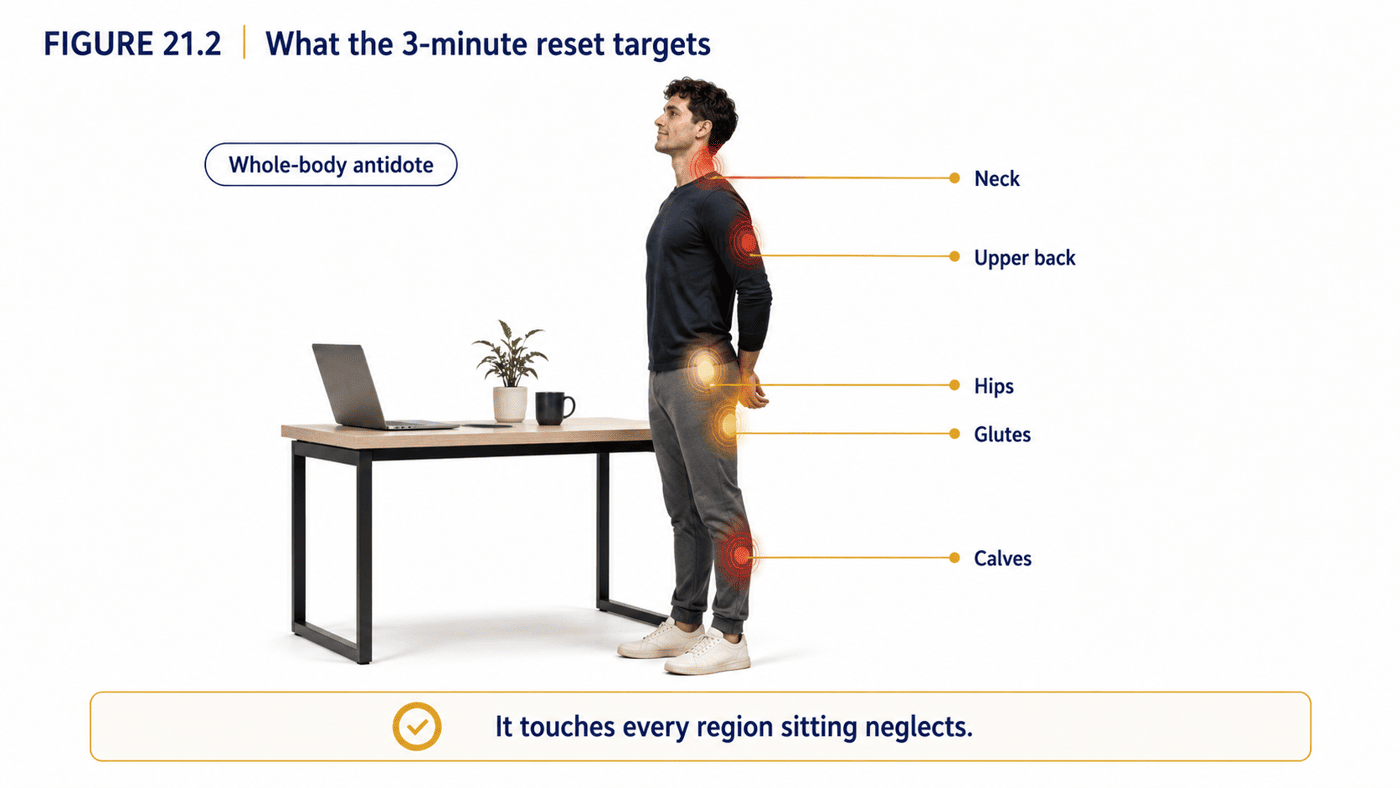
Guided by this principle, the reset touches every region that sustained sitting neglects, as Figure 21.2 illustrates. At the top, it addresses the neck, easing the forward-head posture of Chapter 4, and the shoulders and upper back, countering the rounding of Chapter 5 and the thoracic stiffness of Chapter 9. In the middle, it opens the hips, reversing the sustained flexion of Chapter 10, and reawakens the glutes, the idle powerhouse of Chapter 11. At the bottom, it loads the calves and ankles, restoring the lower-leg muscle pump that long sitting leaves dormant.
This whole-body reach is what makes three minutes so valuable: in that short span, the reset delivers a brief correction to the entire desk-body pattern at once, rather than addressing any single region in isolation. It is, in effect, a rapid head-to-toe antidote to the seated posture — which is exactly why it repays being done often, since each repetition resets the whole system before sitting’s effects can accumulate.
21.4 The Reset, Movement by Movement
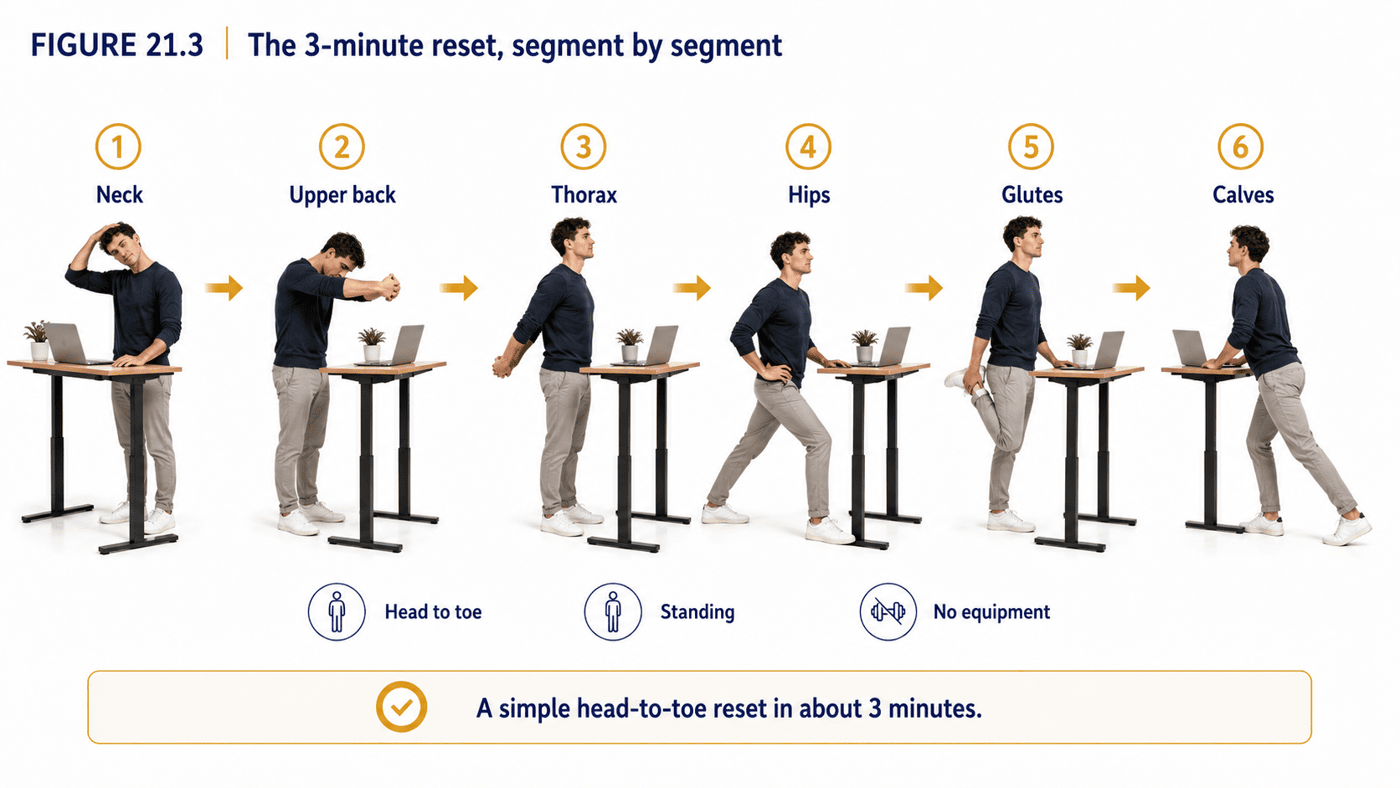
The reset is a short sequence of gentle movements, worked roughly from head to toe. What follows describes each in turn, with the consequence of sitting it is chosen to reverse. Throughout, the movements should be done slowly, smoothly and within a comfortable range — this is a reset, not a workout, and there is no need to strain or to reach the limits of any movement.
1. Stand and reset posture (≈20 seconds)
Stand up. The simple act of rising is itself half the reset, unloading the spine and reversing the seated posture. Standing tall, let the weight settle evenly through both feet, lengthen gently upward through the spine as though growing a little taller, and let the shoulders settle back and down. This re-establishes an upright, balanced posture after the rounded, folded posture of sitting, and sets the starting point for what follows.
2. Neck and shoulders (≈30 seconds)
Gently turn the head to look over one shoulder and then the other, a few times each way; tilt the ear toward each shoulder; and roll the shoulders backward several times, drawing them up, back and down. These movements take the neck through the range that sustained forward-head posture restricts, and release the upper trapezius tension that builds through a long seated bout (Chapters 4 and 16). Keep the movements slow and easy, never forced.
3. Thoracic extension and rotation (≈35 seconds)
Reach both arms up and slightly back, gently arching the upper back to look upward, then lower the arms; repeat a few times. Then, with hands on hips or arms crossed, rotate the upper body smoothly to each side. This directly reverses the flexed, stiff thorax of sustained sitting (Chapter 9), restoring the extension and rotation that the rounded desk posture takes away, and is among the most valuable parts of the whole reset for the upper body.
4. Open the hips (≈35 seconds)
Stand tall and take one foot back into a gentle split stance, allowing the front of the hip of the rear leg to lengthen, feeling a comfortable stretch across the front of the hip; hold briefly, then change sides. This reverses the sustained hip flexion of sitting (Chapter 10), lengthening the hip flexors that hours of folding have kept short and restoring the hip extension the desk body loses. Keep it gentle and balanced — a doorway or desk edge can steady you if needed.
5. Wake the glutes (≈35 seconds)
Perform a few slow squats or sit-to-stands — rising from and lowering toward the chair under control — or, more discreetly, a set of standing glute squeezes, firmly clenching the buttock muscles for a second or two and releasing, several times. This reawakens the glutes, the idle powerhouse of Chapter 11, switching back on the muscles that sustained sitting silences and loading the hips and legs. Squats should be taken only as deep as is comfortable and controlled.
6. Calf raises (≈15 seconds)
Rise up onto the balls of the feet and lower again, several times. This loads the calf muscles and works the lower-leg muscle pump that drives venous return — the pump that long sitting leaves dormant (Chapter 12) — and restores a little circulation and load to the lower legs.
7. Reset the breathing (≈10 seconds)
Finish with a few slow, easy breaths, letting the breath drop low into the abdomen rather than rising into the chest and shoulders. This counters the shallow, upper-chest breathing that sustained desk posture and stress encourage (Chapter 9), relaxes the accessory breathing muscles of the neck, and ends the reset with a moment of calm before returning to work.
21.5 Putting It Together
Strung together, these movements form a single flowing sequence of roughly three minutes, shown in Figure 21.3. The exact timings are not important and can be shortened or lengthened to suit; what matters is moving through the whole sequence, head to toe, so that every region neglected by sitting receives its brief correction. With a little practice the sequence becomes automatic and can be performed almost without thinking, in well under the three minutes suggested.
21.6 When and How Often
The whole value of the reset depends on doing it frequently, and the guiding aim, following Chapter 15, is to interrupt sitting before any bout runs too long. A reasonable target is a reset roughly every hour — about a dozen across a working day, as Figure 21.4 suggests — though more often is better still, and even a few a day is far better than none. The point is to reset before stiffness and fatigue accumulate, not to wait until discomfort forces a break.
Because the difficulty is never knowing what to do but remembering to do it amid absorbing work, the strategies of Chapter 15 apply directly: set a recurring prompt or timer; attach the reset to natural cues such as the end of a task, a meeting or a phone call; and let environmental nudges — rising to refill a glass of water — carry some of the load. The reset asks so little time that the only real obstacle is habit, and building the habit is the whole game.
21.7 Variations for Any Situation
One of the reset’s virtues is its adaptability, and a few variations make it usable in almost any circumstance. A seated version, for the moments when standing is awkward — a meeting, a crowded space — keeps the same principle while remaining in the chair: seated spinal extension and rotation, neck and shoulder movements, glute squeezes, ankle pumps and a few slow breaths. It is less complete than the standing reset, but it captures much of the benefit discreetly.
A discreet version, for open-plan offices where conspicuous movement feels awkward, relies on the least visible elements — a posture reset, subtle shoulder rolls, glute squeezes, ankle pumps, a stand and a short walk to fetch water — so that the reset attracts no attention at all. And a standing-desk version uses the desk itself as a prompt: each shift from sitting to standing becomes a cue to run through the movements, marrying the alternation of Chapter 14 to the reset. Whichever version suits the moment, the underlying principle is unchanged — extend, move, activate — and any version, done often, serves the body well.
Common obstacles, and how to beat them
Three obstacles defeat the reset more often than any other, and each has a simple answer. The first is forgetting — by far the commonest — and the answer is to outsource the remembering to a recurring prompt, a timer or a cue, rather than relying on willpower amid absorbing work. The second is self-consciousness in a shared office; the answer is the discreet version of section 21.7, which attracts no attention, and the reassurance that a colleague rising to move is far more likely to prompt admiration than amusement. The third is the feeling of being too busy; the answer is to recognise that three minutes is almost nothing — less than the time lost to a single distraction — and that the brief mental break tends to improve the focus and productivity of the work that follows, not detract from it.
There is a fourth, subtler obstacle: losing the habit after a good start, then abandoning it in discouragement. The answer here is simply to restart, without guilt. A habit is not ruined by a lapse; it is built by returning, again and again, until it becomes automatic. Nobody resets perfectly every hour of every day, and the aim is not perfection but a reliable default — one that, once established, survives the occasional missed day and reasserts itself naturally.
Stack the reset onto what you already do
The surest way to make any new habit stick is to attach it to an existing one — a technique often called habit-stacking. Rather than trying to remember the reset in the abstract, anchor it to the fixed points that already punctuate the working day, so that the existing habit becomes the cue for the new one. The end of every meeting becomes a reset; every trip to refill a glass of water becomes a reset; the close of each task, each phone call, or each visit to the kettle becomes a reset. The reset then needs no separate act of memory, because it rides on the back of routines that are already automatic.
This approach turns the structure of the working day itself into the reminder system, and it is far more durable than any timer, because it weaves the reset into the fabric of what a person already does. Over a few weeks, the association forms, and rising to move at these natural junctures becomes as automatic as the routines it is attached to. The day’s existing rhythm, in effect, comes to carry the reset along with it.
What three minutes, many times, adds up to
It is worth pausing on the arithmetic, because it transforms how the reset should be valued. Three minutes feels trivial in isolation — but a dozen three-minute resets across a working day amount to some three-quarters of an hour of movement, woven invisibly into the day without a single block of dedicated exercise time. Over a working week that is several hours of movement; over a year, a very substantial amount indeed, accumulated entirely from moments that would otherwise have been spent sitting still. The small and frequent, compounded, become large.
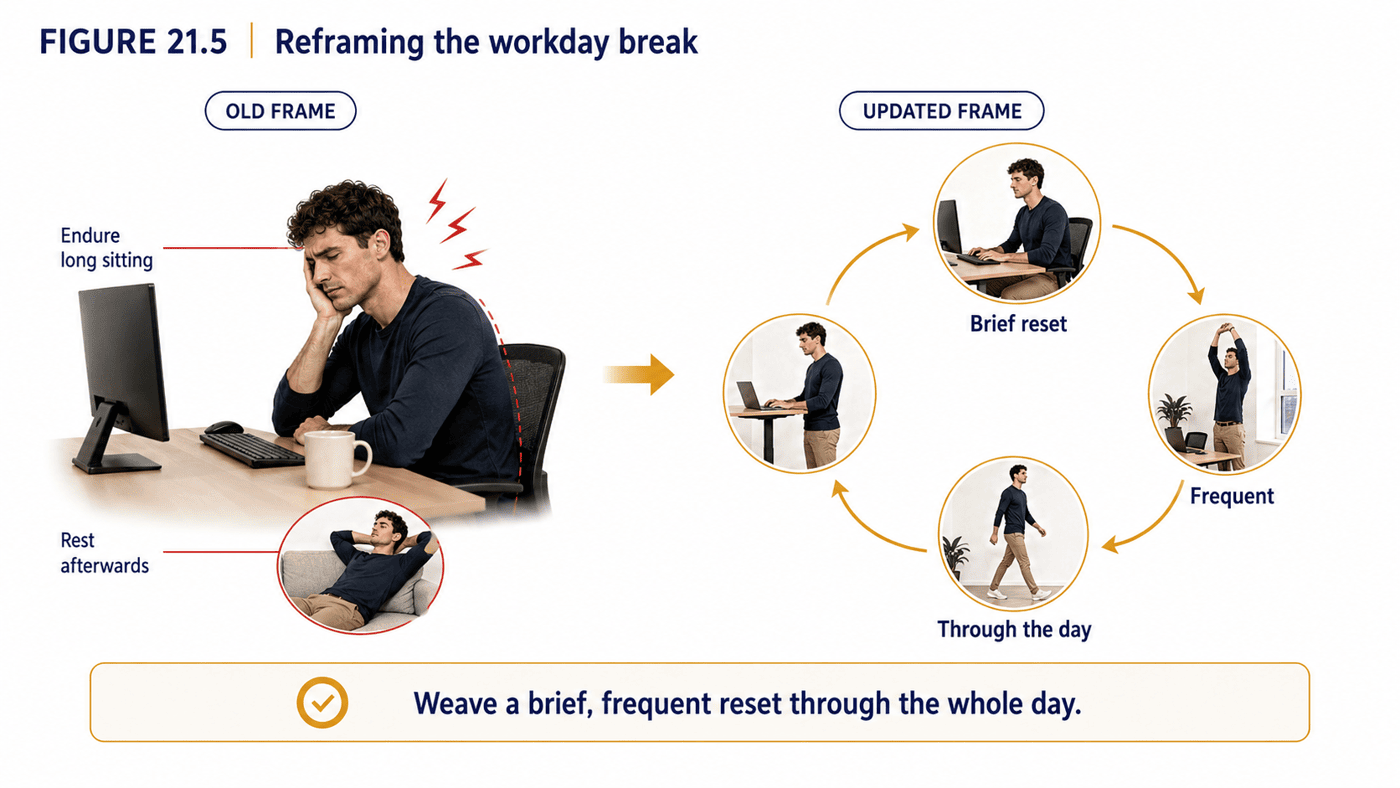
This is the shift in thinking the reset asks for, captured in Figure 21.5: away from the instinct to power through long sitting and rest only afterwards, and toward resetting little and often, all day long. The first approach lets load accumulate and addresses it too late; the second never lets it accumulate at all. The reset is not a grudging interruption of productive work but a frequent, almost effortless habit whose modest doses, added together, deliver more movement than most people manage through formal exercise — and do so precisely where the desk body needs it, spread through the sedentary hours.
The reset in a working life
A familiar example shows how the habit takes hold. An accountant who felt he simply had no time for exercise — long days at the screen, an aching neck and a heavy mid-afternoon slump — was sceptical that three minutes could matter. He began modestly, attaching a brief reset to the end of each meeting and to every trip for water, and set a gentle hourly prompt for the gaps between. The first days felt awkward and easy to forget; within a fortnight, rising to move had become almost automatic.
The effects were quiet but real. The afternoon slump softened, the end-of-day neck ache eased, and — to his surprise — he felt the brief breaks sharpened rather than disrupted his concentration. He had added, without noticing, the better part of an hour of daily movement to a life that had contained almost none, and he had done it without changing his schedule, joining a gym or finding any extra time. The reset had asked almost nothing of him, and repaid it many times over — which is exactly why it is the habit to keep.
The reset and your focus
A persistent worry about the reset is that stepping away from work, however briefly, must cost productivity — and the evidence points firmly the other way. Frequent short breaks from sitting have been shown to improve self-reported energy, mood and even aspects of cognitive function compared with unbroken sitting (Bergouignan et al., 2016). The mind, like the body, is not built for unbroken hours in one mode; attention frays, energy dips, and the unbroken afternoon at the screen yields steadily diminishing returns. A brief movement break interrupts that decline and tends to return the worker refreshed.
Seen this way, the three-minute reset is not a tax on productive work but an investment in it. The time it costs is repaid in sharper focus, better mood and steadier energy across the day, so that the work done after a reset is often better than the work that would have limped on without one. For the desk worker anxious about output, this is the reassurance that matters: moving regularly is not at odds with working well — it is part of working well.
Beyond the desk: the reset anywhere
Although this chapter has framed the reset around the working day, the habit it builds is far more widely useful, because sustained sitting is not confined to the desk. The long car or train journey, the evening on the sofa, the cramped seat of a long-haul flight, the afternoon of back-to-back meetings — all are the same sustained, still, flexed posture in another setting, and all benefit from the same antidote. The principle of extend, move, activate travels everywhere, and the reset can be adapted to any of these situations, standing or seated.
Carrying the reset beyond the office in this way deepens its value, because the desk is only one part of a largely sedentary modern life. The person who has built the habit of interrupting sitting at work tends, naturally, to apply it elsewhere — standing and moving during a long journey, rising in the advertisement break, stretching after an hour on the sofa — and so addresses the sustained sitting of the whole day, not merely the working portion of it. The reset, once learned, is a tool for life, not just for the desk.
21.8 Why So Small a Thing Works
It can seem implausible that something so brief and undemanding could matter much, and yet the reset works precisely because of what this book has shown about the desk body. The harm of sitting comes not from a single dramatic event but from the slow accumulation of sustained load, stillness and idleness; and the antidote to slow accumulation is frequent interruption. A three-minute reset reverses the tissue creep before it builds (Callaghan & McGill, 2001), reawakens the muscles before they fall fully silent (Solomonow, 2004), moves the joints before they stiffen, and contributes to the metabolic benefit of breaking up sitting (Dunstan et al., 2012; Healy et al., 2008). None of this requires intensity; it requires only frequency. The principle is simply that of tissue adaptation to load (Mueller & Maluf, 2002): brief, frequent movement supplies the variation and stimulus that sustained stillness withholds.
The reset is, in this sense, the perfect expression of the book’s thesis. The desk body is not weak; it is under-varied, under-loaded and over-still. The remedy is not heroic exercise but the frequent restoration of variety, load and movement — and three minutes, taken many times a day, delivers exactly that. It is a small habit with effects out of all proportion to its size, and it is the foundation on which the rest of the reset system is built.
There is, finally, something quietly radical in so undemanding a remedy. The desk body’s troubles can seem to call for major intervention — new equipment, gym memberships, wholesale changes to how one works — and yet the most powerful single response turns out to be three minutes of ordinary movement, taken often, costing nothing and asking almost no time. That so small a habit should matter so much is itself the lesson: the harm of modern sitting is built from small, repeated moments, and so, too, is its remedy. Begin here, with the reset, and the rest of the system follows naturally.
| Segment | Movement | What it reverses |
|---|---|---|
| Posture | Stand tall, lengthen, settle shoulders | The folded, rounded seated posture |
| Neck & shoulders | Neck turns and tilts; shoulder rolls | Forward head; upper-trap tension |
| Thoracic | Reach up and back; rotate | The flexed, stiff thorax |
| Hips | Gentle split-stance hip opener | Sustained hip flexion |
| Glutes | Squats / sit-to-stands / squeezes | Idle, switched-off glutes |
| Calves | Calf raises | Dormant lower-leg muscle pump |
| Breathing | A few slow, low breaths | Shallow upper-chest breathing |
Table 21.1. The 3-minute reset at a glance — each segment reverses a specific consequence of sitting.
In summary
- The 3-minute desk reset is the smallest and most frequent tool in the reset system — the microbreak of Chapter 15 made into a concrete, repeatable routine.
- It is built on one principle: reverse what sitting does — extend the flexed, move the still, and switch on the idle.
- In three minutes it targets the whole body — neck, shoulders and upper back, hips, glutes, and calves — a rapid head-to-toe antidote to the seated posture.
- Its power lies in frequency, not duration or intensity: a brief reset taken roughly hourly resets the loading clock before sitting’s effects accumulate.
- Seated, discreet and standing-desk variations make it usable in almost any situation, since the principle, not the exact drill, is what matters.
- It works because the harm of sitting is slow accumulation, and the antidote to slow accumulation is frequent interruption (Callaghan & McGill, 2001; Dunstan et al., 2012).
- Gentle and equipment-free, it is the single most practical habit in this book and the foundation of the reset system — done within comfort, and with advice sought for pain or red flags.
References
Bergouignan, A., Legget, K. T., De Jong, N., Kealey, E., Nikolovski, J., Groppel, J. L., … Bessesen, D. H. (2016). Effect of frequent interruptions of prolonged sitting on self-perceived levels of energy, mood, food cravings and cognitive function. International Journal of Behavioral Nutrition and Physical Activity, 13, 113.
Buckley, J. P., Hedge, A., Yates, T., Copeland, R. J., Loosemore, M., Hamer, M., … Dunstan, D. W. (2015). The sedentary office: An expert statement on the growing case for change towards better health and productivity. British Journal of Sports Medicine, 49(21), 1357–1362.
Callaghan, J. P., & McGill, S. M. (2001). Low back joint loading and kinematics during standing and unsupported sitting. Ergonomics, 44(3), 280–294.
Dunstan, D. W., Kingwell, B. A., Larsen, R., Healy, G. N., Cerin, E., Hamilton, M. T., … Owen, N. (2012). Breaking up prolonged sitting reduces postprandial glucose and insulin responses. Diabetes Care, 35(5), 976–983.
Healy, G. N., Dunstan, D. W., Salmon, J., Cerin, E., Shaw, J. E., Zimmet, P. Z., & Owen, N. (2008). Breaks in sedentary time: Beneficial associations with metabolic risk. Diabetes Care, 31(4), 661–666.
Mueller, M. J., & Maluf, K. S. (2002). Tissue adaptation to physical stress: A proposed “physical stress theory” to guide physical therapist practice, education, and research. Physical Therapy, 82(4), 383–403.
Solomonow, M. (2004). Ligaments: A source of work-related musculoskeletal disorders. Journal of Electromyography and Kinesiology, 14(1), 49–60.