Part VI · DESK BODY PAIN PATTERNS
Headache, Jaw and Screen Stress Pattern
The desk does not only ache in the neck and back; for many it ends the day in a headache. This chapter assembles the tension-headache pattern from neck and jaw tension, screen strain and stress, separates it from the headaches that need attention, sets out the warning signs, and points toward relief. It describes a common pattern — it does not diagnose the reader (Hogg-Johnson et al., 2008).
20.1 The Pattern
The discomforts of the desk body do not stop at the neck and back. For a great many desk workers, a long day at the screen ends in a particular kind of headache: a dull, pressing, band-like ache around the head, often with tightness at the base of the skull and a clenched, tired jaw. This is the desk body’s headache pattern, and it draws together several threads of this book — the neck tension of Chapter 16, the breathing and rib-cage material of Chapter 9, and the pervasive influence of stress and screen work — into a recognisable whole.
This chapter assembles that pattern and, as throughout this part, distinguishes it from the things that need attention. The framing points apply here with particular importance, because headache is one area where the warning signs genuinely matter. This is an educational account of a common pattern, not a diagnosis: headaches have many causes, some of them serious, and only proper assessment can establish what is happening in an individual. The reassuring core is that the commonest desk-related headache — the tension-type headache — is benign, if unpleasant, and responds to the same management of posture, movement, stress and screen habits that this book has developed. But the red flags set out later identify headaches that fall outside this pattern and require prompt or emergency attention, and these must never be dismissed.
20.2 The Typical Presentation
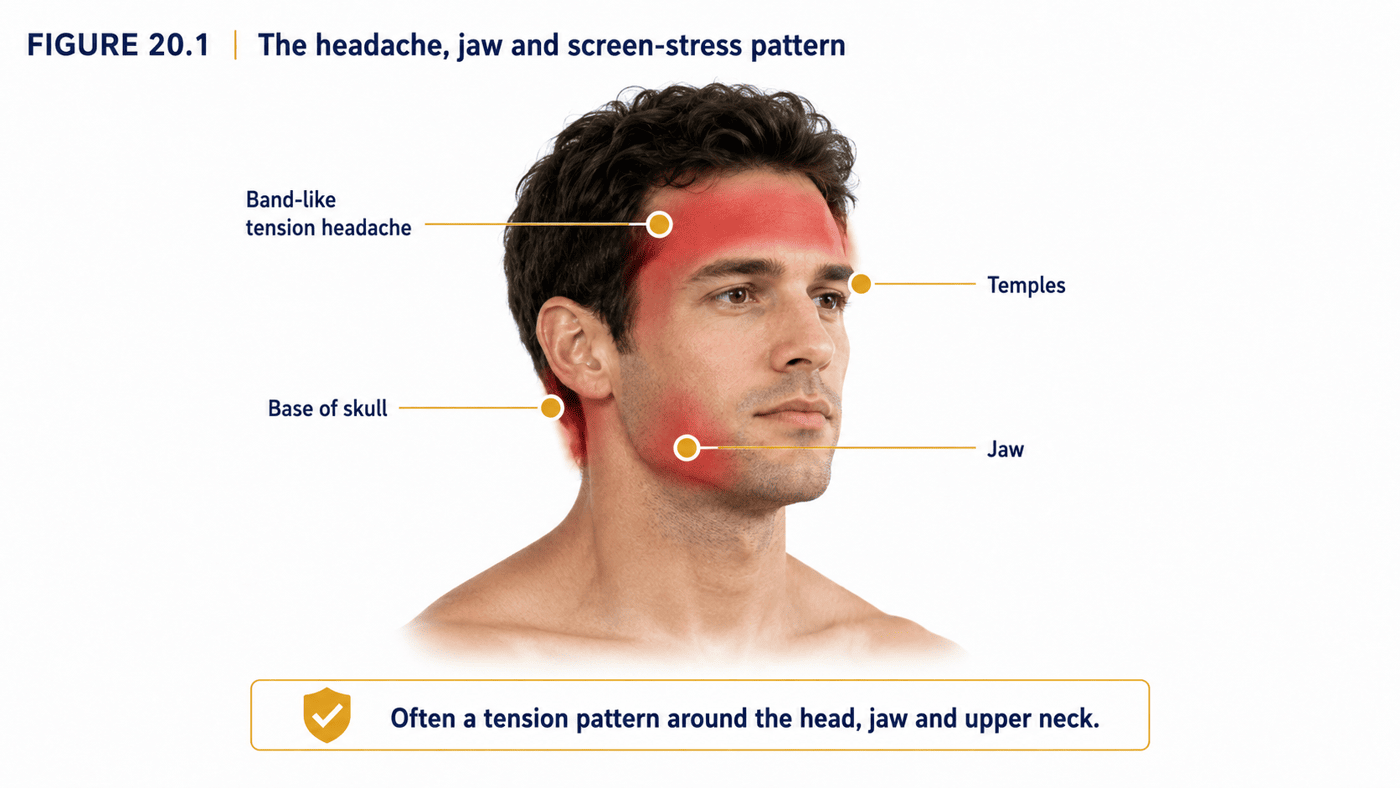
The desk-related tension-type headache has a characteristic presentation, shown in Figure 20.1. It is typically felt as a dull, pressing or tightening ache rather than a throbbing one, often described as a band or a tight cap around the head, or as pressure across the forehead and around the temples. It is frequently accompanied by tightness and tenderness at the base of the skull and in the neck and shoulders, and by a sense of a clenched or tired jaw. It is usually felt on both sides rather than one, and it tends to build through a long day at the screen, worsening with sustained concentration, stress and fatigue, and easing with rest, movement and relaxation (Bendtsen & Jensen, 2009).
This presentation — bilateral, pressing, band-like, building with sustained desk work and stress, eased by rest and movement — is the signature of tension-type headache, the commonest form of headache and the one most closely tied to the desk. Its behaviour, like that of the other patterns in this part, points to its origins in sustained muscular tension and stress rather than in anything sinister. A headache that arrives reliably after hours at the screen and lifts when one steps away is reporting accumulated tension, not announcing disease — though, as always, the red flags mark the exceptions.
20.3 The Mechanical Contributors
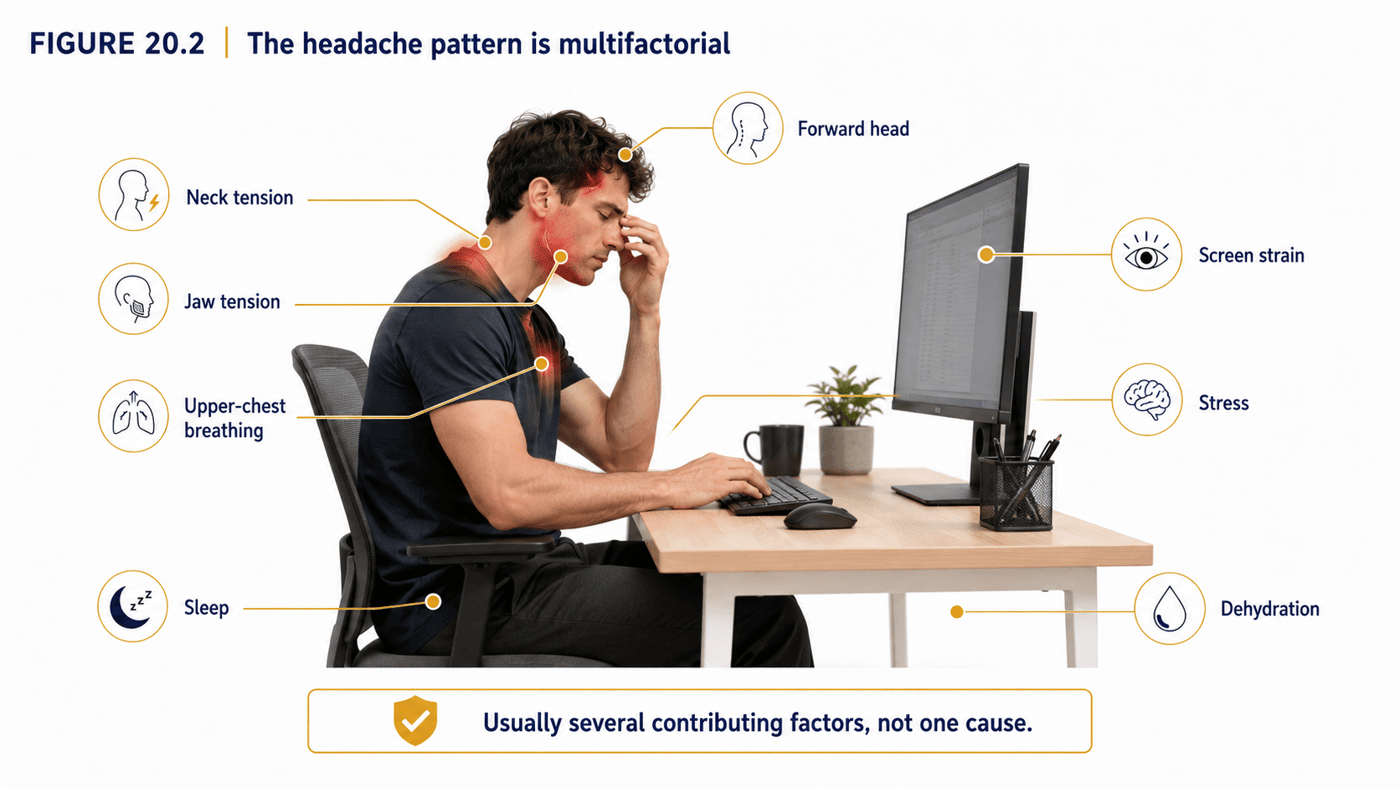
Several mechanical factors feed the desk headache, and Figure 20.2 sets them beside the non-mechanical ones. The central mechanical contributor is neck tension, particularly in the suboccipital muscles at the base of the skull, driven by the forward-head posture of Chapter 16. These small but important muscles, held under sustained tension as they help to hold the tilted head, are intimately connected to headache: tension and tenderness here can refer pain up over the head, producing or feeding the band-like ache (Moseley & Butler, 2015). Forward head posture and reduced neck mobility have been associated with tension-type headache (Fernández-de-las-Peñas et al., 2006), making the desk neck and the desk headache close relations (Hansraj, 2014).
A second mechanical contributor is the jaw. Many people clench the jaw — often unconsciously, and especially under stress or concentration — keeping the powerful muscles of the jaw and temple in sustained contraction; such clenching, a form of bruxism, can contribute to headache and facial and temple ache (Lobbezoo et al., 2013). A third, less obvious mechanical factor is breathing: the shallow, upper-chest breathing of Chapter 9, common in sustained desk posture and stress, recruits the accessory breathing muscles of the neck, adding to the very neck tension that feeds the headache. These mechanical contributors share the now-familiar character of sustained, low-level muscular tension held for hours.
20.4 The Non-Mechanical Contributors
If any pattern in this part is dominated by non-mechanical factors, it is the headache, for stress sits close to its heart. Psychological stress is among the most important triggers of tension-type headache, both directly and through the muscular tension it produces in the neck, shoulders and jaw. The pressure of deadlines, the mental effort of sustained concentration, and anxiety all feed the pattern, which is why it so reliably worsens on the hardest days and eases on holiday.
Other non-mechanical contributors are specific to the desk and easily overlooked. Screen and visual strain — sometimes called computer vision syndrome — is a genuine contributor: sustained close focus on a screen, reduced blinking, glare and uncorrected vision strain the eyes and can provoke or worsen headache (Rosenfield, 2011). Poor sleep both triggers headaches and lowers tolerance to them. And the simple, prosaic factors of dehydration, skipped meals and excess or withdrawn caffeine — all common in an absorbing or stressful working day — are frequent and easily remedied headache triggers. The desk headache is thus a meeting-point of mechanical tension, stress, screen strain and basic self-care, and its management must address all of these.
20.5 The Mechanism in Focus
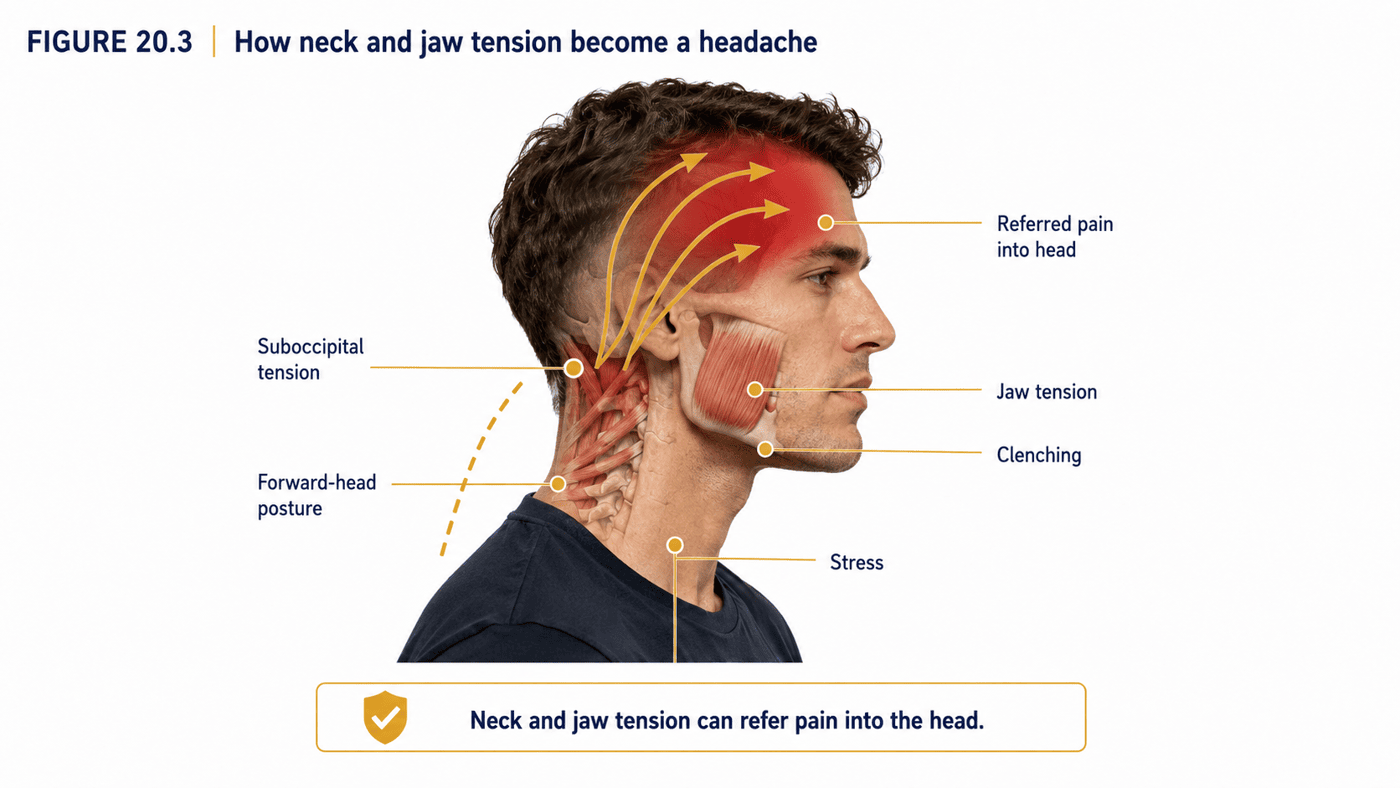
The mechanical heart of the pattern is the way tension in the neck and jaw becomes pain in the head, shown in Figure 20.3. The suboccipital muscles at the base of the skull, held tight by forward-head posture, and the muscles of the jaw and temple, held tight by clenching and stress, are richly connected to the structures that sense head pain. Sustained tension in these muscles refers pain upward and outward, producing the characteristic band of pressure around the head. The headache, in other words, is often a referral from the tense neck and jaw rather than a problem originating in the head itself.
This mechanism explains why the management that follows is effective and why it looks the way it does. Releasing the suboccipital and neck tension through posture, movement and breaks; relaxing the clenched jaw; easing the stress that drives both; and resting the strained eyes — each addresses a genuine source of the referred pain. It also explains the close kinship between this chapter and Chapter 16: the desk neck and the desk headache are, mechanically, two expressions of the same sustained tension, which is why they so often travel together and respond to overlapping measures.
20.6 What It Is Usually Not
The common desk-related tension headache is usually not the frightening thing that headache can make people fear. It is usually not a sign of a brain tumour, an aneurysm or other serious disease; the great majority of recurrent headaches, particularly the bilateral, pressing, stress-related pattern described here, are benign tension-type or related headaches, not manifestations of dangerous pathology. The very predictability of the pattern — arriving with desk work and stress, easing with rest — is itself reassuring, since serious causes rarely behave so consistently with the working day.
This reassurance is genuine and important, because fear of what a headache might mean can itself amplify the tension and stress that feed it, in a loop examined in the next paragraph. The constructive truth is that tension-type headache, while unpleasant and sometimes persistent, is not dangerous and is highly responsive to the management of its contributors. Hurt does not equal harm applies here too: a head that aches with tension is not a head that is damaged. That said, this reassurance is precisely what the red flags qualify — it applies to the recognisable benign pattern, and headaches that depart from it in the ways set out in section 20.7 need to be taken seriously and assessed.
The tension-headache cycle
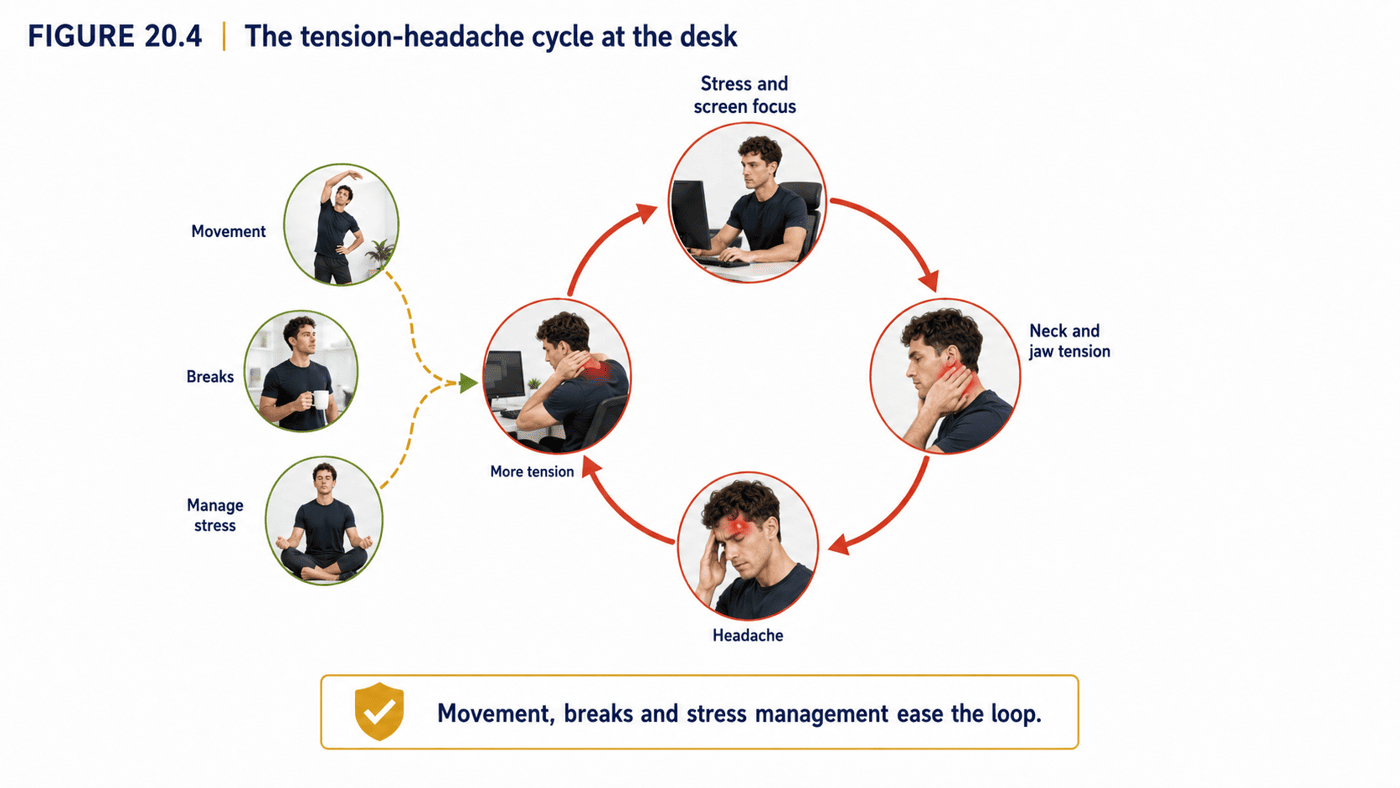
Like low-back pain, the desk headache can be self-perpetuating, and Figure 20.4 shows the loop. Stress and sustained screen focus drive tension in the neck and jaw; that tension produces a headache; the headache, and worry about it, generate further stress and tension; and the cycle turns, each loop feeding the next. Recognising this cycle is useful because it reveals the points of intervention: the loop can be broken at several places at once — by reducing the mechanical tension through posture, movement and breaks, by managing the stress that drives it, and by replacing fear of the headache with the understanding that it is a benign, manageable pattern. As with the back, calm understanding is part of the treatment, not merely reassurance after the fact.
Medication-overuse headache
There is one trap in managing the desk headache that deserves a clear warning, because it is common and counter-intuitive: the overuse of painkillers can itself cause headaches. When pain-relieving medication is taken frequently for headaches — regularly, on many days of the week, over weeks and months — it can paradoxically lead to more frequent headaches rather than fewer, a phenomenon known as medication-overuse, or ‘rebound’, headache. A person caught in this trap finds their headaches becoming more frequent and reaches for more medication, which deepens the very problem they are trying to treat.
The lesson is not that painkillers are forbidden — used occasionally they are perfectly reasonable — but that relying on them frequently, in place of addressing the causes, can backfire. The constructive path is the one this chapter describes: to manage the posture, movement, stress, screen habits and basics that generate the headaches, so that the underlying frequency falls and frequent medication becomes unnecessary. Anyone who finds themselves taking headache medication on a regular basis, or whose headaches are becoming more frequent despite it, should seek advice from a qualified professional rather than simply taking more.
The eyes, lighting and the 20-20-20 habit
Because screen and visual strain feed this pattern directly, a few simple visual habits, drawn from Chapter 13, earn their place in headache management. Sustained close focus on a screen holds the eyes’ focusing muscles in one position and reduces blinking, while glare and poor lighting prompt squinting and leaning toward the display — which, as Chapter 13 noted, drags the head into the very forward posture that feeds neck tension and headache. Controlling glare, setting comfortable screen brightness and text size, and ensuring that any needed vision correction is up to date all reduce this strain.
The single most useful visual habit is the ‘20–20–20’ rule: every twenty minutes or so, look at something around twenty feet away for about twenty seconds. This brief, regular relaxation of the eyes’ focus eases visual strain and, conveniently, coincides with the rough interval at which a movement break is also due — so that a glance into the distance and a few moments of movement can be taken together, addressing the eyes and the neck in one small habit, several times an hour.
20.7 Red Flags: When to Seek Professional Help
Headache is the area of this part where recognising the warning signs matters most, because while the common pattern is benign, certain headaches signal conditions that need prompt or emergency care. The reassurance of this chapter applies to the recognisable tension-type pattern — not to the features below. Anyone with these should seek medical attention, and several are emergencies requiring immediate help. This list is a guide, not a substitute for professional judgement; see Appendix C.
Seek emergency medical care for: a sudden, severe headache that reaches maximum intensity within seconds to minutes (a ‘thunderclap’ headache); a headache accompanied by fever, a stiff neck, a rash, or feeling very unwell (which can indicate meningitis); or a headache with any neurological symptoms — weakness or numbness, difficulty speaking, confusion, drowsiness, a seizure, or sudden visual loss. Seek prompt (if not emergency) professional assessment for: a new or distinctly different headache beginning after the age of fifty; a headache that is progressive, steadily worsening over days or weeks, or consistently worse when lying down, coughing or straining; a headache following a head injury; a headache with persistent visual disturbance, or — particularly in older adults — with scalp tenderness or pain in the jaw on chewing; a first or worst-ever headache; or headaches that are becoming more frequent or failing to respond to usual measures. These features fall outside the ordinary tension pattern and need proper evaluation rather than self-management.
20.8 The Management Approach
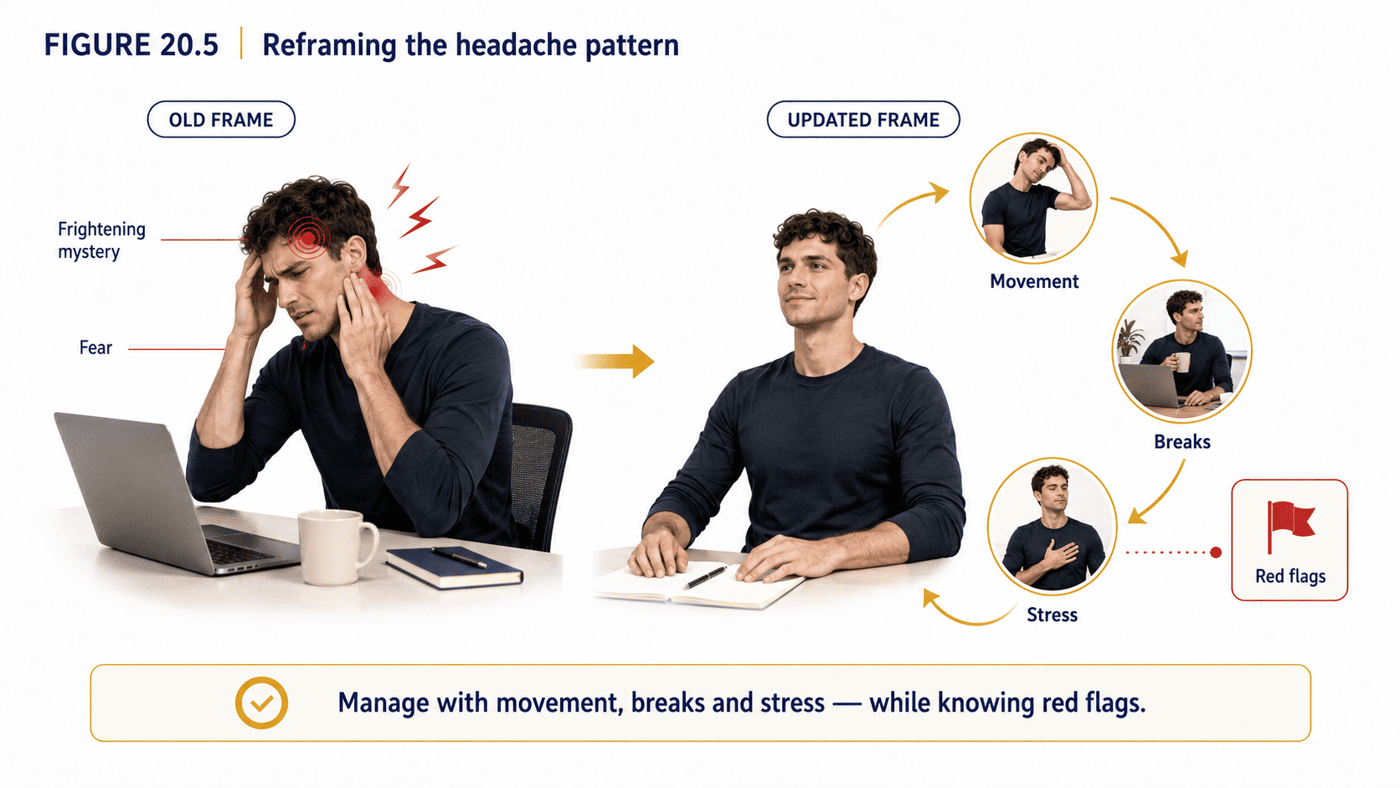
Management follows from the pattern’s nature as a benign, multifactorial tension headache fed by neck and jaw tension, stress, screen strain and basic self-care. Figure 20.5 captures the shift: from a frightening mystery to a manageable tension pattern addressed through movement, breaks and stress — while knowing the red flags. The strands draw together the whole book and this part.
The first is to release the mechanical tension: address the forward-head posture and suboccipital tension through the neck management of Chapter 16, raise the screen (Chapter 13), and — above all — break up sustained desk posture with the frequent movement of Chapter 15, which interrupts the accumulation of tension. The second is to relax the jaw: noticing and releasing the unconscious clench, a habit that often eases with awareness alone. The third is to rest the eyes and ease screen strain, through the lighting and visual measures of Chapter 13 — controlling glare, ensuring vision is corrected, and using the habit of looking into the distance periodically. The fourth is to manage the non-mechanical contributors: to reduce and manage stress, which sits at the heart of the pattern; to protect sleep; and to attend to the simple, powerful basics of hydration, regular meals and sensible caffeine. The fifth is to break the tension-headache cycle with the calm understanding that the pattern is benign and manageable. As ever, the strands work together; and where any red flag is present, this self-management gives way to appropriate medical assessment.
A note on other headaches
It is worth acknowledging that not every headache a desk worker experiences is the tension-type pattern this chapter describes. Migraine, for instance, is common and distinct — typically more severe, often one-sided and throbbing, sometimes with nausea, or sensitivity to light and sound, or visual disturbance — and although desk-related stress, poor sleep, screen strain and missed meals can act as triggers for migraine too, migraine is its own condition and benefits from specific assessment and management. Other headaches have other causes again. The purpose of this chapter is not to suggest that all headaches are desk tension, but to describe the specific, common tension pattern that desk work generates, to show how its contributors can be managed, and — through the red flags — to make clear when a headache should be assessed rather than self-managed. Anyone whose headaches are severe, frequent, distinctive or worrying should seek individual advice from a qualified professional.
The pattern in a working life
A common example draws the pattern together. A project manager in her forties found that her hardest, most deadline-driven days reliably ended in a dull, pressing headache, a band of pressure around her head, with a tight, tired jaw she realised she had been clenching without noticing. She had begun taking painkillers most afternoons, yet the headaches were becoming, if anything, more frequent.
Her pattern was textbook tension headache, fed by stress, sustained screen focus, a clenched jaw and neck tension — and, by now, very possibly compounded by the frequent painkillers themselves. Rather than escalate the medication, she addressed the causes along the lines of this chapter: she broke up her long screen stretches with brief movement, learned to notice and release her jaw clench, rested her eyes with the 20–20–20 habit, kept herself hydrated and fed through busy days, and gave deliberate attention to managing her stress. As the underlying tension eased and her reliance on afternoon painkillers fell, the headaches became less frequent and less intense — a benign, manageable pattern, eased by addressing its many contributors rather than by chasing it with tablets.
A headache diary
Because the desk headache has so many contributors — posture, movement, stress, screens, sleep, hydration, meals, caffeine — it is not always obvious which are driving a particular person’s headaches, and a simple headache diary can bring the pattern into focus. Recording, over a few weeks, when headaches occur and noting alongside them the day’s circumstances — hours at the screen, stress and deadlines, sleep the night before, meals and fluids, caffeine, and how much movement the day contained — often reveals connections that were invisible day to day.
Such a record turns vague suspicion into useful knowledge, and useful knowledge into targeted action. A person who discovers that their headaches cluster on the longest, most sedentary, most stressful days, or follow poor sleep, or arrive when meals are skipped, knows precisely which levers to pull. The diary also helps distinguish the ordinary tension pattern from anything that departs from it — information worth bringing to a professional if assessment is needed. It is a small, low-effort tool that makes the management in this chapter concrete and personal.
| Common worry | What the evidence suggests |
|---|---|
| ‘My headaches mean something serious’ | Most recurrent desk headaches are benign tension-type, not dangerous disease (Bendtsen & Jensen, 2009). |
| ‘It comes from inside my head’ | Often referred from tense neck and jaw muscles (Fernández-de-las-Peñas et al., 2006). |
| ‘Only painkillers will help’ | Addressing posture, movement, stress, screens and basics targets the causes; overuse of painkillers can worsen headache. |
| ‘Screen strain is imaginary’ | Visual strain is a genuine contributor and is modifiable (Rosenfield, 2011). |
| ‘Nothing can be done’ | The tension-headache cycle can be broken at several points; the pattern is manageable. |
Table 20.1. Common worries about the desk headache set against the evidence. Educational only — not a substitute for assessment.
In summary
- For many desk workers a long screen day ends in a headache; this chapter describes the common tension pattern to inform and reassure, not to diagnose.
- It is typically a dull, pressing, band-like, bilateral headache with neck and jaw tightness, building with sustained desk work and stress and easing with rest (Bendtsen & Jensen, 2009).
- Mechanical contributors are neck and suboccipital tension from forward-head posture, jaw clenching, and upper-chest breathing (Fernández-de-las-Peñas et al., 2006; Lobbezoo et al., 2013).
- Non-mechanical contributors are central — stress above all, plus screen and visual strain, poor sleep, and the basics of hydration, meals and caffeine (Rosenfield, 2011).
- The mechanism is pain referred from tense neck and jaw muscles into a band around the head — making the desk headache a close relation of the desk neck.
- It is usually not dangerous: the recurrent, predictable pattern is benign tension-type, and tension is not damage — but the red flags mark the exceptions.
- Red flags — thunderclap onset, fever with stiff neck, neurological symptoms (emergencies); new headache after 50, progressive headache, post-injury or first/worst-ever headache — need prompt or emergency assessment (Appendix C).
- Management releases neck and jaw tension, breaks up posture, rests the eyes, and tends to stress, sleep and the basics — breaking the tension-headache cycle.
References
Bendtsen, L., & Jensen, R. (2009). Tension-type headache. Neurologic Clinics, 27(2), 525–535.
Fernández-de-las-Peñas, C., Alonso-Blanco, C., Cuadrado, M. L., Gerwin, R. D., & Pareja, J. A. (2006). Trigger points in the suboccipital muscles and forward head posture in tension-type headache. Headache, 46(3), 454–460.
Hansraj, K. K. (2014). Assessment of stresses in the cervical spine caused by posture and position of the head. Surgical Technology International, 25, 277–279.
Hogg-Johnson, S., van der Velde, G., Carroll, L. J., Holm, L. W., Cassidy, J. D., Guzman, J., … Peloso, P. (2008). The burden and determinants of neck pain in the general population. Spine, 33(4S), S39–S51.
Lobbezoo, F., Ahlberg, J., Glaros, A. G., Kato, T., Koyano, K., Lavigne, G. J., … Winocur, E. (2013). Bruxism defined and graded: An international consensus. Journal of Oral Rehabilitation, 40(1), 2–4.
Moseley, G. L., & Butler, D. S. (2015). Fifteen years of explaining pain: The past, present, and future. The Journal of Pain, 16(9), 807–813.
Rosenfield, M. (2011). Computer vision syndrome: A review of ocular causes and potential treatments. Ophthalmic and Physiological Optics, 31(5), 502–515.