Part VI · DESK BODY PAIN PATTERNS
Hip and Sciatic-Type Discomfort Pattern
Buttock and leg discomfort frightens desk workers more than almost anything, because of one word: sciatica. This chapter assembles the pattern, draws the crucial distinction between referred ache and true nerve-root pain, sets out the warning signs that genuinely matter, and points toward a calm, active approach. It describes a common pattern — it does not diagnose the reader.
19.1 The Pattern
Few desk-body complaints provoke as much alarm as discomfort in the buttock and back of the leg, and for one reason above all: the dreaded word sciatica, with its connotations of trapped nerves and serious damage. Yet much of the buttock, hip and posterior-leg discomfort that desk workers experience is not what they fear. This chapter sets out to assemble the pattern clearly and, above all, to draw a distinction that brings enormous reassurance: the difference between discomfort referred from the hip and surrounding tissues, which is common and benign, and true compression of a nerve root, which is less common and behaves quite differently.
Drawing on the hip stiffness of Chapter 10 and the gluteal material of Chapter 11, the chapter assembles a coherent picture of this pattern. The framing points of this part apply with particular care here, because the territory is one where fear and misunderstanding run high. This is an educational account of a common pattern, not a diagnosis of any individual; leg symptoms in particular require individual assessment to characterise properly. And the reassuring core is that the common desk-related buttock-and-thigh pattern is usually a referred, non-specific discomfort with a good outlook — while genuine nerve-root pain and the warning signs set out later need appropriate attention (Maher et al., 2017). The aim is to calm unnecessary fear without dismissing the minority of cases that warrant care.
19.2 The Typical Presentation
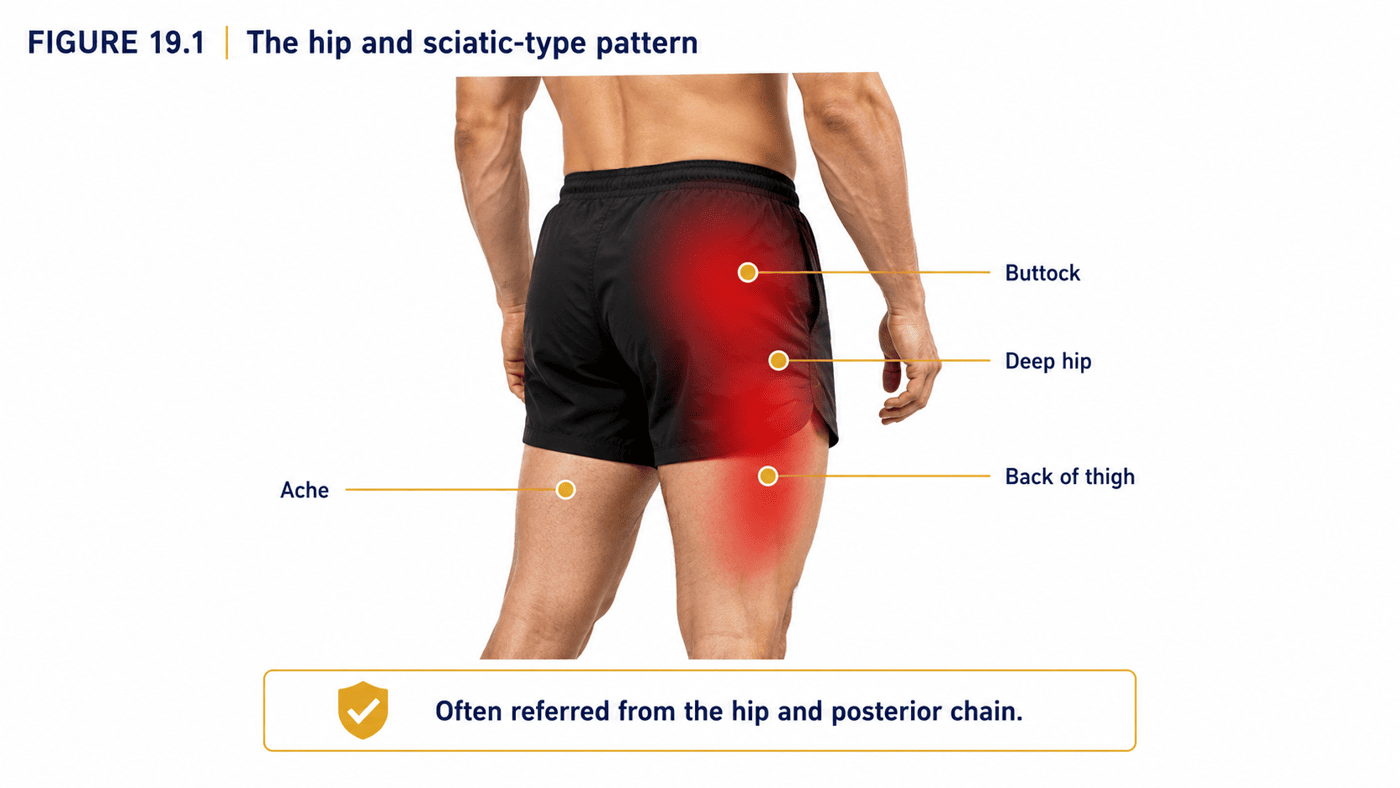
The common desk-related pattern, shown in Figure 19.1, is usually felt in the buttock and deep hip, often spreading into the back of the thigh, and sometimes felt at the outer hip. The quality is typically a deep ache, a tightness or a soreness, frequently worse after prolonged sitting — especially on a hard seat or with a wallet in a back pocket — and often eased by standing up, walking and moving. Crucially, in the common referred pattern the discomfort usually stays in the buttock and thigh and does not radiate in a clear line down past the knee into the foot, nor is it typically accompanied by the numbness, pins-and-needles or weakness that mark true nerve-root involvement.
This behaviour — worse with sustained sitting, eased by movement, confined to the buttock and thigh, without true nerve signs — is again that of a loaded, sensitised, referred pattern rather than a compressed nerve (Moseley & Butler, 2015). A buttock that aches after a long sit and feels better once you walk is reporting sustained load and tissue sensitivity, not announcing a crushed nerve. Recognising this distribution is the first step toward responding calmly rather than fearfully — and the next section makes the distinction explicit.
19.3 The Mechanical Contributors
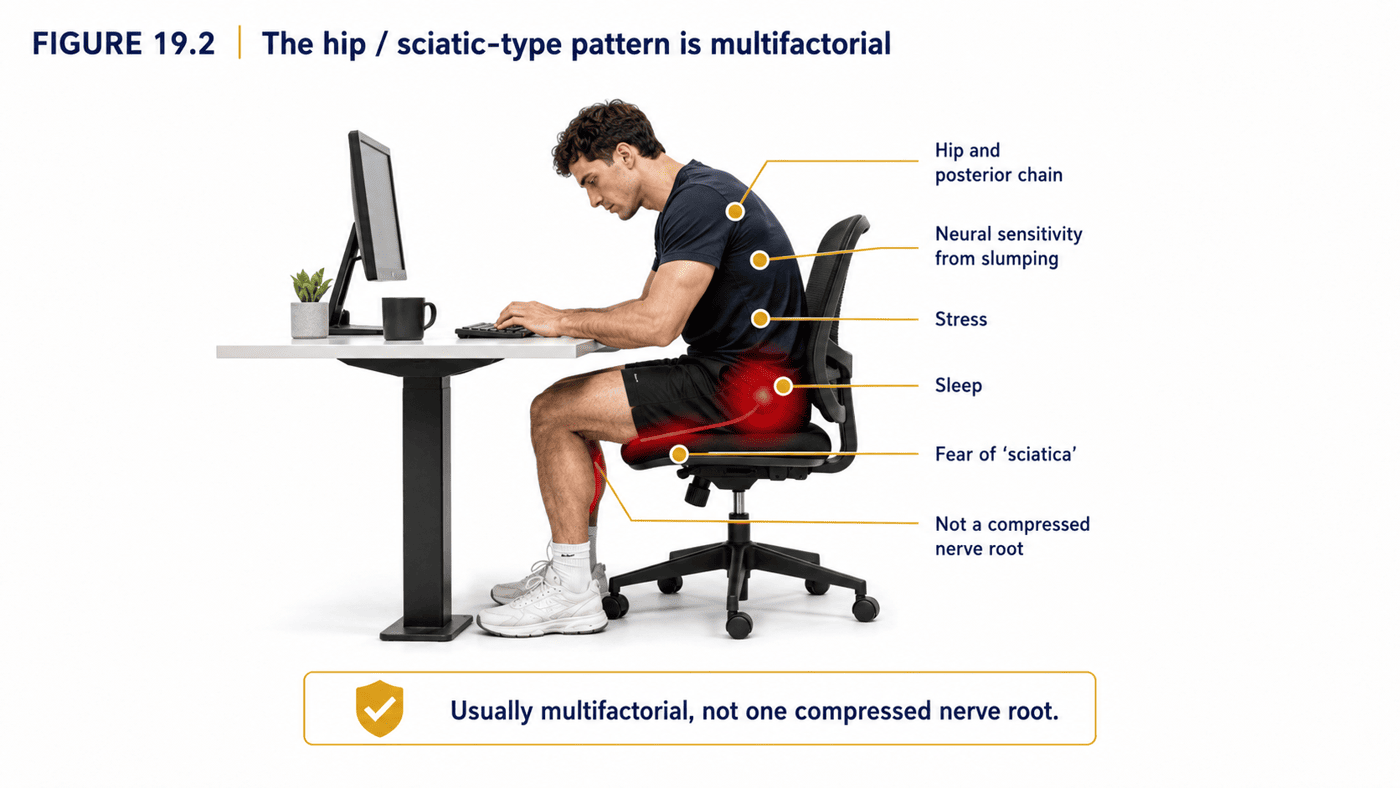
The mechanical contributors to the common pattern follow from earlier chapters, and Figure 19.2 sets them alongside the non-mechanical factors. The sustained hip flexion of prolonged sitting, examined in Chapter 10, shortens and stiffens the hip and keeps the deep muscles of the buttock in a sustained, compressed state against the seat. The under-used glutes of Chapter 11 leave these muscles weak and prone to fatigue and irritation. Direct, prolonged pressure on the buttock from a hard or poorly set seat loads the gluteal tissues and the structures beneath them. And the slumped sitting posture can place the sciatic nerve, which runs down through the buttock and the back of the thigh, under sustained tension and pressure — not compressing it as a disc problem would, but sensitising it mechanically.
This last point introduces an important and reassuring concept: neural sensitivity. A healthy nerve can become sensitised — tender and symptom-producing — through sustained tension, pressure and lack of movement, without being damaged or trapped. Much of the ‘sciatic-type’ discomfort of desk work is of this kind: a mechanically sensitised but undamaged nerve and irritated surrounding tissues, produced by sustained slumped sitting, rather than a nerve root compressed by a disc. Like the other regions in this part, the pattern arises from several ordinary factors converging through sustained posture and under-use — not from a single catastrophic fault.
19.4 The Non-Mechanical Contributors
As elsewhere in this part, non-mechanical factors shape this pattern, and here they are sharpened by the particular dread that the word sciatica carries. Psychological stress raises muscle tension, including in the deep muscles of the buttock and hip, and amplifies pain generally. Poor sleep lowers the threshold at which the tissues and nerves complain. But the most pattern-specific non-mechanical factor is fear — the catastrophic beliefs that buttock-and-leg pain so readily provokes (O’Sullivan et al., 2018).
The very word ‘sciatica’ frightens people, conjuring images of trapped, damaged nerves and impending disability, and this fear has real consequences (Hartvigsen et al., 2018). It drives the same guarding, avoidance and deconditioning described in the previous chapter’s fear-avoidance cycle, and a sensitised nerve is itself influenced by the state of the nervous system, so that fear and vigilance can heighten the very symptoms feared (Vlaeyen & Linton, 2000). As with the low back, then, accurate understanding is active treatment: knowing that the common pattern is a referred, sensitised, undamaged one with a good outlook removes much of the fear that would otherwise feed it.
19.5 Referred Ache vs True Nerve-Root Pain
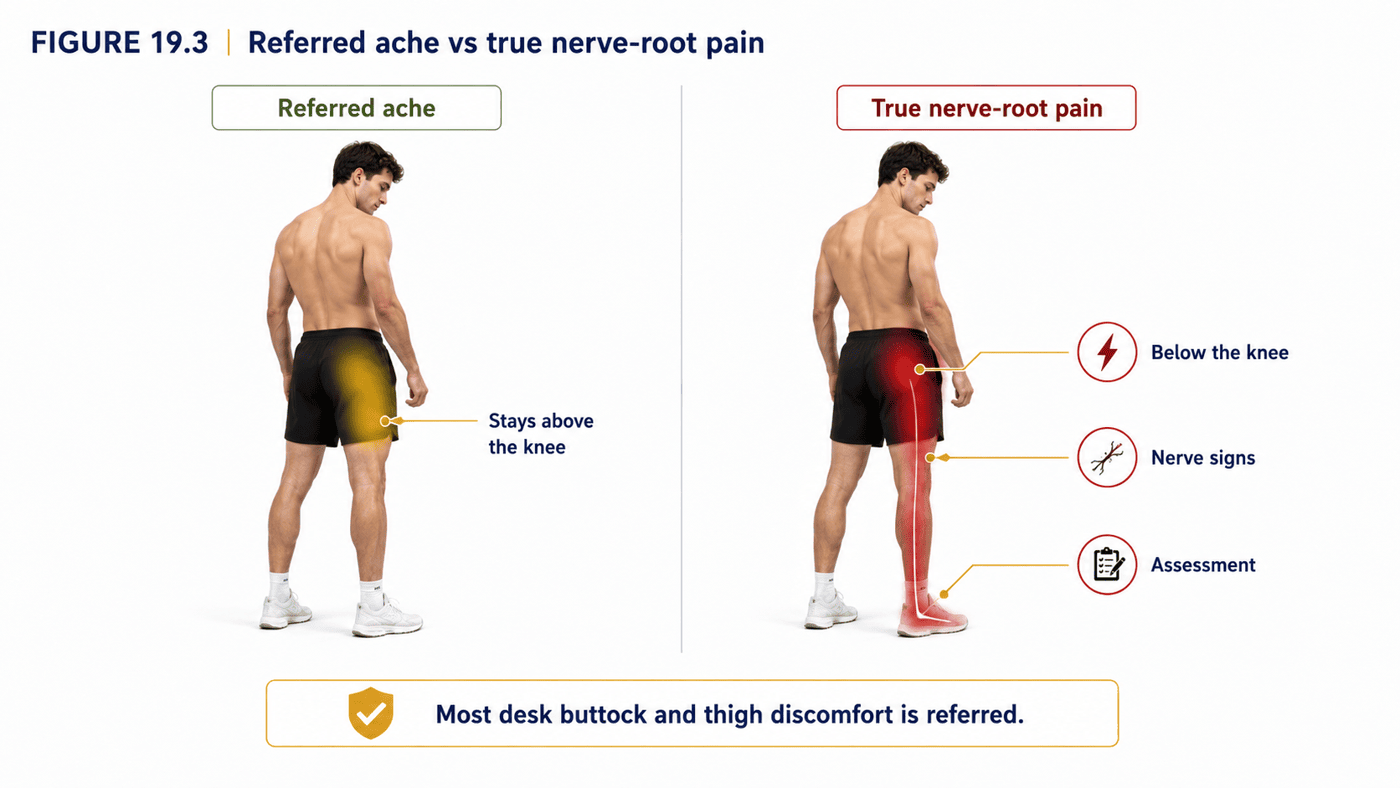
The single most useful thing this chapter can offer is a clear distinction between the common referred pattern and genuine nerve-root pain, illustrated in Figure 19.3, because the two behave differently, carry different significance, and warrant different responses. The common referred pattern — the usual desk-related discomfort — is felt as an ache in the buttock and the back of the thigh, generally staying above the knee, without true nerve signs; it is produced by the hip, the gluteal tissues and a mechanically sensitised nerve, and it has a good outlook with movement and time.
True sciatica, by contrast — more accurately called lumbar radiculopathy — involves actual irritation or compression of a nerve root, usually by a disc, and it behaves distinctively (Konstantinou & Dunn, 2008). Its hallmark is pain that radiates in a clear line below the knee, often into the calf or foot, typically following the territory of the affected nerve, and it is frequently accompanied by numbness, pins-and-needles, or weakness in the leg or foot. This is the pattern that warrants professional assessment — not because it is usually dangerous (most sciatica, too, improves with time and conservative care), but because it should be properly characterised and monitored. The practical rule of thumb is simple and reassuring: discomfort that stays in the buttock and thigh, without numbness, weakness or radiation below the knee, is usually the benign referred pattern; symptoms that travel below the knee with true nerve signs should be assessed. And the red flags in section 19.7 apply to both.
19.6 What It Is Usually Not
The common desk-related buttock-and-leg pattern is usually not the trapped, crushed, damaged nerve people fear. As the previous section set out, most such discomfort is referred and the nerve, where involved, is sensitised rather than compressed. Even where there is genuine nerve-root irritation, it is usually not the catastrophe imagined: the great majority of sciatica improves over time with conservative management, and surgery is needed only in a minority. As with the low back, scans add unnecessary alarm here too, since the disc bulges and degeneration so often blamed are common in pain-free people and frequently incidental (Brinjikji et al., 2015).
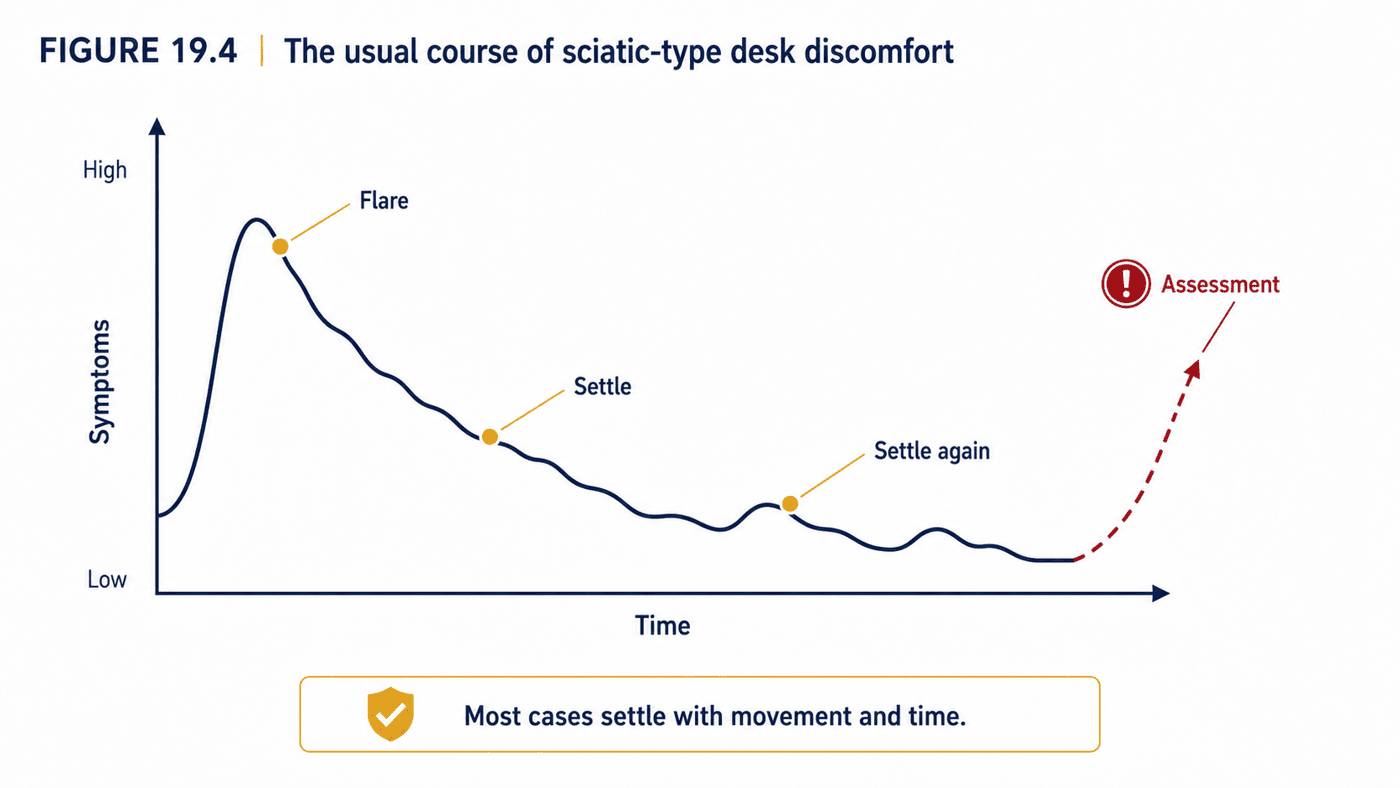
The constructive truth is that nerves, like other tissues, are robust and adaptable. A sensitised nerve is not a damaged one, and it settles as the sustained tension and pressure are relieved and movement is restored; gentle movement, far from being dangerous, helps to desensitise an irritated nerve and is part of the remedy rather than a threat. Hurt does not equal harm applies to the nerve as it does to the back: buttock and leg discomfort can be present, even persistently, without ongoing damage. Figure 19.4 shows the usual course — most non-specific buttock and posterior-thigh discomfort settles with movement and time — while persistent or worsening true nerve symptoms are precisely what assessment is for.
The slump and the nerve
A useful way to understand the sciatic-type pattern is through the way nerves move. Nerves are not inert cables; they glide and slide within the body as we move, lengthening and shortening as joints flex and extend. The sciatic nerve, running from the lower back through the buttock and down the back of the leg, is tensioned by the very posture of sitting — hip flexed, and, in a slump, the back rounded and the head dropped — and held there, without movement, for hours. A nerve kept under sustained tension and pressure, deprived of its normal gliding movement, can become sensitised: tender and symptom-producing, though not damaged.
This is why the slumped, motionless sit is such a reliable provoker of the pattern, and why movement is such a reliable reliever. Gentle movement restores the nerve’s normal glide, relieves the sustained tension, and helps to calm its sensitivity — the opposite of the rest and protection that instinct suggests. Understanding the discomfort as a sensitised, under-moved nerve rather than a trapped or crushed one reframes the whole problem: the answer is not to hold the leg still, but to restore the movement that the sustained slump took away.
Walking as a test and a treatment
Walking holds a special place in this pattern, as both a reassuring test and an effective treatment. The common referred and sensitised pattern typically eases with walking: the rhythmic movement restores the nerve’s glide, activates the idle glutes, relieves the sustained sitting posture and moves the hip through its range. A buttock-and-leg discomfort that eases as one walks is behaving as the benign pattern behaves, and that easing is itself reassuring evidence against a serious compression.
As a treatment, regular walking quietly addresses several of the pattern’s contributors at once, which is why it so often helps where rest does not. There is a useful contrast here with true nerve-root pain, which can sometimes be more provoked by certain activities; but for the ordinary desk-related referred pattern, walking is among the simplest and most effective things a person can do. The person who responds to buttock-and-leg ache by sitting still and protecting the leg often prolongs it; the one who gets up and walks regularly usually does themselves a great deal of good.
19.7 Red Flags: When to Seek Professional Help
The reassurance of this chapter applies to the common pattern — not to the warning signs below, which mark symptoms needing prompt or urgent attention. Because the lower back and legs share the warning signs of the previous chapter, including a genuine emergency, recognising them is essential. Anyone with these features should seek assessment from a qualified healthcare professional, and certain ones are medical emergencies. The list is a guide, not a substitute for professional judgement; see Appendix C.
Seek urgent medical care if buttock or leg symptoms are accompanied by any of the following, which can indicate serious compression of the nerves at the base of the spine (cauda equina syndrome): difficulty passing or controlling urine, loss of bowel control or new incontinence, numbness or altered sensation around the saddle area (buttocks, genitals and inner thighs), or numbness or weakness affecting both legs. These require emergency assessment without delay. Seek prompt (if not emergency) professional assessment for: progressive or significant weakness in the leg or foot, such as a foot that drags or cannot be lifted (foot drop); severe, unrelenting or steadily worsening leg pain; numbness or weakness that is spreading; symptoms following significant trauma; or systemic features such as fever, unexplained weight loss or a history of cancer. True nerve-root symptoms that radiate below the knee, while often benign, also warrant assessment so they can be properly characterised and monitored.
19.8 The Management Approach
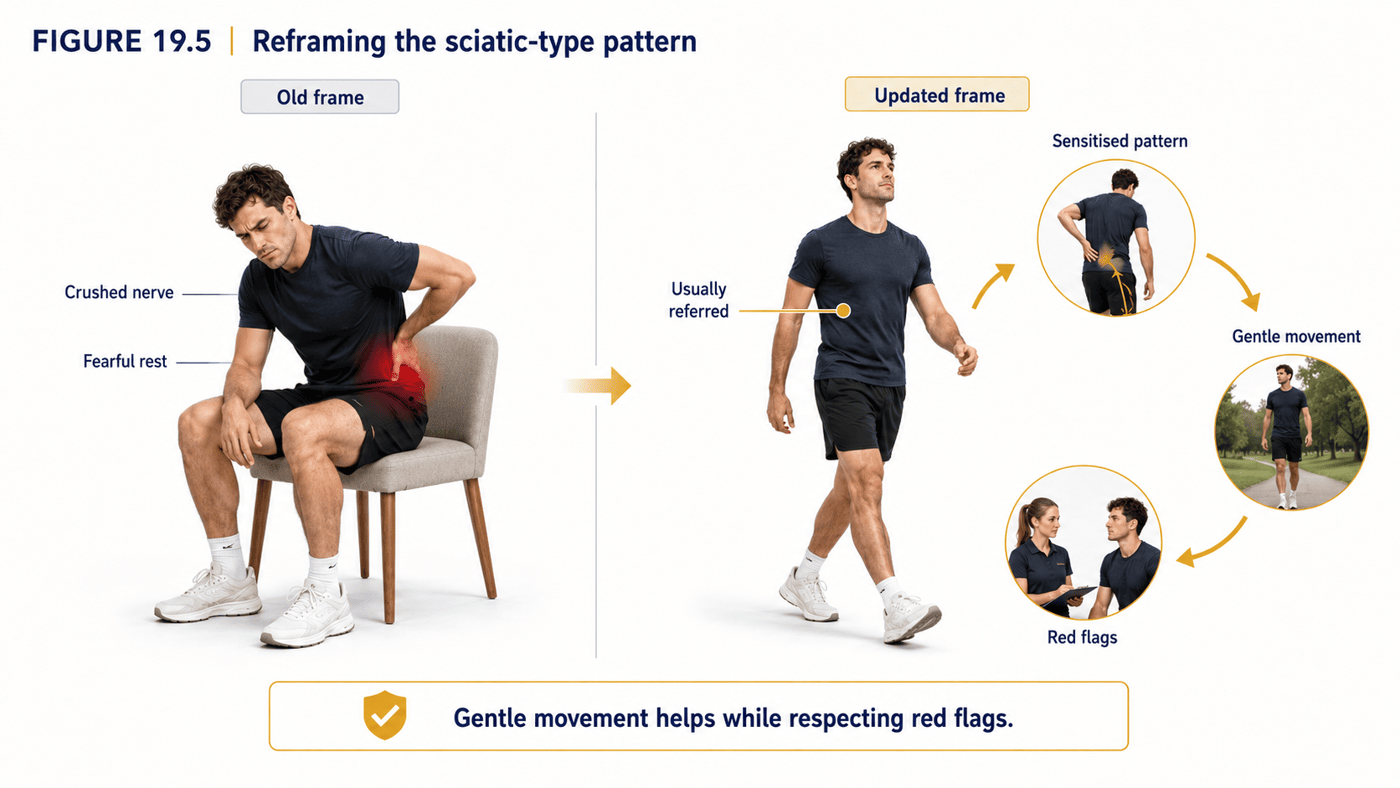
Management follows from the pattern’s nature as a usually-referred, sensitised, fear-amplified problem in robust tissues. Figure 19.5 captures the shift: from a crushed nerve and fearful rest, to a referred, sensitised pattern eased by gentle movement — while respecting genuine red flags. The strands draw on the whole book.
The first is to keep gently moving: against the instinct to rest a ‘trapped nerve’, gentle movement helps desensitise an irritated nerve, eases the sustained tension and pressure, and prevents the deconditioning that prolongs symptoms. The second is to relieve the sustained mechanical load by breaking up prolonged sitting (Chapter 15), adjusting the seat to reduce direct pressure on the buttock, and avoiding sustained slumped postures that tension the nerve. The third is to restore hip mobility and gluteal function (Chapters 10 and 11), addressing the stiff hips and under-used buttock muscles that contribute to the pattern, and rebuilding the capacity of the posterior chain. The fourth is to address the non-mechanical contributors — and here, given the particular dread the symptoms provoke, calm and accurate understanding is an especially powerful treatment, alongside attention to stress and sleep. As ever, the strands work together; and where true nerve-root symptoms or red flags are present, this active self-management sits alongside, not instead of, appropriate professional assessment.
A note on the deep buttock
A word of caution is warranted about the popular tendency to attribute all deep buttock pain to a single named culprit — most often the piriformis muscle, in the much-discussed ‘piriformis syndrome’. Deep gluteal discomfort is real and common, and the muscles of the deep buttock can certainly contribute to it; but pinning it confidently on one specific structure is more difficult than popular accounts suggest, and such labels are contested among clinicians. The more accurate and useful framing, consistent with this whole part, is that deep buttock discomfort is usually a referred, multifactorial pattern arising from the hip, the gluteal tissues and a sensitised nerve together, in a context of sustained sitting and under-use — and that it responds to the same active management of movement, load relief and restored capacity, rather than to a hunt for one muscle to blame.
The pattern in a working life
A common example illustrates the pattern and the power of the right understanding. A software developer in his thirties began to feel a deep ache in one buttock, spreading into the back of the thigh but stopping above the knee, after long stretches of sitting absorbed in his work. Searching online, he found the word ‘sciatica’ and a host of alarming images of trapped and damaged nerves, and convinced himself he had a serious disc problem; he began sitting rigidly still, afraid that movement would worsen the damage.
His symptoms fitted the benign referred pattern, not a compressed nerve root: the ache stayed in the buttock and thigh, above the knee, with no numbness, pins-and-needles or weakness, and it eased when he moved. Reassured that this was a referred, sensitised pattern from sustained sitting rather than a crushed nerve, and that movement would help rather than harm, he changed his approach: he broke up his long sits with regular walking, adjusted his seat to take the direct pressure off his buttock, and worked on his stiff hips and idle glutes. The discomfort settled over a few weeks — and, as importantly, the fear that had been magnifying it dissolved once he understood what the pattern was, and what it was not.
Sitting, the seat and the wallet
Some of the most practical levers for this pattern concern the simple mechanics of how one sits on the buttock (Neumann, 2017). Prolonged sitting on a hard, unyielding seat presses the gluteal tissues and the structures beneath them — including the sensitive nerve — against the chair for hours, and a poorly set seat that concentrates pressure on a small area makes this worse. A reasonably cushioned seat, set at a height that lets the weight distribute through the thighs rather than bearing entirely on the back of the buttock, eases this sustained local pressure.
A small but surprisingly common contributor deserves its own mention: the wallet, or phone, kept in a back pocket while sitting. Perched on one, a person sits tilted and presses an object directly into the gluteal tissues and the path of the nerve beneath, for hours at a time — a needless, sustained, asymmetric pressure that can feed exactly this pattern. The remedy could not be simpler: empty the back pockets before sitting. Combined with breaking up the sitting time and adjusting the seat, removing this hidden source of pressure often helps more than its triviality would suggest.
| Common worry | What the evidence suggests |
|---|---|
| ‘A nerve is trapped and damaged’ | Most desk buttock/leg pain is referred; where the nerve is involved it is usually sensitised, not compressed. |
| ‘Sciatica means surgery’ | Most sciatica improves with time and conservative care; surgery is for a minority (Konstantinou & Dunn, 2008). |
| ‘I should rest the leg completely’ | Gentle movement helps desensitise the nerve; rest tends to prolong symptoms. |
| ‘The scan shows the cause’ | Disc bulges and degeneration are common in pain-free people (Brinjikji et al., 2015). |
| ‘Any leg pain is dangerous’ | Buttock/thigh ache without nerve signs is usually benign; below-knee nerve signs and red flags warrant assessment. |
Table 19.1. Common worries about sciatic-type discomfort set against the evidence. Educational only — not a substitute for assessment.
In summary
- Buttock and leg discomfort frightens desk workers through fear of sciatica; this chapter describes the common pattern to inform and reassure, not to diagnose.
- Most desk-related buttock-and-thigh discomfort is referred from the hip and posterior chain, with a mechanically sensitised — not compressed — nerve.
- Mechanical contributors (sustained hip flexion, idle glutes, seat pressure, slumped posture tensioning the nerve) converge with non-mechanical ones; fear of ‘sciatica’ is especially potent.
- The crucial distinction: referred ache stays in the buttock and thigh without nerve signs; true sciatica radiates below the knee with numbness or weakness and warrants assessment (Konstantinou & Dunn, 2008).
- It is usually not a crushed, damaged nerve: even true sciatica mostly improves with conservative care, scans often mislead, and a sensitised nerve is not a damaged one (Brinjikji et al., 2015).
- Red flags — bladder/bowel or saddle/both-leg symptoms (emergency), foot drop or progressive weakness, severe worsening pain, systemic features — warrant prompt or urgent care (Appendix C).
- Management keeps people gently moving, relieves sustained load and pressure, restores hip and gluteal function, and replaces fear with understanding — alongside assessment where nerve symptoms or red flags are present.
References
Brinjikji, W., Luetmer, P. H., Comstock, B., Bresnahan, B. W., Chen, L. E., Deyo, R. A., … Jarvik, J. G. (2015). Systematic literature review of imaging features of spinal degeneration in asymptomatic populations. American Journal of Neuroradiology, 36(4), 811–816.
Hartvigsen, J., Hancock, M. J., Kongsted, A., Louw, Q., Ferreira, M. L., Genevay, S., … Woolf, A. (2018). What low back pain is and why we need to pay attention. The Lancet, 391(10137), 2356–2367.
Konstantinou, K., & Dunn, K. M. (2008). Sciatica: Review of epidemiological studies and prevalence estimates. Spine, 33(22), 2464–2472.
Maher, C., Underwood, M., & Buchbinder, R. (2017). Non-specific low back pain. The Lancet, 389(10070), 736–747.
Moseley, G. L., & Butler, D. S. (2015). Fifteen years of explaining pain: The past, present, and future. The Journal of Pain, 16(9), 807–813.
Neumann, D. A. (2017). Kinesiology of the musculoskeletal system: Foundations for rehabilitation (3rd ed.). Elsevier.
O’Sullivan, P. B., Caneiro, J. P., O’Keeffe, M., Smith, A., Dankaerts, W., Fersum, K., & O’Sullivan, K. (2018). Cognitive functional therapy: An integrated behavioral approach for the targeted management of disabling low back pain. Physical Therapy, 98(5), 408–423.
Vlaeyen, J. W. S., & Linton, S. J. (2000). Fear-avoidance and its consequences in chronic musculoskeletal pain: A state of the art. Pain, 85(3), 317–332.